
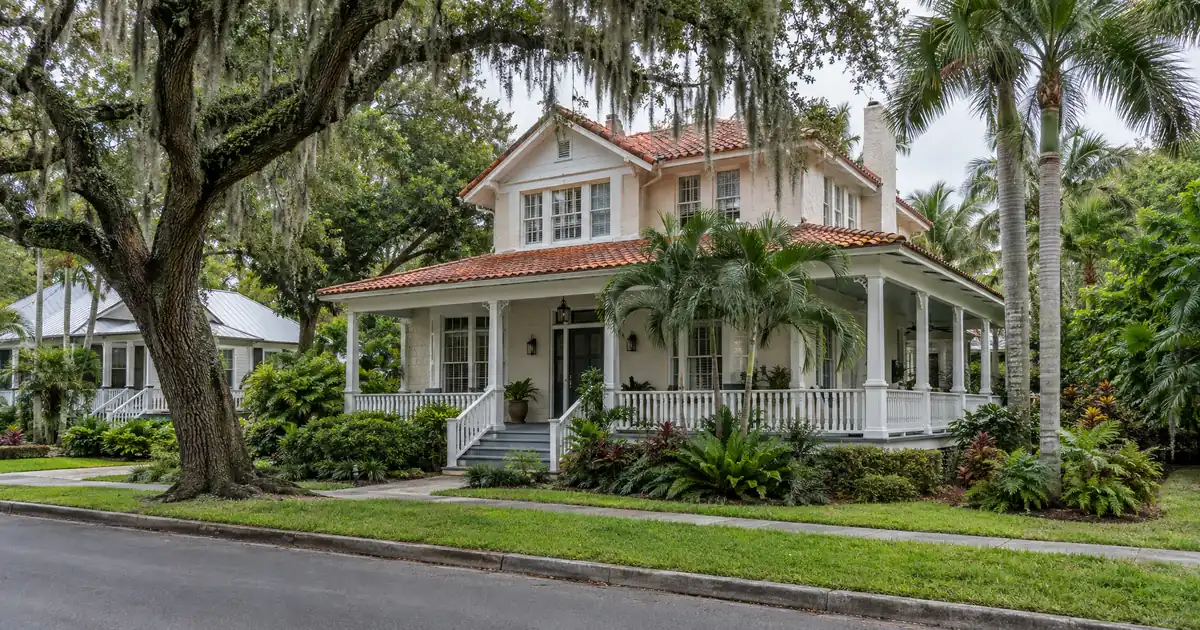
A Pinecrest estate and a Dadeland-area condo are two different cash-out files, and the math favors the condo. The estate carries the equity. The condo carries the coverage ratio. Most investors here hold the first and need the second, which is why the structure matters more than the headline value.
Lendmire, a non-QM mortgage broker (NMLS# 2371349), places DSCR investor financing for Pinecrest, Florida through non-QM wholesale channels that cover 41 markets, including Washington, D.C. This article covers the owner who already holds a Pinecrest rental and wants to pull equity out of it. It skips purchase mechanics.
DSCR Cash-Out Calculator
Run the cash-out numbers in Pinecrest, FL
Rate source: Freddie Mac 30-yr average via FRED® — Federal Reserve Bank of St. Louis · effective Sep 24, 2026
Prefilled with starting assumptions — enter your property’s value, balance, taxes, and insurance for a more accurate picture.
Program parameters update from Lendmire’s centralized guideline source. Taxes and insurance are editable estimates.
As of Sep 24, 2026 · General Freddie Mac market benchmark, not a Lendmire loan offer. Property value, balance, taxes, and insurance are editable estimates. Maximum loan-to-value varies by lender, program, property type, and seasoning. Not a Loan Estimate, approval, or commitment to lend. Program availability and eligibility are subject to lender guidelines, credit approval, property review, and underwriting.
The Quick Read:
A DSCR cash-out refinance on a Pinecrest, Florida rental is underwritten primarily on the property’s rental income measured against its full monthly obligation. The file runs from title seasoning through an appraisal with a rent schedule, then reserves and entity documents, then lender review of coverage against the leverage cap.
- Cash-out caps at 75% LTV, with seasoning of about 6 months from title recording.
- Village-wide single-family coverage runs well under 1.00x once taxes and insurance are included.
- The Dadeland condo pocket is the only place rent-to-price clears coverage comfortably.
- Reserves run about 9 months of PITIA on balances above $1,500,000.
- Appraiser comp selection can swing value more than any rent assumption. Exact terms depend on the lender’s guidelines, property type, leverage, and a full review of the borrower’s file.
Pinecrest Market Snapshot
A quick read on the Pinecrest investor landscape — figures come from the cited sources below. Confirm current property-level numbers before underwriting.
| Metric | Detail |
|---|---|
| Home prices | Median listing $4.3M (Wikipedia: Pinecrest, Florida) |
| Typical rents | $1,898 avg (Apartments.com Pinecrest Rent) |
| Recent appreciation | +2.8% yoy (Zillow Home Values Pinecrest) |
| Population | 18,462 population (Census Reporter Pinecrest, FL) |
| Employment | 30,000+ employees (Baptist Health South Florida) |
Why Pinecrest Files Look Nothing Like Typical Cash-Outs
Pinecrest is an equity story, not a cash-flow story. The Census Bureau puts the village at 18,462 residents across 7.5 square miles, and the population has been roughly flat for two decades. Growth here comes from land value, not headcount.
Zillow’s home value index puts the average Pinecrest home at $2,258,425, up 2.8% over the past year. That is the canonical figure used throughout this article. Redfin’s housing market page shows a recent-sales median of $3.4 million, up 39.3% year over year. The two numbers measure different things (recent closed sales versus a broad value index), so treat both as directional. Sales skew toward the top of the market, and the index smooths that out.
Against that value, rent looks thin. Zillow Rental Manager’s market trends show houses averaging about $6,500 a month, with a range from $1,400 to $65,000. That spread tells you the sample mixes modest units with estate rentals, and the sample is small.
Demand exists, but it comes from next door. Baptist Health South Florida reports more than 30,000 employees, and South Miami Hospital sits directly on the US-1 border. The University of Miami and Miami-Dade schools pull commuters too. No campus or corporate headquarters sits inside the village, so tenants here are renting into the village from those employment centers.
Where the Coverage Math Breaks (and Where It Doesn’t)
Estate-lot rentals don’t clear 1.00x on rent alone. Modeled at 75% LTV against the $2.26 million average value and a $6,500 rent, coverage including taxes and insurance lands below 0.50x. These are modeled assumptions, not sourced deal data. Every figure here varies by lender and program — guidelines, property type, leverage, and credit profile all apply.
A lender reviewing a file like that needs another path, such as a sub-1.00 program, lower leverage, or an interest-only structure. Each one trades leverage or pricing for eligibility. Whether any of them fit depends on lender guidelines, credit review, reserves, and the property itself. A 1.00x baseline is common because rent covers the payment at that level, but it isn’t a universal rule.
Now the Dadeland pocket. Redfin’s Downtown Dadeland Condominium data shows a median sale price near $340,000 at $310 per square foot. Redfin’s rental market page puts median rent there at $3,100. That is roughly 11% gross rent-to-price, versus about 3.5% on village-wide single-family stock.
Run the numbers on a condo at that price and rent, refinanced at 75% LTV. Coverage comes out around 1.3x including taxes and insurance, before HOA dues. Dues will pull that down, and they vary building to building, so get the dues figure before you trust any ratio. Still a workable number. Final terms depend on lender guidelines, property type, leverage, and the borrower’s complete credit picture.
Skip the estate-lot rental if cash flow is the goal. Pinecrest single-family is an appreciation hold. The condo is the asset that actually pays for the structure.
Where the Equity Comes From
The appreciation leg is real. NeighborhoodScout shows a latest-twelve-month appreciation rate of 7.53%, higher than about 90% of Florida cities and towns. An owner who bought into that run has equity sitting idle, and a cash-out turns it into deployable capital.
The cap controls how much you can pull: 75% LTV on cash-out, never the 80% purchase figure. Equity available depends on rent used for lender review, PITIA, reserves, and that ceiling, so it is never a guaranteed cash figure. Standard programs run up to $3,000,000 in loan amount, which covers most Pinecrest balances at 75%. Larger or smaller balances route through different lenders in the network. These specifics are subject to lender guidelines and a full review of property, leverage, and credit.
Seasoning is the gate people forget. Expect roughly 6 months of ownership measured from title recording. A recent purchase doesn’t get to skip that clock because the appraisal looks strong. For the full mechanics, see pulling equity with a DSCR cash-out.
The Appraisal Is the File
The biggest swing in a Pinecrest cash-out is comp selection, not rent. Zillow’s 33156 ZIP index shows an average of $1,543,591, against $2,258,425 for the village proper. The ZIP includes non-village areas at much lower values. An appraiser who pulls ZIP-wide comps can land hundreds of thousands below one who stays inside village limits.
Push for in-village comps, and document why they are the right set. Lot size, square footage, and condition all matter here, since homes commonly run near an acre and around 3,450 square feet. A thin comp set means the appraiser leans on each sale harder than usual.
Rent comps are the second weak point. Renters make up only 19.4% of Pinecrest households per Towncharts, the lowest share in the surrounding area. Census-derived data shows a rental vacancy rate of 7.8% against 2.1% for owners. That pool is shallow. Lenders have fewer true rental comps, and a vacant unit may take longer to re-tenant than in denser Miami-Dade suburbs.
Broker-side, this is the plumbing that holds files up. Working DSCR brokers see a recurring pattern in thin-rental, high-value suburbs like this one: the valuation and the rent schedule get reviewed separately, and a mismatch between them triggers extra questions. A lease with documented rent, plus a market rent opinion tied to actual comparable rentals, tends to keep the file moving. Averaged web rents (and Pinecrest’s range from $1,898 on Apartments.com to $6,500 on Zillow proves the point) won’t survive review.
Duplexes and Dadeland Condos: The Small-Footprint Options
Small multifamily inside the village is scarce but not absent. One active listing describes a duplex with two 3-bedroom, 2-bath units. Comps for a two-unit DSCR file inside Pinecrest proper are thin, so each sale carries outsized weight in valuation. An owner of a duplex here has a stronger coverage story than an estate owner, but a harder appraisal.
The Dadeland-adjacent condo pocket is the realistic cash-flow leg. One wrinkle: building-level leasing rules. One building’s association reportedly allows two rentals per unit per year with a six-month minimum lease. That fits a long-term rental structure fine, but confirm your own building’s limits and get the association documents in early. Missing condo paperwork is a common reason files stall.
For the broader Miami-Dade picture, Kendall, South Miami, and Palmetto Bay carry denser stock at lower price points, and tenants there draw on the same Baptist Health and US-1 corridor. An owner recycling Pinecrest equity into one of those submarkets is working the same tenant base at a far better rent-to-price ratio.
Reserves, Credit, and the Paperwork Stack
The operational checklist for a cash-out here is short but unforgiving. Typical guidance, subject to lender guidelines and borrower profile:
- Credit: tiers at 620, 660, 680, and 700, with a floor of 620. Higher tiers generally support better leverage.
- Reserves: about 6 months of PITIA, rising to about 9 months above $1,500,000, which covers most Pinecrest estate balances.
- Entity: LLC-titled properties are accepted subject to lender program eligibility, so have operating agreements and EIN documentation ready.
- Coverage: a 1.00 minimum is the baseline on most standard programs, with sub-1.00 options handled case by case.
Reserves deserve a hard look on estate-size loans. Nine months of PITIA on a seven-figure balance is a large liquid number, and owners who count on the cash-out proceeds to fund it will be disappointed. Program details can change, so confirm current guidelines with a broker before you plan around any of these figures. The DSCR qualification mechanics page covers how the ratio is built, and Lendmire’s DSCR-versus-conventional breakdown covers why owners with large, income-irregular portfolios use this product. Lendmire’s material on investor refinance options has more on structure.
What Most Pinecrest Owners Get Wrong
The common mistake is applying one villagewide assumption. North Pinecrest estates are the appreciation-led leg, with low rent-to-price and strong equity to harvest. Dadeland condos are the cash-flow leg. A cash-out strategy should size leverage differently by pocket instead of assuming a single ratio.
This one is honestly a toss-up: refinance the estate at lower leverage and accept thin coverage, or sell into the appreciation and redeploy. The estate refi keeps a high-quality hold but costs reserves. The exit trades future appreciation for cleaner capital. Neither is wrong, but owners who assume the estate will cash-flow on rent alone are guessing.
Migration data adds context. About 31% of Pinecrest homebuyer searches are to move out of the area, while New York, San Francisco, and Washington D.C. buyers most often search to move in. Buyers there are high-net-worth relocators, not local move-up buyers. That supports exit values, but it doesn’t put a single extra dollar of rent into the coverage ratio.
The Real Choice
Pinecrest owners looking at a cash-out land on one of two paths, and each has a cost.
DSCR vs. conventional financing
Two common ways to finance an investment property in Pinecrest, FL. They qualify you differently — here’s how investors weigh them.
Why investors choose it
- Qualifies on the property’s rental income — no personal tax returns, W-2s, or pay stubs needed to document income.
- No personal debt-to-income ceiling to clear, so existing mortgages and obligations don’t cap your borrowing the same way.
- Can be closed in an LLC, keeping the property inside a business entity.
- Built for scaling — not held to the limit on number of financed properties that conventional financing applies.
- Underwriting centers on the deal: generally qualifies when the rent covers the payment, a 1.00x coverage ratio being a common baseline (confirmed in underwriting).
- Designed specifically for investment property, including long-term and, where the program allows, short-term rentals.
Where it’s strong
- Often the lowest ongoing financing cost for a buyer who fully qualifies on personal income — a fit for a first property or a cost-first purchase.
Trade-offs for investors
- Requires full personal income documentation and must fit within a debt-to-income limit — salary, existing debts, and other mortgages all count.
- Typically held in your personal name rather than a business entity.
- Caps how many financed properties you can carry, which can become a ceiling as a portfolio grows.
- Evaluates you as a borrower as much as the property, which usually means more paperwork.
How investors usually choose: a first or single property often optimizes for the lowest financing cost; portfolio builders often optimize for leverage, vesting in an LLC, and scaling past conventional caps. The right answer depends on your goals, the property, and current guidelines — both paths run through select lenders in Lendmire’s wholesale network, with eligibility and terms confirmed in underwriting.
The first is to refinance the estate in place. You keep the land and the appreciation, but you accept sub-1.00 coverage, tighter reserves, and a file that depends on the appraiser’s comp set. The second is to pull equity through a leveraged structure on a Dadeland-area condo or a small duplex. Coverage is stronger, but you give up estate-lot land value, and you work with thinner comps and building-level leasing rules.
Pinecrest will keep pricing like a trophy suburb because buyers there are paying for land, not for rent. The decision is whether your equity should keep sitting in the land or go where a lender can see the income.
Frequently Asked Questions
How do you qualify for a DSCR cash-out refinance in Pinecrest, Florida?
Qualification centers on the property’s rent against its full PITIA, with a 1.00 coverage benchmark on most standard programs. You also need about 6 months of seasoning from title recording, credit at or above a 620 floor, and reserves of about 6 months, or 9 months above $1,500,000. Estate-lot rentals often fall below 1.00x, so those files need a lower LTV or a different program structure. All of this is subject to lender guidelines.
What are the requirements for an investment property loan in Pinecrest, Florida?
Expect a property appraisal with a rent schedule, proof of ownership and seasoning, entity documents if the property sits in an LLC, and a reserve account statement. Lenders also review the lease or market rent and the insurance binder. Condo files add association documents. Eligibility depends on the borrower, property, and program, and manufactured homes, log homes, and barndominiums fall outside these programs.
Why does appraisal comp selection matter so much in Pinecrest?
The 33156 ZIP averages about $1.54 million, while the village alone averages about $2.26 million. An appraiser who pulls ZIP-wide comps can pull value well below an in-village set, which directly cuts available cash-out at 75% LTV. Ask for in-village comps and supply the lot, size, and condition reasoning behind them. Terms vary by lender guidelines, property type, leverage, credit profile, and full file review.
Can a Pinecrest estate rental cash-out at 75% LTV clear 1.00x coverage?
Usually not on rent alone. At the village’s average value and a $6,500 rent, modeled coverage including taxes and insurance runs well under 1.00x. A lender may review lower leverage, an interest-only structure, or a sub-1.00 program, but each option changes leverage and pricing, and approval isn’t assured.
What loan-amount ranges may DSCR lenders review for Pinecrest rental properties?
Lendmire arranges DSCR investor loans. Standard programs generally run up to $3,000,000, which covers most Pinecrest balances at 75% LTV, and smaller balances route through select lenders in the network. Investors can get a DSCR quote or review Florida DSCR financing; reach the team at 828-256-2183 for a scenario review.
For current guidelines and terms, see Lendmire’s DSCR loan programs page.
About Lendmire
Lendmire is a non-QM mortgage brokerage (NMLS# 2371349) arranging DSCR investor loans in 41 markets, including Washington, D.C. DSCR eligibility is generally reviewed around property-level rental income rather than personal income, subject to lender and program guidelines, which suits self-employed investors and LLC-owned portfolios. Lendmire was recognized as a 2026 Scotsman Guide Top Mortgage Workplace and a 2025 Scotsman Guide Top Mortgage Workplace.
Get Started
Ready to find the right loan for you?
In about 30 seconds you can review financing options available for your investment property. No commitment required.
Informational only. Not a Loan Estimate, approval, or commitment to lend. Program availability and eligibility are subject to lender guidelines, credit approval, property review, and underwriting.
References
1. Wikipedia: Pinecrest, Florida
3. Zillow Home Values: Pinecrest
4. Census Reporter Pinecrest, FL
5. Baptist Health South Florida
6. U.S. Census Bureau QuickFacts: Pinecrest village, Florida
7. Redfin: Pinecrest Housing Market
8. Zillow — Market Trends Pinecrest FL
10. Redfin: Downtown Dadeland Condominium
11. Redfin — Pinecrest Rental Market
12. NeighborhoodScout: Pinecrest
14. Towncharts: Pinecrest Housing Data
15. a 2026 Scotsman Guide Top Mortgage Workplace
16. a 2025 Scotsman Guide Top Mortgage Workplace
This article is part of Lendmire’s investment property cash-out refinance program — full qualification details, guidelines, and scenarios live on the program page.
Related reading: Cash Out Refinance Investment Property in Pinecrest, Florida: Can the Rent Support a Cash-Out in Pinecrest? · Cash Out Refinance on Investment Property in Florida · Cash Out Refinance Investment Property in Hialeah FL
Guides: Investment Property Cash-Out Refinance in Florida
Brandon Miller
Founder & CEO, Mortgage Loan Originator, Lendmire LLC
- Mortgage Loan Originator · NMLS# 1129696 · Verify on NMLS Consumer Access
- North Carolina Real Estate Broker · License# 343312 · Verify on NCREC
- North Carolina Insurance Producer · License# 19053198 · Property, Casualty, Life, Health · Verify on NAIC SBS
- Lendmire LLC · Firm NMLS# 2371349 · Verify firm licensure
Important disclosures. Lendmire (NMLS# 2371349) is a licensed mortgage brokerage. Lendmire is not a direct lender, depository institution, or financial advisor. All loan inquiries are subject to lender underwriting; this article does not constitute a commitment to lend. Rates, terms, and program guidelines are subject to change without notice and vary by borrower profile, property type, and state. Information in this article is general in nature and is not financial, legal, or tax advice. Equal Housing Opportunity. NMLS Consumer Access: nmlsconsumeraccess.org.