
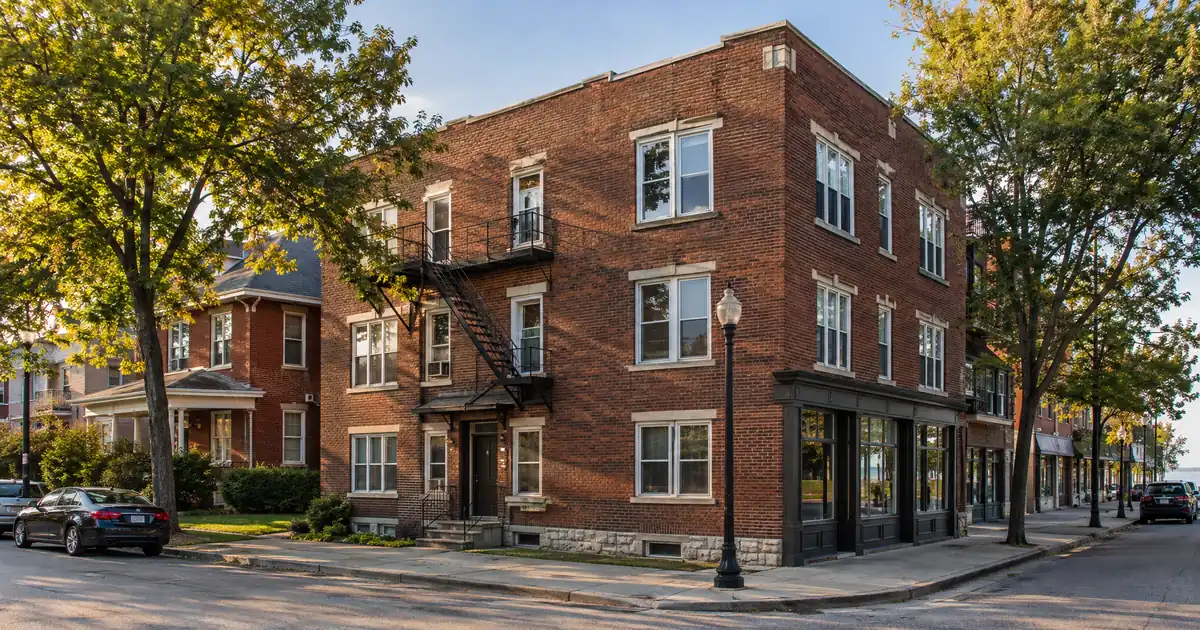
A seven-unit historic brick building downtown, listed on Homes.com with two 2-bedroom units, two 1-bedroom units and three efficiencies, shows what a DSCR cash out refinance in Sandusky, Ohio is built around. Several small rents carry one loan, but the appraisal has few nearby sales to lean on. For an investor who already owns a small building near the waterfront, those two facts decide how much equity can come out and whether the file holds together.
The Short Version: A DSCR cash-out refinance in Sandusky, Ohio is underwritten primarily on the property’s rental income measured against its full monthly obligation. The file moves from title seasoning to the appraisal and rent schedule, then to lender review of coverage, reserves and the 75 percent LTV ceiling before any proceeds are sized.
DSCR Cash-Out Calculator
Run the cash-out numbers in Sandusky, OH
Rate source: Freddie Mac 30-yr average via FRED® — Federal Reserve Bank of St. Louis · effective Oct 1, 2026
Prefilled with starting assumptions — enter your property’s value, balance, taxes, and insurance for a more accurate picture.
Program parameters update from Lendmire’s centralized guideline source. Taxes and insurance are editable estimates.
As of Oct 1, 2026 · General Freddie Mac market benchmark, not a Lendmire loan offer. Property value, balance, taxes, and insurance are editable estimates. Maximum loan-to-value varies by lender, program, property type, and seasoning. Not a Loan Estimate, approval, or commitment to lend. Program availability and eligibility are subject to lender guidelines, credit approval, property review, and underwriting.
- Duplexes and small buildings make up roughly 16 percent of housing units, per NeighborhoodScout, so comps run thin.
- Published average rents span about $1,200 to $1,400 depending on the source.
- The appraisal’s rent schedule, not a headline average, sets the coverage number.
- Cash-out typically requires about six months of seasoning from title recording.
Sandusky Market Snapshot
A quick read on the Sandusky investor landscape — figures come from the cited sources below. Confirm current property-level numbers before underwriting.
| Metric | Detail |
|---|---|
| Typical rents | $1,480–$1,834 target rents for new construction (CommunityScale) |
| Employment | Cedar point 6,500+ employees (State of Ohio “Live Ohio”) |
Downtown: Where Small-Building Equity Is Most Visible
Downtown Sandusky is the strongest place to look for extractable equity in small buildings. It has the densest mix of older multi-unit stock, the most active reinvestment, and listings that show how mixed-unit buildings trade. The caveat is that the sample is small.
Homes.com showed 14 multifamily listings priced from $118,500 to $2,750,000, which is a wide spread for a city of about 24,606 residents per Census Bureau QuickFacts. Listings included a duplex with a 2-bedroom upper unit and a 3-bedroom lower unit, along with the seven-unit brick building above. Downtown reinvestment gives the stock context. Crain’s Cleveland Business reported on a preservation project that returned City Hall downtown and added apartments and storefronts. It also described the Falcon Point Lofts building, where the BGSU hospitality program holds classes. That article is dated, so treat it as qualitative color rather than a current market read.
NeighborhoodScout puts single-family detached homes at 57.82 percent of housing units and large apartment complexes at 18.84 percent. Duplexes, converted homes and small apartment buildings account for 15.90 percent. So a downtown fourplex is a real asset class here, if a thin one. Lenders want several nearby sales on a cash-out. Thin comps are the first friction point to plan for.
The Appraisal Is the Pressure Point
In Sandusky, appraisal comps are the biggest threat to a cash-out file. A thin sales base makes medians swing, and the lender sizes the loan on the appraised value, not on the headline appreciation an owner has in mind.
Redfin puts the median sale price at roughly $144,000, down 4.0 percent year over year, with homes taking about 55 days to sell. Other sources run higher, and Homes.com cites medians well above that figure. That spread is the point. When only a few dozen homes sell in a month, one lakefront or new-build sale can move a median by tens of thousands of dollars. Redfin’s own data shows momentum swinging between strong gains and declines depending on the month.
An investor planning a cash-out should assume the appraiser will lean on whatever recent, similar sales exist within a tight radius. For a duplex, that may mean reaching for comps that are not true duplexes. Here’s the catch: a headline change in a median doesn’t translate into the same change on a specific building.
Prepare the file for this. Gather the current leases, a rent roll showing unit mix and any recent capital improvements that justify value. The appraiser’s Form 1007 rent schedule is what the lender credits for coverage, so a file with signed leases and a clean unit-by-unit breakdown gives the reviewer less to question. The sources conflict on price level, which is why no single rent-to-price ratio belongs in a Sandusky underwrite. The subject property’s own appraisal governs.
What Rent Will a Lender Actually Credit?
Lenders credit the appraisal’s market-rent figure. For Sandusky that usually means a number between $1,200 and $1,400 per unit on average, depending on unit size and condition. Published averages span that range because each source measures a different slice of the market.
RentCafe reports an average of $1,243, up 3.16 percent year over year, with 1-bedrooms at $933 and 2-bedrooms at $1,318. Its data covers buildings with 50 or more units only, so it leans toward larger complexes. Zillow lists an overall average of $1,200, with four-bedroom units at $1,900. Zumper shows $1,397, down 1 percent over the year. Some sources suggest modest growth and others flat to slightly negative, so treat these figures as a range, not a trend.
The CommunityScale housing assessment adds a useful ceiling. It finds that projects are far more likely to lease when rent lands under $1,433 per month, and that the pool of households thins above that. It also finds the strongest rental demand is for 2-bedroom units, attainable to households earning $28,650 to $57,300. Both findings shape underwriting. A 2-bedroom-heavy duplex or small building sits in the deepest part of the tenant pool. Pushing rent per door above that ceiling is a risk, and stacking income across more units is safer. The same report cites CoStar at about 3 percent rental vacancy, with only about 32 units a year under construction in the submarket over the past decade. That supports a stabilized-occupancy assumption, though it is a consultant figure and not a guarantee for any single building.
Running the Coverage Math
The rent-to-debt ratio on a cash-out depends on one thing that works against the owner: appraised value drives the loan size, and rent doesn’t rise with it. Higher value means a bigger loan against the same rent.
DSCR is monthly rent used for lender review divided by the full monthly obligation: principal, interest, taxes, insurance and any HOA dues. The standard benchmark is 1.00x, though some lenders review lower ratios with compensating factors such as lower leverage or more reserves. Here are two modeled scenarios. The values and rents are assumptions, not market facts. Both use a standard 30-year amortization at the 75 percent LTV cap and include taxes and insurance.
First, picture an investor with a single-family rental appraised at an assumed $150,000, renting at an assumed $1,200. Run at 75 percent LTV, the coverage lands in the 1.15–1.20 range. That is workable.
Now change one input. Say the same $1,200 rent but the appraisal comes back at an assumed $190,000 after a strong comp. At 75 percent LTV the coverage slips under 1.00x, even though the owner has more equity. (This surprises owners who expect higher value to mean easier approval.) Paths a lender might review in that case include a lower LTV, a sub-1.00 program, an interest-only structure or a smaller cash-out. Each is subject to lender guidelines, credit approval and property review.
Multi-unit buildings flip that picture. A duplex appraised at an assumed $200,000, with a 2-bedroom at an assumed $1,100 and a 3-bedroom at an assumed $1,350, covers well above 1.6x including taxes and insurance at the same cap. Two rents against one debt payment is the structural reason small multifamily is the better cash-out fit here.
DSCR files in markets like this one typically look like a stack of small, clean-but-unglamorous documents. A signed lease or two, a rent schedule, proof of title recording and an insurance quote that matches the appraisal date. The files that stall usually have one of three issues: a rent assumption above what comps support, a value that outran the nearby sales, or a mismatch between the leases and the unit count. Getting a current insurance quote in early prevents a coverage number from shifting late in review. For the broader mechanics, see Lendmire’s DSCR guide and the guide “The Refi Options”.
Seasoning, Reserves and Loan Size
Three program points matter most for a Sandusky owner: seasoning, reserves and balance size. On most files, a cash-out typically requires about six months of ownership measured from title recording. Reserves generally run about six months of full payment, and credit tiers on most programs start at a 620 floor, with better terms at 660, 680 and 700. All are subject to lender guidelines and vary by borrower, property and loan scenario.
If the property sits in an LLC, per lender program requirements the entity structure and guarantor setup need to match the title and insurance. Mismatched names between the deed, the policy and the application are among the most common documentation snags.
Balance size is the Sandusky-specific wrinkle. Standard programs reach up to $3,000,000, but many Sandusky loans are small, and smaller balances route through select lenders in the network. At roughly $144,000 for a median sale, most loans here will be small. Investors should expect that routing instead of assuming a standard-program minimum. Cash proceeds also aren’t a fixed figure. Available equity depends on rent used for lender review, the full monthly obligation, reserves and the 75 percent ceiling. Programs vary, so confirm the details before assuming a number.
The Demand Behind the Rent Roll
A cash-out underwrite assumes tenants keep paying, so the employment base matters. Sandusky’s tenant demand rests on three pillars: tourism, healthcare and manufacturing.
Per the State of Ohio’s Live Ohio page, Cedar Point employs more than 6,500 people, and the page names Kalahari Resorts, Ventra Sandusky and NOMS Healthcare among top employers. Firelands Health describes a staff of over 2,100 and calls itself Erie County’s largest full-time employer, which supports steady demand from nurses, techs and allied-health staff for 2- and 3-bedroom rentals. Business View Magazine puts manufacturing at 6,298 jobs, the county’s largest sector, ahead of healthcare and retail. It also reports a $40 to $50 million commitment to rebuild the Cedar Point causeway and a $10.5 million Kalahari investment.
The mix is the underwriting story. Tourism adds seasonal swings, while hospital and manufacturing jobs offer a year-round base. Sandusky’s renter share, about half of households, adds depth. Lenders look at lease length and occupancy, so a building with year-round tenants reads cleaner than one dependent on a single season.
Where Cash-Out Files Go Wrong
Cash-out files go wrong in Sandusky in three ways: rents set above the ceiling, comps stretched too far, and the wrong property type.
Underwriting rent per unit well above roughly $1,433 puts the coverage number on tenants who aren’t there. Reaching for comps from the lakefront or from newer subdivisions inflates value. Cold Creek, a partially completed subdivision where recent homes sold at the top of the market, is more of an owner-occupant reference than a DSCR comp. The same goes for the planned new-build rents of $1,480 to $1,834 that CommunityScale proposes for MacArthur Park. Those are targets for new construction, not rents on existing stock. Manufactured homes, log homes and barndominiums fall outside these programs entirely. Check the conventional vs DSCR on investor loans comparison if documentation is a concern.
The stronger play might be the 2-bedroom-heavy building over the one-off single-family, though investors chasing pure appreciation could argue the other way. Verify current local rental rules, taxes and insurance with qualified local professionals before committing to any plan.
DSCR vs. conventional financing
There are two common ways to finance an investment property in Sandusky, OH, and they qualify you differently — here’s how investors weigh them.
Why investors choose it
- Qualifies on the property’s rental income — no personal tax returns, W-2s, or pay stubs needed to document income.
- No personal debt-to-income ceiling to clear, so existing mortgages and obligations don’t cap your borrowing the same way.
- Can be closed in an LLC, keeping the property inside a business entity.
- Built for scaling — not held to the limit on number of financed properties that conventional financing applies.
- Underwriting centers on the deal: generally qualifies when the rent covers the payment, a 1.00x coverage ratio being a common baseline (confirmed in underwriting).
- Designed specifically for investment property, including long-term and, where the program allows, short-term rentals.
Where it’s strong
- Often the lowest ongoing financing cost for a buyer who fully qualifies on personal income — a fit for a first property or a cost-first purchase.
Trade-offs for investors
- Requires full personal income documentation and must fit within a debt-to-income limit — salary, existing debts, and other mortgages all count.
- Typically held in your personal name rather than a business entity.
- Caps how many financed properties you can carry, which can become a ceiling as a portfolio grows.
- Evaluates you as a borrower as much as the property, which usually means more paperwork.
How investors usually choose: a first or single property often optimizes for the lowest financing cost; portfolio builders often optimize for leverage, vesting in an LLC, and scaling past conventional caps. The right answer depends on your goals, the property, and current guidelines — both paths run through select lenders in Lendmire’s wholesale network, with eligibility and terms confirmed in underwriting.
Where the Proceeds Go Next
The point of a cash-out is the next deal, and Sandusky has several directions. The city’s Housing Development Accelerator includes a pattern book for small infill: duplexes, triplexes and fourplexes. That signals public support for the same small-building product this article centers on. The city’s Welcome Home Ohio program is building 14 modular homes and three Habitat for Humanity homes for buyers at or below 80 percent of area median income, per the City of Sandusky. CommunityScale’s report finds that 70 percent of homes built since 2010 and listed recently were priced for the highest income tier, which points to a shortage of attainable housing.
A common pattern is to pull equity from a stabilized building and reinvest in another small multifamily or in renovation on existing stock. For Sandusky owners working through the details, Ohio DSCR investor loans covers the state program picture. Investors can get a rental-income loan quote or call 828-256-2183 to talk through a specific file.
Frequently Asked Questions
How do you qualify for a DSCR cash-out refinance in Sandusky, Ohio?
Qualification centers on the property’s rent versus its full monthly obligation, with a 1.00 coverage ratio as the usual baseline. Lenders also review credit (floor of 620), reserves of about six months, seasoning of about six months from title recording and the 75 percent LTV cap. Exact eligibility depends on lender guidelines, credit profile and property review.
What are the requirements for an investment property cash-out loan in Sandusky, Ohio?
Expect an appraisal with a rent schedule, current leases, proof of title recording, insurance and an entity structure that matches title if the property is in an LLC. Smaller Sandusky balances typically route through select lenders in the network. Terms vary by borrower, property and loan scenario.
Does Sandusky’s thin sales volume hurt cash-out appraisals?
Yes, it can. With only a few dozen sales in a month, an appraiser may have limited true comparables for a duplex or small building, and value can come in below what headline appreciation suggests. Strong documentation of unit mix, leases and improvements helps the reviewer, though the appraiser decides the number.
Is a duplex or a single-family easier to cash out in Sandusky?
A 2-bedroom-heavy duplex often shows better coverage, because two rents carry one debt payment, and CommunityScale finds 2-bedroom units have the deepest tenant demand. A single-family can work but coverage tightens as appraised value rises against a fixed rent.
What a Local Appraiser Would Tell You
In Sandusky the appraisal usually decides the deal, not the borrower. A mixed-unit building with a clean rent schedule and three or four similar sales nearby will hold its value. A one-off with no comps will get cut back, and no amount of appreciation talk changes that.
For current guidelines and terms, see Lendmire’s DSCR loan programs page.
About Lendmire
Lendmire (NMLS# 2371349) is a DSCR-focused mortgage broker that helps arrange investor financing across 41 markets, including Washington, D.C., through wholesale and investor-lending channels. DSCR eligibility is generally reviewed by the lender on the property’s rental income rather than personal income documentation, subject to lender guidelines. That structure suits self-employed investors, LLC operators and portfolios above four financed properties. Scotsman Guide named Lendmire a Top Mortgage Workplace in both 2025 and 2026.
Get Started
Ready to find the right loan for you?
In about 30 seconds you can review financing options available for your investment property. No commitment required.
Informational only. Not a Loan Estimate, approval, or commitment to lend. Program availability and eligibility are subject to lender guidelines, credit approval, property review, and underwriting.
References
1. Homes.com
2. NeighborhoodScout, Sandusky real estate
3. CommunityScale, Sandusky Housing Market Assessment
4. State of Ohio, Live Ohio Sandusky
5. Census Reporter, Sandusky profile
7. Redfin, Sandusky housing market
8. RentCafe, Sandusky rent trends
9. Zillow
10. Zumper
11. Firelands Health
12. Business View Magazine, Erie County
13. City of Sandusky, Housing Development Accelerator
14. City of Sandusky
15. 2025
16. 2026
This article is part of Lendmire’s investment property cash-out refinance program — full qualification details, guidelines, and scenarios live on the program page.
Related reading: Cash Out Refinance Investment Property Sandusky Ohio · DSCR Investment Property Loans in Sandusky, OH: The 2026 DSCR Financing Guide to Cedar Point · Cash Out Refinance Investment Property in Wauwatosa, Wisconsin: The 2026 DSCR Financing Guide to Tosa Village
Guides: Investment Property Cash-Out Refinance in Sandusky, OH · Investment Property Cash-Out Refinance in Ohio
Brandon Miller
Founder & CEO, Mortgage Loan Originator, Lendmire LLC
- Mortgage Loan Originator · NMLS# 1129696 · Verify on NMLS Consumer Access
- North Carolina Real Estate Broker · License# 343312 · Verify on NCREC
- North Carolina Insurance Producer · License# 19053198 · Property, Casualty, Life, Health · Verify on NAIC SBS
- Lendmire LLC · Firm NMLS# 2371349 · Verify firm licensure
Disclosure information. Lendmire is a state-licensed mortgage brokerage under NMLS# 2371349. Lendmire is not a depository institution, direct lender, or financial advisor — all loans referenced are placed through wholesale lender partners and are subject to each lender's underwriting standards. This article is provided for general informational purposes and is not a commitment to lend, nor does it constitute financial, legal, or tax advice. Loan programs, terms, rates, and qualification standards change without notice and depend on borrower profile, property type, and the state in which the subject property is located. Equal Housing Opportunity provider. NMLS Consumer Access: nmlsconsumeraccess.org.