
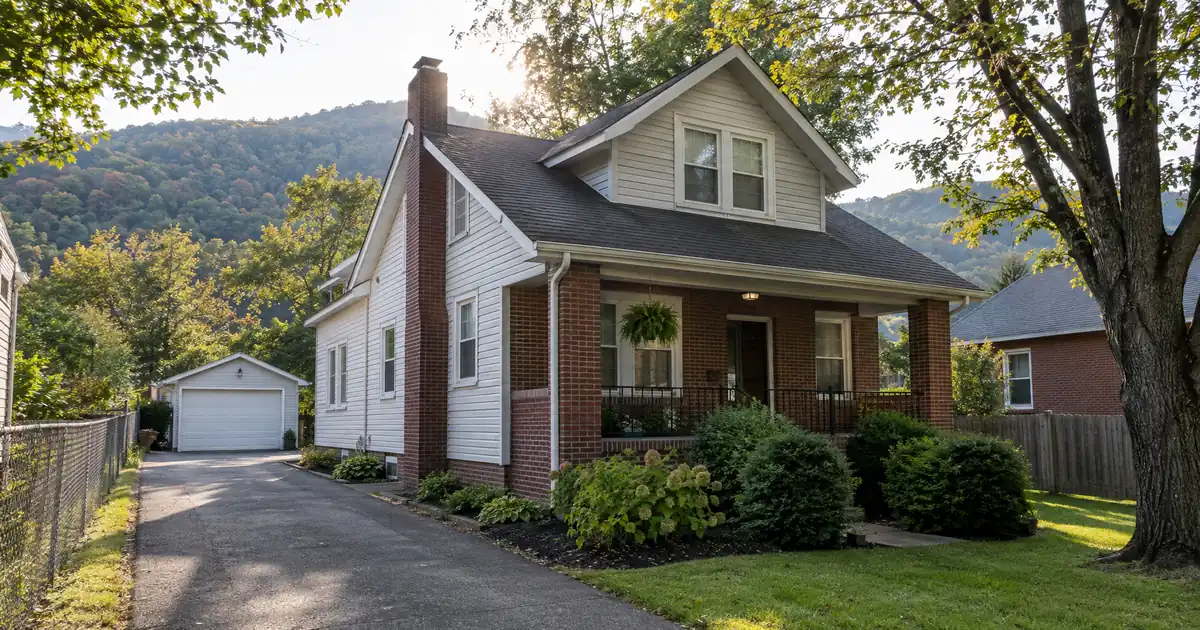
The standard objection to West Virginia is that the state is shrinking, so why would an investor pull equity out of a market with no population tailwind? Census Bureau QuickFacts puts the state at 1,769,979 residents, down 1.3% since the 2020 base. That objection deserves a direct answer, and the answer is that demand here is local and concentrated rather than statewide.
The Quick Read: A cash-out refinance on a West Virginia rental is underwritten primarily on the property’s rental income measured against its full monthly obligation, so the question is which nodes hold rent, not whether the state is growing.
DSCR Cash-Out Calculator
Run the cash-out numbers in West Virginia
Rate source: Freddie Mac 30-yr average via FRED® — Federal Reserve Bank of St. Louis · effective Sep 24, 2026
Prefilled with starting assumptions — enter your property’s value, balance, taxes, and insurance for a more accurate picture.
Program parameters update from Lendmire’s centralized guideline source. Taxes and insurance are editable estimates.
As of Sep 24, 2026 · General Freddie Mac market benchmark, not a Lendmire loan offer. Property value, balance, taxes, and insurance are editable estimates. Maximum loan-to-value varies by lender, program, property type, and seasoning. Not a Loan Estimate, approval, or commitment to lend. Program availability and eligibility are subject to lender guidelines, credit approval, property review, and underwriting.
- Morgantown renters make up 56% of households, the deepest rental base among interior metros.
- Cash-out leverage caps at 75% LTV after roughly six months of ownership.
- Morgantown duplex math models near 1.3x including taxes and insurance, but source rents disagree widely.
- Huntington and Wheeling offer low basis, so coverage depends on tight pricing.
- Exact terms depend on the lender’s guidelines, property type, leverage, and a full review of the borrower’s file.
Lendmire (NMLS# 2371349) is a DSCR-focused mortgage broker arranging investor loans across 40 states plus Washington, D.C., 41 markets total. For West Virginia owners who already hold rentals, it can structure DSCR loan options for West Virginia investors around equity extraction rather than purchase. The thesis here is narrow: pull equity from the nodes where rent holds, and skip the rest.
Does a Shrinking State Break the Equity Thesis?
No. A flat statewide population caps appreciation but does not erase rental demand in nodes with institutional anchors. USAFacts ranks West Virginia 39th in population at 1.77 million, with a loss of about 1,300 residents in the latest year. That is attrition, not collapse.
The anchors are specific. WVU Medicine is described as the state’s largest health system and one of its largest employers. West Virginia University drives Morgantown, Marshall University drives Huntington, and Charleston Area Medical Center supports the Kanawha Valley. Clarksburg adds a federal layer through the FBI’s CJIS Division.
This is a stacked-nodes market, not a statewide trade. An owner refinancing in a node with a hospital or university behind it faces a different risk profile than one holding a house in a town with neither. Coverage ratios should be read the same way, node by node.
Morgantown: Where Equity Actually Stacks
Morgantown has the strongest rent profile of the interior markets. RentCafe, using Yardi Matrix data, reports an average rent of $1,279, up 3.72% year over year. Unit rents run $884 for a 1BR, $1,181 for a 2BR, and $1,667 for a 3BR. Renters occupy 56% of households.
Prices support the case without stretching it. Redfin shows a $240K median sale price, up 4.1%. Zillow puts its citywide value index at $272,226, up 2.7%. The two series use different methods, so treat them as a band rather than a single number.
Now the multi-unit angle. Redfin’s multifamily listings show 18 Morgantown properties with a $300K median list price. Run the numbers on a duplex with two 2BR units at $1,181 each, valued at that median at 75% LTV. Rent divided by full PITIA, including taxes and insurance, lands around 1.3x. This is a modeled assumption using list price and market-average rent, not a closed comp. Every figure here varies by lender and program — guidelines, property type, leverage, and credit profile all apply.
Compare that with a single-family 3BR at $1,667 against a $240K value at the same 75% LTV. The coverage number lands closer to 1.2x. A duplex stacks two rent streams on one loan balance, so it clears the 1.00x benchmark with more cushion than a house carrying the debt alone. Most standard programs are built around that benchmark, though exact eligibility depends on lender guidelines.
Property type matters. Redfin’s 26505 listings are mostly small multi-unit stock near WVU’s downtown campus, including triplexes and duplexes with mixed unit sizes. A local brokerage names Woodburn and Greenmont as pockets with duplexes and small apartment buildings. That source is promotional, so use it for context only. Some of those listings sell as-is, which can matter for appraisal condition on a later cash-out.
Here is the catch. Source rents disagree sharply. Apartments.com showed $874 as an average, down 1% year over year, against RentCafe’s $1,279. On the lower figure, that same duplex model drops to roughly 1.0x. Lenders typically rely on the appraiser’s market rent schedule or the actual lease, so an owner whose lease sits well under market can see qualifying income and proceeds shrink. Underwrite from the lease and the appraisal, never from one aggregator.
The Seasoning Clock and the 75% Ceiling
Equity extraction runs on three constraints: roughly six months of ownership measured from title recording, a 75% LTV ceiling on cash-out, and a coverage number at or above 1.00x on rent used for lender review. Reserves typically run about six months of PITIA, and credit tiers generally start at a 620 floor, all subject to lender guidelines. The guide “What Is a DSCR Loan” covers the ratio mechanics, and the DSCR cash-out refi mechanics page walks through the sequence.
Appreciation alone rarely produces much cash here. Consider an investor who bought a Morgantown rental at 80% LTV and watched value climb 4% a year, in line with Redfin’s reading. After two years, ignoring amortization, the loan sits near 74% of the new value. That is barely under the cash-out ceiling, so extractable proceeds are close to nothing. Proceeds are not a guaranteed figure either; they depend on rent used for lender review, PITIA, reserves, and the 75% cap. Final terms depend on lender guidelines, property type, leverage, and the borrower’s complete credit picture.
Appreciation is thin in this state, so the cash comes from basis. Buy below market and add value, and the improvements may support a higher appraised value, depending on comps and underwriter review. If a reappraisal does come in higher, the 75% cap would then apply to that new number. Owners who bought low-basis rentals years ago, or renovated into a higher rent schedule, are the ones most likely to have real extraction room.
Hold periods matter as much as price. A property that has been held and leased for a stretch generally gives the lender a cleaner rent history and gives the owner a cleaner appraisal story. Proceeds then become the down payment on the next acquisition, which is the point of the exercise. Smaller West Virginia balances often route through select lenders in the network, since many local properties sit well below the standard program sizes. Programs allow up to $3,000,000 on standard files.
Charleston and Huntington: Low Basis, Tight Cushion
Charleston carries the best small-multifamily inventory. NeighborhoodScout shows 66.61% of units as single-family detached, 16.42% in large apartment complexes, and 12.91% in duplexes or small converted buildings. That 12.91% slice is where a duplex-style cash-out makes sense.
The data is messy, though. Resideline tracked 308 closed sales with a $201,500 median, but the middle half spanned $107,360 to $335,000. Rent sources conflict as well: RentCafe reports $1,388, while Apartments.com showed $983 in an older reading. A fair read is $160K to $220K for value and a wide rent range. Underwrite each property on local comps and the lease, because the averages do not settle it. The tenant base is workforce-driven, tied to CAMC and state government employment. Renters are 37% of households.
Huntington is lower still. Apartments.com reports $785 for a 1BR and $961 for a 2BR, with rents up 9.7% year over year. The 3BR figure of $909 sits below the 2BR, which looks like a thin-sample artifact. No reliable current Huntington price series turned up in the research, so a rent-to-value edge cannot be asserted. Demand is anchored by Marshall, Cabell Huntington Hospital, and St. Mary’s Medical Center. Absolute rents are low, so cushion depends on a low purchase basis. An owner who bought at a steep discount may clear coverage. One who paid retail may not.
Deal-by-Deal Territory
Wheeling, Parkersburg, and the Eastern Panhandle each fail the same test in a different way: the numbers conflict or the cushion is thin.
DSCR vs. conventional financing
There are two common ways to finance an investment property in West Virginia, and they qualify you differently — here’s how investors weigh them.
Why investors choose it
- Qualifies on the property’s rental income — no personal tax returns, W-2s, or pay stubs needed to document income.
- No personal debt-to-income ceiling to clear, so existing mortgages and obligations don’t cap your borrowing the same way.
- Can be closed in an LLC, keeping the property inside a business entity.
- Built for scaling — not held to the limit on number of financed properties that conventional financing applies.
- Underwriting centers on the deal: generally qualifies when the rent covers the payment, a 1.00x coverage ratio being a common baseline (confirmed in underwriting).
- Designed specifically for investment property, including long-term and, where the program allows, short-term rentals.
Where it’s strong
- Often the lowest ongoing financing cost for a buyer who fully qualifies on personal income — a fit for a first property or a cost-first purchase.
Trade-offs for investors
- Requires full personal income documentation and must fit within a debt-to-income limit — salary, existing debts, and other mortgages all count.
- Typically held in your personal name rather than a business entity.
- Caps how many financed properties you can carry, which can become a ceiling as a portfolio grows.
- Evaluates you as a borrower as much as the property, which usually means more paperwork.
How investors usually choose: a first or single property often optimizes for the lowest financing cost; portfolio builders often optimize for leverage, vesting in an LLC, and scaling past conventional caps. The right answer depends on your goals, the property, and current guidelines — both paths run through select lenders in Lendmire’s wholesale network, with eligibility and terms confirmed in underwriting.
- Wheeling. Redfin shows a $169,888 median sale price, up 4.4%. Zillow shows $154,161, up 4.6%. Neighborhood medians swing wildly on tiny samples, and no reliable rent source turned up. The appraisal drives everything.
- Parkersburg. Resideline reports a $143,000 median across 219 closings. A dated rent source shows softness, with a $997 average and a double-digit decline. That reading is directional at best.
- Eastern Panhandle. This is the highest-priced WV market. Redfin shows Martinsburg at a $260K median, down 13.5%, while Jefferson County shows $399K, up 3.6%. A local brokerage cites a $410,000 Jefferson County resale median, so appreciation here is strong but source-dependent. Current rent data was stale, which leaves the cushion unverifiable.
The Panhandle is an appreciation play for DC-commuter demand, and a cash-out there can work when value has risen faster than the loan. Thin rent-to-value fit means coverage becomes the binding constraint, not LTV. Treat all of these as deal-by-deal.
Experience Signal: What the Desk Tends to See
On files from markets like this one, the common friction point is rent documentation rather than equity. Owners arrive with a value in mind and a lease well below market, or a market rent from an aggregator that the appraiser will not support. The cleaner files from a documentation standpoint tend to carry a current lease, a rent schedule from the appraisal, and an LLC chain of title that is already in order, subject to lender program eligibility.
What to Watch Over the Next 6-24 Months
Coverage and appreciation will move on a few indicators, and each one can break the current pattern.
1. Rent dispersion. If aggregator rents converge, underwriting gets simpler. If they stay 45% apart, appraisal rent schedules will keep deciding outcomes.
2. Vacancy. The Census Bureau puts national rental vacancy at 7.3% in the latest quarter, up from 7.0% a year earlier. Outside metro areas it ran 5.8% against 8.0% in principal cities, per the Census release. Rural West Virginia sits on the lower side of that split.
3. Supply. Berkeley County new-construction closings fell from 91 to 43 while resales rose, per the Fox Essell Faster update. That points to tightening new supply in the Panhandle.
4. Employer anchors. Current top-employer data lives at WorkForce West Virginia. Older lists put WVU Medicine and CAMC near the top, and any shift in hospital or university headcount flows straight into rental demand.
Owners should also confirm current local rental rules, taxes, and insurance with qualified local professionals before committing. For a side-by-side with bank financing, see the guide “Where DSCR and Conventional Diverge”.
Where the Asymmetry Sits
The mispriced corner is small multi-unit stock near WVU in Morgantown. Prices near the median listing of $300K sit against two or three rent streams, in a market where 56% of households rent. Single-family houses in the same city lean on one rent. Small multi-unit buildings near the core are where basis, rent, and a 75% LTV ceiling line up best, provided the lease or appraisal supports the rent. These specifics are subject to lender guidelines and a full review of property, leverage, and credit.
Frequently Asked Questions
How do you qualify for a DSCR cash-out refinance in West Virginia?
Qualification centers on the property’s rent used for lender review against its full PITIA, with 1.00x as the common benchmark. Lenders typically look for about six months of ownership, a credit score at or above 620, and about six months of PITIA in reserves, all subject to lender guidelines. Cash-out leverage tops out at 75% LTV. Rent comes from the lease or the appraisal’s rent schedule.
What are the requirements for an investment property loan in West Virginia?
Typical files need a rental property, a coverage ratio at or above 1.00x, and reserves. Manufactured homes, log homes, and barndominiums fall outside these DSCR programs, which matters in rural counties. LLC-titled borrowers may qualify subject to lender program eligibility. Terms vary by borrower, property, and loan scenario.
Can a Morgantown duplex support a cash-out refinance?
Often yes, if rent supports it. A modeled duplex with two 2BR units lands near 1.3x including taxes and insurance at 75% LTV, but only on RentCafe-level rents. On the lower Apartments.com figure the number falls toward 1.0x. The lease and appraisal rent schedule decide it.
Is Wheeling or Parkersburg a good cash-out market?
Both are deal-by-deal. Prices are among the lowest in the state, but rent data is thin or stale, and neighborhood medians swing on tiny samples. The appraisal and the lease matter more here than any citywide average.
How does DSCR program review differ from a bank’s approach in this market?
DSCR files are reviewed mainly on the property’s rent against its debt rather than on personal income documentation. That suits LLC-held rentals and self-employed owners. A DSCR quote is available at 828-256-2183.
For current guidelines and terms, see Lendmire’s DSCR loan programs page.
Get Started
Ready to find the right loan for you?
In about 30 seconds you can review financing options available for your investment property. No commitment required.
Informational only. Not a Loan Estimate, approval, or commitment to lend. Program availability and eligibility are subject to lender guidelines, credit approval, property review, and underwriting.
About Lendmire
Lendmire is a DSCR-focused mortgage brokerage, NMLS# 2371349, placing investor loans across 41 markets, including Washington, D.C. DSCR eligibility is generally reviewed by the lender on a property’s rental income rather than personal income documentation, which fits LLC-held rentals, self-employed investors, and portfolios scaling past conventional financed-property limits. Lendmire was named a 2026 Scotsman Guide Top Mortgage Workplace and was recognized by Scotsman Guide in 2025.
This article is part of Lendmire’s investment property cash-out refinance program — full qualification details, guidelines, and scenarios live on the program page.
Related reading: DSCR Loans in Morgantown, West Virginia: Investor Financing for Sunnyside, South Park, Cheat Lake & Real Estate Investors · DSCR Loans West Virginia: Investor Financing for Charleston, Morgantown, Snowshoe, New River Gorge, and Real Estate Investors · DSCR Loans in Charleston, West Virginia: Investor Financing for South Hills, Kanawha City, Elk City & Real Estate Investors
Guides: Investment Property Cash-Out Refinance in West Virginia
References
2. Freddie Mac 30-yr average via FRED® — Federal Reserve Bank of St. Louis
4. USAFacts
5. WVU Medicine
8. Charleston Area Medical Center
10. Redfin
11. Zillow
12. Redfin’s multifamily listings
Brandon Miller
Founder & CEO, Mortgage Loan Originator, Lendmire LLC
- Mortgage Loan Originator · NMLS# 1129696 · Verify on NMLS Consumer Access
- North Carolina Real Estate Broker · License# 343312 · Verify on NCREC
- North Carolina Insurance Producer · License# 19053198 · Property, Casualty, Life, Health · Verify on NAIC SBS
- Lendmire LLC · Firm NMLS# 2371349 · Verify firm licensure
Legal disclosures. Lendmire (NMLS# 2371349) is a state-licensed mortgage brokerage that arranges financing through wholesale lender relationships. Lendmire is not a direct lender, depository institution, or registered financial advisor. The discussion above is general informational content about real estate financing — it is not financial, legal, or tax advice, and readers should consult licensed professionals for guidance on their individual circumstances. Loan inquiries are subject to lender underwriting; this article does not represent a commitment to lend. Loan terms, rates, and qualification standards vary by borrower, property, and state, and are subject to change at any time. Equal Housing Opportunity. NMLS Consumer Access: nmlsconsumeraccess.org.