
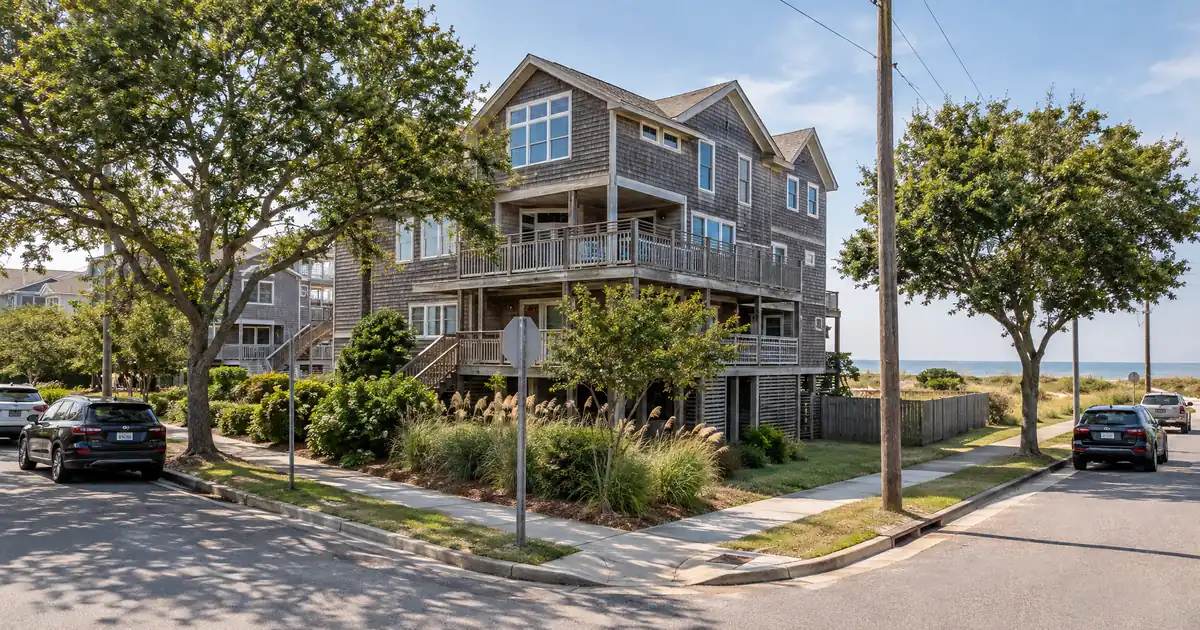
The Quick Read: A DSCR loan tests the rental property’s income, while a bank statement loan tests the borrower’s deposits, and occupancy decides which one fits an Outer Banks luxury home. A pure investment rental usually points to DSCR, and a home you will live in or use as a second home points to bank statements.
- DSCR qualifies primarily on property-level rental income covering the payment, subject to lender guidelines.
- Bank statements qualify on documented income under the applicable program, subject to lender guidelines, using 12 months of deposits.
- Owner-occupied or second-home use can only be financed on the bank statement side.
- Reserves commonly run around 6 months of the housing payment on bank statement files.
- Sequencing is common: bank statements for the home you live in, DSCR for the rental.
Outer Banks luxury homes make this choice harder than usual. The loans are large, the income is seasonal, and many owners want a few family weeks on the calendar. This guide referees both options fairly. It also names the point where each one stops working.
What your deposits qualify you for.
Alt-doc programs read 12 months of business or personal bank deposits instead of tax returns. Enter your average monthly deposits and see the income a lender would credit you.
The expense factor is set by the lender from your business type and profit-and-loss statement; it is not a number you choose. This widget quotes no rate and no payment.
Program parameters shown update from Lendmire’s centralized guideline source.
Estimate
Illustrative estimate only — not a quote, Loan Estimate, approval, or commitment to lend. Deposit average, expense factor, and housing ratio are editable assumptions; the expense factor a lender applies is set from your business type and documentation. No interest rate or monthly payment is quoted here. Purchase capacity is a simplified illustration and does not account for taxes, insurance, HOA dues, or other debts. Alt-doc income documentation is available on consumer mortgages in the states where Lendmire is licensed for consumer lending; actual terms vary by lender, borrower, and property.
The Honest Answer: Who Each Option Is Really For
DSCR suits the investor whose house is a business. The lender looks at what the property earns against its full monthly obligation. Your personal deposits and tax returns matter far less. Bank statement lending suits the self-employed buyer whose cash flow is strong but whose tax returns, after write-offs, understate it. That buyer might be buying a second home or a primary residence.
The flip point is how you plan to use the house. If it will be a true rental with limited personal use, DSCR is usually the cleaner lane. If the family will treat it as a second home, the deal works to bank statements. The same is true if you cannot show the house earning enough to cover itself.
Lendmire is a broker arranging financing through select lenders in its wholesale network, so both lanes are available to compare. For a broader primer on property-based qualification, see the complete DSCR loans guide.
Side-by-Side
The bank statement column below reflects Lendmire’s network guidelines for consumer-purpose files. The DSCR column describes published industry norms and varies by lender.
| Factor | DSCR Loan | Bank Statement Loan |
|---|---|---|
| What is tested | The property’s rental income | The borrower’s deposits |
| Income documents | Rental evidence, lease or STR history | 12 months of business or personal statements |
| Occupancy | Non-owner-occupied rentals | Primary, second home, or investment |
| Entity vesting | LLC common, subject to program terms | Varies by program and occupancy |
| Personal DTI | Generally not the focus | Tested against derived income |
| Reserves | Vary by lender and loan size | Commonly around 6 months |
| Loan sizes | Vary by lender | Roughly $125,000 to $3,500,000 |
| Disclosure regime | Business-purpose, TRID-exempt | Owner-occupied: TRID applies; rental: exempt |
When a DSCR Loan Is the Better Fit
DSCR is the better fit when the Outer Banks home is a true investment and the property can show its own income. The investor holds title in an LLC, subject to lender program eligibility. The borrower wants personal income left out of the analysis.
DSCR loans are designed for non-owner-occupied investment properties. Because they are business-purpose investor loans, they are reviewed differently from a standard owner-occupied mortgage. The CFPB’s Truth in Lending exam procedures treat credit to acquire a non-owner-occupied rental as business-purpose credit. That is why personal-income tests do not drive the file.
Three profiles tend to favor DSCR:
- The portfolio builder. Each financed rental adds to personal debt-to-income on a bank statement file. A property-based test keeps the next purchase from being judged on the last one.
- The investor with strong rental history. A home with a documented booking record can carry its own file.
- The buyer with messy personal accounts. Commingled deposits weaken a statement file. DSCR does not read personal deposit patterns.
How short-term rental income is counted
This is where luxury shore homes get tricky. Lenders typically rely on trailing platform or management statements, a third-party market projection, or an appraiser’s opinion. They differ on which one they accept, and some apply a haircut to the projection.
The standard appraisal rent form was never built for nightly rentals. Fannie Mae’s June 2024 Appraiser Update says Form 1007 was not designed for appraising single-family properties used as short-term rentals and cannot estimate the nightly fee. Agency rules do not govern DSCR loans, but the form’s limits are why a conservative rent opinion can shrink the coverage number. HousingWire’s reporting makes the same point: using the 1007 for STR income can produce artificially low ratios.
Across Lendmire’s wholesale network, the practical pattern is simple. Files with twelve months of documented platform income give the lender something firm to underwrite. Files built on a projection invite more haircuts and more questions.
Seasonality and the coverage number
The Outer Banks swings hard between summer and winter. The Island Free Press, reporting on Outer Banks Visitors Bureau data, said average STR daily rates rose 6% to about $617 even as booked guest nights in Dare County fell 10.9%. It also reported first-half adjusted paid occupancy near 44%. Strong nightly rates can mask soft occupancy, so a trailing-twelve-month figure and a projection can tell different stories.
That is one reason sub-1.00 coverage deserves a plain explanation. Programs below 1.00 are available through select lenders in the network, but leverage and terms adjust. If the home only clears coverage on a generous projection, treat that as a signal to check the assumptions, not to hunt for a looser program.
Recourse and the LLC
An LLC changes who holds title. It rarely removes the personal guaranty. Investors who assume entity ownership means no personal exposure are often surprised by the guaranty paperwork. Plan for it.
When a Bank Statement Loan Is the Better Fit
A bank statement loan is the better fit when you are self-employed, your deposits tell a stronger story than the property does, or the home will not be a pure rental. Qualification happens on documented income under the applicable program, subject to lender guidelines. The lender typically reviews 12 months of business or personal statements and removes transfers, refunds and one-time asset sales. Then it applies an expense factor to business deposits. Expense factors are lender-specific, so never assume a universal formula.
Occupancy is the dividing line. A bank statement loan can finance a primary residence, which DSCR cannot. On a primary residence, select lenders offer leverage up to 90% LTV on a purchase or rate-and-term refinance, with the strongest files earning the top of that range. An asset-depletion alternative, which qualifies from liquid assets, runs to about 80% LTV on a primary residence. Final terms depend on lender guidelines, property type, leverage, and the borrower’s complete credit picture.
The second-home buyer
Many Outer Banks luxury buyers plan to use the house themselves, with some rental weeks around family time. If that describes you, the file may be an owner-occupied second home, which is a consumer mortgage and carries consumer disclosure rules. A bank statement loan can fit that case. A DSCR loan may not, because the lender expects the property to operate as an investment.
For owner-occupied cash-out, the ceilings are lower than the purchase figure. A primary residence reaches up to 80% LTV with a fixed expense ratio, or 75% with an accountant-prepared ratio. A second home reaches up to 75% LTV, depending on loan size and credit. These specifics are subject to lender guidelines and a full review of property, leverage, and credit.
Investment property on bank statements
If you use bank statements on a non-owner-occupied rental, including a short-term rental, the loan is business-purpose and exempt from consumer disclosure timing. Cash-out on an investment property tops out around 75% LTV. Investment purchase leverage on this documentation varies by lender, so leave that number to the file review.
The weak spots
Bank statements stress a borrower in four ways:
- Lumpy or commingled deposits can shrink qualifying income.
- Ownership percentage in a business affects how much of the deposit stream counts.
- Stacked DTI grows with every financed property.
- Large payments on a luxury loan hit personal DTI directly.
A loan in the roughly $125,000 to $3,500,000 range covers many Outer Banks homes, but the upper end draws more scrutiny on reserves and credit. Reserves commonly run around 6 months of the housing payment.
Worked Scenarios
These are modeled profiles, not market data.
Scenario one: the portfolio operator. Picture an investor who owns several rentals through an LLC and is eyeing an oceanside home with a full year of platform history. Coverage clears the benchmark at roughly 1.2x on trailing income, and personal DTI is already stretched. DSCR is the natural lane. The property carries itself, and the investor’s other loans do not drag on it.
Scenario two: the self-employed second-home buyer. Say a business owner with strong deposits and low taxable income wants a luxury home where the family will spend most of the summer. Rental income is a bonus, not the plan. Bank statements fit better, because the file is built on the borrower and the occupancy is personal. Expect reserves near 6 months and a full review of deposits.
Scenario three: the new rental with no history. An investor buys a home that has never been listed on a platform. Coverage rests on a projection that may fall short of 1.0x after a haircut. A bank statement file could carry the purchase while the booking record builds. Later, a refinance into DSCR can make sense once there is a stabilized year. The weak spot is that “stabilized” is lender-defined and seasonal, so one good summer may not be enough.
A Decision Checklist
Choose DSCR if most of these are true:
- The home will be a true rental with limited owner use.
- You can document platform income or support a credible projection.
- You want to vest in an LLC, subject to program terms.
- Personal DTI is already carrying other mortgages.
Choose bank statements if most of these are true:
- You will live in the home or use it as a second home.
- Your deposits are clean and show strong cash flow.
- You are comfortable with a full review of your accounts.
If you are split, run both. The numbers rarely lie about which lane is cheaper in effort and documentation.
Documents to Gather
| DSCR path | Bank statement path |
|---|---|
| STR income evidence or market projection | 12 months of business or personal statements |
| Entity documents and guaranty paperwork | Business ownership documents |
| Asset statements for reserves and down payment | Credit profile and debt schedule |
| Insurance quotes for the property | Insurance quotes for the property |
Statements on the DSCR side verify funds and reserves. They are not used to derive income. Short-term rental rules can vary by city, county, HOA, and property type, so investors should confirm local rules before relying on projected rental income. Septic limits and occupancy-tax registration are two items that can affect what a shore home legally earns.
Combining the Two
Investors often use both. A common sequence is a bank statement loan for the home you live in, then DSCR for the rentals that follow. The two lanes do not compete. They serve different occupancy types.
For a luxury investor looking at a different coastal market, Lendmire’s article DSCR vs. Bank Statement Loan for a Palm Beach Luxury Rental Investor shows how the same trade-offs play out elsewhere.
The Verdict
If the house is a business, lean DSCR. If the house is part of your life, lean bank statements. If the rental record is unproven, consider bank statements as a bridge, and revisit DSCR once there is a year of real bookings. The wrong move is picking a product to fit a plan the property does not support. A beach house that only works on an optimistic projection is the problem to solve first.
Tax treatment varies; consult a qualified professional. If you are self-employed and want to see how the numbers work, Lendmire can help you compare bank statement loan options based on your deposits, the property, credit profile, leverage, and your goals. Reach the team at 828-256-2183 or request a quote.
Seasonal swings are the Outer Banks’ defining feature, and the loan that survives a slow February matters more than the one that looks best in July.
Frequently Asked Questions
Can I use a bank statement loan on an Outer Banks home I plan to rent out?
Yes, in many cases. On a non-owner-occupied rental, including a short-term rental, the loan is business-purpose, and leverage on this documentation varies by lender. Investment cash-out on bank statements tops out around 75% LTV. If the property is a true investment, compare it against DSCR before choosing.
Does an LLC make a DSCR loan non-recourse?
Usually not. An LLC can hold title, subject to lender program eligibility, but the members commonly sign a personal guaranty. Entity ownership changes title and liability layering. It does not typically remove personal responsibility for the loan.
What if my Outer Banks rental has no booking history?
It depends on the lender. Some accept a market projection, often with a haircut. Others want documented history. A new rental is where a bank statement file can serve as a bridge before a later DSCR refinance.
Can I stay at the house myself?
Some personal use is common, but heavy owner use can change the occupancy category. An owner-occupied second home is a consumer mortgage and fits the bank statement lane. A DSCR loan expects an investment property. Discuss your planned use up front.
How much cash do I need in reserve?
Bank statement files commonly look for around 6 months of the housing payment. DSCR reserves vary by lender and loan size. Larger luxury loans draw closer attention on both sides.
About Lendmire
Lendmire (NMLS# 2371349) is a mortgage brokerage serving self-employed and high-net-worth borrowers in 16 states. Bank statement, P&L-only, 1099-only and asset-based mortgages are arranged through wholesale lending channels; Lendmire brokers the financing and the lender underwrites each application. Scotsman Guide named Lendmire a Top Mortgage Workplace in both 2025 and 2026.
Get Started
Ready to find the right loan for you?
See your offer in seconds. No credit pull, no obligation.
Informational only. Not a Loan Estimate, approval, or commitment to lend. Program availability and eligibility are subject to lender guidelines, credit approval, property review, and underwriting.
References
1. CFPB’s Truth in Lending exam procedures
2. Fannie Mae, Appraiser Update June 2024
3. HousingWire, short-term rentals and the appraisal playbook
4. Island Free Press, Outer Banks rental demand
This article is part of Lendmire’s bank statement loan program — full qualification details, guidelines, and scenarios live on the program page.
Related reading: DSCR Loan vs Bank Statement Loan for an Investor With No W2 Income · DSCR vs Bank Statement Loan for a Galena Rental Investor · Jumbo DSCR vs Bank Statement Loan for a Beverly Hills Rental
Brandon Miller
Founder & CEO, Mortgage Loan Originator, Lendmire LLC
- Mortgage Loan Originator · NMLS# 1129696 · Verify on NMLS Consumer Access
- North Carolina Real Estate Broker · License# 343312 · Verify on NCREC
- North Carolina Insurance Producer · License# 19053198 · Property, Casualty, Life, Health · Verify on NAIC SBS
- Lendmire LLC · Firm NMLS# 2371349 · Verify firm licensure
Legal disclosures. Lendmire (NMLS# 2371349) is a state-licensed mortgage brokerage that arranges financing through wholesale lender relationships. Lendmire is not a direct lender, depository institution, or registered financial advisor. The discussion above is general informational content about real estate financing — it is not financial, legal, or tax advice, and readers should consult licensed professionals for guidance on their individual circumstances. Loan inquiries are subject to lender underwriting; this article does not represent a commitment to lend. Loan terms, rates, and qualification standards vary by borrower, property, and state, and are subject to change at any time. Equal Housing Opportunity. NMLS Consumer Access: nmlsconsumeraccess.org.