
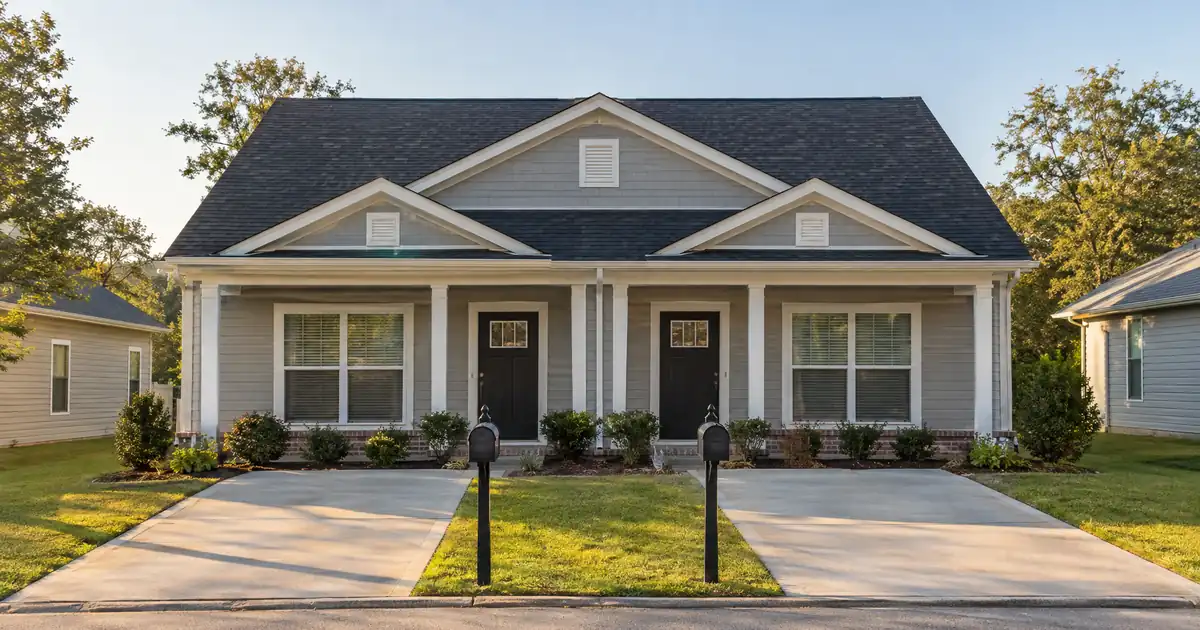
The Quick Read: Yes, if you live in one of the two units as your main home. FHA programs cover one- to four-unit owner-occupied homes, so a duplex is eligible. The usual conditions apply: you must have owned and lived there for 12 months before the case number, and the new loan generally tops out at 80% of the appraised value. Everything is subject to lender guidelines and full file review.
What Does “Live In It” Actually Mean for a Duplex?
It means the duplex is your principal residence. You sleep there, your mail goes there, and your bills show it. The other unit can be rented to a tenant, sit vacant, or house a relative. Occupancy of your own unit is the test, not who lives next door.
HUD’s Handbook 4000.1 limits FHA programs to one- to four-unit owner-occupied principal residences. There is no separate duplex rule for cash-out. A two-unit home follows the same cash-out rules as a single-family house, with a few extra steps around the second unit.
Here is where people get tripped up. If you move out and rent both units, the standard FHA cash-out is off the table. A second home or an investment property does not qualify. Occupancy decides the leverage, and that is the whole story on that front.
How Does the FHA Cash-Out Refinance Work?
A cash-out refinance replaces your current mortgage with a new, larger one. You pay off the old loan, and the difference comes to you as cash. The new loan has to fit under the program’s value cap, so you need real equity before you can take any out.
Across the wholesale programs Lendmire places FHA files with, the FHA cash-out reaches 80% loan-to-value (LTV). LTV is the new loan balance divided by the home’s appraised value. At 80%, at least 20% of the value stays in the home as your equity.
The 80% figure is a ceiling, not a promise. Credit, income, payment history, and the appraisal still decide how much you can actually borrow. Lendmire’s piece on the FHA cash-out refinance program covers the basics for any property type. This article stays on what changes when the home has two units.
What Are the Eligibility Rules for a Duplex?
The rules are the same ones a single-family owner faces. The table shows how each one reads when your home has two units.
| Requirement | What it means for a duplex |
|---|---|
| Occupancy | You live in one unit as your main home |
| Seasoning | Owned and lived in 12 months before the case number |
| Max LTV | 80% of appraised value |
| Payment history | Mortgage payments made on time recently |
| Ratios | Housing and total debt measured against income |
| Appraisal | Includes market rent for the second unit |
Seasoning is the waiting period before you can cash out. For FHA, it is 12 months of owning and occupying the home before the case number is assigned. Lenders look for proof such as employment records or utility bills tied to the address.
Payment history matters too. Loans with very little payment history generally cannot be cashed out. For longer-held loans, lenders expect mortgage payments made on time over the past year. Confirm the exact wording in the handbook on hud.gov or with your loan officer.
Credit and ratios follow the standard FHA approach. The base pair is 31/43, meaning housing costs at 31% of income and total debt at 43%. Documented compensating factors can stretch that toward 40/50 at the top tier. An automated finding governs most files. Minimum credit scores vary by lender, and the wholesale programs Lendmire works with start at a 580 decision score.
Can the Other Unit’s Rent Help You Qualify?
Often, yes. For a two- to four-unit home, rental income from the subject property can count as qualifying income. It is not a guaranteed add-on, and the lender decides how much to use.
The number is not your actual rent roll alone. HUD Mortgagee Letter 2023-17 says the lender documents proposed rental income with an appraisal showing fair market rent. The form is the Small Residential Income Property Appraisal Report. The appraiser’s market rent figure drives the calculation. Where leases exist, the lender can consider them alongside it.
Say you own a duplex with a tenant in the second unit at a rent that is below market. The lender works from the appraiser’s market figure, not just from what you happen to collect. That can help or hurt, depending on how your lease compares with the market.
This is a mortgage qualifying matter, not tax advice. Tax treatment can depend on your situation; borrowers should speak with a qualified tax professional before relying on any deduction or credit.
What About the Self-Sufficiency Test?
Duplex owners can usually relax on this one. The net self-sufficiency test is a three- and four-unit requirement, where the rent has to carry the payment on its own. A two-unit home is not tied to it under the handbook language. Confirm the current text on hud.gov, because the handbook updates from time to time.
Do Reserves Apply?
They may. Reserves are cash left in the bank after closing, counted in months of housing payments. HUD’s guidance ties reserve requirements to the unit count when rental income is used. Three- and four-unit homes carry a firmer requirement. For a two-unit home, reserves may apply depending on how the file is underwritten, so ask your loan officer early. Final terms depend on lender guidelines, property type, leverage, and the borrower’s complete credit picture.
Which Duplex Situations Are Harder?
A few scenarios deserve a closer look before you apply.
- You bought less than 12 months ago. Standard cash-out is not available yet. You may qualify for a different refinance type that does not pay you cash, and that one has its own leverage rules.
- You inherited the duplex. The 12-month occupancy minimum can be waived, as long as you never treated the home as an investment property. If you rent it out after inheriting, the 12-month clock applies.
- You moved out recently. Cash-out generally requires that the home is your principal residence. A move-out can end eligibility.
- One unit has a business in it. Mixed-use homes have their own rules. HUD’s handbook sets a residential floor-area test, and your lender can tell you how it applies.
- You want to fund renovations. An FHA 203(k) is a separate renovation program, and HUD’s 203(k) comparison fact sheet states there is no cash-out refinance under it.
- Your current loan is not FHA. That is fine. A conventional loan can generally be refinanced into an FHA cash-out if you qualify.
How Do Loan Limits Work on a Two-Unit Home?
County loan limits apply, and they rise with the number of units. A two-unit home has a higher limit than a single-family home in the same county. Limits are reset every year, so check your county on HUD’s loan-limit lookup rather than relying on a number you saw last year.
Your cash-out loan has to satisfy two tests at once. It must fit under the county limit, and it must stay at or below 80% of appraised value. Whichever is lower caps your loan. In high-value areas, the 80% test usually bites first. In lower-cost areas, a high-value duplex can run into the county limit.
What Does It Cost?
The costs are structural, not mysterious. The first is the upfront mortgage insurance premium: 1.75% of the base loan, which is usually financed into the balance. The second is an annual premium that runs between 0.15% and 0.75% of the balance, depending on term, loan amount, and LTV. On a thirty-year loan above 90% LTV, the annual premium lasts the full term. At or below 90%, it ends after eleven years.
Cash-out at 80% LTV lands at or below that 90% line, so the annual premium on this type of loan generally drops off after eleven years. Your lender confirms how it applies to your file.
There are also third-party closing costs, such as the appraisal and title work. These show up on your Loan Estimate and Closing Disclosure, and you should compare both before signing. A refinance also resets your loan. You are trading your current balance and terms for a larger balance and new ones.
A practical way to think about it: the cash you take is not free money. It becomes part of a larger loan, and the premium is calculated on that larger amount.
How Does Your Duplex Compare to a Single-Family Home?
| Factor | Duplex (you live in one unit) | Single-family home |
|---|---|---|
| Eligible for FHA cash-out | Yes | Yes |
| Max LTV | 80% | 80% |
| Occupancy test | Principal residence | Principal residence |
| Appraisal | Adds a market-rent form | Standard appraisal |
| Rental income counts | Possibly | Not applicable |
| Loan limit | Higher two-unit county limit | One-unit county limit |
The finance rules are nearly identical. The differences are paperwork and the appraisal. The extra rent form adds a step, but it can also help your ratios.
Is FHA the Right Choice, or Should You Look at Conventional?
It depends on your credit, your equity, and your plans. FHA tends to suit borrowers with moderate credit who want flexible ratio rules and a 580 score floor within the wholesale programs Lendmire places. A conventional cash-out can make sense when your credit is strong and you want different mortgage insurance mechanics. If you are weighing reserves on a conventional loan against a duplex, Lendmire’s piece Conventional Cash-Out Refinance Reserves When You Live in a Duplex lays out how that side works.
A fair toss-up for many house-hackers: FHA is easier on credit, while conventional can cost less over a long hold. Run both before you commit. A borrower who plans to move within a couple of years may weigh the larger balance differently than one staying for a decade.
What Is the Step-by-Step Process?
1. Confirm occupancy. You must have lived in the duplex for 12 months as your main home, with documents to prove it.
2. Check your equity. Estimate whether a loan at 80% of value still pays off your balance and leaves cash for you.
3. Review your mortgage history. Make sure recent payments are on time.
4. Look up your county limit. Use HUD’s lookup tool for two-unit properties.
5. Apply and document. Provide income, assets, and any leases for the second unit.
6. Complete the appraisal. It includes the market-rent analysis for both units.
7. Review your disclosures. Compare your Loan Estimate and Closing Disclosure line by line.
8. Close, then wait out rescission. A refinance of your principal home carries a right to cancel.
On that last step: under Regulation Z, you can cancel until midnight of the third business day after closing. The cancellation must be in writing. A phone call is not enough. Funds are not paid out until that window closes.
Key Terms Defined
Cash-out refinance: A new mortgage larger than your current one, with the difference paid to you in cash.
LTV (loan-to-value): Your loan balance divided by the home’s appraised value.
Seasoning: The required waiting period of ownership and occupancy before you can refinance.
Principal residence: The home you live in as your main address.
Right of rescission: Your right to cancel certain refinances in writing within a limited window after closing; the exact timing and which transactions qualify vary by file and lender.
Upfront mortgage insurance premium: A one-time FHA charge of 1.75% of the base loan, usually financed.
Frequently Asked Questions
Can I rent out the other unit and still qualify?
Yes. You can rent the second unit, and lenders may count market rent toward your income. The rent must be documented through the appraisal and any leases. You still have to live in your own unit as your main home.
Does my current loan have to be FHA?
No. A conventional loan can generally be refinanced into an FHA cash-out if you qualify. The home must still meet the 12-month ownership and occupancy test, and the new loan must fit the 80% LTV ceiling.
What if I inherited the duplex?
The 12-month occupancy minimum can be waived for inherited property, provided you have never treated it as an investment property. If you rent it out after inheriting, the 12-month occupancy clock applies. Your lender confirms how the exception reads on your file.
Can I move out after I close?
The loan is made on the basis that the home is your principal residence. Moving out right away raises occupancy questions. Talk with your loan officer before you apply if a move is on your horizon.
Does 80% LTV mean I get approved for that amount?
No. It is the maximum, not a guarantee. Credit, income, payment history, and the appraised value still decide what you can borrow, subject to lender guidelines and full file review.
If you are weighing a cash-out refinance against keeping the loan you have, Lendmire can help you compare the programs and the equity each one reaches.
For your own numbers, request a scenario review with Lendmire.
About Lendmire
Lendmire, NMLS# 2371349, is a mortgage brokerage with consumer lending licenses in 16 states. FHA, VA, conventional and jumbo purchase and refinance loans are arranged through wholesale lending partners, and each application is reviewed individually by the lender. Scotsman Guide named Lendmire a Top Mortgage Workplace in both 2025 and 2026.
For the program’s current guidelines, see FHA loan programs.
Get Started
Ready to find the right loan for you?
In about 30 seconds you can review financing options available for your home or investment property. No commitment required.
Informational only. Not a Loan Estimate, approval, or commitment to lend. Program availability and eligibility are subject to lender guidelines, credit approval, property review, and underwriting.
References
1. HUD Handbook 4000.1 property type eligibility excerpt
2. HUD Mortgagee Letter 2023-17
3. HUD 203(k) Program Comparison Fact Sheet
4. HUD county loan-limit lookup
This article is part of Lendmire’s FHA Loan series — every loan program’s qualification details, guidelines, and scenarios live on the loan options page.
Related reading: Can a Texas Homestead Move From FHA to Conventional Cash-Out Refinance? · FHA Cash-Out vs FHA 203k Refinance When the Appraisal Decides · Can an FHA Cash-Out Refinance Exceed the County Loan Limit?
Brandon Miller
Founder & CEO, Mortgage Loan Originator, Lendmire LLC
- Mortgage Loan Originator · NMLS# 1129696 · Verify on NMLS Consumer Access
- North Carolina Real Estate Broker · License# 343312 · Verify on NCREC
- North Carolina Insurance Producer · License# 19053198 · Property, Casualty, Life, Health · Verify on NAIC SBS
- Lendmire LLC · Firm NMLS# 2371349 · Verify firm licensure
Legal disclosures. Lendmire (NMLS# 2371349) is a state-licensed mortgage brokerage that arranges financing through wholesale lender relationships. Lendmire is not a direct lender, depository institution, or registered financial advisor. The discussion above is general informational content about real estate financing — it is not financial, legal, or tax advice, and readers should consult licensed professionals for guidance on their individual circumstances. Loan inquiries are subject to lender underwriting; this article does not represent a commitment to lend. Loan terms, rates, and qualification standards vary by borrower, property, and state, and are subject to change at any time. Equal Housing Opportunity. NMLS Consumer Access: nmlsconsumeraccess.org.