
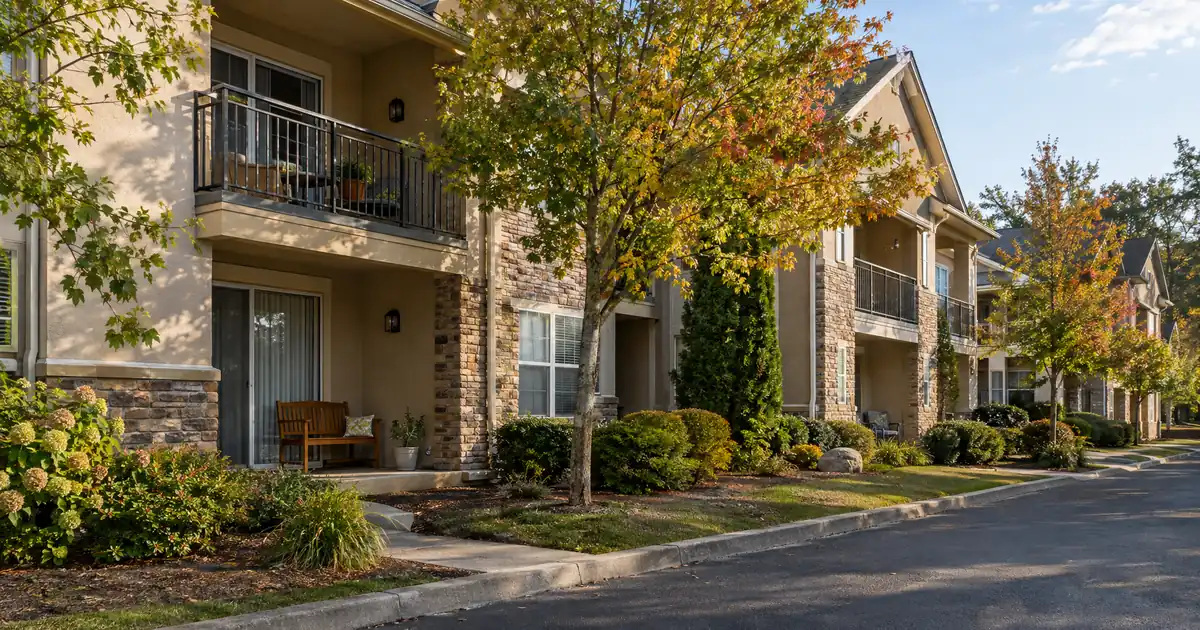
The Quick Read: An FHA loan can finance a condo you plan to live in, but two things have to pass: you and the building. Your credit, income, and savings are reviewed the way they would be on a house. The condo project must also be eligible, either as an approved project or through a single-unit approval. Check the building first, then the budget.
What Does “FHA-Eligible Condo” Actually Mean?
An FHA-eligible condo is a unit in a building that meets HUD’s project standards, either through full project approval or a one-off review of that single unit. The government does not own or sell these homes. “Eligible” is a label on the building, not a quality grade.
FHA payment estimate
Starting assumptions reflect an example price and the FHA minimum investment. Replace them with your own figures.
Editable benchmark: 7.32% as of October 22, 2026 · Freddie Mac 30-year average via FRED®. A conventional market reference, not an FHA loan quote.
Illustrative starting assumptions: a $350,000 price, the FHA minimum investment as the down payment, a thirty-year term at the current Freddie Mac benchmark, and property taxes and insurance estimated at typical national rates. Every field is editable.
Illustrative estimate only — not a Loan Estimate, approval, quote, or commitment to lend. The rate field carries the weekly Freddie Mac thirty-year conventional benchmark, a market reference and not an FHA loan quote; your rate is set by the lender at lock. FHA mortgage insurance follows HUD’s published schedule for the term, leverage and loan size entered; taxes, insurance and dues are editable estimates; closing costs are not included; county loan limits are not checked here. Licensed in sixteen states for consumer mortgages. Lendmire is not affiliated with or acting on behalf of FHA, HUD, or the federal government.
HUD’s condominium page explains that Section 203(b) of the National Housing Act allows FHA to insure a mortgage on a one-family unit in a project, along with an undivided interest in the common areas. Terms run up to 30 years. The unit must sit in an FHA-approved condominium project, or in a non-approved project that meets the Single-Unit Approval (SUA) requirements.
There is no separate “condo loan.” It is the standard FHA purchase loan with an added property test. Buyers get tripped up here. A strong file does not rescue a building that fails.
Key Takeaways
- Two gates: the borrower and the building. Both must clear.
- Two building routes: an approved project, or Single-Unit Approval for a unit in a non-approved project.
- Condo dues count inside your housing payment when the lender calculates ratios.
- The home must be your primary residence. FHA is not built for second homes or rentals.
- Check the building’s status before you make an offer, not after.
The Two-Gate Model
Here is how it works across the FHA loan programs Lendmire arranges through wholesale lenders. The borrower gate looks like any FHA purchase. The building gate is the extra step, and it is where condo deals most often stall.
| Gate | What gets reviewed | Who supplies the information |
|---|---|---|
| Borrower | Credit, income, assets, ratios | You and your documents |
| Building | Project status, finances, insurance, legal standing | Association, management company, public records |
If you are early in the process, Lendmire’s FHA loan programs page covers the base program. What follows is the condo-specific layer.
The Borrower Gate: What Your File Needs
The borrower side is the familiar part. Across the wholesale programs Lendmire places FHA files with, the maximum financing on a purchase is 96.5% of value, with a 3.5% minimum investment from you. That applies at a decision score of 580 or higher, which is where those programs start. HUD has a lower 500-579 tier with a larger minimum investment, but that tier sits below where these wholesale programs reach. Lenders may set their own higher floors, and all of it is subject to lender guidelines and full file review.
Seller or interested-party contributions can go up to 6% of the price. A non-occupant co-borrower is allowed. The home must be an owner-occupied principal residence.
Ratios work like this. The base pair is 31/43, meaning housing payment over income and total debts over income, with no compensating factors. With documented compensating factors, the ratios can stretch to 40/50 at the top tier. Most files run through an automated finding that largely decides the outcome.
Mortgage insurance applies to every FHA loan. The Consumer Financial Protection Bureau confirms that it is required and that the cost passes to the homeowner. Mechanically, there is an upfront premium of 1.75% of the base loan, which can be financed. There is also an annual premium between 0.15% and 0.75% of the balance, depending on term, loan amount, and LTV. On a thirty-year loan above 90% LTV, the annual premium lasts for the term. At or below 90% LTV, it ends after eleven years. Those are program mechanics, not a quote.
Condo dues matter a great deal here. Dues, and any special assessments, sit inside the housing payment the lender measures against your income. A building with high dues quietly shrinks the loan size you can carry, even if the price looks friendly. Two units at the same price can produce very different qualifying results.
The Building Gate: Two Routes to Eligibility
A building can qualify through one of two routes, and knowing which one applies changes your strategy.
Route A: An approved project. The project already holds HUD approval. According to HUD’s FHA Connection help page, approval of the project comes first, and applications for insurance on individual units can’t be processed until the project is approved. Approved projects get a unique seven-character Condo ID. That page predates the 2019 rule, so treat it as background on how approval works, not as the current full picture.
Route B: Single-Unit Approval (SUA). The unit sits in a non-approved project. HUD’s condominium page says the project must be complete and ready for occupancy, have at least five dwelling units, and not be a manufactured home. It must also meet a subset of the full approval requirements.
| Factor | Approved project | Single-Unit Approval |
|---|---|---|
| Who applies | Association or review channel | The lender, for one unit |
| What’s reviewed | Whole project | Subset of project standards plus the unit |
| Fits when | Building is on HUD’s list | Building is not listed or has lapsed |
| Minimum size | Per HUD standards | At least five units |
Many buyers believe FHA only works when the building is on the approved list. That has not been true since the 2019 rule created SUA as an alternative. The Federal Register rule text also lets HUD set certain project standards within ranges, such as the share of FHA-insured units, the minimum owner-occupancy percentage, and the cap on commercial space. HUD sets the specific percentages by notice, so those numbers can change. Ask the lender for the current figures rather than trusting a blog post.
What the Lender Reviews Inside the Building
The building review turns on a few themes. Here is what each one means for you, and what a failure looks like.
| Test | Why it exists | Common failure sign |
|---|---|---|
| Project finances | Shows the association can pay its bills | Thin reserves, a budget that doesn’t cover insurance |
| Insurance | Protects owners and the lender | Gaps in liability, hazard, or flood coverage |
| Owner-occupancy mix | Owner-occupied buildings tend to be better maintained | Heavy investor or rental ownership |
| Delinquent dues | Unpaid dues starve the budget | A large share of owners behind on payments |
| Litigation | Legal fights can threaten finances | Pending lawsuits against the association |
| Commercial space | Too much non-residential use changes the building’s character | Large retail or office footprint |
| Completion | Unfinished projects are riskier | Construction not done |
Two documents drive this. The lender completes Form HUD-9991, the loan-level and Single-Unit Approval questionnaire. Per HUD’s instructions for that form, the information must come from verifiable sources such as the association, its management company, public records, or independent third parties, and it can be no more than 90 days old. Sections 1 through 3 apply to every condo loan. Section 4 applies only to SUA or non-approved projects. The project-level questionnaire, Form HUD-9992, asks about stable operating income, budget coverage of insurance costs, consistent financial records, and any “Financial Distress Event” in the last 36 months.
You don’t fill these out. Your agent and the lender request them from the association or its management company. Cooperation from the association matters, so start early.
Insurance gets extra attention in flood areas. Under a recent HUD letter, for condos in a Special Flood Hazard Area, the lender must make sure the association carries flood insurance on the buildings, protecting unit owners and common areas.
A practical note from the broker side: files fall apart over the building more often than over the buyer. A buyer with solid credit and a clean down payment can still lose a contract because the association is slow with paperwork, the budget has no reserve line, or a lawsuit shows up in the questionnaire. Lendmire’s team usually suggests asking for the budget, insurance certificate, and any pending-litigation disclosure at the start, not near the end.
How to Check a Building Before You Offer
Start with HUD’s public condo lookup tool, where results show a project’s status, such as Approved, Expired, Rejected, or Withdrawn. An “Expired” status does not always mean the building is bad. It may mean the association hasn’t recertified. It does mean a standard approved-project route is closed until that is resolved.
A few edge cases are worth knowing.
Approval dates. Under the 2019 rule, project approval now runs on a longer cycle. The National Association of Realtors’ assessment says certification was extended from two to three years, with a six-month grace period for recertification materials. Older guides and some blogs still show two years. They are outdated.
Phased projects. Approval attaches to legal phases. A phase counts as complete when all units are built out and have a certificate of occupancy. One phase may qualify while another does not.
Owner-occupancy definition. HUD’s form counts a unit as owner-occupied if the owner lives in it for any part of the calendar year and doesn’t rent it for most of the year.
Outside events. Approval channels can be affected by things outside anyone’s control. During a past federal shutdown, HUD noted that one approval channel was unavailable while others continued. It is dated, but it illustrates that timing can shift.
If the lookup comes back unfavorable, you have options. Ask whether the building could qualify under SUA. Ask the seller or association whether recertification is in progress. Or look at a different building. This is also the point where a buyer with a heavy investor mix in the building may want to compare other loan types.
Primary Home Rules
FHA condo financing is for the home you live in. You live in it as your principal residence, and the program covers one to four units, which for condos means the single unit you buy. It is not a path to a second home or a rental. If a rental or vacation purchase is what you actually have in mind, occupancy decides the leverage and the program, and FHA is the wrong tool.
Moving in is part of the deal. Plan for the move-in timing your lender spells out, and don’t treat it as optional paperwork. A recent HUD letter also updated borrower residency requirements for case numbers assigned on or after May 25, 2025, so ask your loan officer how that affects you.
How Condo Dues and Special Assessments Change What You Can Buy
Think of dues as part of the loan, not a side expense. Lenders count your principal and interest, taxes, hazard insurance, mortgage insurance, and HOA or condo fees together as the housing payment. HUD’s own Handbook 4000.1 glossary lists HOA and condominium fees and special assessments among “Property Charges.” If dues cover some utilities, the lender may be able to adjust for that with documentation.
Here is the effect without any dollar figures. Picture two units priced the same. One building has modest dues. The other has high dues because it covers a pool, doorman, and aging elevators. The second buyer’s ratios hit the 31/43 base pair sooner, so that buyer qualifies for less, or needs strong compensating factors to reach the higher 40/50 ceiling.
Special assessments deserve the same attention. A pending assessment can change ratios and slow a closing. Ask the association about any approved or anticipated assessments during your due diligence.
What the Buying Process Looks Like
1. Talk to a lender first. Get a sense of your file against the borrower gate before you shop.
2. Search with the building in mind. Check the lookup tool for each building you like.
3. Write the offer with protection. Include financing and condo-approval contingencies so you can leave if the building fails.
4. Order the documents. The lender requests the questionnaire information, budget, and insurance certificate.
5. Appraisal. An FHA-roster appraiser values the unit under FHA property standards.
6. Review and decision. The lender weighs both gates.
7. Closing. As a consumer mortgage, your Loan Estimate and Closing Disclosure apply.
Association approval can take weeks in some buildings, so don’t schedule a move-out date until the building review looks settled.
If the Building Doesn’t Qualify
Choose among four paths:
- Ask about SUA if the building isn’t on the approved list.
- Wait or negotiate if recertification is underway and your contract allows it.
- Switch loan types if your file and the building fit another program better. Conventional or VA may handle the building differently. See Lendmire’s piece VA Loan Condo Approval Rules for a Veteran Buying a Primary Home if you’re a veteran.
- Walk away under your contingency and look at a different building.
Honestly, the cleanest outcome is usually a different building. A building that struggles to meet basic standards can also be harder to resell later, since the next buyer faces the same gate.
FHA vs. Conventional for a Condo
This one depends on your file. FHA tends to suit buyers with smaller down payments or modest credit scores, because it allows 96.5% financing and a 3.5% minimum investment at a 580 score. It also asks you to carry mortgage insurance for the term in many cases. Conventional financing may suit buyers with stronger credit and larger down payments, and it applies its own condo project review.
| Factor | FHA | Conventional |
|---|---|---|
| Down payment | As low as 3.5% | Varies by program |
| Credit flexibility | Broader | Often tighter |
| Mortgage insurance | Required on all loans | Depends on down payment |
| Building review | HUD approval or SUA | Its own project review |
| Best for | Smaller down payment, moderate credit | Strong credit, larger down payment |
Lendmire’s article FHA and Conventional Cash-Out Requirements for a Condo Primary Home looks at the refinance side of that comparison.
Pros of FHA for a condo: low minimum investment, flexible credit tiers, and loans insured by FHA qualify as Qualified Mortgages per the CFPB. Cons: mortgage insurance, the added building gate, and the possibility that a good unit sits in a building that doesn’t qualify.
Common Misconceptions
- “The government sells these condos.” No. FHA insures the loan. It does not own or sell the unit.
- “If I qualify, the condo qualifies.” No. The building has its own test.
- “Approved means a good buy.” No. Approval is a minimum standard, not an endorsement.
- “Approval never expires.” Approval does expire. Recertification is part of the system.
- “HOA dues don’t affect my loan.” They do. They sit inside the housing payment.
Key Terms Defined
Single-Unit Approval (SUA): A route that lets a lender approve one unit in a building that isn’t on HUD’s approved list, if the project meets a set of requirements.
HRAP and DELRAP: The two channels for project approval, one run through HUD review and one through qualified lenders.
Form HUD-9991: The questionnaire the lender completes on a condo loan.
Special assessment: A one-time charge the association levies on owners for a large cost, which counts in the housing payment.
Mortgage insurance premium: The FHA insurance charge, with an upfront piece and an annual piece.
Owner-occupancy mix: The share of units lived in by their owners rather than rented out.
Frequently Asked Questions
Can I use an FHA loan to buy a condo I plan to rent out?
No. FHA condo financing is for a principal residence you occupy. Occupancy sets the leverage and the program, so a rental purchase falls outside this loan.
How do I know whether a building is FHA-eligible?
Start with HUD’s public condo lookup tool, which shows a project’s status. If the building isn’t listed or shows Expired, ask your lender whether it could qualify through Single-Unit Approval. The lender completes the review and makes the final call, subject to lender guidelines.
Do condo fees count against me when I apply?
Yes. Condo or HOA dues and any special assessments sit inside the housing payment the lender measures against your income. Higher dues can lower the loan amount you qualify for, even at the same purchase price.
What if the building fails review after I’m under contract?
A financing or condo-approval contingency in your contract is what protects you. You can ask about Single-Unit Approval, wait for recertification if the contract allows, switch to another loan type, or walk away. Your agent can help you write those protections before you sign.
Is the credit minimum different for a condo than for a house?
The borrower side works the same. Across the wholesale programs Lendmire places FHA loans with, the starting point is a 580 decision score for 96.5% financing and a 3.5% minimum investment, subject to lender guidelines and full file review. Some lenders set a higher floor.
If you are buying a home and want to see whether an FHA loan fits your file, Lendmire can help you compare the options and what each one asks of the file. Nothing here is a commitment to lend.
For your own numbers, request a scenario review with Lendmire.
About Lendmire
Lendmire (NMLS# 2371349) is a mortgage broker licensed for consumer lending in 16 states. Lendmire arranges FHA, VA, conventional and jumbo purchase and refinance loans through wholesale lenders; every file is underwritten by the lender under the applicable program guidelines. Scotsman Guide named Lendmire a Top Mortgage Workplace in both 2025 and 2026.
Get Started
Ready to find the right loan for you?
In about two minutes you can review financing options available for your home or investment property. No commitment required.
Informational only. Not a Loan Estimate, approval, or commitment to lend. Program availability and eligibility are subject to lender guidelines, credit approval, property review, and underwriting.
References
3. HUD – FHA Connection condo help
4. Federal Register – Project Approval for Single-Family Condominiums
5. HUD – Form HUD-9991 Instructions
7. National Association of Realtors – FHA Condominium Rule Assessment
This article is part of Lendmire’s FHA loan program — full qualification details, guidelines, and scenarios live on the program page.
Related reading: How to Close an FHA Streamline on a 2-4 Unit Primary Home · FHA vs Conventional Loan for a Condo Buyer on Mortgage Insurance · How an FHA Lender Sizes a Cash-Out Refinance on a Primary Home
Brandon Miller
Founder & CEO, Mortgage Loan Originator, Lendmire LLC
- Mortgage Loan Originator · NMLS# 1129696 · Verify on NMLS Consumer Access
- North Carolina Real Estate Broker · License# 343312 · Verify on NCREC
- North Carolina Insurance Producer · License# 19053198 · Property, Casualty, Life, Health · Verify on NAIC SBS
- Lendmire LLC · Firm NMLS# 2371349 · Verify firm licensure
Disclosure information. Lendmire is a state-licensed mortgage brokerage under NMLS# 2371349. Lendmire is not a depository institution, direct lender, or financial advisor — all loans referenced are placed through wholesale lender partners and are subject to each lender's underwriting standards. This article is provided for general informational purposes and is not a commitment to lend, nor does it constitute financial, legal, or tax advice. Loan programs, terms, rates, and qualification standards change without notice and depend on borrower profile, property type, and the state in which the subject property is located. Equal Housing Opportunity provider. NMLS Consumer Access: nmlsconsumeraccess.org.