
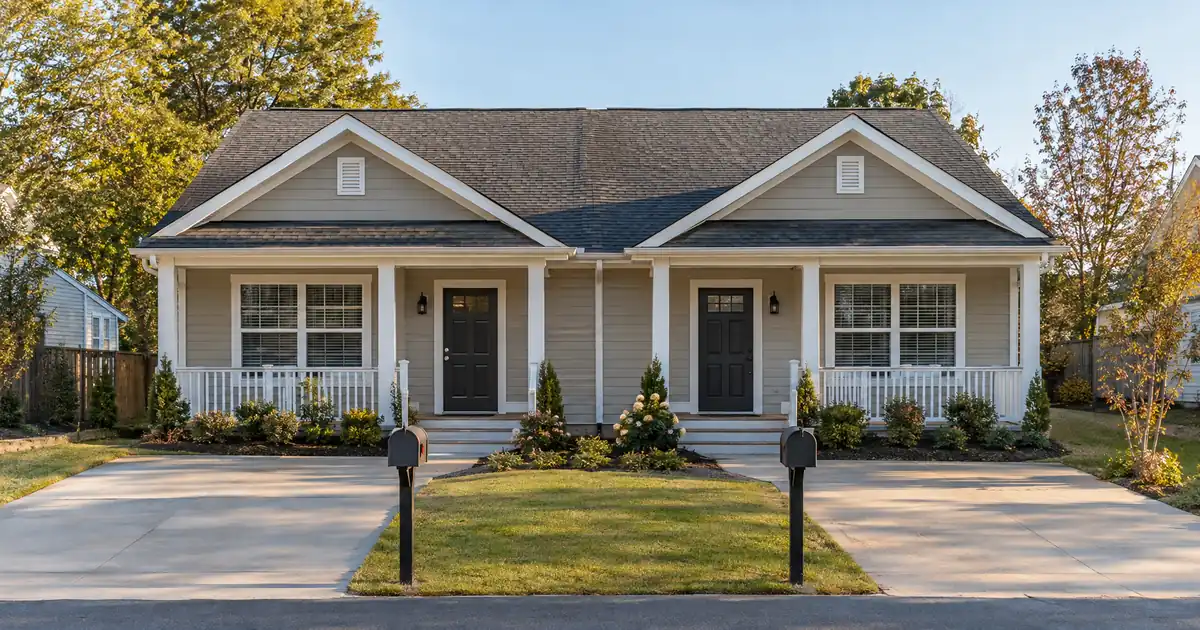
The Quick Read: An FHA loan can finance a duplex as long as you live in one of the two units as your principal residence. It is the same FHA loan used for a single-family home, with a 3.5% minimum investment at a 580 decision score or higher. Part of the rent from the second unit can help you qualify, but only a reduced share counts, and the county loan limit for two units caps the insured loan amount.
What Is an FHA Duplex Loan?
There is no separate “duplex product.” A duplex is a two-unit residential property, and FHA insures loans on one- to four-unit homes. The FDIC’s overview of the Section 203(b) program describes it as the centerpiece of FHA insurance for one- to four-unit residential properties.
FHA payment estimate
Starting assumptions reflect an example price and the FHA minimum investment. Replace them with your own figures.
Editable benchmark: 7.32% as of October 22, 2026 · Freddie Mac 30-year average via FRED®. A conventional market reference, not an FHA loan quote.
Illustrative starting assumptions: a $350,000 price, the FHA minimum investment as the down payment, a thirty-year term at the current Freddie Mac benchmark, and property taxes and insurance estimated at typical national rates. Every field is editable.
Illustrative estimate only — not a Loan Estimate, approval, quote, or commitment to lend. The rate field carries the weekly Freddie Mac thirty-year conventional benchmark, a market reference and not an FHA loan quote; your rate is set by the lender at lock. FHA mortgage insurance follows HUD’s published schedule for the term, leverage and loan size entered; taxes, insurance and dues are editable estimates; closing costs are not included; county loan limits are not checked here. Licensed in sixteen states for consumer mortgages. Lendmire is not affiliated with or acting on behalf of FHA, HUD, or the federal government.
Here is how the insurance works. FHA insures the lender, not you. If a borrower defaults, FHA pays the lender the remaining balance, and the borrower still faces foreclosure, as the Congressional Research Service explains.
The appeal of a duplex is simple. You buy a two-unit building with a low down payment, live in one side, and let the other unit’s rent help carry the cost. Lendmire arranges these loans as a broker through wholesale lenders, and FHA loan programs are a regular part of that work. Across the wholesale programs Lendmire places files with, the duplex file looks much like a single-family file, with one added layer: the rent documentation.
Key Takeaways
- You must live in the duplex. Pure investment purchases do not qualify for FHA.
- The minimum investment is 3.5% at a 580 decision score or higher.
- Rent from the unit you do not occupy can count, but only a reduced portion.
- Duplexes skip the extra rental self-sufficiency test that applies to three- and four-unit buildings.
- County loan limits apply, and the limit for two units is higher than for a one-unit home.
- FHA mortgage insurance is required on every FHA loan.
Requirements at a Glance
| Requirement | What it means for a duplex |
|---|---|
| Occupancy | You live in one unit as your principal residence |
| Minimum investment | 3.5% at a 580 decision score or higher |
| Maximum financing | 96.5% of the lesser of price or appraised value |
| Property type | Two-unit residential building |
| Appraisal | Value plus market rent on the same report |
| Mortgage insurance | Upfront premium plus an annual premium |
| Loan size | County loan limits apply |
Every figure here is subject to lender guidelines and full file review. Nothing here is a commitment to lend.
How Does the Occupancy Rule Work?
You must move in within 60 days of signing and intend to stay at least a year. HUD’s FHA guidance on owner-occupants says at least one borrower must occupy the property as a principal residence within 60 days of signing the security instrument and intend to stay at least one year.
Two details trip people up. The 60 days is a move-in deadline, not a stay requirement. The one-year piece is about your intent when you sign, not a lock that traps you. Life changes. But you certify your intent in writing, and misstating it is a serious problem.
A few practical points follow from that rule:
1. You pick the unit you will live in. Rent is counted on the unit you do not occupy.
2. You cannot rent both units from the start. That makes it an investment, which FHA does not finance.
3. A non-occupant co-borrower is allowed. At least one borrower on the loan still has to occupy the home.
4. Existing tenants matter. If the seller has a tenant in the other unit, the lease can document that rent. If the unit is vacant, the appraisal’s market rent does the work.
A duplex you will not live in is a different loan conversation entirely. For the owner-occupied lane, occupancy sets the leverage, and that is where FHA’s low minimum investment comes from.
How Does Rental Income Help You Qualify?
Lenders count 75% of the lesser of the appraiser’s market rent or the lease rent. HUD Mortgagee Letter 2023-17 says rental income from the subject property may be considered effective income for a two- to four-unit dwelling. When there is no rental history since the last tax filing, the lender must use 75 percent of the lesser of the fair market rent or the lease rent.
The 25% haircut allows for vacancy and upkeep. Taking the lower of the two rent figures keeps a generous lease from overstating the income.
Here is the step-by-step logic of how this works in underwriting:
1. The appraiser reports market rent for the two-unit building.
2. The lender compares that figure to any lease for the other unit.
3. The lender takes the lower number and counts 75% of it.
4. That counted rent offsets the housing payment in your debt ratios.
The rent lowers your ratio. It does not replace your own income. Your credit, job income, debts, and assets are reviewed as they would be on any FHA loan.
Think about a vacant second unit. The lender has no tenant to point to, so the appraised market rent carries the weight. Think about a seller’s tenant on a month-to-month deal. The lease, or lack of one, can change which number is lower. Either way, the counted rent is a qualifying figure, and your actual rent can differ.
Ratios in Plain Words
Across the wholesale programs Lendmire places FHA files with, the base pair is 31/43. That means housing costs up to 31% and total debts up to 43% of income, with no compensating factors. Documented compensating factors, such as reserves or a strong credit profile, can reach 40/50 at the top tier. The automated finding governs most files, so two borrowers with the same ratios can get different answers.
What Does the Appraisal Cover?
One appraisal covers value and rent. Prospective leases go in if available, per Mortgagee Letter 2023-17.
Both units get looked at. The property has to meet FHA’s condition standards for safety, soundness, and security, so peeling paint, a failing roof, or a broken heating system in either unit can stall the file until it is fixed. The appraisal also feeds two numbers at once: the value that sets your loan amount and the rent that feeds your ratios.
Another question deserves a straight answer: is it really a duplex? In-law suites, basement apartments, and converted garages are not always legal second units. If the property is not a legal two-unit building, the file can change shape. Ask about legal unit status before you write an offer.
What Do Mortgage Insurance and Loan Limits Mean for You?
Every FHA loan carries mortgage insurance. The CFPB says FHA mortgage insurance is required for all FHA loans and is included in the monthly payment, the closing costs, or both. It does not shrink with a better credit score.
The structure is mechanical:
- Upfront premium: 1.75% of the base loan, which can be financed into the loan.
- Annual premium: between 0.15% and 0.75% of the balance, depending on term, loan amount, and LTV.
- Duration: on a thirty-year loan above 90% LTV, the annual premium lasts for the term. At or below 90% LTV, it ends after eleven years.
That duration rule matters for a duplex buyer. With the 3.5% minimum, you start above 90% LTV, so the premium stays for the life of the loan unless you refinance out of FHA. The exact numbers vary by lender and program and follow a full review of property, leverage, and credit.
Loan limits work differently from what many buyers assume. County loan limits apply, and they change every year. HUD sets higher limits for two-unit homes than for one-unit homes, and higher still in high-cost areas, as its annual limits announcement describes. The limit caps the insured loan amount. It is not an approval. Your income, credit, and ratios decide what you can actually borrow.
Where the Rules Change: Duplex vs. Three- and Four-Unit Homes
The duplex is the easy case. Three- and four-unit buildings face an extra self-sufficiency test, which asks whether the building’s rent after a vacancy reduction can cover the full payment. A duplex does not face that test. Three- and four-unit homes also tend to draw tighter reserve expectations. Check the details in HUD’s Handbook 4000.1 or with your loan officer, since lender overlays vary.
That is why many house-hacking buyers start with a duplex. It gives you a second income stream with fewer hoops.
Named Edge Cases
Commercial space. A mixed-use building can be eligible, but no income from commercial space counts, per HUD’s Mortgagee Letter.
Boarders. Boarder income counts only with a two-year history on your tax return and current receipt.
ADU on a one-unit home. A single-family home with one accessory dwelling unit is still a one-unit property. A property with two or more units has to count the extra dwelling as another unit.
A second FHA loan. The default is one FHA-insured principal residence at a time. Limited exceptions exist, such as job relocation or a growing household. Handbook 4000.1 and your lender decide those cases individually.
Refinancing a duplex you live in. The same occupancy and rent documentation framework applies. The FHA Streamline refinances an existing FHA loan with no appraisal, a limited credit review, and a net tangible benefit. An FHA cash-out reaches 80% LTV on a home you have owned and occupied for 12 months before the case number. Final terms depend on the lender’s guidelines, the property type, and the borrower’s complete credit picture.
Credit events. HUD’s waiting periods are two years from a chapter 7 discharge and three years from a foreclosure. Those are HUD rules, not a promise about any particular file.
Is FHA the Right Fit for Your Duplex?
It depends on your down payment and credit. The CFPB notes that borrowers with higher credit scores or a somewhat larger down payment, in the 5 to 15 percent range, may find FHA more expensive than a conventional loan with private mortgage insurance. It is an archived post, so treat it as a pointer.
Here is the decision in practice:
| Your situation | FHA tends to fit | Compare conventional |
|---|---|---|
| Down payment | Near 3.5% | 5% or more |
| Credit profile | Mid-range scores | Strong scores |
| Rent offset | Needed to qualify | Not needed |
| Time in the home | Long-term | Planning to refinance soon |
FHA is also a poor match for some people. If you do not want to be a landlord, a duplex adds a tenant, repairs, and vacancy risk. If you plan to rent both units, FHA is off the table.
Lendmire’s related pieces on how self-employed mortgage rules work when you live in one unit you own and how much rent a jumbo loan counts when you live in one unit cover other owner-occupied options if FHA does not fit.
Key Terms Defined
Owner-occupant: a borrower who lives in the property as a principal residence.
Principal residence: the home where you live most of the time and receive your mail.
Mortgage insurance premium: FHA’s insurance charge, paid as an upfront amount and an annual amount collected monthly.
County loan limit: the cap on the insured loan amount for a property type in a given county.
Fair market rent: the rent the appraiser expects the unit to bring in, reported on the appraisal.
Self-sufficiency test: an extra rent-coverage check for three- and four-unit FHA homes.
Common Mistakes to Avoid
1. Planning to rent both units. FHA requires you to occupy one.
2. Counting all the rent. Only 75% of the lesser figure counts.
3. Assuming the loan limit is your approval. Your file sets that.
4. Skipping the legal-unit check on an in-law suite or basement apartment.
5. Treating mortgage insurance as optional. It applies to every FHA loan.
6. Ignoring repairs. Condition issues in either unit can hold up the file.
Tax treatment can depend on your situation; borrowers should speak with a qualified tax professional before relying on any deduction or credit.
Frequently Asked Questions
Can I buy a duplex with FHA if I plan to move out later?
Yes, if you intend to live there at least a year when you sign. After that, life changes such as a move or a growing household happen, and you can keep the property. You generally cannot hold several FHA-insured principal residences at once, so a later FHA purchase depends on one of the limited exceptions.
Does the second unit need a tenant when I buy?
No. A vacant unit is documented through the appraiser’s market rent. If there is a tenant, the lender compares the lease to the appraised rent and uses the lower figure, then counts 75% of it.
Can a co-borrower who will not live there be on the loan?
Yes. A non-occupant co-borrower is allowed, as long as at least one borrower occupies the home as a principal residence.
How much of the rent counts toward qualifying?
Seventy-five percent of the lesser of the appraised market rent or the lease rent. The reduction allows for vacancy and upkeep, so your qualifying figure will usually be below your actual rent.
Does a duplex need extra reserves or a self-sufficiency test?
A duplex does not face the self-sufficiency test that applies to three- and four-unit homes. Reserve expectations are tighter on larger buildings and can vary by lender, particularly on manually underwritten files.
If you are buying a home and want to see whether an FHA loan fits your file, Lendmire can help you compare the options and what each one asks of the file.
For your own numbers, request a scenario review with Lendmire.
About Lendmire
Lendmire (NMLS# 2371349) is a mortgage brokerage serving homeowners and home buyers in 16 states. FHA, VA, conventional and jumbo purchase and refinance loans are arranged through wholesale lending channels; Lendmire brokers the financing and the lender underwrites each application. Scotsman Guide named Lendmire a Top Mortgage Workplace in both 2025 and 2026.
Get Started
Ready to find the right loan for you?
In about two minutes you can review financing options available for your home or investment property. No commitment required.
Informational only. Not a Loan Estimate, approval, or commitment to lend. Program availability and eligibility are subject to lender guidelines, credit approval, property review, and underwriting.
References
1. FDIC’s overview of the Section 203(b) program
2. Congressional Research Service
3. HUD FHA Answers: owner-occupant definition
4. HUD Mortgagee Letter 2023-17
5. CFPB: What is mortgage insurance and how does it work
6. HUD 2026 FHA loan limits announcement
8. CFPB archive: down payment blog
This article is part of Lendmire’s FHA loan program — full qualification details, guidelines, and scenarios live on the program page.
Related reading: FHA Loan Appraisal Requirements for Property Condition · FHA Loan Documentation for a Cosigner Who Won’t Live in the Home · FHA Loan Eligibility Requirements for Borrowers
Brandon Miller
Founder & CEO, Mortgage Loan Originator, Lendmire LLC
- Mortgage Loan Originator · NMLS# 1129696 · Verify on NMLS Consumer Access
- North Carolina Real Estate Broker · License# 343312 · Verify on NCREC
- North Carolina Insurance Producer · License# 19053198 · Property, Casualty, Life, Health · Verify on NAIC SBS
- Lendmire LLC · Firm NMLS# 2371349 · Verify firm licensure
Disclosures. The information presented in this article is general market commentary, not financial, legal, or tax advice. Lendmire is a mortgage brokerage (NMLS# 2371349) — not a direct lender or depository institution — and loan placement is subject to lender underwriting. Nothing in this content represents a commitment to lend. Loan terms, pricing, and program availability vary based on borrower qualifications, property characteristics, and state of subject property, and are subject to change at any time. Lendmire complies with Equal Housing Opportunity requirements. Consumer access: nmlsconsumeraccess.org.