
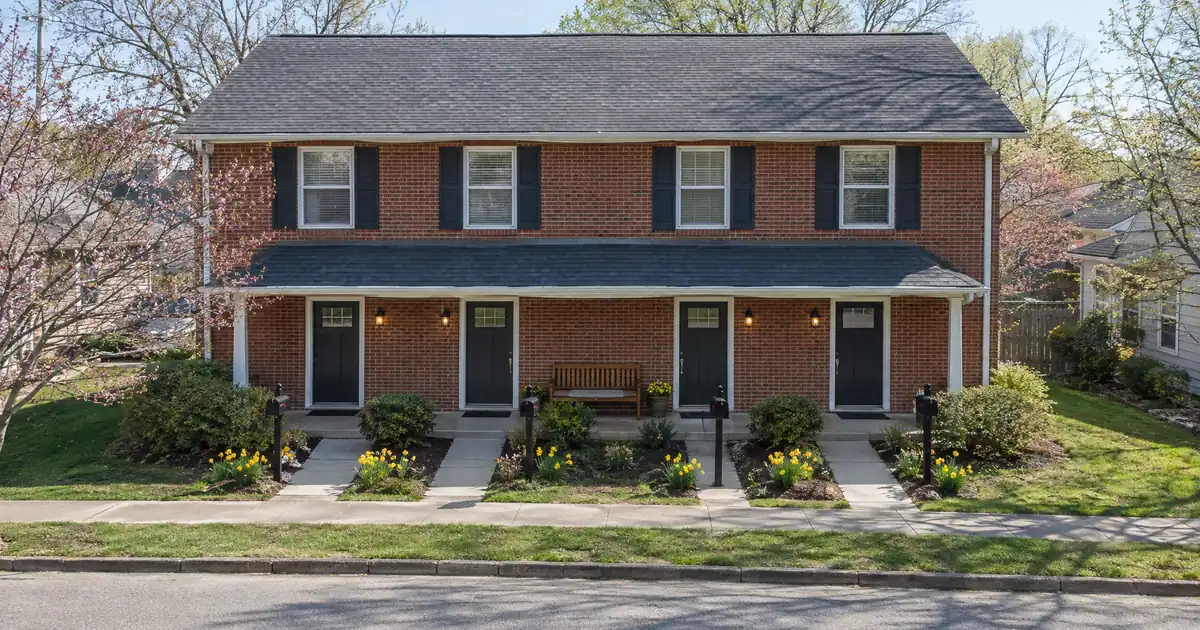
The Quick Read: An eligible veteran can use a VA loan to buy a duplex, triplex, or fourplex with no down payment, as long as the veteran lives in one of the units. The loan is underwritten on your whole financial picture, and only part of the rent counts as income. Reserves, landlord experience, and the condition of every unit also shape the outcome. Everything here is subject to lender guidelines and full file review, and nothing is a commitment to lend.
What Does “2-4 Unit” Mean for a VA Loan?
A 2-4 unit is a residential building with two to four separate living units: a duplex, triplex, or fourplex. Lenders treat these as home loans, not commercial loans. That is why a VA loan can finance them.
VA payment estimate
Starting assumptions reflect an example price with no down payment and a first-use funding fee. Replace them with your own figures.
Editable benchmark: 7.32% as of October 22, 2026 · Freddie Mac 30-year average via FRED®. A conventional market reference, not a VA loan quote.
Illustrative starting assumptions: a $350,000 price, no down payment with full entitlement, a first-use funding fee financed into the loan, a thirty-year term at the current Freddie Mac benchmark, and property taxes and insurance estimated at typical national rates. Every field is editable.
Illustrative estimate only — not a Loan Estimate, approval, quote, or commitment to lend. The rate field carries the weekly Freddie Mac thirty-year conventional benchmark, a market reference and not a VA loan quote; your rate is set by the lender at lock. The funding fee follows VA’s published table for the use and down payment entered; the residual-income figure is VA’s guideline for the region and family size, and the rough residual shown subtracts only the housing payment and the debts entered, while VA also deducts taxes, maintenance and utilities. Taxes, insurance and dues are editable estimates; closing costs are not included. Licensed in sixteen states for consumer mortgages. Lendmire is not affiliated with or acting on behalf of the Department of Veterans Affairs.
The catch is occupancy. A VA home loan cannot be used for a pure investment. You buy the building, you live in one unit, and the other units are rented to tenants. That setup is often called a house hack, and it is the whole idea behind this strategy.
Some buildings mix uses, such as a shop on the ground floor with apartments above. Third-party summaries say one business unit may be allowed alongside up to four family units, with the nonresidential space kept subordinate. Treat that as a question for your loan officer, because the details depend on VA’s property rules and the lender.
- VA financing for 2-4 units requires you to live in one unit.
- With full entitlement, the program allows 100% financing with no down payment and no mortgage insurance.
- Residual income is the controlling underwriting test.
- Only a portion of the rent counts toward qualifying, and reserves matter.
- Every unit has to meet VA’s property standards, not just yours.
How Does No Down Payment Actually Work?
With full entitlement, the program finances 100% of the purchase price, as long as the price is not above the appraised value. There is no down payment and no mortgage insurance of any kind. There is also no VA loan limit with full entitlement.
Entitlement is the amount of your benefit that VA can guarantee. Your certificate of eligibility (COE) shows where you stand. If you have remaining entitlement from an earlier VA loan, a down payment may be required. For that situation, speak with a loan officer rather than guessing at a county figure.
Across the wholesale programs Lendmire places VA files with, the practical ceiling is not a VA cap. The wholesale programs we work with serve loan amounts up to $4,000,000 with full entitlement. Your income, your reserves, and the appraisal set the real limit. Final terms depend on lender guidelines, property type, leverage, and the borrower’s complete credit picture.
VA’s own materials say the program does not require down payments or monthly mortgage insurance. They also describe a one-time funding fee, which is how the program offsets the cost to taxpayers.
The funding fee
The funding fee is a one-time charge based on the loan amount, not the purchase price. It is the same on a 2-4 unit as on a single-family home. You can pay it in cash or finance it into the loan.
The tiers in the programs we place work like this:
| Use and down payment | Funding fee |
|---|---|
| First use, under 5% down | 2.15% |
| First use, 5% to under 10% down | 1.5% |
| First use, 10% or more down | 1.25% |
| Subsequent use, under 5% down | 3.3% |
| Subsequent use, 5% to under 10% down | 1.5% |
| Subsequent use, 10% or more down | 1.25% |
Veterans who receive compensation for a service-connected disability do not pay the fee. VA lists other exempt groups too. The fee is described here as a mechanic, not a price quote.
Zero down is not zero cash
This is where first-time buyers get surprised. Even with no down payment, you still face closing costs, the appraisal, and prepaid items like insurance. The funding fee can be financed, but the rest takes real money.
The bigger need is reserves. Reserves are savings left in the bank after closing, enough to cover your housing payment if the rent stops. On a multi-unit loan they matter more than on a single-family purchase, and the next section explains why.
How Is a VA 2-4 Unit Loan Underwritten, Step by Step?
Underwriting is the lender’s review of whether you can repay the loan. VA’s standards are written into 38 CFR 36.4340. The steps below follow how a file typically moves.
Step 1: Confirm eligibility. The lender checks your certificate of eligibility. VA’s service requirements decide who is eligible, and the COE confirms your entitlement.
Step 2: Application and credit. The lender pulls your credit and reviews your housing history, including current or recent mortgages and rent payments. VA sets no minimum credit score. The wholesale programs Lendmire places VA loans with start at a 580 decision score, and some lenders set a higher floor.
Step 3: Occupancy certification. You certify that you intend to live in one of the units. Lenders and VA take this seriously. Misrepresenting your intent can be treated as fraud, so only certify what you plan to do.
Step 4: Show landlord capability. The file documents prior experience managing rental units or similar collection work. That is how the regulation judges whether you are likely to succeed as a landlord. Some lenders may accept a property-management arrangement, but that depends on the lender, so ask early.
Step 5: Document reserves. If you want rent from the other units counted, you generally need verified cash reserves to carry the full housing payment without rental help for at least six months. Confirm the exact reserve requirement with your lender, since handbook wording and lender overlays can differ.
Step 6: VA appraisal. A VA-assigned appraiser sets the market value and checks Minimum Property Requirements. These are VA’s standards for safety, soundness, and sanitation. Each living unit must be reachable without walking through another unit. If the appraisal comes back “subject to” repairs, those repairs must be done before VA guarantees the loan.
Step 7: Underwriting decision. The lender runs your debt-to-income ratio and your residual income, and a VA-approved underwriter signs off on the loan analysis. Then comes closing, where the funding fee is paid or financed.
Every step is a place a file can stall. One unit failing the property standards can hold up the entire loan.
What Does Residual Income Mean, and Why Does It Decide the File?
Residual income is the money left each month after your taxes, debts, and housing costs, before you pay for food, transportation, and everything else. VA compares it against a table based on family size and region. Residual income is the controlling test in the programs we place.
The regulation says the two primary standards are debt-to-income ratio and residual income, and a veteran ordinarily must meet both. Debt-to-income (DTI) is your monthly debts divided by your gross monthly income. The 41% figure is a guideline, not a cap. A ratio above it needs residual income well above the table.
Failing one standard does not automatically disqualify you, according to the official CFR text. Strong compensating factors can help. These include high residual income, significant savings, low DTI, long job history, and a small jump in housing payment.
The reverse is also true. Passing both standards does not guarantee approval. The lender has to weigh every factor in your file.
How Does Rental Income Count?
Only part of the rent counts. Under the regulation, rental income used in the loan analysis is 75% of the amount on the lease or rental agreement, unless a greater percentage can be documented. The other 25% is the cushion for vacancy and costs.
Picture a duplex where the second unit has a signed lease. The lender takes 75% of that lease amount and adds it to your qualifying income or uses it to offset your payment. You do not get credit for the full rent, and you do not get credit for rent no one has agreed to pay yet.
Prospective rent, meaning rent from a unit with no lease yet, is held to a stricter standard. Per the regulation, it is generally not counted unless you show a reasonable likelihood of success as a landlord and have verified reserves covering the payment for at least six months. That is why a vacant unit is harder to use than a leased one.
Your real cash flow also depends on things the lender does not model: vacancy, repairs, and any utilities you pay. Budget with those in mind. Treat the counted rent as a qualifying tool, not a forecast of what you will keep.
Where Does the General Rule Break?
The rules above cover most files. These cases are where they bend.
Partial entitlement. If an earlier VA loan is still using part of your entitlement, a down payment may come back into the picture. Your loan officer can run your COE and tell you where you stand.
Mixed-use buildings. A business unit may be allowed, but the nonresidential space generally must be subordinate. Confirm the details before you make an offer.
Joint VA loans. Two eligible veterans buying together can have different unit allowances. A joint loan with a non-spouse may need VA prior approval.
A non-veteran co-borrower. A co-borrower who is not a veteran can change how much of the loan is guaranteed and whether a down payment is needed. Speak with a loan officer before you plan around zero down.
Moving out later. Handbook language gives a “reasonable time” to occupy the home. You can keep the property after you move, but you must truly intend to live there at closing. Do not state that intent unless it is real.
Failed condition. An appraisal “subject to” repairs means the work has to be completed first. Cosmetic issues generally do not trigger repairs. Safety and soundness items do.
Existing rental history. If you already own rentals, lenders typically want your tax-return history to document that income.
Should You Choose VA, FHA, or Conventional for a 2-4 Unit?
It depends on your eligibility and your cash. FHA also finances owner-occupied 2-4 unit homes, and conventional loans do too. The programs differ on down payment, mortgage insurance, and how rent is treated.
| Factor | VA | FHA | Conventional |
|---|---|---|---|
| Who it serves | Eligible veterans | Any qualified buyer | Any qualified buyer |
| Down payment | None with full entitlement | Required | Required |
| Mortgage insurance | None | Yes | Depends on down payment |
| Occupancy | Live in one unit | Live in one unit | Live in one unit |
The practical read: if you are eligible and have full entitlement, VA usually asks for the least cash up front. If you are not eligible, FHA or conventional is the path. A loan officer can compare how each treats your rental income and reserves.
What Should You Check Before You Make an Offer?
Screen the property before you fall in love with it. A deal that fails the appraisal costs you time and money.
- Legal unit count. Confirm the building is legally a duplex, triplex, or fourplex. Unpermitted conversions cause trouble.
- Separate access. Each unit must be reachable without passing through another unit.
- Condition. Look for safety, soundness, and sanitation problems in every unit, not only yours.
- Existing leases. If tenants are in place, ask for the leases. A signed lease is what lets the lender count the rent.
- Utilities. Learn who pays what. Shared meters can change your real costs.
- Deferred maintenance. A multi-unit building multiplies repair risk. Roofs, plumbing, and heating serve several households.
The VA appraisal is not a home inspection. It tests value and minimum standards, not every system. Hire your own inspector.
Where Is This a Stretch?
Honest answer: a 2-4 unit purchase asks more of you than a single-family home. You become a landlord the day you close. Vacancy happens. A boiler can fail in a unit you do not live in.
The strategy works best when you have savings after closing, some landlord or management experience, and a building in decent shape. It is a stretch when you are using the lowest possible cash, counting on rent from a vacant unit, or buying a building with obvious deferred repairs.
One more point of friction: triplexes and fourplexes generally face tighter scrutiny on reserves and rental-income documentation than duplexes. If your reserves are thin, a duplex may be the more realistic first step.
If you want to see how this fits alongside other options, Lendmire’s piece Can a VA Loan Finance a Second Home or a 2-4 Unit House Hack? covers the occupancy side in more depth.
Key Terms Defined
Entitlement: The amount of your VA benefit available to back a loan, shown on your certificate of eligibility.
Certificate of eligibility (COE): The VA document that confirms you qualify and shows your entitlement.
Residual income: The money left each month after taxes, debts, and housing costs, tested against a VA table.
Debt-to-income ratio (DTI): Your monthly debts divided by your gross monthly income.
Minimum Property Requirements: VA’s standards for a home’s safety, soundness, and sanitation.
Reserves: Savings left after closing that could cover your housing payment.
Funding fee: A one-time VA charge, based on the loan amount, that can be financed or waived for exempt veterans.
Frequently Asked Questions
Can I really buy a fourplex with no down payment?
Yes, if you are eligible, have full entitlement, live in one unit, and the file meets underwriting and property standards. The loan covers up to 100% of the price, as long as the price is not above the appraised value. You still need closing costs and reserves. Everything is subject to lender guidelines and full file review.
Does the whole rent count toward qualifying?
No. The regulation provides for 75% of the amount on the lease or rental agreement, unless a greater percentage can be documented. Rent from a unit with no lease is held to a stricter test that includes verified reserves.
Is there a minimum credit score?
VA itself sets none, but lenders add their own. The wholesale programs Lendmire places VA loans with start at a 580 decision score. Some lenders set a higher floor, so the number that matters is your lender’s.
Is there a VA loan limit on a 2-4 unit?
Not with full entitlement. The lender, the appraisal, and your qualifying income set the practical ceiling. With remaining entitlement from an earlier loan, a down payment may be required, so speak with a loan officer.
Do I have to pay the funding fee?
Usually, unless you are exempt. Veterans receiving compensation for a service-connected disability do not pay it, and VA lists other exempt groups.
If you are buying a home and want to see whether a VA loan fits your file, Lendmire can help you compare the options and what each one asks of the file.
For your own numbers, request a scenario review with Lendmire.
About Lendmire
As a mortgage broker (NMLS# 2371349), Lendmire helps homeowners and home buyers in 16 states with FHA, VA, conventional and jumbo purchase and refinance loans arranged through wholesale lenders. Lendmire is never the lender; program terms are set by the lender and the agency guidelines. Scotsman Guide named Lendmire a Top Mortgage Workplace in both 2025 and 2026.
Get Started
Ready to find the right loan for you?
In about 30 seconds you can review financing options available for your home or investment property. No commitment required.
Informational only. Not a Loan Estimate, approval, or commitment to lend. Program availability and eligibility are subject to lender guidelines, credit approval, property review, and underwriting.
References
1. VA – Funding fee and closing costs
3. eCFR – 38 CFR Part 36, Subpart B
4. GovInfo – 38 CFR 36.4340 (2023 ed.)
This article is part of Lendmire’s VA loan program — full qualification details, guidelines, and scenarios live on the program page.
Related reading: VA Jumbo Loan Down Payment Requirements With Partial Entitlement · Does a Home Above the Conforming Limit Need a Down Payment With a VA Loan? · Can a Veteran Use a VA Loan With No Down Payment at Any Price?
Brandon Miller
Founder & CEO, Mortgage Loan Originator, Lendmire LLC
- Mortgage Loan Originator · NMLS# 1129696 · Verify on NMLS Consumer Access
- North Carolina Real Estate Broker · License# 343312 · Verify on NCREC
- North Carolina Insurance Producer · License# 19053198 · Property, Casualty, Life, Health · Verify on NAIC SBS
- Lendmire LLC · Firm NMLS# 2371349 · Verify firm licensure
Important disclosures. Lendmire (NMLS# 2371349) is a licensed mortgage brokerage. Lendmire is not a direct lender, depository institution, or financial advisor. All loan inquiries are subject to lender underwriting; this article does not constitute a commitment to lend. Rates, terms, and program guidelines are subject to change without notice and vary by borrower profile, property type, and state. Information in this article is general in nature and is not financial, legal, or tax advice. Equal Housing Opportunity. NMLS Consumer Access: nmlsconsumeraccess.org.