
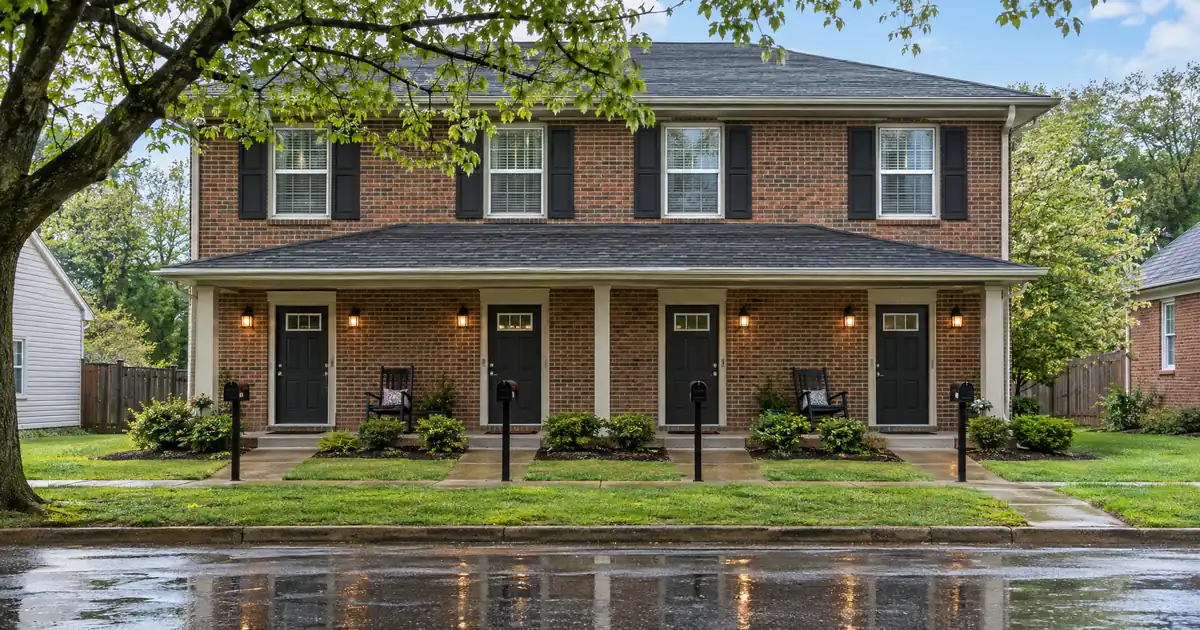
The Quick Read: Not for a vacation home, and not for a pure investment property. Yes for a duplex, triplex, or fourplex, as long as you live in one of the units. A VA loan also works for a new primary residence while you keep your old home as a rental. The common thread is occupancy: the VA guaranty is built for the home you live in.
Why Does the VA Draw the Line at Your Primary Residence?
The VA draws the line there because the law requires you to certify that you intend to occupy the property as your home. Lenders can’t wave that off. The VA Lenders Handbook says you must either live there now or intend to move in within a reasonable time.
VA payment estimate
Starting assumptions reflect an example price with no down payment and a first-use funding fee. Replace them with your own figures.
Editable benchmark: 7.32% as of October 22, 2026 · Freddie Mac 30-year average via FRED®. A conventional market reference, not a VA loan quote.
Illustrative starting assumptions: a $350,000 price, no down payment with full entitlement, a first-use funding fee financed into the loan, a thirty-year term at the current Freddie Mac benchmark, and property taxes and insurance estimated at typical national rates. Every field is editable.
Illustrative estimate only — not a Loan Estimate, approval, quote, or commitment to lend. The rate field carries the weekly Freddie Mac thirty-year conventional benchmark, a market reference and not a VA loan quote; your rate is set by the lender at lock. The funding fee follows VA’s published table for the use and down payment entered; the residual-income figure is VA’s guideline for the region and family size, and the rough residual shown subtracts only the housing payment and the debts entered, while VA also deducts taxes, maintenance and utilities. Taxes, insurance and dues are editable estimates; closing costs are not included. Licensed in sixteen states for consumer mortgages. Lendmire is not affiliated with or acting on behalf of the Department of Veterans Affairs.
That one rule explains most of the confusion online. Some pages say “no second homes.” Others say “yes, you can buy again.” Both are right. A beach house, a ski cabin, or a rental you never plan to live in is out. A new home you will live in is fine, even if the last one stays on your balance sheet.
The “second home” question rarely means what it sounds like. Most people asking it want one of three things: a getaway property, a rental, or a bigger home while keeping the old one. The VA answers no, no, and yes.
Quick Answer Table: What Is and Isn’t Allowed
| Property type | VA loan allowed? | Key condition |
|---|---|---|
| Vacation home | No | You won’t live there as your home |
| Pure investment property | No | No owner occupancy |
| Single-family primary | Yes | You occupy it |
| Duplex, triplex, fourplex | Yes | You occupy one unit |
| Five or more units | No | Beyond the four-unit limit |
| New home, old home kept as rental | Yes | New home is your primary residence |
Mixed-use buildings carry extra property conditions. Ask your loan officer before you write an offer on one.
How Does a 2-4 Unit House Hack Work With a VA Loan?
You buy a two-to-four-unit building, move into one unit, and rent the others. The VA’s underwriting chapter states that the borrower must occupy one unit as a residence. House hacking just means your tenants help carry the building.
The leverage is the draw. Across the wholesale programs Lendmire places VA files with, a purchase can run at 100% financing, with no down payment as long as the price isn’t above the appraised value. There is no mortgage insurance of any kind. With full entitlement there is no VA loan limit. That combination is hard to match on any other owner-occupied loan, which is why veterans look at multi-unit buildings in the first place.
Two cautions. If you have only remaining entitlement, a down payment may be required, so speak with a loan officer rather than guessing at a limit. And the funding fee applies, which the next section covers.
What Do Lenders Do With the Rent?
Rent can help you qualify, but only at a discount and only when it is documented. Lenders typically count a portion of the lease or the appraiser’s fair-rent opinion, not the full amount. Some lenders also look for landlord experience or a property manager. Those conditions vary by lender, so treat any single rule you read online as a starting point.
If rent isn’t used to qualify, the full payment counts against you as debt. That is a cleaner file in one way: reserve requirements tied to rental income generally drop away. The tradeoff is a tighter debt picture.
When rent is used, reserves come into play. The VA handbook says reserve funds must be in your account before closing. Gift funds can’t count toward them. Cash proceeds from a VA refinance can’t count either. Lenders usually express reserves in months of payments, and some wholesale lenders set their own overlays above VA’s baseline.
What Does Residual Income Have to Do With It?
Residual income is the controlling test on a VA file. It’s the money left each month after your major obligations and living costs. The 41% debt-to-income figure is a guideline, not a cap. A higher ratio needs residual income well above the VA table. Rental income gets folded into this picture only under the rules above, subject to lender guidelines and full file review.
How Long Do You Have to Move In?
The handbook defines a “reasonable time” as within 60 days after closing. Longer can be reasonable if you certify a specific move-in date and a particular future event makes it possible. Occupancy beyond 12 months after closing generally can’t be considered reasonable.
The handbook text contains no minimum length of stay. Some online pages claim you must stay one or two years. Treat those with suspicion and ask your loan officer what the lender requires. Don’t assume a number.
Exceptions exist. If you are active duty and can’t move in yourself, occupancy or intent to occupy by your spouse or dependent child satisfies the requirement. Misrepresenting your intent is a different matter entirely, and it’s a file problem you don’t want.
What Is the “Second Home” That Does Work?
A new primary residence while you keep the old home. VA says the home loan is a lifetime benefit, and in many cases you can keep your current home and use remaining entitlement to buy another home to live in.
Picture a service member who gets orders to a new base. The old house stays as a rental. The new house gets a VA purchase loan. This is one way a borrower can keep one property while buying another.
Entitlement is the amount of your benefit that the VA guarantees for lenders. When you use it on one loan, that portion is tied up until the loan is paid off or the entitlement is restored. Your Certificate of Eligibility (COE) shows what you’ve already used. If you have full entitlement, the no-down-payment structure applies. If you have only remaining entitlement, a down payment may be required.
One quirk worth knowing: VA’s own method for working out remaining entitlement uses the one-unit county limit column, even for a 2-4 unit purchase. County limits vary, so the figure depends on where you buy. A loan officer can run it for you.
How Is the Old Home’s Rent Treated?
Differently from a house hack. Rent from the home you’re leaving is used only to offset that mortgage payment, and only if the property doesn’t look difficult to rent. It may not be added to your effective income. Established rentals you already own need a two-year rental history itemized on your tax return. Rental losses reduce your income.
Tax treatment can depend on your situation; borrowers should speak with a qualified tax professional before relying on any deduction or credit.
Can You Refinance Into or Out of This Setup?
Sometimes. An IRRRL, the VA’s streamlined refinance of an existing VA loan, only requires you to certify that you previously lived in the home. That means it can refinance a home that has since become a rental. The IRRRL needs a net tangible benefit, no VA appraisal, and seasoning of the later of 210 days from the first payment or the sixth payment. The funding fee is 0.5% unless you’re exempt.
A VA cash-out refinance reaches 100% of the appraised value, including the financed funding fee, and it can refinance any loan type into VA. Occupancy certification still applies. If you’re weighing that route on a multi-unit home, Lendmire’s piece Can a Veteran Do a VA Cash-Out on a 2-4 Unit Primary Home? covers it in detail.
What Does the Funding Fee Cost on a Second VA Purchase?
The funding fee is a one-time charge, which can be financed into the loan, that VA collects to keep the program running. It is waived for veterans receiving compensation for a service-connected disability and the other exempt groups.
| Use | Down payment | Fee |
|---|---|---|
| First use | Under 5% | 2.15% |
| First use | 5% to under 10% | 1.5% |
| First use | 10% or more | 1.25% |
| Subsequent use | Under 5% | 3.3% |
| Subsequent use | 5% or more | 1.5% or 1.25% |
VA’s published schedule lays out the same tiers. A second no-down purchase carries the higher tier. Putting 5% or more down lowers it. Check your exemption status before you budget.
Which Path Fits You?
Match your goal to the answer:
- “I want a beach house.” A VA loan won’t do it. Occupancy rules block it.
- “I’m relocating and keeping my home.” Yes. Buy the new primary with remaining or full entitlement.
- “I want a fourplex and I’ll live in one unit.” Yes, with conditions on rent, reserves, and property standards.
- “I want a ten-unit building.” No. VA stops at four units.
- “I want to buy a rental I won’t live in.” Not on a VA loan.
What Are the Real Risks of House Hacking?
Vacancy is the big one. An empty unit means you cover the payment from your own pocket. That’s why lenders discount rent and ask for reserves.
Repairs come next. The VA appraiser, assigned from VA’s fee panel, notes repairs needed to meet the Minimum Property Requirements. Appraisers use the 1025 form for 2-4 unit properties, according to a VA circular. Every unit may need to pass, vacant ones included.
You also become a landlord. That means leases, tenant calls, and turnover. A property manager can handle it, but it costs money, and some lenders want to see either landlord experience or a manager.
The honest read: a house hack on a VA loan is a strong play when the building’s rents are healthy relative to the price and you’ve got cash set aside. It’s a stretch when the numbers only work if every unit is full all the time.
What Are the Steps?
1. Get your COE and check your entitlement.
2. Have a loan officer review your residual income and debt.
3. Decide how rent will be treated: counted or not.
4. Line up reserves in your own account, not gifted.
5. Make an offer; the lender orders the appraisal.
6. Certify your occupancy intent and move in within the reasonable-time window.
Lendmire’s VA loan programs page covers the broader program. For whether a full-value VA cash-out fits a 2-4 unit home you already live in, there’s also Lendmire’s article Can a VA Cash-Out Cover Full Value on a 2-4 Unit Primary Home?.
Key Terms Defined
Entitlement: The portion of your VA benefit that backs a lender’s loan, which determines whether a down payment is needed.
COE (Certificate of Eligibility): The VA document that shows you qualify and how much entitlement you’ve used.
Residual income: The money left each month after major obligations and living costs, which is the controlling VA test.
Funding fee: A one-time, reviewable VA charge, waived for exempt veterans.
House hacking: Living in one unit of a multi-unit property and renting the others.
Frequently Asked Questions
Can I use a VA loan to buy a vacation home?
No. The VA requires you to certify that you’ll occupy the property as your home. A vacation home or pure rental fails that test. The workable route is buying another primary residence while keeping the first.
Can I have two VA loans at once?
Often yes, if you have enough remaining entitlement. VA calls the home loan a lifetime benefit, and you can keep your current home while using remaining entitlement on another one to live in. With only remaining entitlement, a down payment may be required, so speak with a loan officer.
Does the rent count toward qualifying on a duplex?
Usually only in part and only when documented. Lenders discount projected rent, and some add conditions such as landlord experience. If rent isn’t used, the full payment counts as debt. Details vary by lender and are subject to full file review.
What credit score do I need?
VA sets no minimum score. The wholesale programs Lendmire places VA loans with start at a 580 decision score. Some lenders set a higher floor, so your file may need more than the minimum.
Can I buy a building with five or more units?
Not with a VA loan. Eligibility stops at four units, and you must live in one of them.
If you are buying a home and want to see whether a VA loan fits your file, Lendmire can help you compare the options and what each one asks of the file. Program figures here are subject to lender guidelines and full file review, and nothing here is a commitment to lend.
The strongest VA house hack is the one where the building still works on paper with a vacant unit.
For your own numbers, request a scenario review with Lendmire.
About Lendmire
Lendmire (NMLS# 2371349) is a mortgage broker licensed for consumer lending in 16 states. Lendmire arranges FHA, VA, conventional and jumbo purchase and refinance loans through wholesale lenders; every file is underwritten by the lender under the applicable program guidelines. Scotsman Guide named Lendmire a Top Mortgage Workplace in both 2025 and 2026.
Get Started
Ready to find the right loan for you?
In about 30 seconds you can review financing options available for your home or investment property. No commitment required.
Informational only. Not a Loan Estimate, approval, or commitment to lend. Program availability and eligibility are subject to lender guidelines, credit approval, property review, and underwriting.
References
1. VA Lenders Handbook (VA Pamphlet 26-7) Ch. 3, The VA Loan and Guaranty
2. VA Lenders Handbook Ch. 4, Credit Underwriting
3. VA News: Veterans can use their VA-guaranteed home loan benefit more than once
4. VBA Circular 26-23-06 Exhibit B (loan fee table)
This article is part of Lendmire’s VA loan program — full qualification details, guidelines, and scenarios live on the program page.
Related reading: Refinancing a VA Loan Into a Conventional Loan to Restore Your Entitlement · Can You Fund a Business With a VA Cash-Out on an Existing VA Loan? · How to Get a VA Cash-Out With a Second Home in Texas
Brandon Miller
Founder & CEO, Mortgage Loan Originator, Lendmire LLC
- Mortgage Loan Originator · NMLS# 1129696 · Verify on NMLS Consumer Access
- North Carolina Real Estate Broker · License# 343312 · Verify on NCREC
- North Carolina Insurance Producer · License# 19053198 · Property, Casualty, Life, Health · Verify on NAIC SBS
- Lendmire LLC · Firm NMLS# 2371349 · Verify firm licensure
Legal disclosures. Lendmire (NMLS# 2371349) is a state-licensed mortgage brokerage that arranges financing through wholesale lender relationships. Lendmire is not a direct lender, depository institution, or registered financial advisor. The discussion above is general informational content about real estate financing — it is not financial, legal, or tax advice, and readers should consult licensed professionals for guidance on their individual circumstances. Loan inquiries are subject to lender underwriting; this article does not represent a commitment to lend. Loan terms, rates, and qualification standards vary by borrower, property, and state, and are subject to change at any time. Equal Housing Opportunity. NMLS Consumer Access: nmlsconsumeraccess.org.