
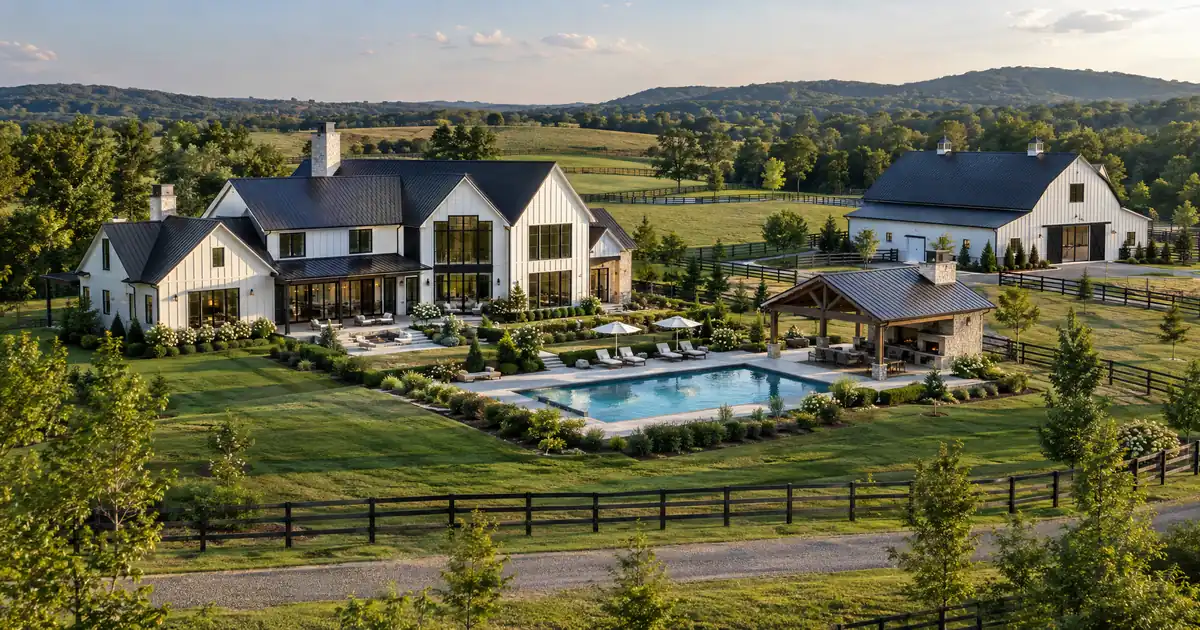
How To Finance An Estate On Acreage Using Business Bank Statements — The Quick Read: An estate on acreage often runs into trouble with standard rent-based underwriting, because the property is bigger, more expensive, and harder to compare to nearby homes than a typical rental. Business bank statement financing solves this by qualifying on deposit income from the borrower’s operating entity instead of the property’s rent alone. Sizes through select wholesale programs run from $300,000 to $30,000,000, with leverage stepping down as the loan gets bigger. This is a documentation choice, not a workaround — and it works best when the borrower’s real income lives inside a business account.
Why Acreage Estates Trip Up Standard Underwriting
An estate on acreage is a property-comps problem before it’s ever a borrower problem. The home is large, custom, and often surrounded by land that doesn’t have five recent comparable sales nearby — which is exactly the scenario appraisers flag for extra scrutiny.
On a standard DSCR file — a loan that qualifies primarily on whether the property’s rental income covers its own payment, rather than the borrower’s personal income — the appraiser pulls comparable rents to support a market rent number. Fannie Mae’s own guidance describes this rent-schedule tool, the Form 1007, as built to estimate market rent through comparable rental data and adjustments. That works fine for a typical single-family rental. It works poorly for a ten-acre estate with a pool house, a barn, and no true rental comps within miles, particularly outside the official USDA rural area definition. Final eligibility is subject to lender guidelines, credit approval, reserves, and property review.
The mismatch isn’t the borrower’s fault. A $2.5 million estate might rent, in theory, for far less than its mortgage payment would suggest — not because the property is a bad investment, but because the appraiser’s rent conclusion is anchored to what similar homes in the area actually lease for, not to the size or grandeur of the subject property. That’s the moment a straight DSCR file stalls out and business bank statement qualification becomes the more coherent path.
Key Terms Defined
Business bank statement loan: A non-QM mortgage — a loan outside the standard conforming mortgage box — that qualifies a borrower using 12 or 24 months of business account deposits instead of traditional personal-income documentation.
Expense ratio: A haircut applied to business deposits before what’s left counts as income, since a business account mixes revenue with operating costs.
DSCR: Short for debt service coverage ratio — a number showing whether a property’s rent covers its own monthly obligation. Above 1.00 generally means rent exceeds the payment; below 1.00 means it falls short.
Interest-only period: A stretch of the loan term where payments cover interest only, not principal, which some borrowers use to manage cash flow on a large loan.
Case-by-case review: Above certain loan sizes, every file gets individually underwritten rather than approved against a fixed published grid.
Key Takeaways
- Acreage estates often fail standard rent-based coverage tests because comparable rents are thin or nonexistent.
- Business bank statement qualification reads the borrower’s actual operating cash flow instead.
- Sizes run $300,000 to $30,000,000 through select wholesale programs, with leverage stepping down as the loan grows.
- Above $4,000,000, every file is reviewed case by case before submission — never assume a published number applies automatically.
- Working farms, ranches, and heavy agricultural use push a file into a different lending category entirely.
How The Documentation Actually Works
The lender reads either personal statements, business statements, or a blend — and that single choice reshapes the whole income calculation. Personal account deposits are assumed to already approximate net income. Business account deposits get an expense ratio applied first, because a business account commingles revenue with overhead.
Across the wholesale programs Lendmire places files through, the expense ratio typically follows a scale based on business size and type. Lower ratios generally apply to service businesses with no employees. Higher ratios apply as employee count grows, or when the business sells a product instead of a service. The exact scale varies by program, so confirm it with the lender. Sometimes a borrower’s accountant can document a lower ratio instead of using the flat default. Some files also allow a profit-and-loss method as an alternative, subject to program limits. Transfers from the borrower’s own business into a personal account typically count in full. This matters for owners who pay themselves directly from operating income.
The lookback window is 12 or 24 consecutive statement months, and the months must be consecutive — a transaction history summary doesn’t substitute for the actual statements. A shorter window can capture a recent uptick in the business; a longer window smooths out seasonal swings, which matters if the estate doubles as a working operation with seasonal cash flow (a vineyard harvest, a wedding-season venue, a seasonal agritourism business).
Business bank statement qualification doesn’t erase the property side of the file. The CFPB’s Ability-to-Repay compliance guide requires a lender to determine repayment ability considering income or assets and employment status — deposits have to genuinely represent income, not just cash moving through an account. That’s why clean books, separated business and personal accounts, and consistent deposit patterns matter more on this file type than on a plain W-2 purchase.
What Leverage And Size Actually Look Like
Leverage steps down as the loan gets bigger, and it’s scoped by occupancy — primary residence, second home, or investment property each run their own ladder.
On a primary residence, purchase leverage through select wholesale programs typically runs 90% to $1,000,000, stepping to 85% to $2,000,000, 80% to $3,000,000, and 75% at the top credit tier to $4,000,000. Above $4,000,000 everything moves to case-by-case review — leverage in the 60%-65% range is common up to roughly $6,000,000, and a separate bank portfolio program can carry twelve-month-statement files out to $30,000,000 on its own ladder: roughly 65% to $5,000,000, 60% to $10,000,000, and 55% to $30,000,000, generally interest-only at 60% or the band’s ceiling, whichever is lower.
Second homes and investment properties — which is where most acreage estates purchased as rental or hybrid-use assets land — run about five points lower at every size tier than a primary residence. An estate bought as an investment or seasonal-rental asset should plan leverage assumptions accordingly, and case-by-case review still applies above $4,000,000.
| Loan Size | Primary Residence Purchase | Investment Property Purchase |
|---|---|---|
| $300K-$1M | ~90% | ~85% |
| $1M-$2M | 85%-80% | 80% |
| $2M-$3M | 80% | 75%-80% |
| $3M-$4M | 75% | 60%-75% |
| $4M-$6M | Case-by-case (~60-65%) | Case-by-case (~55-65%) |
Credit floors run 660 on the portfolio program and 680 on the bank statement program that carries files to $30,000,000, with 700 typically required once a file crosses the super-jumbo size lines. Debt-to-income can run as high as 50% on many files. Reserves — liquid funds left over after closing — typically scale with size: around 3 months of the payment for smaller loans, 6 months as the loan grows past $500,000, and 9 months or more on the largest files, plus additional reserves per other financed property.
The Farm-Use Line Nobody Should Cross
An estate with a horse paddock or a vegetable garden isn’t a farm. An estate generating real income from cattle, hay production, or a commercial vineyard operation is — and that distinction determines which lending category the file belongs in.
The agencies’ rules don’t cover DSCR loans or bank-statement non-QM loans. But even they draw a clear line here. Non-QM lenders in Lendmire’s wholesale network generally follow the same logic, even without agency rules in mind. If there’s a working farm on the property, the file shifts toward agricultural or hobby-farm loan products. Those products have their own rules for acreage and income. They’re separate from a standard residential business bank statement file.
The practical test: does the acreage support the estate, or does the acreage produce a farming income in its own right? If it’s the latter, the loan conversation changes before financing type even comes up.
Where Business Bank Statement Qualification Fits Best
This path fits best when the estate’s income actually runs through an operating entity — a working estate, an agritourism operation, or a legitimate wedding and event venue business, not a bare residential rental.
A large acreage property marketed as a short-term rental, event space, or retreat doesn’t fit a standard long-term-lease rent conclusion at all. Fannie Mae’s own appraiser guidance recognizes this. It says a short-term rental works more like a going concern with business income, not a property that simply produces rental income. It also says the standard rent schedule form wasn’t built for this use case. That gap is exactly where business bank statement qualification becomes the more coherent path. The estate’s actual operating cash flow runs through a real business account. Deposit-based underwriting reads that cash flow directly, instead of forcing an ill-fitting rent number onto a hospitality business.
DSCR loans are built for non-owner-occupied investment properties. Because they’re business-purpose investor loans, lenders review them differently than a standard owner-occupied mortgage. For a borrower whose acreage estate has inconsistent or nonexistent long-term rent comps, but steady business deposits, that difference is the whole point. Read Lendmire’s complete DSCR loans guide to see how the property-income side of that comparison typically works.
Across files like this, a pattern shows up consistently. An estate with a working operation attached almost always clears easier using 12-24 months of business deposits than using a pure rent-versus-payment test. That’s because the appraiser has nothing solid to compare the rental income to. The strongest files pair clean, separated business accounts with a CPA letter documenting the actual expense ratio — submitted before the appraisal even goes out.
Where This Runs Into Real Friction
Rural comparable scarcity is the recurring bottleneck on acreage estate files, and it hits both the rent side and the value side of the appraisal. Underwriters commonly look for a handful of genuinely comparable properties within a reasonable radius to treat a file as a normal rural purchase rather than an outlier requiring extra review — and an unusually large or unique estate may simply not have that many nearby.
Vacant or newly acquired acreage without lease history makes this harder. Underwriting then relies entirely on the appraiser’s opinion, with even fewer anchors to support it. Well and septic systems create another practical problem on rural-edge acreage. A functioning system is typically a closing condition, not just a footnote. A failed system becomes a repair item — one that must be resolved before funding.
Super-jumbo size limits are generally $3,500,000 for a primary residence and $3,000,000 for a second home or investment property. Above those limits, lenders commonly add extra requirements. These typically include a 700 credit score floor, a clean 24-month history of housing payments, four years of seasoning on any credit event, and no rural property beyond ten acres. The hardest combination to finance through this channel is an acreage estate that goes over ten acres and also exceeds those size limits. It’s worth flagging this early, before you even order an appraisal.
Common Misconceptions Worth Clearing Up
“There’s a 10-acre cap across all lending.” Not for a bank-statement non-QM file at moderate loan sizes. Where a real ten-acre ceiling does apply in Lendmire’s network is above the super-jumbo overlay lines, and that’s a program-specific overlay, not a market-wide rule.
“Bank statement loans are the old stated-income loans.” They aren’t. A pre-crisis stated-income loan took a borrower’s word with no verification. A modern bank statement loan verifies income against actual, consecutive deposit history under the ability-to-repay framework, and the CFPB’s compliance guide requires a lender to have a reasonable basis for believing the borrower can repay, considering income, assets, and employment.
“An estate that doesn’t cash-flow on paper can’t be financed.” A rent-schedule shortfall is a program-fit problem, not a dead end. It signals the file needs a different qualifying lens — business income from a real operating entity tied to the property — rather than the pure rent-versus-payment math a standard rental file runs on.
Who This Fits — And Who It Doesn’t
This path fits a borrower whose real income runs through a business account and who owns an estate that doesn’t have clean rental comps nearby — a working ranch-adjacent property with an events business, an agritourism operation, a self-employed owner buying a large property that a straight rent test won’t clear. It fits a borrower with clean, separated accounts and the discipline to document expenses ahead of underwriting rather than after.
It fits less well for a borrower whose deposits are inconsistent, mostly personal transfers with no traceable business source, or a property that’s genuinely a working farm rather than a residence with acreage attached. It also fits less well for anyone assuming a published leverage figure applies automatically above $4,000,000 — every file that size is reviewed case by case, and treating a ladder number as guaranteed before underwriting has looked at the file is a common and avoidable mistake.
For a related comparison of how documentation choice changes the whole file, see DSCR loan vs. bank statement loan for investors.
This article is for general information only and isn’t legal or tax advice. Anyone weighing entity structure, deposit documentation, or the tax treatment of an acreage estate purchase should talk with a qualified attorney or CPA about their own situation before making decisions.
Frequently Asked Questions
Can I use both personal and business bank statements on the same file? Yes, in many cases lenders in Lendmire’s network will blend both account types, though the underwriting math differs — personal deposits are generally treated as already-net income, while business deposits get an expense ratio applied first.
Does the acreage size itself disqualify a property? Acreage alone typically doesn’t disqualify a file; the underwriting concern is comparable-sale and comparable-rent scarcity, plus whether the land is used for real farming or ranching income rather than simple residential use.
What happens if my estate has no rental history at all? The file can still move forward on business bank statement income if the borrower’s operating entity shows consistent deposits; the appraiser’s market rent opinion becomes less central to qualification when income is documented through deposits instead.
Is a short-term rental estate treated the same as a long-term rental? No — a short-term rental or event-venue estate is generally read as a business rather than a simple rental property, which is exactly the scenario where business bank statement qualification tends to fit better than a standard rent-schedule approach.
How far above $4,000,000 can this go? Sizes run to $30,000,000 through a separate bank portfolio program carrying twelve-month-statement files on its own leverage ladder, but every file above $4,000,000 is reviewed case by case before submission — there’s no fixed published number at that size.
For current guidelines and terms, see Lendmire’s super jumbo bank statement loan programs page.
Self-employed borrowers can compare both super jumbo programs on Lendmire’s self-employed mortgages page.
About Lendmire
Lendmire (NMLS# 2371349), a non-QM mortgage broker serving investors in 40 markets including Washington, D.C., helps structure DSCR scenarios commonly evaluated around a property’s rental income rather than personal income paperwork, subject to lender guidelines. A Scotsman Guide Top Mortgage Workplace in 2025 and 2026, Lendmire places loans through wholesale investor lenders and is not a direct lender.
Lendmire’s Top Mortgage Workplace recognition is documented by Scotsman Guide 2025 Top Mortgage Workplace and Scotsman Guide 2026 Top Mortgage Workplace.
Get Started
Ready to find the right loan for you?
In about 30 seconds you can review financing options available for your home or investment property. No commitment required.
Informational only. Not a Loan Estimate, approval, or commitment to lend. Program availability and eligibility are subject to lender guidelines, credit approval, property review, and underwriting.
References
1. official USDA rural area definition
2. CFPB — ATR/QM Small Entity Compliance Guide
Brandon Miller
Founder & CEO, Mortgage Loan Originator, Lendmire LLC
- Mortgage Loan Originator · NMLS# 1129696 · Verify on NMLS Consumer Access
- North Carolina Real Estate Broker · License# 343312 · Verify on NCREC
- North Carolina Insurance Producer · License# 19053198 · Property, Casualty, Life, Health · Verify on NAIC SBS
- Lendmire LLC · Firm NMLS# 2371349 · Verify firm licensure
Compliance and disclosures. Lendmire (NMLS# 2371349) is a licensed mortgage broker and is not a direct lender, depository institution, financial advisor, or tax professional. Content in this article is general market analysis and educational information — not financial, legal, or tax advice for any specific situation. Lendmire does not guarantee loan approval; every transaction is subject to underwriting by the funding lender. Mortgage pricing and loan program guidelines are subject to change at any time without notice and vary by borrower characteristics, property type, and state regulations. Lendmire complies with Equal Housing Opportunity. Licensure verification: NMLS Consumer Access.


