
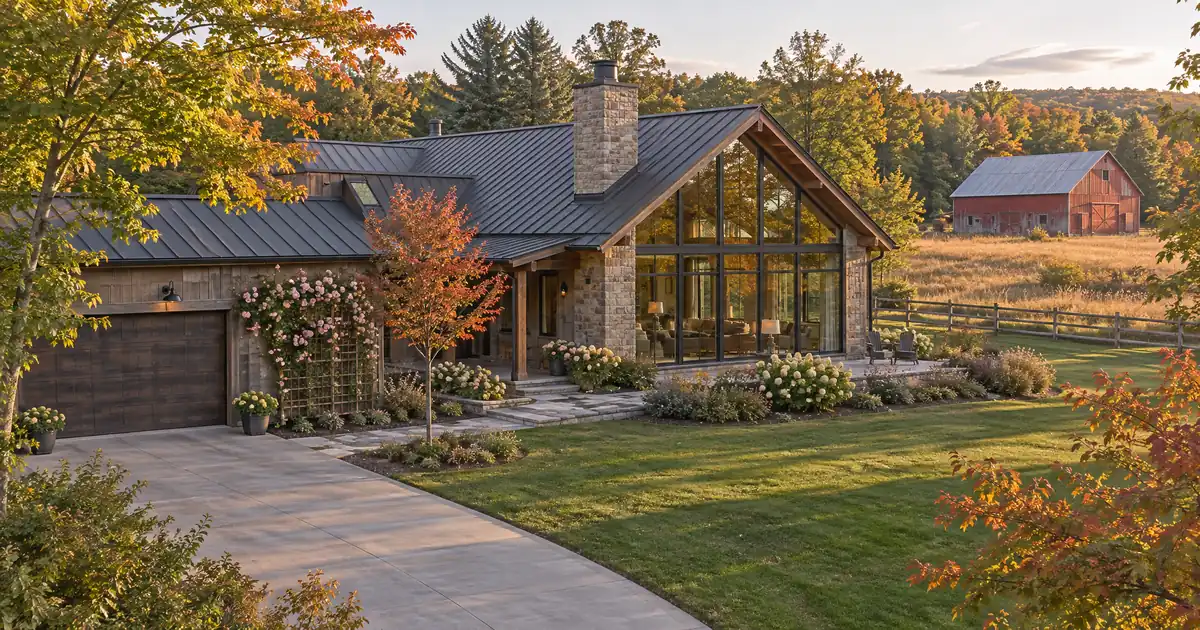
The Quick Read: The underwriter first decides whether your place is a home on land or a farm with a house on it. Then the appraisal sets the value, and value times the cash-out leverage cap sets your ceiling. Credit, debt load and seasoning on the existing loan come last. Subject to lender guidelines, acreage alone rarely decides the file.
Key Takeaways
- A rural cash-out is judged on how the property is used, not on a flat acreage number. Individual lenders may set their own limits.
- The appraisal is the biggest swing factor. Thin comparable sales in the country can pull value down, and your cash shrinks faster than the value does.
- Conventional cash-out typically tops out at 80% of value on a one-unit primary residence and 75% on two- to four-unit homes, second homes and investment property.
- The loan being paid off usually must be at least 12 months old, and you typically must have been on title for 6 months.
- Working farms and ranches generally fall outside standard residential programs.
Key Terms Defined
Cash-out refinance: A new, larger mortgage that pays off your current first mortgage and hands you the difference in cash.
LTV (loan-to-value): The new loan amount divided by the appraised value of the property.
Seasoning: The minimum time you have held the property or the existing loan before a lender will refinance it.
Overlay: A rule a lender adds on top of the program guidelines, such as its own acreage limit.
Residential character: The test of whether a property is mainly a place to live, rather than a farm, ranch or business.
Comparables (comps): Recent sales of similar nearby homes that an appraiser uses to estimate value.
Cash-out refinance estimate
The starting figures are an example value with a balance and a cash request in proportion. Replace them with yours.
Editable benchmark: 7.18% as of November 5, 2026 · Freddie Mac 30-year average via FRED®. A conventional market reference, not a cash-out refinance quote.
Illustrative starting assumptions: a $350,000 home value, a $193,000 current balance, the agency cap on a one-unit principal residence, a thirty-year term at the current Freddie Mac benchmark, and property taxes and insurance estimated at typical national rates. Every field is editable.
Illustrative estimate only — not a Loan Estimate, approval, quote, or commitment to lend. The rate field carries the weekly Freddie Mac thirty-year conventional benchmark, a market reference and not a cash-out refinance quote; a cash-out loan is priced by the lender at lock. The cash available is the loan the program cap allows less the balances paid off, before closing costs, which are not included. The HELOC line is the program’s combined loan-to-value ceiling applied to the same value and balance. Taxes and insurance are editable estimates. Licensed in sixteen states for consumer mortgages.
What Is a Cash-Out Refinance on Rural Property?
A cash-out refinance replaces your current first mortgage with a new one. The new loan is bigger, and the extra money comes to you. A home equity loan or HELOC works differently because it sits behind your first mortgage and leaves it in place. The Consumer Financial Protection Bureau draws that same line.
“Rural” is not a loan category by itself. It describes where the home sits and how thin the local market is. Underwriters handle a country home on a few acres much like any other house, with extra questions about land, access, water and septic.
Lendmire’s cash-out refinance programs page lays out the options. As a mortgage broker, Lendmire shops these files across wholesale lenders and matches the property to a program. The best fit depends on your property, credit profile, leverage need and documentation.
If your home is mostly a residence, expect a normal cash-out review. If it earns its keep as a farm, expect a different loan type.
The Underwriting Sequence, Step by Step
Here is the order a typical rural file follows.
1. Classify the transaction. If the new loan pays off the first mortgage and returns more than a small amount of cash, it is a cash-out. That puts it under the cash-out leverage limits and pricing. Fannie Mae’s Selling Guide notes that pricing adjustments on cash-out depend on LTV and credit score.
2. Check title, occupancy and seasoning. A cash-out is written on a primary residence, a second home or an investment property, and occupancy sets the leverage. The loan being paid off must be at least 12 months old, counted note date to note date. You must have been on title for 6 months. Delayed financing, inheritance and legal-award exceptions exist. Family land that came to you by inheritance gets its own paperwork, so bring the estate documents early.
3. Test the property. The underwriter asks whether this is a residence or an agricultural operation. More on that below.
4. Order the appraisal. The appraiser picks comps, checks zoning and land use, and values the home, land and outbuildings. This is where rural files win or stall.
5. Qualify the borrower. Across the wholesale conventional programs we place files with, the minimum decision score starts at 620. The automated finding governs most files, with a total debt ratio ceiling of 50%. Manually underwritten loans use 36% or 45%, with reserve and score factors from the agency matrix. Any payments left on the original loan count toward your debt ratio. The Eligibility Matrix also calls for reserves on certain cash-out files when the debt ratio runs above 45%.
6. Apply the leverage cap. Appraised value times the cap gives the maximum loan. Your payoff, closing costs and cash all fit inside it.
7. Clear conditions. Expect requests for income and asset documents, the current mortgage statement and homeowners insurance. Rural files also need proof of road access, a working well and a working septic system.
How Does a Lender Decide Whether It’s a Home or a Farm?
The test is use, not size. Standard agency guidelines will not buy loans on agricultural properties such as farms or ranches. Fannie Mae’s property eligibility rules also exclude vacant land, homes without road access that meets local standards, and properties not suitable for year-round occupancy.
The same guidelines allow rural residential properties. Training material from Enact Mortgage Insurance, quoting Freddie Mac’s guide, says a small barn can be acceptable when it adds little to total value. Large barns, silos or several facilities for farm animals may point to an agricultural property, whatever value the appraiser assigns. That training material also notes that agency guides set no flat acreage cap, while many lenders set their own.
So a 12-acre property with a house, a shed and a small barn is likely fine. A 12-acre property with a hay operation and livestock barns is a different story.
| Rural feature | Underwriter concern | Typical fix |
|---|---|---|
| Large acreage | Value may sit mostly in land | Appraiser separates house value from land |
| Big barn or silo | Looks agricultural | Show small contribution to total value |
| Well and septic | Must work and meet local rules | Inspection or test results |
| Private road | Legal, year-round access | Recorded easement or maintenance agreement |
| Few nearby sales | Weak comps, low value | Experienced rural appraiser, wider comp search |
| Home business on site | Mixed use | Document that the home is mainly residential |
Why the Appraisal Decides So Much
Everything downstream hangs on the appraised value. A rural appraiser may reach several miles for comps, and sales can be old or different in style. Land, outbuildings and utilities all get weighed. A conservative number hits your cash directly, because the payoff and costs stay fixed.
Run it with percentages. Say you owe 50% of what you think the home is worth, and the cash-out cap is 80%. On paper you can pull roughly 30% of that value before costs. Now the appraisal comes in 10% lower than you expected. The cap now produces 72% of your expected value, and the payoff still takes 50%, so cash drops to about 22%. That is a loss of 8 points out of 30, or more than a quarter of your proceeds, from a 10% miss in value.
If the appraisal lands low, you generally have these paths:
- Ask the lender whether the appraiser can review additional comps you supply.
- Take a smaller cash amount.
- Wait and reapply when more comparable sales exist.
- Choose a different program with a different leverage structure.
Leverage, Mortgage Insurance and the Wholesale Lane
The envelope is simple. Conventional cash-out reaches 80% LTV on a one-unit principal residence. It reaches 75% on two- to four-unit principal residences, second homes and investment property. If your rural place is a vacation cabin, occupancy sets the cap. That is the whole story for second homes. These specifics are subject to lender guidelines and a full review of property, leverage, and credit.
One wholesale lane goes further. It reaches just under 90% LTV with no mortgage insurance, at a 680 score and a 50% ratio on a thirty-year fixed loan. The home must be a primary residence with a conforming balance, and the lane carries its own six months of seasoning. In Texas, a cash-out on a homestead (a Section 50(a)(6) loan) is capped at 80% of the home’s value by the state constitution, and that wholesale lane is not written there.
Because the lender’s property rules and overlays vary, a rural file can fit one lender and miss another. That mismatch is what a broker is for.
Which Programs Allow Cash Out on Rural Property?
| Program | Cash back? | Rural note |
|---|---|---|
| Conventional cash-out | Yes | Property must be residential in character |
| Wholesale no-MI lane | Yes, primary residence only | Conforming balance, 680 score |
| FHA Streamline | No, it is a rate-and-term tool | Existing FHA loan required |
| VA IRRRL | No, it is a rate-and-term tool | Existing VA loan required |
| USDA refinance | Generally not offered | Look at another loan type for cash |
Confirm the government-program rows with the agencies themselves before you rely on them. A VA owner who wants cash should read Lendmire’s piece VA Cash-Out Refinance Requirements on a Rural Property With Acreage.
Where the General Rule Breaks
Working farm or ranch. Standard residential programs generally decline it. This needs agricultural or portfolio financing, which is a different product.
Hobby farm. Eligible when the property stays primarily residential. Large livestock facilities invite extra scrutiny.
Multiple parcels. Lenders usually want adjoining parcels with similar zoning, and the appraiser has to explain how the land affects value.
No year-round access or seasonal-only home. Standard guidelines exclude these.
Manufactured or non-standard construction. Each lender sets its own rules on foundation, titling and age, so ask before you pay for an appraisal.
Seasonal or farm-related income. Underwriters look at how that income is documented and how steady it is. Lenders typically average it over time rather than count a single strong year.
Free-and-clear property. A loan on a home with no mortgage is still a cash-out, and it is judged under the same leverage limits.
Questions to Ask Before You Pay for an Appraisal
- What is your acreage limit, and does the house plus land fit under it?
- How do you treat barns, shops and other outbuildings?
- Does your program write this property type, such as manufactured or mixed use?
- What do you need to prove road access, well and septic?
- How far back can the appraiser pull comps?
- What are the seasoning requirements on my current loan and title?
- Can I see the leverage cap for my occupancy type?
What the Decision Looks Like in Practice
A cash-out swaps your existing loan for a new one, so you give up the old terms. The CFPB’s guide to using home equity points out that a bigger loan can raise the payment and stretch the payoff period. That matters most if your current loan has terms worth keeping.
The CFPB’s research on cash-out borrowers found that many use proceeds to pay down other debt. If you plan to clear cards, plan for the habit as well as the payoff.
If you are weighing a cash-out refinance against keeping the loan you have, Lendmire can help you compare the programs and the equity each one reaches. Reach the team at 828-256-2183, or request a quote through Lendmire’s mortgage quote page.
Frequently Asked Questions
Is there a maximum acreage for a rural cash-out refinance?
Standard agency guidelines do not set a flat acreage cap. Lenders can add their own limits, though. What matters most is whether the property is still mainly residential. Ask each lender for its acreage and outbuilding rules before you order an appraisal.
Can I get a cash-out refinance if I own a small hobby farm?
Often yes, if the home stays primarily residential. A small barn that adds little to total value is usually fine. Large barns, silos or several animal facilities can lead an underwriter to treat the place as agricultural, which falls outside standard programs.
Why does a rural appraisal affect my cash so much?
Fewer nearby sales mean weaker comps, and appraisers lean conservative. Your loan ceiling is appraised value times the leverage cap, and your payoff is fixed. Any drop in value therefore comes straight out of your cash, as the percentage example above shows.
How long must I own the home before a cash-out?
Typically the loan being paid off must be at least 12 months old, and you must have been on title for 6 months. Exceptions exist for delayed financing, inheritance and legal awards. The wholesale no-MI lane carries its own six months of seasoning.
Can I get cash out with an FHA, VA or USDA loan?
The FHA Streamline and VA IRRRL are rate-and-term tools and do not pay you cash. USDA refinance programs are generally not built for cash out either. Other FHA and VA cash-out options have their own rules, so confirm details with a loan officer and the agencies.
For current guidelines and terms, see Lendmire’s refinance programs page.
About Lendmire
As a mortgage broker (NMLS# 2371349), Lendmire helps homeowners and home buyers in 16 states with FHA, VA, conventional and jumbo purchase and refinance loans arranged through wholesale lenders. Lendmire is never the lender; program terms are set by the lender and the agency guidelines. Scotsman Guide named Lendmire a Top Mortgage Workplace in both 2025 and 2026.
Get Started
Ready to find the right loan for you?
See your offer in seconds. No credit pull, no obligation.
Informational only. Not a Loan Estimate, approval, or commitment to lend. Program availability and eligibility are subject to lender guidelines, credit approval, property review, and underwriting.
References
1. CFPB Office of Research blog on cash-out refinances
2. Fannie Mae Selling Guide B2-1.3-03, Cash-Out Refinance Transactions
3. Fannie Mae Eligibility Matrix
4. Fannie Mae Selling Guide B2-3-01, General Property Eligibility
5. Enact Mortgage Insurance, Rural Appraisals training presentation
7. CFPB older Americans home equity guide
8. CFPB newsroom: cash-out borrowers and credit scores
This article is part of Lendmire’s cash-out refinance program — full qualification details, guidelines, and scenarios live on the program page.
Related reading: How Lenders Underwrite a Cash-Out Refinance When It Resets the Mortgage to a New 30 Years · Does a Cash-Out Refinance Make Sense to Pay for Home Repairs on a Rural Property? · How Lenders Underwrite a Cash-Out Refinance for Renovations and the Appraisal Requirement
Brandon Miller
Founder & CEO, Mortgage Loan Originator, Lendmire LLC
- Mortgage Loan Originator · NMLS# 1129696 · Verify on NMLS Consumer Access
- North Carolina Real Estate Broker · License# 343312 · Verify on NCREC
- North Carolina Insurance Producer · License# 19053198 · Property, Casualty, Life, Health · Verify on NAIC SBS
- Lendmire LLC · Firm NMLS# 2371349 · Verify firm licensure
Disclosures. The information presented in this article is general market commentary, not financial, legal, or tax advice. Lendmire is a mortgage brokerage (NMLS# 2371349) — not a direct lender or depository institution — and loan placement is subject to lender underwriting. Nothing in this content represents a commitment to lend. Loan terms, pricing, and program availability vary based on borrower qualifications, property characteristics, and state of subject property, and are subject to change at any time. Lendmire complies with Equal Housing Opportunity requirements. Consumer access: nmlsconsumeraccess.org.