
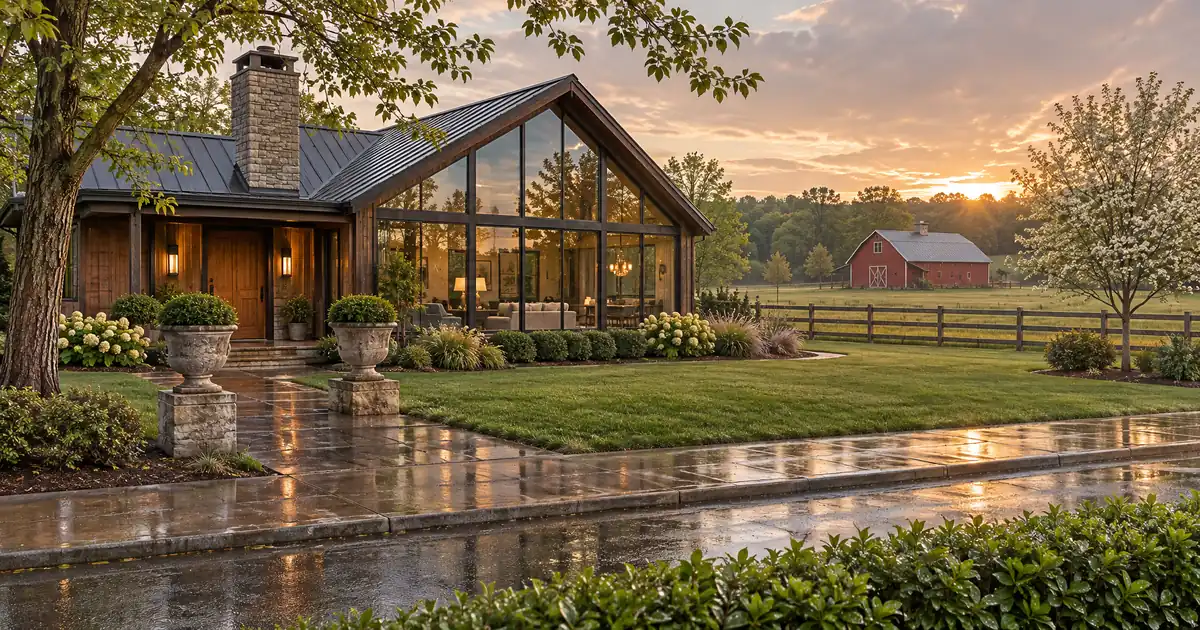
The Quick Read: A rural home with few nearby sales can still qualify for a cash-out refinance, but the appraisal sets the ceiling on how much cash you can take. Agency guidelines let appraisers use older, more distant or less similar sales when nearby ones are scarce, as long as they explain the choice. Conventional cash-out on a one-unit principal residence is capped at a set loan-to-value limit, so a conservative value cuts your cash directly. Prove the property is a home, not a farm, and prepare the appraiser’s file before the visit. These specifics are subject to lender guidelines and a full review of property, leverage, and credit.
What Is a Cash-Out Refinance, and How Is It Different From Rate-and-Term?
A cash-out refinance replaces your current first mortgage with a larger one and pays you the difference. A refinance only pays off the existing loan, closing costs and, in some cases, a purchase-money second lien. It allows just small, incidental cash back.
Cash-out refinance estimate
The starting figures are an example value with a balance and a cash request in proportion. Replace them with yours.
Editable benchmark: 7.18% as of November 5, 2026 · Freddie Mac 30-year average via FRED®. A conventional market reference, not a cash-out refinance quote.
Illustrative starting assumptions: a $350,000 home value, a $193,000 current balance, the agency cap on a one-unit principal residence, a thirty-year term at the current Freddie Mac benchmark, and property taxes and insurance estimated at typical national rates. Every field is editable.
Illustrative estimate only — not a Loan Estimate, approval, quote, or commitment to lend. The rate field carries the weekly Freddie Mac thirty-year conventional benchmark, a market reference and not a cash-out refinance quote; a cash-out loan is priced by the lender at lock. The cash available is the loan the program cap allows less the balances paid off, before closing costs, which are not included. The HELOC line is the program’s combined loan-to-value ceiling applied to the same value and balance. Taxes and insurance are editable estimates. Licensed in sixteen states for consumer mortgages.
The two follow different leverage limits. Rate-and-term on a one-unit principal residence runs to a higher LTV than cash-out, though never above 90% of value on any program. Conventional cash-out on that same home runs to 80%. On a two- to four-unit principal residence, a second home or an investment property, conventional cash-out is capped at 75%. Occupancy sets the leverage, and a cash-out is not limited to a primary residence. Terms depend on the lender’s guidelines, the property type, the leverage, and a full review of the credit profile.
A home owned free and clear is still a cash-out. Freddie Mac’s Guide section 4301.5 defines a cash-out refinance as a mortgage with no specific restrictions on how the proceeds are used. It covers both paying off a first lien and a property owned outright.
Two government products get confused with this one. The FHA Streamline and the VA streamline refinance are streamlines for people who already hold an FHA or VA loan. They lower the cost of an existing government loan. They are not cash-out tools. Lendmire’s cash-out refinance programs page covers the programs that do return equity.
Key Terms Defined
Comparable sale (comp): A recently sold home similar to yours that an appraiser uses to support your home’s value.
Overlay: A rule a lender adds on top of the agency guidelines, such as a lower acreage tolerance.
Seasoning: The minimum time you must hold the property or the loan before a cash-out is allowed.
LTV (loan-to-value): The new loan amount divided by the appraised value of the home.
Delayed financing: An exception that lets a recent cash buyer take cash out before the usual ownership period passes.
Can You Qualify? The Checklist
| Factor | Why it matters | What rural adds |
|---|---|---|
| Equity | Cash is limited by LTV | A low value shrinks the cash |
| Credit | Sets program access | Same as any file |
| Income and debts | Total ratio must fit | Land or outbuilding income may be scrutinized |
| Occupancy | Sets leverage | Must read as a home |
| Seasoning | Time on title and loan age | Same as any file |
| Property type | Must be residential | Farm features raise questions |
On credit and ratios, the wholesale conventional programs start at a 620 decision score. The automated finding governs most files, with a total ratio ceiling of 50%. Manually underwritten loans use tighter ratios, with reserve and score factors from the Eligibility Matrix. Every figure here is subject to lender guidelines and a full file review. None of it is a commitment to lend.
Seasoning is where recent buyers get stuck, and it has two separate parts. Under Fannie Mae’s cash-out guide, the first mortgage being paid off must be at least 12 months old, counted note date to note date. The same section sets out a delayed-financing exception for recent cash purchases and requires extra reserves on some automated files with a high debt ratio. Separately, a borrower must have been on title for 6 months, with exceptions for delayed financing, inheritance and legal awards. Delayed financing waives only the wait. The loan is still a cash-out.
A wholesale lane also reaches 85% LTV with no mortgage insurance at a 680 score and a 50% ratio on a thirty-year fixed, primary residence, conforming balance, with its own six months of seasoning. It is the one exception to the rule that mortgage insurance applies above 80%. Texas homestead cash-outs are capped at 80% of value by the state constitution, and that lane is not written there. The exact numbers vary by lender and program and follow a full review of property, leverage, and credit.
Is Your Rural Property Eligible?
Eligibility turns on use, not acreage. Agency guides set no flat acreage cap. Fannie Mae and Freddie Mac decline agricultural properties such as working farms and ranches. A home with a barn, a workshop or a few animals can still be a residential property.
Agricultural-type outbuildings, such as silos, large barns and animal facilities, may signal a farm. The lender decides from the property’s characteristics, zoning and land use. Farm income driving the property is the red flag.
Individual lenders can apply their own overlays on top of the agency rules. A property on a lot some lenders consider too large may fit with another lender. Ask about acreage tolerance before you pay for an appraisal. Properties that are really farms or aren’t suitable for year-round occupancy may need a non-agency or portfolio lender instead.
How Do Appraisers Handle Few Comparables?
Rural appraisals are common enough that the agency guide spells out the remedies. Fannie Mae’s comparable sales guidance acknowledges that rural properties often sit on large lots in relatively undeveloped areas, so recent, truly comparable sales nearby may be scarce or missing. In a low-activity area, the appraiser may not find three truly comparable sales in the last 12 months.
The guide lets appraisers do several things:
- Use sales from competing market areas.
- Use sales that are not truly comparable when better ones don’t exist.
- Use older sales if they are the best indicator of value.
- Use distant sales, with an explanation of the choice.
Fannie Mae’s appraisal FAQ confirms there is no hard distance limit. Here is the catch: allowed doesn’t mean generous. Wider searches and bigger adjustments can still produce a lower value. Because your cash is capped by LTV, a lower value reduces your cash dollar for dollar.
What you can supply to help the appraiser:
| Problem | What the appraiser does | What you can supply |
|---|---|---|
| Few recent sales | Widens time or distance | A list of nearby sales you know of |
| Unusual structures | Adjusts for differences | Dated receipts for upgrades |
| Large lot | Compares to similar acreage | Survey, plat and land-use records |
| Outbuildings | Judges use and value | Proof they serve the home |
Step-by-Step: How to Apply
1. Pre-screen the property. Describe acreage, outbuildings, zoning and use to a loan officer before you spend money. Ask about overlays on acreage and comp tolerance.
2. Pick the product. Conventional, FHA or VA, depending on your loan and eligibility. A VA cash-out is open to borrowers with a non-VA loan and goes through a private lender, as VA’s cash-out page explains. It requires a valid Certificate of Eligibility.
3. Gather documents. Expect income records, current mortgage statement, insurance, tax records and evidence of improvements. For rural files, add a survey or plat and anything showing how the land is used.
4. Prepare the appraisal packet. Write an improvement list with approximate dates. Gather sales you know of, even those further away. Give access to every building.
5. Request a rural-experienced appraiser. The lender orders the appraisal, but you can raise the point when you discuss lender choice.
6. Review the appraisal. If the value looks off, ask your loan officer about an appraisal reconsideration request. Include recent sales and condition evidence the appraiser didn’t have.
7. Underwrite and close. The lender checks income, credit, ratios, reserves and title. You receive a Loan Estimate and, before closing, a Closing Disclosure.
You are entitled to a copy of every appraisal at no added cost under the ECOA valuations rule. The lender may charge a reasonable fee for the appraisal itself.
Can You Skip the Appraisal on a Rural Home?
Sometimes, but don’t count on it. Fannie Mae’s automated system can offer value acceptance on some loans, including certain cash-outs. It generally needs a prior appraisal on file in Fannie Mae’s database. A rural home with thin sales data often won’t have one.
Another version, value acceptance with property data, replaces the appraisal with an inspection-style data collection. If it flags problems, the lender may require professional reports on the well, septic, foundation, roof, electrical or mold. The cash-out rules still apply when value acceptance is used.
If the Appraisal Comes in Low
A low value doesn’t end the file. Work through it in this order.
1. Check the report for errors. Look at square footage, bedroom count, lot size and listed improvements.
2. Submit a reconsideration packet. Add recent in-area sales, condition adjustments and a note on why the chosen comps don’t fit.
3. Resize the cash-out. On a cash-out loan, which is capped at 80% LTV, a lower value means a smaller loan. A smaller cash-out may still cover your goal. Final terms depend on the lender’s guidelines, the property type, and the borrower’s complete credit picture.
4. Switch programs. A different program, or a lender with a different overlay, may produce a different outcome.
5. Wait or reapply later. If sales in your area are sparse, more recent sales may help a later value.
Weigh this against the cost. A cash-out can lengthen payoff time and raise your payment, because the new loan is larger and the terms reset. Rolling closing costs into the loan lowers cash due at closing but adds interest over the life of the loan.
Mortgage insurance matters too. On the agency path it applies above 80% LTV, except in the no-MI wholesale lane described above. You may request cancellation at 80% of original value, and the servicer must end it automatically at 78%. Each figure is subject to lender guidelines and a complete review of property type, leverage, and credit.
Questions to Ask a Lender Before You Apply
- Do you have an acreage or outbuilding overlay?
- How do you handle appraisals with distant or older comps?
- Can I request a reconsideration if the value is low?
- Which programs reach my property type?
- What is the seasoning on my current loan and my time on title?
Frequently Asked Questions
Is there an acreage limit for a cash-out refinance?
Agency guides set no flat acreage cap. Eligibility depends on whether the property is primarily residential. A lender may set its own overlay, so ask before you order an appraisal.
What if there aren’t three comparable sales?
The appraiser may use older, more distant or less similar sales, or sales from competing areas, and must explain the choice. A thin comp set can still lower value, which reduces the cash you can take.
Can I get a cash-out refinance if I own my home free and clear?
Yes. Freddie Mac treats a free-and-clear refinance with cash back as a cash-out. Leverage limits and seasoning rules apply.
Will the VA IRRRL or FHA Streamline give me cash?
No. Both are streamlines for existing government loans. For cash from equity, look at a cash-out program.
Can I see the appraisal?
Yes. The lender must give you a copy of each appraisal without added cost, though it may charge a reasonable fee for the appraisal itself.
Next Step
If you are weighing a cash-out refinance against keeping the loan you have, Lendmire can help you compare the programs and the equity each one reaches. Lendmire is a mortgage broker, and all programs are subject to lender guidelines and full file review.
For your own numbers, request a scenario review with Lendmire.
About Lendmire
Lendmire (NMLS# 2371349) is a mortgage broker licensed for consumer lending in 16 states. Lendmire arranges FHA, VA, conventional and jumbo purchase and refinance loans through wholesale lenders; every file is underwritten by the lender under the applicable program guidelines. Scotsman Guide named Lendmire a Top Mortgage Workplace in both 2025 and 2026.
Get Started
Ready to find the right loan for you?
See your offer in seconds. No credit pull, no obligation.
Informational only. Not a Loan Estimate, approval, or commitment to lend. Program availability and eligibility are subject to lender guidelines, credit approval, property review, and underwriting.
References
1. Freddie Mac Guide Section 4301.5
2. Fannie Mae Selling Guide B2-1.3-03, Cash-Out Refinance Transactions
3. Fannie Mae Selling Guide B4-1.3-08, Comparable Sales
7. Fannie Mae B4-1.4-10 Value Acceptance
8. Fannie Mae B4-1.4-11 Value Acceptance + Property Data
This article is part of Lendmire’s cash-out refinance program — full qualification details, guidelines, and scenarios live on the program page.
Related reading: Cash-Out Refinance Requirements on a Rural Property · Does a Cash-Out Refinance Make Sense to Pay for Home Repairs on a Rural Property? · Cash-Out Refinance Requirements When You Are Relocating
Brandon Miller
Founder & CEO, Mortgage Loan Originator, Lendmire LLC
- Mortgage Loan Originator · NMLS# 1129696 · Verify on NMLS Consumer Access
- North Carolina Real Estate Broker · License# 343312 · Verify on NCREC
- North Carolina Insurance Producer · License# 19053198 · Property, Casualty, Life, Health · Verify on NAIC SBS
- Lendmire LLC · Firm NMLS# 2371349 · Verify firm licensure
Important disclosures. Lendmire (NMLS# 2371349) is a licensed mortgage brokerage. Lendmire is not a direct lender, depository institution, or financial advisor. All loan inquiries are subject to lender underwriting; this article does not constitute a commitment to lend. Rates, terms, and program guidelines are subject to change without notice and vary by borrower profile, property type, and state. Information in this article is general in nature and is not financial, legal, or tax advice. Equal Housing Opportunity. NMLS Consumer Access: nmlsconsumeraccess.org.