
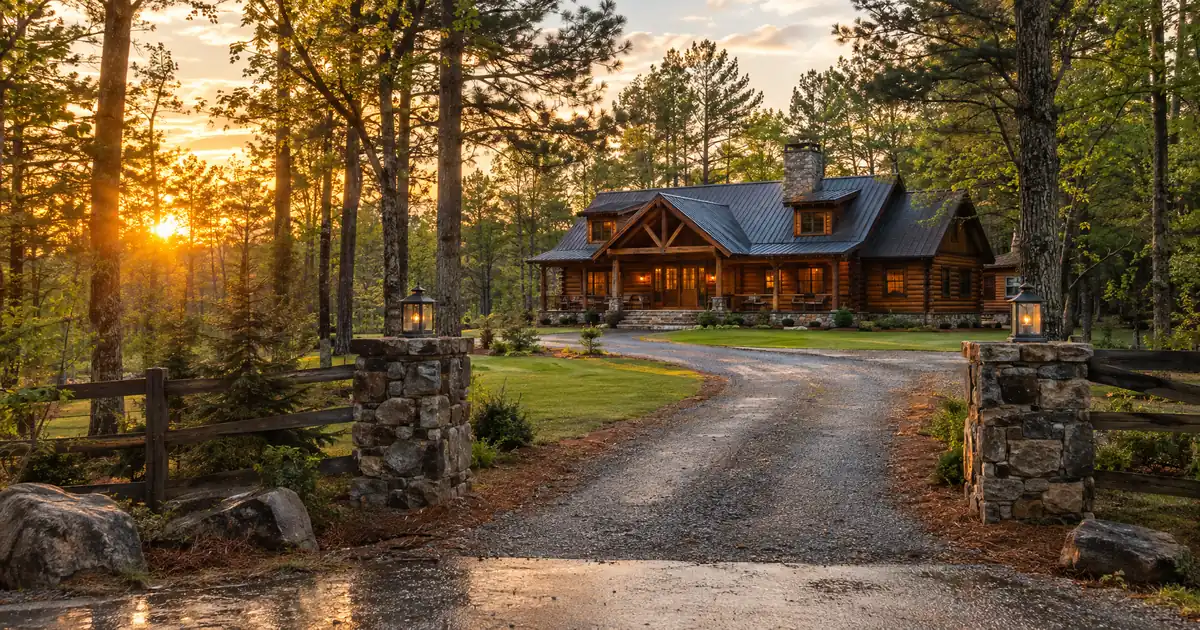
The Quick Read: The route depends on how you will use the cabin, not on how large the loan is. A bank statement loan is reviewed for the borrower on deposits, and it fits a self-employed buyer who will use the cabin personally or rent it. A DSCR loan is reviewed primarily on property-level rental income covering the payment, subject to lender guidelines, and it fits a cabin bought purely as a rental. Rural collateral adds appraisal risk to both routes.
- Personal use points to bank statements. A pure rental can use either route.
- Through select wholesale programs, rural collateral is capped at 80% leverage, ten acres or less, and a $3,000,000 loan amount, subject to full underwriting.
- Bank statement files turn deposits into income after an expense ratio. DSCR files turn rent into a coverage ratio.
- A thin rural appraisal is a common reason either file loses leverage. Leverage, reserves, and pricing vary by lender and program; the final terms follow the full file review.
Key Terms Defined
Jumbo loan: A loan above the conforming limit, which means it is underwritten outside standard agency boxes.
Bank statement loan: A non-QM mortgage that reads 12 or 24 months of deposits to set qualifying income instead of traditional personal-income documentation.
DSCR: The debt service coverage ratio, which is monthly rent used for lender review divided by the full monthly obligation (principal, interest, taxes, insurance and any HOA dues).
Non-QM: A mortgage that sits outside the standard qualified-mortgage box, with the lender verifying repayment ability through alternative records.
Expense ratio: The share of business deposits the underwriter treats as operating cost before counting the rest as income.
Rural property: In the program terms below, a property in a rural area, which carries its own leverage cap and acreage limit.
First Fork: How Will You Use the Cabin?
Occupancy decides the route before any math runs. Across the wholesale network, a personal-use cabin goes to a bank statement program as a primary or second home. A cabin held only as a rental can go to a DSCR program or to a bank statement program as an investment property. A cabin you will use some weeks and rent the rest needs an honest disclosure, because the stated use drives the program.
| How you will use it | Usual route | Watch-out |
|---|---|---|
| Family getaway only | Bank statement, second home | Second homes are one-unit only |
| Rental only | DSCR or bank statement | Rent evidence drives DSCR |
| Mixed personal and rental | Bank statement, usually | Disclose planned personal use up front |
| Primary residence cabin | Bank statement | Rural cap still applies |
DSCR loans are designed for non-owner-occupied investment properties. Because they are business-purpose investor loans, they are reviewed differently from a standard owner-occupied mortgage, and the federal truth-in-lending rulebook’s scope section lists the factors that decide whether a loan counts as business purpose. A buyer who wants weekends in the cabin should not force a personal-use purchase into a DSCR file. The mismatch tends to surface late, when the lender asks about intended use.
How a Bank Statement Loan Works on a Cabin
A bank statement loan is reviewed for the borrower on documented deposits under the applicable program, subject to lender guidelines. The strongest fit is a founder, physician, attorney, entertainer or investor whose traditional personal-income documentation understates cash flow.
1. Pick a lookback. The portfolio non-QM program accepts 12 or 24 consecutive months of personal or business statements. The bank portfolio program uses 12 months. Statements must be consecutive, and a transaction history does not substitute.
2. Total eligible deposits. The underwriter removes transfers between your own accounts, loan proceeds and other non-income deposits. Transfers from your own business into a personal account count in full.
3. Apply the expense ratio. Business statements need at least 25% ownership. The expense ratio is a fixed percentage applied to eligible deposits, and it rises with the number of employees and with product-based businesses, so a larger operation keeps a smaller share of each deposit as income. An accountant-provided ratio can replace the fixed one, and a profit-and-loss method is capped at a maximum ratio set by the program.
4. Average into monthly income. Eligible deposits divided by the statement months, after the expense ratio, gives qualifying income. A business with one to five employees keeps 60 cents of each eligible deposit dollar as income. That figure feeds a debt-to-income test of up to 50%.
5. Layer on credit, reserves and appraisal. The portfolio program sets a 660 credit floor, the bank program 680, and both move to 700 above the super-jumbo line. Reserves run 3 months to $500,000, 6 months to $1,500,000 and 9 months above, plus 2 months per additional financed property to a 12-month maximum. First-time investors carry 12 months. All of this is through select wholesale programs, subject to full underwriting.
For a deeper walk through account choice, Lendmire’s piece How to Use Business Bank Statements for a Super Jumbo Loan covers personal versus business accounts in detail.
Asset paths for a personal-use cabin
Two asset-based paths exist for primary and second homes only. An asset allowance divides liquid assets by 36, 60 or 84 months to add qualifying income, and it is capped at 80% leverage. Assets-only qualifies with no DTI when U.S. liquid assets equal the loan amount plus closing costs plus sixty months of any net loss on other residential property. Retirement accounts count at 70%, or 80% at age 59.5 and older. Business funds, gifts, cryptocurrency and unvested stock never count. An investment-property cabin cannot use these paths. Terms vary by lender guidelines, property type, leverage, credit profile, and full file review.
How DSCR Works on a Cabin
DSCR asks one question: does the cabin’s rent cover its own full monthly obligation? The formula is monthly rent used for lender review divided by principal, interest, taxes, insurance and any HOA dues. A ratio above 1.00 means rent covers the payment. Select lenders in the network use 1.00 as a program floor, and some programs review below it. Where sub-1.00 coverage is available through select lenders, leverage and terms adjust.
For a long-term rental, the rent figure is typically the lower of the lease rent and the appraiser’s market rent. Form 1007 covers one-unit properties. For a short-term rental, the income can come from an appraiser’s analysis, a manager’s trailing statement, bank statements or a third-party projection. Lenders usually apply an expense factor to gross revenue before running the ratio, and each lender sets its own.
The appraisal form matters here. Fannie Mae’s appraiser update states that Form 1007 was not designed to appraise short-term rentals and that the lender decides how to categorize the income. McKissock’s explainer on Form 1007 reaches the same place: income is ultimately the lender’s call. Do not multiply a nightly rate by 30 and call it monthly rent. Seasonal cabins also need presentation, because the lender tests the averaged year, and a weak winter matters only if it drags the average under the floor or goes unexplained.
Short-term rental rules can vary by city, county, HOA, and property type, so investors should confirm local rules before relying on projected rental income.
Clearing 1.00 does not mean the cabin makes money. Repairs, vacancy, management, utilities and capital costs sit outside the ratio. Two lenders can also quote different coverage on the same cabin because they apply different expense factors. The complete DSCR loans guide walks through the formula and the documents behind it.
What Makes a Rural Cabin Different
Rural collateral changes the loan before the income test starts. Through select wholesale programs, rural property is typically limited to 80% leverage on ten acres or less, and never above $3,000,000. Above $3,500,000 on a primary residence and $3,000,000 on a second home or investment property, the super-jumbo overlays also rule out rural property. Those overlays include a 700 credit floor, a 0x30x24 housing history and 48-month seasoning on any credit event. A jumbo cabin therefore sits in a narrow band, and the size of the loan and the rural label both count against leverage.
The appraisal is the swing factor. The appraiser values the real property only, so furniture, equipment and rental business income do not count. Rural comps are scarce, so an appraiser may reach farther in distance and time, and adjustments become less certain. Excess land beyond what is typical for the area can be valued at little or nothing. A low appraisal hurts a purchase less than a cash-out, because a purchase is capped by price and a cash-out is capped by appraised value. HousingWire’s coverage of short-term rentals and the appraisal playbook describes why appraisers want a narrative addendum for nightly pricing, seasonality and occupancy.
Check these items before you make an offer:
- Acreage: ten acres or less keeps the file inside the rural program limit.
- Water and septic: well and septic systems need to be documented and in working order.
- Road access: a private road or seasonal access raises questions about year-round habitability.
- Construction type: log, A-frame, manufactured and barndominium cabins are each reviewed individually by the program.
- Agricultural character: farming activity or income, even minor, can change how a lender views the property.
- Comps: ask the appraiser’s office how far they expect to reach for sales.
In practice, rural cabin files often arrive with a strong borrower and a weak comp set. The borrower documents cleanly, the appraisal reaches far for comps, and leverage steps down after the value lands. Setting expectations for a lower value before the contract goes firm is the cleanest habit.
Bank Statements vs DSCR on the Same Cabin
The routes differ on what they test, what they need and what they do to your future borrowing.
| Factor | Bank statement | DSCR |
|---|---|---|
| What is tested | Borrower deposits | Property rent |
| Occupancy | Primary, second, investment | Investment only |
| Core documents | 12 or 24 months of statements | Lease or appraiser rent, rent evidence |
| Personal DTI | Counts, up to 50% | Not part of the test |
| Asset paths | Primary and second homes only | Not applicable |
| Rural friction | 80% cap, ten acres | Same collateral limits |
| Best fit | Strong deposits, personal use | Rental-first investor scaling |
Bank statement loans tie approval to the borrower, so they suit someone with strong deposits and low taxable income. DSCR ties approval to the cabin and keeps personal debt-to-income out of the test, which helps an investor adding properties. A bank statement cabin loan lands on your DTI and uses up capacity for the next purchase.
Same Cabin, Two Paths
Picture a cabin in the $1,000,000 to $1,500,000 band, on seven acres, bought by a self-employed owner of a business with a few employees. The numbers below are modeled assumptions, not market data.
On the bank statement route as a second home, the purchase ladder in that band tops out at 80% through select programs, which matches the rural cap. Qualifying income comes from deposits after a 40% expense ratio, and the lender checks DTI, reserves at 6 months and the appraisal. The cabin’s rent never enters the file.
On the DSCR route as an investment property, the same band sits at 80% for purchases, and rural caps hold it there. Say the appraiser’s rent analysis supports coverage of roughly 1.1x. That clears a 1.00 floor with thin room, so a modest drop in the rent estimate or a higher expense factor would push it below. A sub-1.00 result may still be reviewed through select lenders in the network, with leverage and terms adjusting. Qualification stays subject to lender guidelines, credit approval and property review.
The strong-deposits borrower with a seasonal cabin usually does better on bank statements. The investor with five rentals already financed and a cabin with a long rental record usually does better on DSCR.
DSCR vs. conventional financing
There are two common ways to finance an investment property, and they qualify you differently — here’s how investors weigh them.
Why investors choose it
- Qualifies on the property’s rental income — no personal tax returns, W-2s, or pay stubs needed to document income.
- No personal debt-to-income ceiling to clear, so existing mortgages and obligations don’t cap your borrowing the same way.
- Can be closed in an LLC, keeping the property inside a business entity.
- Built for scaling — not held to the limit on number of financed properties that conventional financing applies.
- Underwriting centers on the deal: generally qualifies when the rent covers the payment, a 1.00x coverage ratio being a common baseline (confirmed in underwriting).
- Designed specifically for investment property, including long-term and, where the program allows, short-term rentals.
Where it’s strong
- Often the lowest ongoing financing cost for a buyer who fully qualifies on personal income — a fit for a first property or a cost-first purchase.
Trade-offs for investors
- Requires full personal income documentation and must fit within a debt-to-income limit — salary, existing debts, and other mortgages all count.
- Typically held in your personal name rather than a business entity.
- Caps how many financed properties you can carry, which can become a ceiling as a portfolio grows.
- Evaluates you as a borrower as much as the property, which usually means more paperwork.
How investors usually choose: a first or single property often optimizes for the lowest financing cost; portfolio builders often optimize for leverage, vesting in an LLC, and scaling past conventional caps. The right answer depends on your goals, the property, and current guidelines — both paths run through select lenders in Lendmire’s wholesale network, with eligibility and terms confirmed in underwriting.
Which Route Fits Which Borrower
| Borrower profile | Usual route | Watch-out |
|---|---|---|
| Owner-operator, personal use | Bank statement | Cabin loan stacks on DTI |
| Strong deposits, thin rent | Bank statement | Rural comps cut leverage |
| Portfolio investor, rental only | DSCR | Seasonal rent must average above the floor |
| Rental plus occasional personal use | Bank statement | Disclose use before contract |
| High liquid assets, low deposits | Asset allowance, second home | Not available on investment property |
A 24-month lookback smooths seasonality but can lower the average if recent months are strongest. A 12-month lookback helps a rising business.
Document Checklist
For a bank statement file:
- Twelve or twenty-four consecutive months of statements, with no pages missing
- Business ownership documentation of at least 25% for business statements
- An accountant letter if you want an expense ratio lower than the fixed one
- Source-of-funds records for the down payment and reserves
For a DSCR file:
- A current lease, or an appraiser’s rent analysis, or short-term rental income evidence
- Entity documents if the cabin is vested in an LLC, subject to program eligibility
- Insurance evidence and the property tax bill
- Reserves documentation
Source of funds is the quiet gap. Down payments held in a business account, brokerage or credit line need a paper trail, and cash-out proceeds cannot satisfy reserves on the larger files.
Why Files Stall
Most stalls come from four places. The first is an appraisal with few comps, which cuts leverage after the contract is signed. The second is statements with transfers or non-income deposits that the underwriter removes, leaving income lower than the borrower expected. The third is rent evidence that cannot support the DSCR, such as a nightly-rate estimate without history. The fourth is a use mismatch, where the borrower says rental on one form and personal use on another. Clean statements, a rent analysis the lender accepts and an honest use statement fix most of these before submission.
If coverage is thin but deposits are strong, the bank statement route is the fallback, and the reverse is also true. If a cabin cannot clear either route at the leverage you planned, a larger down payment is usually what restores the file.
Next Steps
1. Decide the use: personal, rental or mixed. 2. Pull 12 and 24 months of statements and compare the averages. 3. Ask for the appraiser’s expected comp radius on rural collateral. 4. Run the DSCR ratio on both lease rent and appraiser rent if the cabin is a rental. 5. Price the reserves and down payment into your source-of-funds plan.
Tax treatment can depend on how the funds are used and how the property is held; investors should keep clear records and speak with a qualified tax professional before relying on any deduction.
Frequently Asked Questions
Can I buy a rural cabin without traditional personal-income documentation?
Yes, in many cases. A bank statement loan is reviewed on 12 or 24 months of deposits after an expense ratio instead of traditional income documentation. Consumer mortgage lending is licensed in AL, CA, CO, FL, GA, IN, MI, MT, NM, NC, OH, PA, TN, TX, VA and WA, so personal-use cabins in other states need a separate check. Everything is through select wholesale programs, subject to full underwriting.
Can rental income from a cabin help me qualify?
Yes, through DSCR on a cabin held purely as a rental. The rent comes from a lease or an appraiser’s rent analysis, and short-term rental income is judged by each lender’s expense factor. On a bank statement loan the cabin’s rent does not drive qualification.
Does the cabin type matter?
Yes. Log, A-frame, manufactured and barndominium cabins are reviewed individually. Water, septic, road access and acreage also count. Rural property is typically limited to 80% leverage on ten acres or less, and never above $3,000,000.
Can I use an LLC?
For a DSCR investment cabin, often yes, subject to program eligibility and the entity’s documents. A personal-use bank statement loan generally closes in an individual’s name.
Which route is better if I plan to buy more properties?
DSCR usually scales better, because it keeps your personal DTI out of the test. A bank statement cabin loan uses DTI capacity that a later purchase may need. If the cabin is personal use, the bank statement route may still be the only route.
If You Are Ready to Compare Options
Reach the team at 828-256-2183 or request a quote. Nothing here is a commitment to lend, and every file is underwritten individually.
For current guidelines and terms, see Lendmire’s super jumbo bank statement loan programs page.
Self-employed borrowers can compare both super jumbo programs on Lendmire’s self-employed mortgages page.
About Lendmire
A non-QM mortgage broker (NMLS# 2371349), Lendmire arranges DSCR financing for real estate investors in 41 markets — 40 states plus Washington, D.C. Because deals are underwritten primarily on property cash flow rather than personal income documentation, the structure suits self-employed buyers and entity-owned portfolios. Lendmire places loans through wholesale investor lenders; it is not a direct lender. Scotsman Guide named Lendmire a Top Mortgage Workplace in both 2025 and 2026.
Get Started
Ready to find the right loan for you?
In about 30 seconds you can review financing options available for your home or investment property. No commitment required.
Informational only. Not a Loan Estimate, approval, or commitment to lend. Program availability and eligibility are subject to lender guidelines, credit approval, property review, and underwriting.
References
1. CFPB, Regulation Z §1026.3 scope and business-purpose exemption
2. Fannie Mae Appraiser Update, Form 1007 and short-term rentals
3. McKissock, Form 1007 and its impact on short-term rental appraisals
4. HousingWire, short-term rentals and the appraisal playbook
This article is part of Lendmire’s super jumbo bank statement loan program — full qualification details, guidelines, and scenarios live on the program page.
Related reading: Super Jumbo Cash-Out Refinance Loan Limits on Bank Statements · Can You Get a Super Jumbo Cash-Out When a Private Bank Said No? · Can a Practice Owner Get a Super Jumbo Cash-Out Without Bank Statements?
Brandon Miller
Founder & CEO, Mortgage Loan Originator, Lendmire LLC
- Mortgage Loan Originator · NMLS# 1129696 · Verify on NMLS Consumer Access
- North Carolina Real Estate Broker · License# 343312 · Verify on NCREC
- North Carolina Insurance Producer · License# 19053198 · Property, Casualty, Life, Health · Verify on NAIC SBS
- Lendmire LLC · Firm NMLS# 2371349 · Verify firm licensure
Legal disclosures. Lendmire (NMLS# 2371349) is a state-licensed mortgage brokerage that arranges financing through wholesale lender relationships. Lendmire is not a direct lender, depository institution, or registered financial advisor. The discussion above is general informational content about real estate financing — it is not financial, legal, or tax advice, and readers should consult licensed professionals for guidance on their individual circumstances. Loan inquiries are subject to lender underwriting; this article does not represent a commitment to lend. Loan terms, rates, and qualification standards vary by borrower, property, and state, and are subject to change at any time. Equal Housing Opportunity. NMLS Consumer Access: nmlsconsumeraccess.org.