
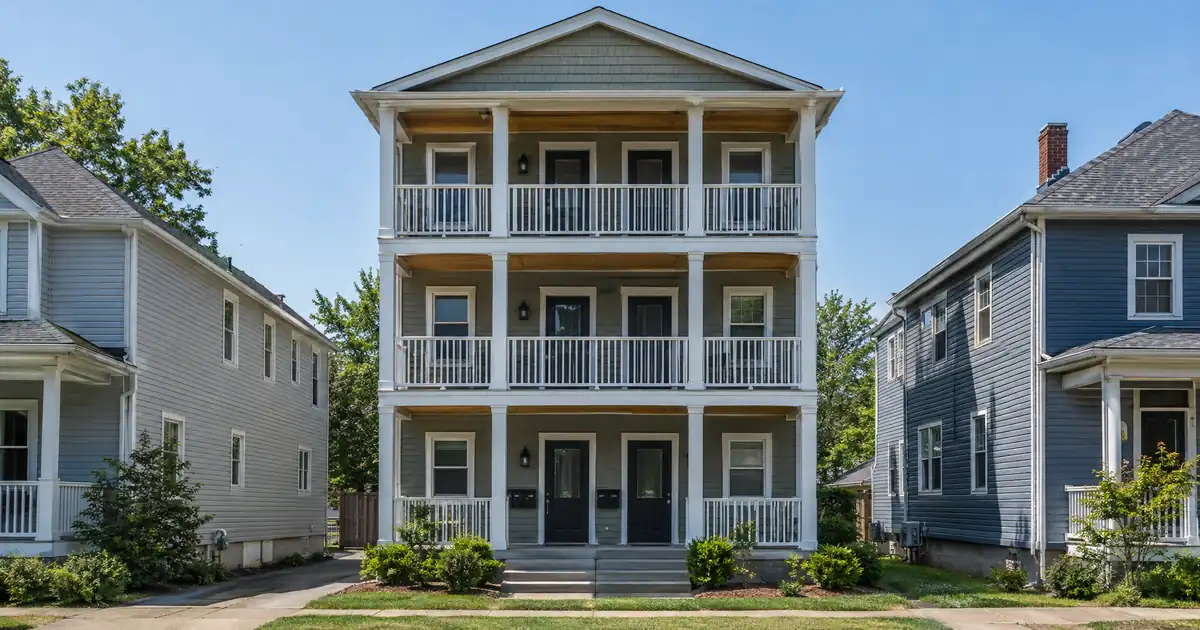
The Quick Read: You leave FHA by paying it off with a new non-FHA mortgage. On a 2-4 unit home you live in, the cash you can take out is capped lower than on a one-unit home. Whether the move pays off depends on three things: how much equity the new appraisal shows, what the new loan’s mortgage insurance looks like, and how long you plan to keep the loan. Everything below is subject to lender guidelines and a full file review. Nothing here is a commitment to lend.
Key Takeaways
- Leaving FHA means a refinance. The new conventional loan pays off the FHA loan in full.
- Many borrowers leave to end FHA mortgage insurance. Conventional insurance can come off by equity. FHA insurance follows a schedule set when the loan began.
- Taking cash on a 2-4 unit is more conservative than on a one-unit home. Equity, not income, usually sets the limit.
- Rental income from the other units helps you qualify, but lenders count only part of it and want it documented.
- If you want cash and keep an FHA loan, FHA has its own cash-out refinance. It is worth pricing against the conventional path.
What “Leaving FHA” Actually Means
Leaving FHA means a new loan replaces your FHA loan. The new loan pays off the old balance, and the FHA loan closes out. There is no switch or conversion.
The new conventional loan comes in two shapes:
- Rate-and-term (limited cash-out). The new loan covers your payoff and closing costs. You get no meaningful cash.
- Cash-out. The new loan is larger than your payoff, and you keep the difference at closing.
On a 2-4 unit, that choice matters more than people expect. The two shapes carry different leverage limits and different pricing. Some borrowers want to drop the insurance and take cash, and those two goals pull against each other. More cash means a higher balance against the home’s value. A higher balance can bring back mortgage insurance on the new loan.
You must also live in the building. FHA loans are for owner-occupants of one to four units, so you needed to live in one unit to get the loan. If you have since moved out, the conventional options change, because the home may no longer count as your primary residence.
Why Borrowers Leave FHA
The main reason is mortgage insurance. FHA charges an upfront premium of 1.75% of the base loan, which is usually financed into the balance. It also charges an annual premium between 0.15% and 0.75% of the balance, depending on term, loan amount and LTV.
LTV, or loan-to-value, is your loan balance divided by the home’s value. Here is the part that surprises people. On a thirty-year loan above 90% LTV at the start, the annual premium lasts for the whole term. At or below 90%, it ends after eleven years. The exact numbers vary by lender and program and follow a full review of property, leverage, and credit.
Pricing and available terms vary by lender, borrower profile, property type, and full underwriting review. Paying the balance down, or watching the home gain value, does not change that schedule. Your equity can grow a lot while the premium stays.
Other reasons come up too:
- A better credit profile. You may have bought with a score near the FHA floor and climbed since.
- Equity you want to use. You may have a repair, a debt payoff or a down payment on another purchase in mind.
- More flexibility. Conventional underwriting has its own rules for credit and debt, and some borrowers fit them better now than at purchase.
If you are still comparing starting points, Lendmire’s overview of FHA loan programs lays out what the original loan asks for. It helps to know what you are leaving.
Does Leaving FHA End Mortgage Insurance?
Not automatically. The new loan has its own insurance rules, and they differ by law and by design.
HUD sets the FHA schedule in Mortgagee Letter 2023-05. The length of the premium depends on your LTV at origination, not on your equity today. FHA mortgage insurance is not the same product as private mortgage insurance (PMI). Calling it “PMI” is a common mix-up.
Conventional PMI works differently. Per the Consumer Financial Protection Bureau, you can ask your servicer to cancel PMI when the balance is scheduled to reach 80% of the home’s original value. Servicers must generally end it automatically at 78%. To request cancellation, you need these:
- A written request.
- A good payment history.
- No junior liens.
- Evidence that the value has not declined.
So the new loan could have no insurance if your LTV on the new appraisal is 80% or lower. It could carry PMI that eventually comes off if your LTV is higher. That is the real contrast with FHA, where the premium follows a fixed schedule.
Two cautions. First, a cash-out raises your LTV, so taking more cash can bring insurance back. Second, loans classed as high-risk are exempt from some cancellation rights. Treat “no insurance” as a possible result, not a promise. The insurance outcome is set by your credit, your equity and the lender’s pricing.
Why a 2-4 Unit Changes the Math
A duplex, triplex or fourplex behaves differently from a one-unit home at almost every step. Four things change.
Leverage. On cash-out, Fannie Mae’s eligibility matrix allows a lower maximum LTV for a 2-4 unit primary residence than for a one-unit home. Limited cash-out is higher but tiered by unit count, so check the current matrix for your exact unit count. The same home can give you less cash than a neighbor’s single-family house with the same equity.
Appraisal. A 2-4 unit usually needs a full appraisal, and one form for small residential income properties is built for it. The appraiser also reports on the rents, so expect a rent schedule in the file.
Rental income. When you live in one unit and rent the others, that rent can help you qualify. Lenders generally count only part of the documented rent, and they want leases. Rules also tie how much rent helps to your landlord history. Your loan officer should confirm the current treatment for your file.
The extra FHA test. FHA treats 3-4 unit homes with a self-sufficiency test. In plain terms, the adjusted rent from all the units, yours included, has to cover the full housing payment. Conventional financing has no equivalent test. Its limits are built around LTV and debt ratios. That can help a 3-4 unit borrower who struggled with that test. Confirm the details of FHA’s version with your loan officer, because the test has its own method for adjusting rents.
One more edge case. A conventional program built for lower-income or lower-down-payment borrowers allows 2-4 unit primary residences for purchase and limited cash-out, but it does not allow cash-out. Check the HomeReady terms before assuming a lower-down-payment conventional program fits a cash-out plan.
How Cash-Out Works on a 2-4 Unit
The proceeds come from one simple chain:
1. The appraisal sets your home’s value.
2. The lender applies the maximum LTV for your unit count and occupancy to that value. That gives the largest new loan.
3. From that loan, the payoff of your FHA loan comes out first, including interest to the payoff date.
4. Closing costs come out next.
5. What is left is your cash.
Run it with percentages of value. Say your FHA balance equals 60% of the new appraised value. An FHA cash-out refinance reaches 80% LTV on a home you have owned and occupied for 12 months. That leaves room of about 20% of value before costs. A conventional 2-4 unit cash-out has a lower cap, so the room is smaller. If the cap were 10 points under that FHA ceiling, you would have roughly half the room. Final terms depend on the lender’s guidelines, the property type, and the borrower’s complete credit picture.
Now the seasoning rules. Under the Fannie Mae cash-out rules, the first mortgage you are paying off must be at least 12 months old, measured note date to note date. At least one borrower must have been on title for six months before disbursement. Higher debt ratios can also trigger a reserve requirement. A home that was listed for sale must come off the market by the time the loan funds. Each figure is subject to lender guidelines and a complete review of property type, leverage, and credit.
Two points follow from that. A recent FHA purchase is not ready for a cash-out right away. And the more cash you take, the larger the new balance and the stronger the case for running the break-even math below.
Four Paths Compared
| Path | Mortgage insurance | Cash available | Best fit |
|---|---|---|---|
| Stay in FHA | Follows the original schedule | None | Short holding period |
| FHA cash-out | FHA premium continues | Up to 80% LTV | Lower credit, needs cash |
| Conventional rate-and-term | Depends on new LTV | None | Strong equity, drop insurance |
| Conventional cash-out | Depends on new LTV | Lower cap on 2-4 units | Strong credit and equity |
FHA cash-out requires the home to be owned and occupied for 12 months before the case number. The conventional path asks for the seasoning described above. Neither path has a single right answer. It turns on your credit, your equity and your plans. For a closer side-by-side of the two cash-out routes when you live in the building, see Lendmire’s piece FHA vs Conventional Cash-Out When You Live in a 2-4 Unit Primary Home.
Is It Worth It? The Break-Even Test
A refinance has new closing costs, and the new loan restarts your term. Both are real. Compare them against what you save.
The Consumer Financial Protection Bureau suggests looking at the total cost of borrowing over about five years. It also notes that borrowers keep a mortgage about five years on average. Compare Loan Estimates on origination charges, lender credits and cash to close.
Here is a simple framework:
- Savings. Add up what you stop paying: the FHA annual premium, and any change in your monthly cost from the new loan’s insurance and pricing.
- Costs. Add the closing costs and the financed portion of the balance.
- Break-even. Divide the costs by the monthly savings. That is how many months you need to keep the loan.
- Cash-out penalty. A larger balance carries its own cost. If you take cash for something that does not pay you back, count that cost too.
Be wary of “no-cost” refinance offers. The costs are not gone. They are built into the rate or the balance. Compare the whole Loan Estimate, not the label.
Step by Step
1. Name your goal. Is it dropping insurance, taking cash or both? The goal decides the loan type.
2. Gather the numbers. Pull your payoff figure, your last statements and your lease agreements for the rented units.
3. Check your credit. Pull your credit before the application. A score that has risen since purchase is the main thing a conventional loan can reward.
4. Collect Loan Estimates. The Consumer Financial Protection Bureau advises getting Loan Estimates from at least three lenders. Then compare the Closing Disclosure against the Loan Estimate for the lender you chose, because some costs can change.
5. Appraisal and underwriting. Expect a full appraisal on a 2-4 unit and a request for rental documentation.
6. Closing and payoff. The new lender pays off your FHA loan. The old servicer sends a final payoff that includes interest through the payoff date. It typically refunds the remaining escrow balance afterward. Keep paying the old loan until the payoff clears.
When Staying in FHA Makes Sense
Leaving is not always smart. Stay put, or choose an FHA refinance, in these cases:
- You plan to sell or move soon. Closing costs may not pay back.
- Your credit has slipped. FHA is often easier to qualify for than conventional.
- Your equity is thin. If your LTV on the new appraisal stays high, the new loan may carry PMI and the savings shrink.
- You are happy with the loan. The FHA Streamline refinances an existing FHA loan with no appraisal and a limited credit review. It requires a net tangible benefit, and the premium continues.
There is also a two-step path. Take an FHA cash-out now, up to 80% LTV on a home owned and occupied for 12 months. Then move to conventional later once your equity and credit support it. This can work for borrowers who need cash today but are close to conventional qualification. The FHA rate-and-term refinance with an appraisal reaches 97.75% on a principal residence you have occupied for the previous twelve months. Leverage, reserves, and pricing vary by lender and program; the final terms follow the full file review.
Honestly, this one is a toss-up for many borrowers. The conventional path wins on insurance. The FHA path wins on flexibility and on leverage when you want cash. Run both.
What Stalls a File
These are the problems that come up most often on 2-4 unit refinances:
- The appraisal comes in low. A lower value means a higher LTV. That can reduce cash or bring PMI back.
- Unit-level paperwork is missing. Leases, security deposits and proof of rent need to match.
- A recent late payment. Payment history on the existing FHA loan matters for cash-out.
- Occupancy surprises. If you have already moved out, the loan options change.
- Property condition. Deferred repairs on any one unit can slow the appraisal.
- A recent listing. A home that was on the market has to come off before funding.
Fix these before you apply, not after.
Key Terms Defined
Mortgage insurance premium (MIP). FHA’s insurance charge, paid upfront and annually, with an end date set by your original LTV and term.
PMI. Private mortgage insurance on a conventional loan, which can be cancelled once equity reaches the required level.
LTV. Loan-to-value, meaning your loan balance as a percentage of the home’s appraised value.
Rate-and-term refinance. A refinance that pays off your loan and closing costs without giving you meaningful cash.
Cash-out refinance. A refinance where the new loan is larger than your payoff, and you receive the difference at closing.
Seasoning. The waiting period a lender wants on the existing loan or on your ownership before a refinance.
Net tangible benefit. The requirement that an FHA Streamline leave you measurably better off.
Frequently Asked Questions
Can I leave an FHA loan right after buying?
Yes for a limited refinance, but cash-out has waiting periods. The existing first mortgage must be at least 12 months old, and one borrower must have been on title for six months. A new buyer will also want time for closing costs to pay back.
Will the new conventional loan have mortgage insurance?
It depends on your LTV on the new appraisal. At 80% LTV or lower there is typically none. Above that, conventional PMI usually applies, and unlike FHA’s, it can be cancelled by equity under federal rules. Credit and pricing also play a role.
Can the rent from my other units help me qualify?
Yes, within limits. Lenders count only part of documented rent, and they want leases and an appraiser’s rent schedule. Landlord history can change how much rent counts.
Is cash-out on a duplex the same as on a single-family home?
No. Conventional cash-out allows a lower maximum LTV on a 2-4 unit primary residence than on a one-unit home. Two borrowers with the same equity can get different amounts.
What if I have moved out of the building?
The options change. A home you no longer live in is no longer a primary residence, and conventional programs treat it with lower leverage. Tell your loan officer early so the file starts on the right track.
Next Step
If you are weighing whether to leave an FHA loan for conventional, Lendmire can help you compare the options and what each one asks of the file. Lendmire is a mortgage broker arranging FHA, VA, conventional and jumbo loans through wholesale lenders. Its consumer lending is licensed in 16 states.
For your own numbers, request a scenario review with Lendmire.
About Lendmire
Lendmire (NMLS# 2371349) is a mortgage broker licensed for consumer lending in 16 states. Lendmire arranges FHA, VA, conventional and jumbo purchase and refinance loans through wholesale lenders; every file is underwritten by the lender under the applicable program guidelines. Scotsman Guide named Lendmire a Top Mortgage Workplace in both 2025 and 2026.
Get Started
Ready to find the right loan for you?
In about 30 seconds you can review financing options available for your home or investment property. No commitment required.
Informational only. Not a Loan Estimate, approval, or commitment to lend. Program availability and eligibility are subject to lender guidelines, credit approval, property review, and underwriting.
References
1. HUD Mortgagee Letter 2023-05
2. CFPB: When can I remove PMI from my loan?
3. Fannie Mae Eligibility Matrix
4. HomeReady
5. Fannie Mae Selling Guide B2-1.3-03, Cash-Out Refinance Transactions
6. CFPB: Compare Loan Estimates
7. Consumer Financial Protection Bureau
This article is part of Lendmire’s FHA Loan series — every loan program’s qualification details, guidelines, and scenarios live on the loan options page.
Related reading: FHA vs Conventional Cash-Out When You Live in a 2-4 Unit Primary Home · Can a 2-4 Unit Primary Home With a High DTI Get an FHA Cash-Out? · How to Document a Manual FHA Cash-Out on a 2-4 Unit Primary Home
Brandon Miller
Founder & CEO, Mortgage Loan Originator, Lendmire LLC
- Mortgage Loan Originator · NMLS# 1129696 · Verify on NMLS Consumer Access
- North Carolina Real Estate Broker · License# 343312 · Verify on NCREC
- North Carolina Insurance Producer · License# 19053198 · Property, Casualty, Life, Health · Verify on NAIC SBS
- Lendmire LLC · Firm NMLS# 2371349 · Verify firm licensure
Important disclosures. Lendmire (NMLS# 2371349) is a licensed mortgage brokerage. Lendmire is not a direct lender, depository institution, or financial advisor. All loan inquiries are subject to lender underwriting; this article does not constitute a commitment to lend. Rates, terms, and program guidelines are subject to change without notice and vary by borrower profile, property type, and state. Information in this article is general in nature and is not financial, legal, or tax advice. Equal Housing Opportunity. NMLS Consumer Access: nmlsconsumeraccess.org.