
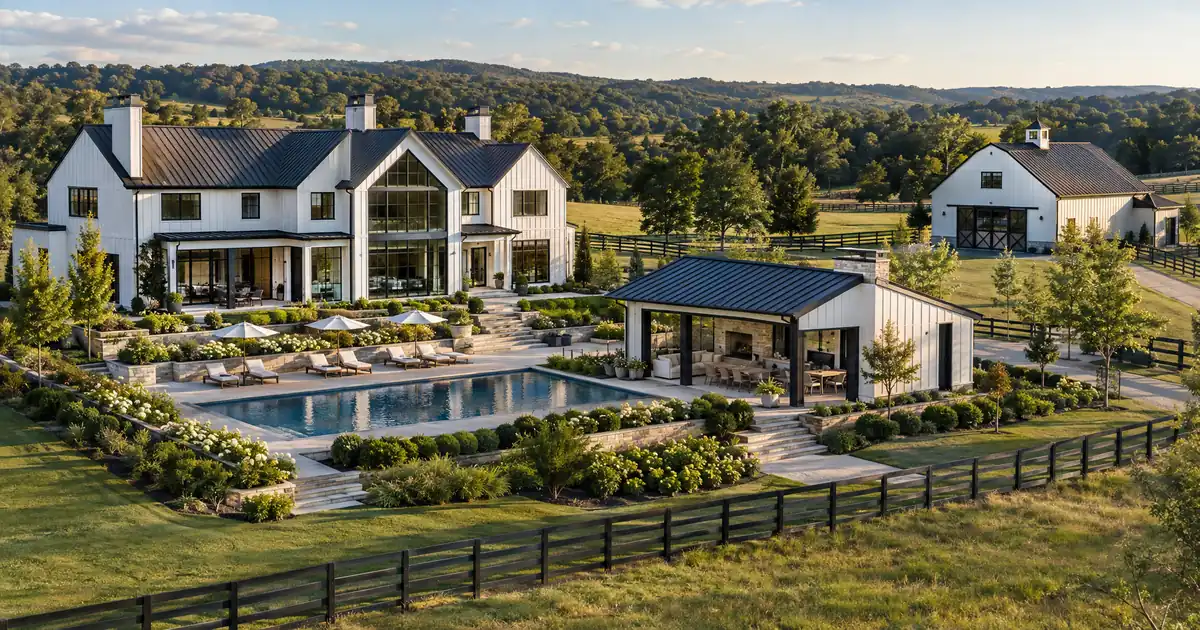
Property on Twenty Acres Qualify — The Quick Read: A twenty-acre parcel does not automatically fit a super jumbo asset-based loan. Across the wholesale programs Lendmire places files with, rural-classified property caps out at ten acres, and above roughly $3,000,000 to $3,500,000 in loan amount, rural property is excluded outright regardless of acreage. That does not kill the deal on its own — an appraiser can often carve the parcel down to a supportable site size, and the right structure still depends on whether the property is a residence or a rental.
If you’re staring at twenty acres and a stack of brokerage statements instead of a W-2, the acreage question and the income question are two completely separate underwriting problems. One decides if the property is even eligible. The other decides how much loan your assets can support. Answering “can this deal close” means answering both.
Does The Ten-Acre Cap Apply To Every Loan Size?
Yes, in the sense that it’s a network-wide ceiling for rural-classified property, not just a super jumbo rule. On the programs Lendmire places files with, rural property tops out at 80% loan-to-value on ten acres or less, and it’s never eligible above $3,000,000 in loan amount at all. Above that, a separate overlay kicks in.
Once the loan amount crosses $3,500,000 on a primary residence, or $3,000,000 on a second home or investment property, a tighter set of super jumbo overlays applies. That tier requires a 700 credit floor, clean housing payment history for 24 months, 48-month seasoning after any credit event, no non-occupant co-borrowers, and — critically — no rural property at all, with ten acres as the outer limit on any parcel that does clear. In plain terms: the ten-acre ceiling isn’t a super jumbo invention. It’s the baseline rural rule, and the super jumbo tier just adds more restrictions on top of it.
So a twenty-acre parcel is already twice the network’s rural ceiling before loan size even enters the conversation.
Why Loan Amount Still Changes The Conversation
Bigger loans don’t get more room on acreage — they get less. That’s the opposite of what most borrowers assume, and it’s worth walking through by tier.
| Loan Amount | Rural Property Allowed? | Acreage Ceiling | Notes |
|---|---|---|---|
| Under $3,000,000 | Yes, if classified rural | 10 acres, 80% LTV max | Standard property rules apply |
| $3,000,000-$3,500,000 (2nd home/investment) | No | 10 acres (moot — rural excluded) | Super jumbo overlay begins here for non-primary occupancy |
| $3,500,000+ (primary residence) | No | 10 acres (moot — rural excluded) | 700 credit floor, 48-month seasoning, no non-occupant co-borrowers |
| Above $4,000,000 | Case-by-case review | Case-by-case | Every file reviewed individually before submission |
An investor structuring a purchase near the $3,000,000 or $3,500,000 line should model whether trimming the loan amount changes the outcome. A property that’s declined outright as rural at $3.6 million might get a fairer look at $2.8 million, simply because the harder overlay hasn’t triggered yet.
Key Terms Defined
Asset depletion (asset allowance): a method of turning liquid savings into qualifying income by dividing the balance by a set number of months, instead of using pay stubs or traditional personal-income documentation.
Assets-only qualification: a documentation path with no debt-to-income calculation at all, used when liquid assets on hand equal the loan amount plus closing costs plus a cushion for any losses on other rental property.
Rural classification: an appraisal and underwriting designation based on how built-up the surrounding neighborhood is, separate from raw lot size — a twenty-acre lot in a dense suburb isn’t automatically “rural” the way the same acreage in an isolated county would be.
Excess land carve-out: when an appraiser values only the portion of a large parcel that matches typical lot sizes in the area, treating the remaining acreage as non-contributory to value.
DSCR loan: a loan that qualifies a rental property based on the rent it generates rather than the owner’s personal income or assets — Lendmire’s complete DSCR loans guide covers how that math works.
Two Underwriting Tracks Run At Once
Every super jumbo asset-based file has to clear two separate gates, and they don’t talk to each other. One is about the borrower. One is about the dirt.
Track one is income qualification. This is where the asset allowance or assets-only path comes in, and it has nothing to do with lot size. Track two is property eligibility — zoning, use, neighborhood build-out, and acreage — and it runs entirely through the appraisal. A borrower can have $10 million in liquid brokerage assets and still get stopped cold if the property itself doesn’t fit the box. Rural classification and acreage sit inside that second track, independent of how strong the borrower’s balance sheet looks.
This split matters. Investors often assume a strong asset picture “buys” flexibility on the property side. It doesn’t. The appraiser never sees the bank statements. And the underwriter reviewing acreage won’t raise the ceiling just because the borrower is well capitalized.
Can An Appraisal Fix An Oversized Parcel?
Often, yes — this is the most common way a twenty-acre file gets back on track. When a property sits on more land than is typical for the area, land above the network’s cap generally gets carved out of the appraisal rather than triggering a flat decline. The appraiser identifies a supportable site size — say, the five acres that match what’s typical in that market — and treats the remainder as excess land that doesn’t proportionally add to value.
That carve-out can bring a twenty-acre file back within program limits — but only if two things check out. First, the improved area (house, driveway, septic, well, outbuildings) must be clearly defined and separate from the raw acreage. Second, the extra land can’t be doing its own income-generating work. That means no leased hayfield, no working orchard, nothing that looks like agricultural use rather than a residential yard. Land zoned or used for farming, ranching, or orchards generally falls outside eligibility entirely. It starts to look like a business asset, not a home site.
Whether the carve-out works comes down to comparable sales, too. If every comp in the area sits on one to three acres and the subject property is twenty, the appraiser needs enough data to support a value on the trimmed site size without leaning on the excess acreage to make the number work.
Which Asset-Based Path Actually Fits?
This depends on occupancy — and the two paths aren’t interchangeable. The asset allowance method divides liquid assets by 36, 60, or 84 months. It’s built only for primary residences and second homes, capped at 80% loan-to-value. Also, the 84-month divisor is required as a standalone qualifying method on anything above $3,500,000. This method isn’t available on investment property.
The assets-only path works differently and has no debt-to-income calculation at all. It requires liquid U.S. assets equal to the loan amount, plus closing costs, plus sixty months of any net loss on other residential real estate the borrower holds. Retirement accounts count toward either path at 70% of value, rising to 80% once the borrower is past 59½. Business funds, gift funds, most trusts, unvested stock, and cryptocurrency never count toward either calculation.
So, is the twenty-acre parcel meant as a personal residence? Then asset allowance is likely the right lane, subject to the acreage and rural rules above. Is it meant as a rental? Then asset allowance is off the table entirely. It’s a tool for personal residences and second homes, not investment properties.
What If The Twenty Acres Is Meant As A Rental?
Is the property meant to earn rental income, not be a home? Then asset-based qualification usually isn’t the right tool. A DSCR loan fits better here. It qualifies mainly on whether the property’s rental income covers the payment, subject to lender guidelines. DSCR loans are built for non-owner-occupied investment properties. They’re business-purpose loans, so lenders review them differently than a standard owner-occupied mortgage.
Switching qualification methods doesn’t erase rural acreage rules. The same questions still apply: how built-up is the area around the property, and how much of the land can the appraiser actually support? Say an investor is weighing whether to structure a large-acreage purchase on assets, on DSCR, or another basis. It may help to compare how asset-based qualification stacks up against DSCR for someone living off a portfolio. The two paths solve very different problems, even on the same property.
Across the wholesale network Lendmire places files with, one pattern shows up again and again on large-acreage files: strong asset files usually get stopped by property eligibility, not income qualification. A borrower can clear the assets-only threshold easily and still lose the deal. Why? The appraiser may not be able to isolate a supportable site size. Or the neighborhood may read as rural once the appraisal comes back. Answering the acreage and use-classification question before submitting the file tends to save more time than polishing the asset paperwork.
What Does This Look Like At The Top End?
Loan sizes across these programs run from roughly $300,000 up to $30,000,000, split across two wholesale channels — a portfolio non-QM program carrying files to $6,000,000, and a bank portfolio program that carries twelve-month bank-statement files up to $30,000,000 on its own leverage ladder. On a primary residence, leverage steps down as the loan grows: up to 90% under $1,000,000, 85% up to $2,000,000, and down to 65-60% once a file lands in the $4,000,000-$10,000,000 range on the bank program’s ladder, with everything above $4,000,000 reviewed case by case before it’s even submitted. Second homes and investment property generally run about five points lower at every size tier, subject to underwriting.
None of that leverage matters, though, if the underlying acreage doesn’t clear property eligibility first. A borrower discussing an investment-property file near the $3,500,000 mark should note the size and structure considerations that come with a super jumbo loan on a rental past that threshold, since both the leverage ladder and the acreage rule tighten at roughly the same point.
Tax treatment can depend on how the funds are used and how the property is held; investors should keep clear records and speak with a qualified tax professional before relying on any deduction.
Frequently Asked Questions
Does a twenty-acre property automatically get declined?
No. It usually gets flagged for structuring rather than an automatic decline. If the appraiser can carve the improved site down to a supportable, typical-for-the-area size and the excess acreage isn’t producing independent income, the file can still move forward under the network’s ten-acre framework.
Is there a federal rule that caps acreage on these loans?
No federal regulator sets an acreage ceiling for asset-based or non-agency lending. Even the Fannie Mae Selling Guide’s site section of the appraisal report doesn’t impose a hard acreage limit — the caps investors run into come from individual lender and investor overlays layered on top of general appraisal guidance, checked case by case.
Can I combine asset income with rental income on this property?
Some programs allow blending asset-based income with other sources, but that only changes the income-qualification math. It has no effect on the acreage or rural-property rules, which are evaluated on the appraisal side, completely separate from how the borrower qualifies.
Is asset depletion considered a risky or subprime loan type?
No. Asset depletion and asset utilization are recognized, established loan classifications that show up regularly in securitized non-agency mortgage pools, per SEC EDGAR RMBS filing data. They’re built for asset-rich borrowers whose traditional personal-income documentation understate their real financial position, not for weak credit files.
If the acreage doesn’t fit, are there other options?
Yes. Reducing the loan amount to stay under the $3,000,000-$3,500,000 overlay threshold, pursuing an excess-land carve-out on the appraisal, or — for a rental property — switching to DSCR lender review are all paths worth reviewing before assuming the deal is dead. Lendmire can walk through which one fits at 828-256-2183 or through a pricing quote request.
For current guidelines and terms, see Lendmire’s super jumbo bank statement loan programs page.
Self-employed borrowers can compare both super jumbo programs on Lendmire’s self-employed mortgages page.
About Lendmire
A DSCR-focused mortgage broker, Lendmire (NMLS# 2371349) places investor financing across 40 markets — 39 states plus Washington, D.C. — with DSCR eligibility generally reviewed by the lender on property cash flow instead of tax returns, subject to lender guidelines. Scotsman Guide named Lendmire a Top Mortgage Workplace in 2025 and 2026.
Lendmire’s Top Mortgage Workplace recognition is documented by Scotsman Guide 2025 Top Mortgage Workplace and Scotsman Guide 2026 Top Mortgage Workplace.
Get Started
Ready to find the right loan for you?
In about 30 seconds you can review financing options available for your home or investment property. No commitment required.
Informational only. Not a Loan Estimate, approval, or commitment to lend. Program availability and eligibility are subject to lender guidelines, credit approval, property review, and underwriting.
References
1. Fannie Mae Selling Guide – Site Section of Appraisal Report
2. SEC EDGAR RMBS Data Comparison Exhibit
Brandon Miller
Founder & CEO, Mortgage Loan Originator, Lendmire LLC
- Mortgage Loan Originator · NMLS# 1129696 · Verify on NMLS Consumer Access
- North Carolina Real Estate Broker · License# 343312 · Verify on NCREC
- North Carolina Insurance Producer · License# 19053198 · Property, Casualty, Life, Health · Verify on NAIC SBS
- Lendmire LLC · Firm NMLS# 2371349 · Verify firm licensure
Compliance and disclosures. Lendmire (NMLS# 2371349) is a licensed mortgage broker and is not a direct lender, depository institution, financial advisor, or tax professional. Content in this article is general market analysis and educational information — not financial, legal, or tax advice for any specific situation. Lendmire does not guarantee loan approval; every transaction is subject to underwriting by the funding lender. Mortgage pricing and loan program guidelines are subject to change at any time without notice and vary by borrower characteristics, property type, and state regulations. Lendmire complies with Equal Housing Opportunity. Licensure verification: NMLS Consumer Access.


