
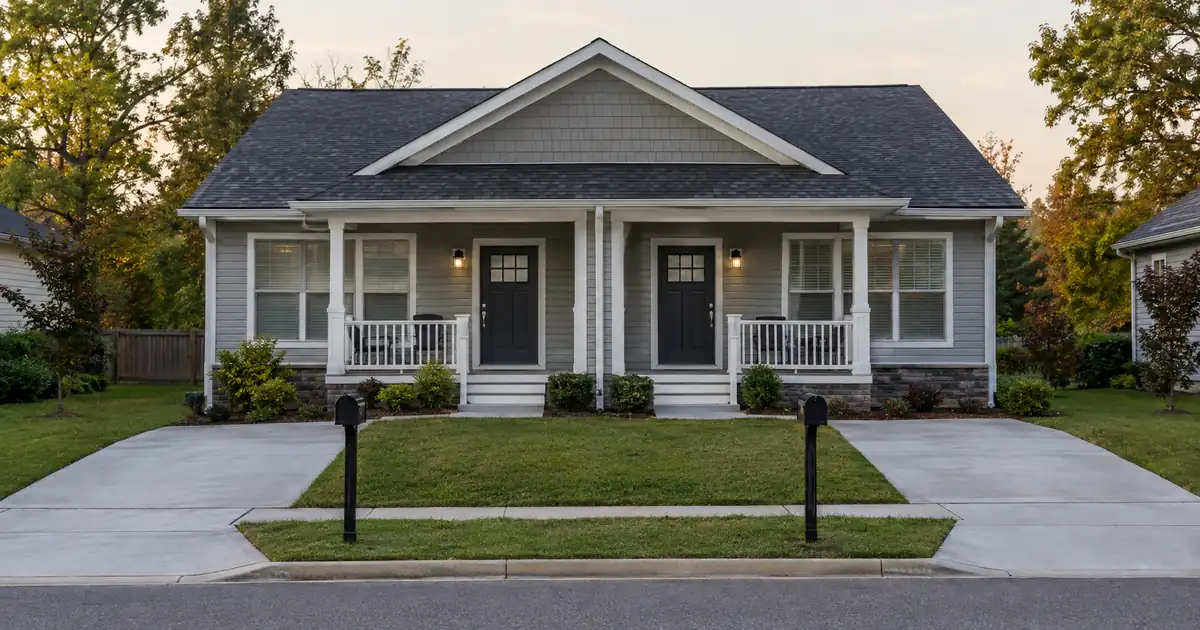
The Quick Read: A VA cash-out refinance reaches the same ceiling on a duplex, triplex or fourplex that it reaches on a single-family home: up to 100% of the appraised value, including the financed funding fee. The federal rule sets no lower cap by unit count. Conventional cash-out does drop on 2-4 units, so the gap between the two programs gets wider as the unit count goes up. The borrower must live in one of the units, and the final number still depends on the appraisal, the payoff, the fee and the lender’s guidelines.
Key Takeaways
- VA’s ceiling is 100% of reasonable value. It does not shrink for 2-4 units.
- Conventional cash-out on a 2-4 unit primary home is capped lower than on a 1-unit home.
- Net cash is the new loan minus every payoff, any fee paid in cash, and closing costs.
- The funding fee sits inside the 100% ceiling, so it comes out of the cash first.
- The 90% figure many people quote is a benefit test, not a cap.
- Occupancy and rental-income rules decide whether the file works, more than unit count does.
Does VA Treat a 2-4 Unit Home Differently on Cash-Out?
No, not on the ceiling. Under 38 CFR 36.4306, a cash-out refinance loan cannot exceed 100 percent of the reasonable value of the dwelling. Nothing in that section lowers the cap for a duplex or fourplex.
What changes on a multi-unit home is the file around the number, not the number itself:
- Occupancy. VA’s cash-out refinance page says the borrower must live in the home being refinanced. Live in one unit and the other units can be rented. Move out and the property no longer fits the cash-out program.
- Appraisal. The appraiser sets the reasonable value, and that value is the denominator in every leverage test. On a 2-4 unit, the appraisal has to address all the units.
- Underwriting. Credit, income and residual income are all reviewed. Residual income is the controlling test on VA files. The 41% debt-to-income figure is a guideline, not a cap.
Across the wholesale programs Lendmire places VA files with, full entitlement carries no VA loan limit, and the programs start at a 580 decision score. A borrower with remaining entitlement instead of full entitlement may need a down payment, and that is a conversation to have with a loan officer, not a number to guess.
If you want the full program overview, Lendmire’s VA cash-out refinance program page lays out the structure. This article stays on the 2-4 unit question.
How Is the Cash Calculated?
Net cash is arithmetic. Take the new loan amount. Subtract the payoff of every lien on the home. Subtract the funding fee if it is paid in cash instead of financed. Subtract closing costs that are paid from proceeds. What is left is the check.
The only hard limit is the ceiling. The new loan, including a financed funding fee, cannot go above 100% of the appraised value. If part of the fee would push the loan over that line, the rule says the excess is paid in cash at closing. VA Circular 26-18-30 says the same: VA will not guarantee a refinance above 100% loan-to-value, and a borrower who closes above it pays the excess at closing.
That is the fee drag. On a cash-out, the funding fee is 2.15% for first use and 3.3% for subsequent use, unless the borrower is exempt, such as a veteran receiving compensation for a service-connected disability. Because the fee lives inside the ceiling, every point of fee is a point of cash you do not receive when the loan is already at the cap.
Three ways the same home produces different checks:
1. High payoff. A borrower who bought recently with little down has little equity to release. The ceiling is generous, but the payoff eats most of it.
2. Long ownership, small balance. The same ceiling releases a large share of the value. The fee is a smaller share of the check.
3. Low appraisal. Every dollar of value lost lowers the ceiling and the cash by the same amount. Appraisal reconsideration, with recent sales of comparable multi-unit homes, is the normal response when the value comes in light.
VA vs. Conventional on the Same Owner-Occupied Home
This is where unit count shows up. Fannie Mae’s Eligibility Matrix lists a 75% maximum LTV for a cash-out refinance on a 2-4 unit principal residence, versus 80% on a 1-unit primary home. Freddie Mac’s cash-out limits are similarly more restrictive on multi-unit homes.
| Factor | VA cash-out | Conventional cash-out |
|---|---|---|
| Ceiling, 1 unit | 100% of value | 80% (Fannie Mae matrix) |
| Ceiling, 2-4 units | 100% of value | 75% (Fannie Mae matrix) |
| Mortgage insurance | None | Depends on program |
| Unit count changes cap? | No | Yes |
| Occupancy | Borrower must live there | Primary-home rules apply |
On a fourplex the gap is 25 percentage points of value before fees. On a single-family home it is 20. So VA’s advantage grows with unit count, even though VA itself did not change anything.
Keep one distinction straight. Fannie Mae also has a limited cash-out tier for people who take no cash back. That tier carries a different, higher number. Do not mix it up with the true cash-out figure above.
Lender caps matter too. VA’s ceiling is 100%, but some lenders set a lower cap through their own overlays. The cap on a given file is whatever the lender’s guidelines allow, so the answer comes from the file, not the headline.
What Pulls the Number Down?
Most of the shrinkage comes from five places.
The appraisal. It sets the denominator. A low value cuts the ceiling and the cash together.
The funding fee. Financed, it uses ceiling room. Paid in cash, it comes out of pocket. Exempt borrowers skip it.
Closing costs. Allowable costs can be paid from proceeds. Only the funding fee and certain energy-efficiency improvements can be added to the loan itself.
Lender overlays. A lender can cap below 100%, ask for a higher score than the 580 floor in the network programs, or require more reserves on a 2-4 unit. Overlays differ by lender.
The payoff. A second lien, a home-equity line or a tax lien all get paid from the new loan before any cash reaches the borrower.
One more thing here: VA cash-out can refinance a non-VA loan. A conventional or FHA mortgage can be paid off and rolled into a VA loan. That is often how a borrower on a multi-unit home ends up at the VA ceiling in the first place.
The 90% Myth
The most common error in summaries is calling 90% a VA cash-out cap. It is not. The cap is 100% of reasonable value.
The 90% figure shows up in two places. First, it is one of eight net tangible benefit tests. A VA Type II cash-out (a loan that exceeds the payoff, which means cash back) must meet at least one. Second, if the borrower pays more than one discount point, the resulting loan has to stay at 90% of value or below.
Many lenders do set 90% as their own cap. That is an overlay, not the VA rule. When a quote comes back at 90%, ask whether it is a lender limit.
Qualifying on a Multi-Unit File
Underwriting is where 2-4 unit files get stuck, so the paperwork is worth organizing first.
Eligibility. The Certificate of Eligibility decides. A borrower can get it through a lender, VA.gov or by mail.
Type I vs. Type II. VA’s circular defines Type I as a loan, including the funding fee, that does not exceed the payoff of the loan being refinanced. Type II exceeds the payoff. Cash back means Type II. A no-cash VA-to-VA refinance carries extra tests such as seasoning and fee recoupment.
Net tangible benefit. The loan has to pass at least one test. The listed tests are:
- eliminating monthly mortgage insurance
- a shorter term
- a lower interest rate
- a lower payment
- higher residual income
- refinancing an interim construction loan
- a loan at or below 90% of reasonable value
- converting an adjustable rate to a fixed rate
Seasoning applies as well. In the network programs, the cash-out carries the same seasoning as the IRRRL: the later of 210 days from the first payment and the 6th payment.
Rental income from the other units. This is the piece that surprises borrowers. The VA underwriting regulation, 38 CFR 36.4340, counts prospective rent on a multi-unit property only if the veteran shows a reasonable likelihood of success as a landlord. It also calls for verified reserves to carry the full housing payment for six months without the rent. Even then, the lender counts 75 percent of the lease amount unless a greater percentage is documented. Whether that rent helps debt-to-income on a cash-out is a file-level question, and lenders layer their own reserve overlays on top.
Reserves. Cash-out proceeds generally cannot be counted as the reserves required for a rental. The reserves have to sit in the borrower’s account before closing. Files that assume proceeds will cover reserves are the ones that get sent back.
Disclosures. The lender must give a loan comparison and must estimate the dollar amount of equity being removed, with a warning that it may affect the ability to sell later. The borrower certifies receipt. It is a consumer loan, so the Loan Estimate and Closing Disclosure apply.
Where the General Rule Breaks
Named edge cases, since these are what actually stop files:
- The home is not occupied. A rental, vacant property or second home does not fit the cash-out program. A borrower who moved out of a duplex and now rents every unit is outside it.
- Renting the other units is fine. It is not a violation by itself, as long as the borrower lives in one unit. The 75% and reserves rule governs how that income can be used to qualify.
- A streamline gives no cash. The IRRRL needs no appraisal and no credit package, but VA’s IRRRL page is clear that it does not pay out equity. Its fee is 0.5% unless the borrower is exempt.
- Low appraisal. Covered above. The ceiling falls with the value.
- State law. In some states, the law itself limits how much equity a cash-out can take. A homeowner should ask the loan officer whether any state limit applies.
- Remaining entitlement. A borrower who has used VA before may be in a different position than one with full entitlement. That needs a loan officer’s read, not a guess.
Key Terms Defined
Reasonable value: The appraised value VA uses as the base for every loan-to-value test.
Funding fee: A one-time VA charge that can be financed into the loan and is waived for exempt borrowers.
Type II refinance: A VA refinance where the new loan exceeds the payoff, which means cash goes to the borrower.
Net tangible benefit: A test showing the refinance gives the borrower a real, measurable improvement.
Residual income: The money left each month after major obligations, which VA treats as the controlling test.
Entitlement: The amount of VA guaranty a veteran has available to use.
What the Decision Looks Like in Practice
Picture a veteran who lives in one unit of a fourplex and rents the other three. She has owned it a long time, holds a conventional loan, and wants cash for repairs. On a conventional cash-out, the ceiling is 75% of value. Under VA, it is 100%, less the financed fee.
Her decision is not only about the ceiling. She weighs three things:
1. How much of the extra reach she actually needs, since more borrowed equity means a larger balance.
2. Whether the larger balance and a financed fee fit her monthly budget and residual income.
3. Whether the cash is worth the equity removed, since the lender has to tell her how much that is.
The ceiling is only the outer edge. The sensible borrowing amount is usually well inside it. Tax treatment can depend on your situation; borrowers should speak with a qualified tax professional before relying on any deduction or credit.
If you are weighing a cash-out refinance against keeping the loan you have, Lendmire can help you compare the programs and the equity each one reaches.
Frequently Asked Questions
Does a duplex or fourplex get a lower VA cash-out cap?
No. The regulation sets 100% of reasonable value and does not distinguish by unit count. Conventional cash-out does, which is why VA looks stronger on 2-4 units. Individual lenders may still set a lower cap by overlay.
Can I use a VA cash-out on a property I rent out?
Only if you live in it. The program requires the borrower to occupy the home being refinanced. Renting the other units while living in one is allowed, but a fully rented property does not fit the cash-out program.
Can I take cash out with a streamline?
No. The IRRRL refinances an existing VA loan to a lower rate or from adjustable to fixed, with no appraisal and no cash back. Taking cash means a full cash-out with an appraisal and full underwriting.
Does the rent from the other units count toward qualifying?
Sometimes. Lenders count 75% of the lease amount, and only when the borrower shows landlord capability and verified reserves for six months of housing payments. Whether it helps on a given file is a lender-level call.
Can the funding fee always be rolled into the loan?
Only up to the 100% ceiling. Any part that would push the loan above it is paid in cash at closing.
For your own numbers, request a scenario review with Lendmire.
About Lendmire
Lendmire — NMLS# 2371349 — is a mortgage broker that arranges FHA, VA, conventional and jumbo home purchase and refinance financing in 16 states through wholesale lenders. Every option is subject to the lender’s guidelines and full underwriting. Scotsman Guide named Lendmire a Top Mortgage Workplace in both 2025 and 2026.
Get Started
Ready to find the right loan for you?
In about 30 seconds you can review financing options available for your home or investment property. No commitment required.
Informational only. Not a Loan Estimate, approval, or commitment to lend. Program availability and eligibility are subject to lender guidelines, credit approval, property review, and underwriting.
References
2. VA cash-out refinance loan page
4. Fannie Mae Eligibility Matrix
This article is part of Lendmire’s VA Loans series — every loan program’s qualification details, guidelines, and scenarios live on the loan options page.
Related reading: How Much a VA Cash-Out Releases After Big Home Value Gains · How Much a VA Cash-Out Releases With a Disability Rating · How Much a Veteran With a Disability Rating Keeps in a VA Cash-Out
Brandon Miller
Founder & CEO, Mortgage Loan Originator, Lendmire LLC
- Mortgage Loan Originator · NMLS# 1129696 · Verify on NMLS Consumer Access
- North Carolina Real Estate Broker · License# 343312 · Verify on NCREC
- North Carolina Insurance Producer · License# 19053198 · Property, Casualty, Life, Health · Verify on NAIC SBS
- Lendmire LLC · Firm NMLS# 2371349 · Verify firm licensure
Important disclosures. Lendmire (NMLS# 2371349) is a licensed mortgage brokerage. Lendmire is not a direct lender, depository institution, or financial advisor. All loan inquiries are subject to lender underwriting; this article does not constitute a commitment to lend. Rates, terms, and program guidelines are subject to change without notice and vary by borrower profile, property type, and state. Information in this article is general in nature and is not financial, legal, or tax advice. Equal Housing Opportunity. NMLS Consumer Access: nmlsconsumeraccess.org.