
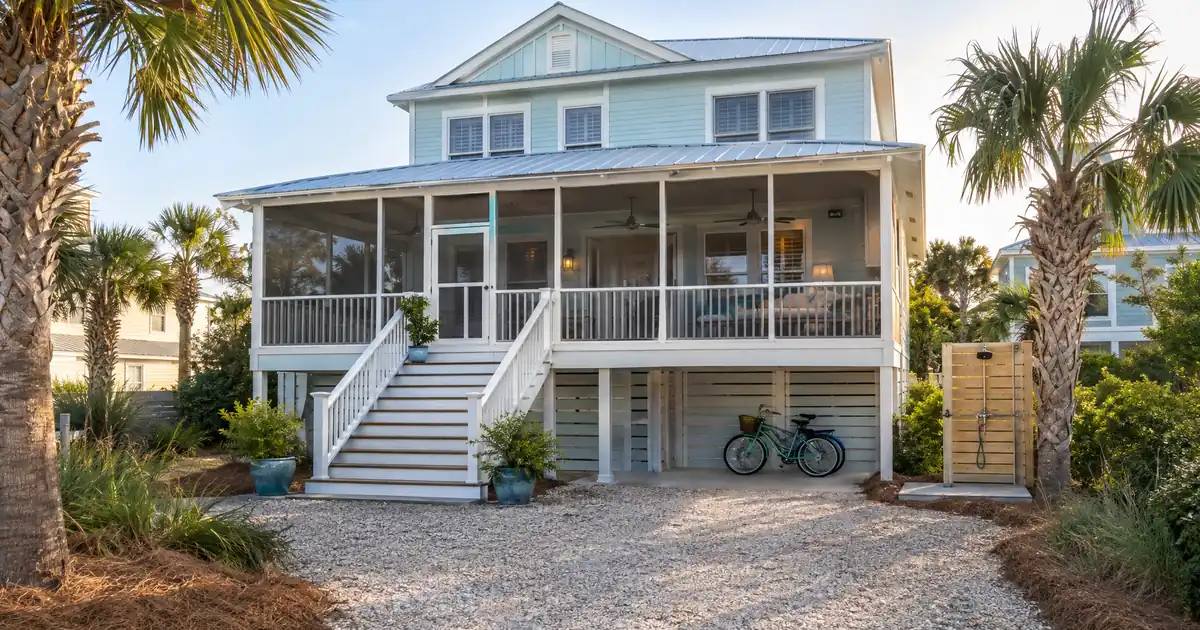
Second-home Financing In Rehoboth Beach For Business Owners — The Quick Read: A second home you plan to personally use is a consumer-purpose loan, full stop — even if you own three companies and your W-2 is basically decorative. The fix for business owners isn’t a DSCR loan; it’s an alternative-documentation program that is reviewed around bank deposits, a P&L, or assets instead of traditional personal-income documentation, layered onto standard second-home occupancy rules. Get the classification right first, then the paperwork gets easy.
Why Business Owners Get This Wrong
Most business owners assume that because they run a company, any property they buy can be financed as a “business” loan. It can’t — not automatically. What decides the loan category is what the property is for, not who’s signing the note.
Buy a place in Rehoboth Beach so you and your family can spend summers there, and that’s personal use. It stays a consumer-purpose mortgage no matter how the buyer earns a living. The rules that trigger — full income and asset disclosure, appraisal-based valuation, standard consumer underwriting — apply the same way they would to a W-2 employee down the street.
That distinction matters because it rules out the loan type most self-employed buyers ask for by name.
Key Terms Defined
Second home — a property you personally occupy part of the year that isn’t your main residence and isn’t run as a rental business.
DSCR loan — a loan sized to how much rental income a property generates rather than to the borrower’s personal income; built for non-owner-occupied investment property.
Bank-statement loan — a mortgage that qualifies a borrower using deposits from personal or business bank accounts instead of traditional personal-income documentation.
Expense ratio — the percentage of gross deposits a lender subtracts to estimate real qualifying income when reviewing business account statements.
Occupancy certification — a signed statement at closing about how you intend to use the property; misrepresenting it is treated as fraud, not a gray area.
Can You Get a DSCR Loan for a Rehoboth Beach Second Home?
No. DSCR loans are built for pure rental property. They’re not for a home you personally use. DSCR loans are business-purpose investor loans, so lenders review them differently than a standard owner-occupied mortgage. The zero-personal-occupancy certification simply doesn’t match a family beach house you plan to visit every summer.
If your actual plan is heavy short-term rental with only occasional personal stays, that’s a different conversation. It usually means treating the purchase as an investment property from day one, rather than trying to retrofit a second-home loan later. Lendmire’s complete DSCR loans guide walks through how that qualification path works when the property is a true rental.
The Documentation Fix: Qualifying Without Tax Returns
Business owners who write off aggressively on their returns don’t have to use those returns to qualify. Across the wholesale network Lendmire works with, income for a second-home purchase can come from 12 or 24 consecutive months of bank statements instead — personal or business.
Here’s how the math actually runs on a business-account file. First, eligible deposits get divided by the statement period. Then that number gets reduced by an expense ratio meant to strip out real overhead. That ratio generally scales with employee count and business type. It runs lower for a service business with no employees. It runs higher for a business with a handful of employees. It runs higher still for a business with a larger staff or any product-based business. An accountant can supply a different figure instead, or the file can use a profit-and-loss method, which may allow a larger share of stated income to qualify. Transfers you move from your own business account into your personal account count in full.
For owners whose income doesn’t map cleanly to deposits at all, an asset-based path exists too. One version divides liquid assets by 36, 60, or 84 months to generate qualifying income; a standalone version requires liquidity equal to the loan amount, closing costs, and reserves, with no income calculation at all. These paths run through select lenders in Lendmire’s wholesale network and are always subject to full underwriting.
Picking the wrong account type — business when personal would’ve worked, or the reverse — is the single most common way a self-employed file underperforms. It’s worth getting that call right before submission, not after.
What Leverage Actually Looks Like on a Second Home
Leverage on a second home steps down as the loan size climbs, and it runs roughly five points below what the same borrower would get on a primary residence at the same price point. On loans in the $300,000 to $1,000,000 range, purchase and rate-term financing typically run to 85% loan-to-value with a 700 credit floor, on most files through select wholesale programs.
Move into the $1,000,000 to $2,000,000 band and leverage generally holds near 80%, with the credit floor climbing to 700 above roughly $1.5 million. From $2,000,000 to $3,000,000, purchase and rate-term leverage is typically 80% down to 75%, tightening as the price climbs, with a 720 credit floor. Cash-out is scoped separately and lower — commonly around 70% to 60% in this range, and market surveys generally describe second homes requiring roughly 10% down and investment properties needing 15-25% as a baseline comparison, though the wholesale-network figures above are the ones that actually govern files placed through Lendmire.
Above $3,000,000, leverage compresses further and every file gets reviewed case by case before submission — that’s true across the board on jumbo second-home files, never a flat “up to” number. In the $3,000,000 to $4,000,000 band, purchase financing typically runs 65%, with a 760 credit floor and case-by-case review standard at this size. Above $5,000,000, second-home files move onto a separate bank-portfolio ladder that runs 55% down to 50% as size increases to $30,000,000, with interest-only options capped at 60% loan-to-value or the size band’s ceiling, whichever is lower.
Rehoboth Beach’s Rental Rules Matter Even If You’re Not Renting
If any rental use enters the picture — even occasional weeks when you’re not there — Rehoboth Beach and Delaware both attach compliance obligations on top of the mortgage itself. The city requires a short-term rental license with a $150 annual fee, and Delaware layered on a 4.5% state rental tax on short-term agreements signed on or after January 1, 2025.
None of that changes your loan classification by itself, but it does affect what a lender’s rent analysis — or your own pro forma — should assume about net cash flow if rental income ever factors into the underwriting.
The bigger tripwire is the IRS’s occupancy test, which is separate from any mortgage rule but often gets cross-checked against it. Per IRS Topic No. 415, you’re treated as using a dwelling as a residence if your personal use exceeds the greater of 14 days per year or 10% of the days it’s rented at fair value; rent it for fewer than 15 days and you don’t report the income or deduct expenses at all. A second home financed under personal-use terms that quietly turns into a heavy rental operation creates a mismatch between what you told the lender and what you told the IRS — and that mismatch gets noticed.
Second Home or Investment Property — Which One Are You Actually Buying?
| Factor | Second Home | Investment Property (DSCR) |
|---|---|---|
| Personal use | Required, part of the year | None — non-owner-occupied |
| Qualifying basis | Borrower income (bank statements, P&L, assets) | Property’s rental income |
| Loan purpose | Consumer-purpose | Business-purpose |
| Entity/LLC vesting | Not typical | Generally allowed |
| Rental income allowed | Occasional, incidental | Primary use case |
Nolo’s guide to second homes versus investment property draws the same line most agency guidelines do. A second home rider generally stops the owner from handing the property to a rental management company or committing it to mandatory rental agreements. That’s exactly why LLC vesting and DSCR-style structuring don’t fit a true second home. Those tools belong to the investment-property side of the table.
Rehoboth Beach’s own average home value sits at $811,382, up 2.8% over the past year, according to Zillow’s Home Value Index. That price point puts a lot of Rehoboth second-home purchases squarely in the $1,000,000-and-under band where leverage tends to be most favorable — but plenty of buyers are shopping well above that, where the size-based leverage ladder and case-by-case review at the top matter a lot more.
What Happens If You Want to Convert It Into a Rental Later
Financing a home as a second home doesn’t lock you out of ever renting it. But converting it isn’t automatic, and you can’t do it by simply changing your mind. A primary residence can sometimes convert into a rental through a DSCR refinance, but only once the borrower has genuinely moved into a new primary residence, with lease and payment documentation to prove it. A second home moving toward heavier rental use follows a similar logic. The occupancy story on file has to match reality. If it doesn’t, the fix is a refinance into an investment-property structure, not a quiet change in how the property gets used.
Business owners looking at this option often ask about similar coastal markets. Lendmire covers this topic in second-home financing in Rosemary Beach for business owners. It walks through a similar personal-use-versus-rental decision, but in a different resort setting. The underlying logic works well across coastal second-home markets.
A Quick Word on Sizing and Documentation Together
A business owner’s file usually gets built around two decisions at once: how the income gets documented, and how large the loan is. Across the wholesale network, loan amounts on these bank-statement and asset-based programs run from $300,000 up to $6,000,000 on the portfolio non-QM side, with a separate bank-portfolio program carrying twelve-month-statement files as high as $30,000,000 on its own leverage ladder. Every file above roughly $4,000,000 gets reviewed case by case before it’s even submitted — that’s standard, not a red flag.
Reserve requirements scale with size too. You typically need 3 months of payments on loans up to $500,000, 6 months up to $1,500,000, and 9 months above that. You’ll also need additional months for each other financed property you already carry. Credit floors run from a 660 baseline up to 700 or higher once loan size crosses into super-jumbo territory, generally above $3,000,000 to $3,500,000 depending on occupancy type.
Tax treatment can depend on how the funds are used and how the property is held; investors should keep clear records and speak with a qualified tax professional before relying on any deduction.
Frequently Asked Questions
Can a self-employed business owner buy a Rehoboth Beach second home without traditional personal-income documentation?
Yes, through bank-statement, profit-and-loss, or asset-based documentation programs rather than a standard tax-return underwrite. Qualifying income comes from deposits or liquid assets instead of a 1040, subject to lender guidelines and full underwriting.
Does owning a business let me use a DSCR loan for a personal-use beach house?
No. DSCR loans are business-purpose, non-owner-occupied products, and a home you intend to personally use doesn’t fit that occupancy category regardless of how you earn income.
How much rental income can I earn on a Rehoboth Beach second home without reclassifying it? The IRS treats personal use above 14 days a year, or 10% of the days it’s rented at fair value, as residence use with rental-expense limits attached — a threshold worth knowing before assuming casual rental income carries no tax consequences.
What credit score do I need for a jumbo second-home purchase in Rehoboth Beach?
It depends on loan size. Typical floors run around 700 on standard-sized second-home files and climb to 760 once the loan crosses into higher jumbo bands, on most files through select wholesale programs.
Can I vest a Rehoboth Beach second home in my LLC?
Generally, no — LLC vesting is a feature of investment-property DSCR loans, not personal-use second-home financing. If entity ownership matters to you, that usually points toward structuring the purchase as an investment property instead.
If you’re weighing a second home against a straight rental purchase in a coastal market, Lendmire can help you compare how the documentation, leverage, and occupancy rules actually play out for your specific income profile and goals.
For current guidelines and terms, see Lendmire’s super jumbo bank statement loan programs page.
About Lendmire
Lendmire — NMLS# 2371349 — is a mortgage brokerage specializing in DSCR investor loans, helping arrange financing across 40 markets, including Washington, D.C., through wholesale and investor-lending channels. The model centers on property-level rental income reviewed by the lender rather than W-2 documentation, subject to lender guidelines, suiting entity-owned and multi-property investors. Lendmire holds Scotsman Guide Top Mortgage Workplace recognition for 2025 and 2026.
Lendmire’s Top Mortgage Workplace recognition is documented by Scotsman Guide 2025 Top Mortgage Workplace and Scotsman Guide 2026 Top Mortgage Workplace.
Get Started
Ready to find the right loan for you?
In about 30 seconds you can review financing options available for your home or investment property. No commitment required.
Informational only. Not a Loan Estimate, approval, or commitment to lend. Program availability and eligibility are subject to lender guidelines, credit approval, property review, and underwriting.
References
2. Nolo — Investment Property vs. Second Home
3. Zillow Home Value Index — Rehoboth Beach
Brandon Miller
Founder & CEO, Mortgage Loan Originator, Lendmire LLC
- Mortgage Loan Originator · NMLS# 1129696 · Verify on NMLS Consumer Access
- North Carolina Real Estate Broker · License# 343312 · Verify on NCREC
- North Carolina Insurance Producer · License# 19053198 · Property, Casualty, Life, Health · Verify on NAIC SBS
- Lendmire LLC · Firm NMLS# 2371349 · Verify firm licensure
Compliance and disclosures. Lendmire (NMLS# 2371349) is a licensed mortgage broker and is not a direct lender, depository institution, financial advisor, or tax professional. Content in this article is general market analysis and educational information — not financial, legal, or tax advice for any specific situation. Lendmire does not guarantee loan approval; every transaction is subject to underwriting by the funding lender. Mortgage pricing and loan program guidelines are subject to change at any time without notice and vary by borrower characteristics, property type, and state regulations. Lendmire complies with Equal Housing Opportunity. Licensure verification: NMLS Consumer Access.


