
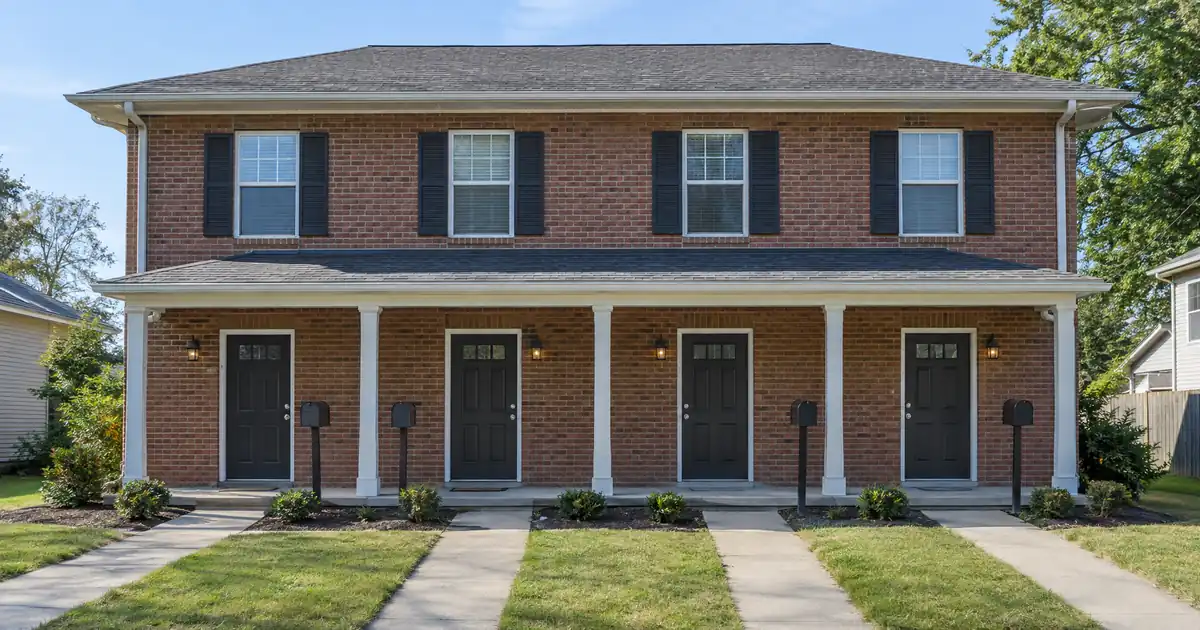
The Quick Read: A fourplex can qualify for a VA cash-out refinance only if you live in one of the four units as your home. The loan can reach 100% of the appraised value, including a financed funding fee, and it goes through full credit, income and residual-income underwriting. The rent from the other three units can help you qualify, but it counts under tighter rules than your own wages do, and each lender may layer on its own limits.
What a VA Cash-Out on a Fourplex Actually Is
A VA cash-out refinance replaces your current mortgage with a new VA-guaranteed loan that is larger than the payoff. The difference comes to you as cash. On a fourplex, the same rules apply as on a single-family home, with a few added steps because three of the units produce rent.
Here is the part that trips people up. VA financing reaches buildings of up to four units, but the program exists to finance a home. You certify that you occupy, or intend to occupy, one unit as your primary residence. If all four units are rented to others and you live elsewhere, this is not a VA transaction.
Across the wholesale programs Lendmire places VA files with, the fourplex files that run clean are the ones where occupancy is obvious from the paperwork: your address on your ID, your credit file and your bank statements matches the subject property.
The program details here are subject to lender guidelines and full file review, and nothing here is a commitment to lend. Lendmire is a mortgage broker, so it arranges these loans through wholesale lenders rather than lending directly. The VA cash-out refinance program page covers the basics for any property type.
Key Terms Defined
Reasonable value: VA’s term for the appraised value of the property.
Entitlement: The portion of your VA benefit that backs the loan for the lender. Full entitlement means no VA loan limit applies; remaining entitlement from a prior VA loan can change how much you can borrow.
Certificate of Eligibility (COE): The VA document that confirms you qualify for the benefit. VA decides this, under VA’s own service rules.
Net tangible benefit (NTB): A test showing the new loan leaves you better off in a measurable way, such as a lower payment or a shorter term.
Residual income: What is left of your monthly income after taxes, debts, housing costs and set living expenses. On VA loans, it is the controlling test.
Overlay: A rule a lender adds on top of VA’s minimum. An overlay is not a VA rule.
Seasoning: The waiting period after your existing loan begins before you can refinance it.
Is the 100% Cap a VA Rule or a Lender Rule?
The 100% cap is VA’s rule. Under 38 CFR 36.4306 on eCFR, the new loan may not exceed 100% of reasonable value. The funding fee can be financed into the loan, but any part of it that would push the loan above 100% must be paid in cash at closing.
The loan-to-value ratio is the total new loan, including a financed funding fee, divided by the appraised value. So on a fourplex appraised at a given figure, the funding fee eats into the same ceiling as your payoff and your cash out.
That is the VA ceiling. Some lenders choose a lower one. Plenty of lenders stop cash-out at 90% of value as their own policy, and some set a higher credit floor than others. The wholesale programs Lendmire works with reach 100% of appraised value on a VA cash-out, subject to lender guidelines. When you compare offers, ask each lender whether a limit is VA’s or its own.
How the Fourplex Loan Is Underwritten, Step by Step
A cash-out is not a streamline. It carries a full appraisal, full credit review and full income review. Here is the order a file generally follows.
1. Confirm eligibility. You need a COE. A cash-out can pay off any existing first loan, whether it is VA, FHA or conventional. Refinancing a non-VA loan into VA counts as a cash-out and still needs a net tangible benefit.
2. Certify occupancy. You certify that you live in the home, or intend to. Treat that certification as a legal statement, not a formality. A lender will look for supporting evidence in the file.
3. Order the VA appraisal. The appraiser sets reasonable value for the whole building. On a two-to-four unit property, the appraiser also gives an opinion of fair rent for the other units, and minimum property requirements apply to the building as a whole. A unit with a broken heater or a missing smoke detector can hold up the entire file.
4. Run the credit and income review. The lender builds your debt-to-income ratio and residual income. The 41% debt-to-income figure is a guideline, not a cap. A ratio above it needs residual income well above the VA table. A 580 decision score is where the wholesale programs Lendmire uses begin, though VA itself sets no minimum score and some lenders set higher ones.
5. Decide whether to count the rent. More on this below, because it is where fourplex files differ most from single-family files.
6. Receive the required disclosures. The lender must give you a VA comparison of the old and new loan, including payoff, loan type, term, total payments and loan-to-value, plus an estimate of the equity being removed. The regulation also calls for you to certify that you received them. Because this is a consumer mortgage, the standard Loan Estimate and Closing Disclosure apply too.
7. Close, with the fee settled. The funding fee is either paid at closing or financed inside the 100% ceiling.
Rental Income: What Counts and What Doesn’t
You can qualify with the rent or without it. That choice shapes the whole file.
If you use rent from the other units, VA’s underwriting standards in 38 CFR 36.4340 are what govern it. In practice, lenders count only part of the rent, not the full amount, and they want proof you can manage rental property. That proof is usually landlord experience or a property manager. They also want reserves, meaning your own money set aside after closing. Expect the lender to ask for leases, or for the appraiser’s fair-rent opinion where leases don’t exist.
Two details matter on a refinance. First, cash you take out at closing generally does not count as your reserves, so plan your reserves from savings or other assets. Second, if you leave the rent out of your qualifying income, lenders generally count your full housing payment as debt, and the rent-related reserve and landlord-experience asks fall away. Your lender confirms how this works on your file.
Here is a way to think about it. Picture a borrower with steady wages, a modest debt load and three rented units. Counting rent at a partial amount may raise qualifying income enough to matter, but it adds paperwork and a reserve requirement. A borrower with strong wages may do better leaving the rent out and keeping the file simple. It is a judgment call, and a loan officer can model both versions on your numbers. The exact numbers vary by lender and program and follow a full review of property, leverage, and credit.
Where the General Rule Breaks
Most of the friction on fourplex VA cash-outs comes from edge cases, not from the core rule.
The 90% line shows up twice. It is a common lender cap, and it is also a VA shortcut. Under the net tangible benefit tests in Cornell’s copy of the regulation, a new loan at or below 90% of reasonable value meets the benefit requirement on its own. Other tests include eliminating monthly mortgage insurance, a shorter term, a lower payment, or more monthly residual income. The two 90% lines serve different purposes, so it helps to keep them separate.
Financed costs. The regulation limits loan-to-value to 90% in certain cases where financed closing costs are involved on an adjustable-rate conversion. This is narrow, but your lender will know when it applies.
The self-sufficiency test. Some lenders require the rent from all units to cover the full payment on three- and four-unit properties. Treat this as a lender overlay, not a VA rule. It is easy to confuse with an FHA requirement for the same property type. If one lender applies it and another does not, that is the difference, and it is a good reason to compare.
Entitlement. If you used some of your benefit on a prior VA loan, you may have only partial entitlement. That can limit loan size or call for a down payment. Speak with a loan officer about your own entitlement; do not guess from a county figure.
Existing VA loan seasoning. When the loan you are refinancing is already a VA loan, the same seasoning and net tangible benefit tests apply to the new cash-out.
Occupancy gaps. A vacant unit is usually fine. A unit lived in by family is fine too, as long as the file is clear. The harder case is a borrower who has moved out or who never lived there. If you are active duty, spouse occupancy and orders can change how the certification is made, so raise it with the lender at the start.
Five or more units. A fifth residential unit makes the property ineligible. Mixed-use buildings with a business unit are treated case by case, so ask before you assume.
The Funding Fee on a Cash-Out
On a VA cash-out refinance, the funding fee is 2.15% for first use and 3.3% for later use. The fee can be financed inside the 100% ceiling. Veterans who receive compensation for a service-connected disability, and a few other groups, are exempt. VA’s funding fee page explains the exemptions.
Financing the fee raises your balance, which means it costs interest over time. If you can pay the fee in cash and your reserves allow it, that is a trade-off worth weighing. There is also no mortgage insurance on a VA loan, which is one of the benefits when you refinance out of a loan that carried it. Your lender will state any fee on the Loan Estimate, so verify the figure there.
What the Appraisal Looks At on Four Units
A fourplex appraisal is less routine than a house appraisal. The appraiser sets reasonable value for the building, which sets your loan ceiling. A low value pulls down everything: loan size, cash out, and whether the funding fee can be financed.
Expect the appraiser to look at all four units. Condition, safety items and working systems matter in each. Rental comparables for multi-unit buildings are thinner than for single-family homes, which is where values can come in lower than an owner expects. If you believe the value missed, ask your loan officer about a reconsideration request with recent nearby sales. Tenants should get notice of access, since the appraiser may need to enter their units.
A Document Checklist for the Fourplex File
Most delays on these files come from missing paper, not from a failed rule. Gather these before you apply:
- Your COE.
- Proof you live in the property.
- Current leases for the rented units, or a plan for how rent will be shown.
- Landlord experience or property-manager documentation if you plan to count rent.
- Reserve evidence if rent counts: your own savings or other assets, not cash-out proceeds.
- Your current mortgage statement and payoff information.
- Income and debt records for the full underwriting review.
What the Decision Looks Like in Practice
For most borrowers, the question comes down to three comparisons.
| Question | If yes | If no |
|---|---|---|
| Do you live in one unit? | Cash-out is on the table | VA is not the program |
| Does the loan clear the benefit test? | Cash-out stays on the table | Restructure or pause |
| Do you need the rent to qualify? | Add landlord and reserve paperwork | Simpler file |
If you are weighing a cash-out against keeping the loan you have, a few trade-offs matter. A cash-out removes equity and resets the loan. Keeping an existing VA loan may preserve terms that a new loan would not. And if you do not plan to stay in the building, a VA cash-out is the wrong tool.
Tax treatment can depend on your situation; borrowers should speak with a qualified tax professional before relying on any deduction or credit.
If you are weighing a cash-out refinance against keeping the loan you have, Lendmire can help you compare the programs and the equity each one reaches.
Frequently Asked Questions
Can I do a VA cash-out on a fourplex if I rent out all four units?
No. The borrower must occupy one unit as a primary residence. A building rented entirely to others is not a VA transaction, so the file would need a different kind of financing outside this program.
Does VA stop cash-out at 90% of the value?
No. The regulation allows up to 100% of reasonable value, including a financed funding fee. Many lenders cap at 90% as their own policy, and the wholesale programs Lendmire works with reach 100%, subject to lender guidelines and full file review.
Can I count all the rent from the other three units?
Usually not. Lenders count only part of the rent, and they want landlord experience or a property manager plus reserves. You can also choose to leave the rent out and qualify on your income alone.
Can I refinance a non-VA loan into a VA cash-out?
Yes. A cash-out can pay off any existing first loan, including FHA and conventional. The new loan still needs a net tangible benefit and full underwriting.
Do I need to have an existing VA loan?
No. You need a Certificate of Eligibility and a home you occupy. If you do have a VA loan, seasoning and net tangible benefit tests apply to the new loan.
For your own numbers, request a scenario review with Lendmire.
About Lendmire
Lendmire (NMLS# 2371349) is a mortgage brokerage serving homeowners and home buyers in 16 states. FHA, VA, conventional and jumbo purchase and refinance loans are arranged through wholesale lending channels; Lendmire brokers the financing and the lender underwrites each application. Scotsman Guide named Lendmire a Top Mortgage Workplace in both 2025 and 2026.
Get Started
Ready to find the right loan for you?
In about 30 seconds you can review financing options available for your home or investment property. No commitment required.
Informational only. Not a Loan Estimate, approval, or commitment to lend. Program availability and eligibility are subject to lender guidelines, credit approval, property review, and underwriting.
References
1. eCFR, 38 CFR 36.4306 (refinancing loans)
2. eCFR, 38 CFR 36.4340 (underwriting standards)
3. Cornell Legal Information Institute, 38 CFR 36.4306
4. VA, Funding Fee and Closing Costs
This article is part of Lendmire’s VA Loans series — every loan program’s qualification details, guidelines, and scenarios live on the loan options page.
Related reading: VA Cash-Out Cap Requirements for a Jumbo Loan Above the Conforming Limit · VA vs Conventional Cash-Out Requirements on a Texas Homestead · VA Cash-Out Requirements for a Surviving Spouse at Full Value
Brandon Miller
Founder & CEO, Mortgage Loan Originator, Lendmire LLC
- Mortgage Loan Originator · NMLS# 1129696 · Verify on NMLS Consumer Access
- North Carolina Real Estate Broker · License# 343312 · Verify on NCREC
- North Carolina Insurance Producer · License# 19053198 · Property, Casualty, Life, Health · Verify on NAIC SBS
- Lendmire LLC · Firm NMLS# 2371349 · Verify firm licensure
Disclosure information. Lendmire is a state-licensed mortgage brokerage under NMLS# 2371349. Lendmire is not a depository institution, direct lender, or financial advisor — all loans referenced are placed through wholesale lender partners and are subject to each lender's underwriting standards. This article is provided for general informational purposes and is not a commitment to lend, nor does it constitute financial, legal, or tax advice. Loan programs, terms, rates, and qualification standards change without notice and depend on borrower profile, property type, and the state in which the subject property is located. Equal Housing Opportunity provider. NMLS Consumer Access: nmlsconsumeraccess.org.