
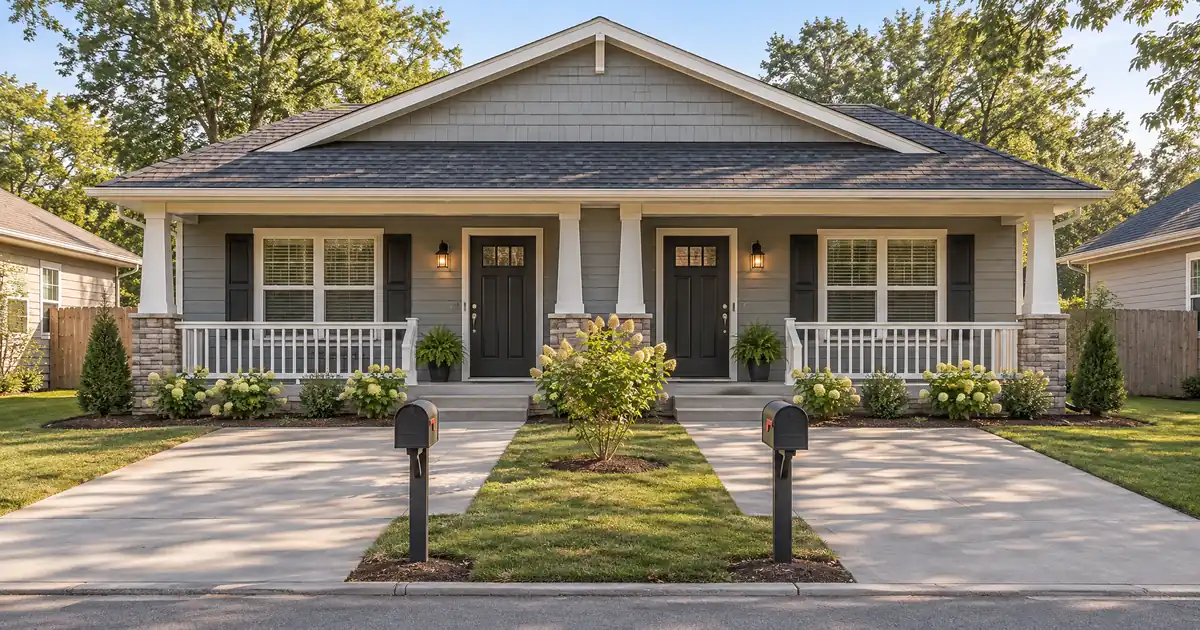
The Quick Read: It depends on how much equity you want to pull and how long you have owned the home. VA cash-out can be the stronger fit for a veteran with eligibility, because it can reach higher leverage and carries no monthly mortgage insurance. FHA cash-out is the fallback when VA is off the table. It caps leverage at 80% of appraised value and charges both an upfront and an annual premium. A duplex works with either program as long as you live in one of the units.
If you have a Certificate of Eligibility and want the most cash with the lowest ongoing cost, VA is the first loan to price. If you lack eligibility, or your VA file runs into trouble, FHA cash-out is a workable second choice that leaves at least 20% equity in the home. Both programs are for the home you live in, so neither works if you have moved out and rented both units.
FHA cash-out estimate
Seeded with an example value, a balance to match, and a round cash request; change any field.
Editable benchmark: 7.18% as of November 5, 2026 · Freddie Mac 30-year average via FRED®. A conventional market reference, not an FHA cash-out refinance quote.
Illustrative starting assumptions: a $350,000 home value, a $193,000 current balance, the FHA cap on a principal residence with the upfront premium financed, a thirty-year term at the current Freddie Mac benchmark, and property taxes and insurance estimated at typical national rates. Every field is editable.
An illustration, not a Loan Estimate, an approval, a quote, or a commitment to lend. The rate shown is the weekly Freddie Mac thirty-year conventional benchmark, used as a market reference; an FHA cash-out is priced by the lender at lock, and this is not an FHA cash-out refinance quote. HUD’s cap limits the base loan; the upfront premium is financed on top of the capped base loan; the monthly premium for the first year follows the snapshot’s schedule. Cash available means the base loan the cap permits less the balances retired, before closing costs, which this calculator leaves out. The line figure applies the line program’s combined loan-to-value ceiling to the same value and balance. Taxes and insurance are estimates you can edit. Licensed in sixteen states for consumer mortgages.
Side-by-Side
| Factor | VA Cash-Out | FHA Cash-Out |
|---|---|---|
| Who it is for | Eligible veterans and service members | Any qualified owner-occupant |
| Maximum leverage | Higher; depends on lender overlays | 80% of appraised value |
| Credit floor | Set by the lender | 580 decision score on the programs Lendmire places |
| Mortgage insurance | None monthly; one-time funding fee | Upfront 1.75% plus annual premium |
| Occupancy | Veteran lives in the home | Owner lives in one unit |
| Units allowed | Up to four, if you occupy one | One to four, if you occupy one |
| Documentation | COE, full appraisal, income and credit review | Full appraisal, income and credit review |
| Ownership test | Seasoning applies if paying off a VA loan | Owned and occupied 12 months before the case number |
Two notes on the table. First, “lender overlays” are a lender’s own rules stacked on top of the program’s. A lender’s ceiling can sit below what the program technically allows. Second, every figure here is subject to lender guidelines and full file review. None of it is a commitment to lend.
What a Cash-Out Refinance Actually Does
A cash-out refinance replaces your current mortgage with a larger one. You keep the difference in cash. That is different from a home equity loan or a HELOC, which sit behind your first mortgage and leave it in place, as the CFPB’s research blog explains.
That matters for a duplex owner. Your first mortgage may carry terms you like. Replacing it means taking on the new program’s insurance or fee structure on the whole balance. A bigger loan can also mean a higher monthly payment or a longer payoff, a point the CFPB’s home equity guide makes plainly.
Key Terms Defined
Cash-out refinance: a new mortgage that pays off your old one and gives you the leftover equity as cash.
Adjusted value: the appraised value FHA uses to measure its leverage cap.
Certificate of Eligibility (COE): the document that proves your VA loan benefit. A lender can usually pull it for you.
Net tangible benefit: VA’s test that the new loan must clearly help you, such as a lower payment, a shorter term or a move out of a riskier loan.
Funding fee: VA’s one-time charge, which can be financed into the loan.
Seasoning: the waiting period before a loan or home qualifies for the next step.
How the Duplex Changes the Picture
A duplex does not shut the door on either program. Both VA and FHA treat the loan as an owner-occupant loan, so you must live in one unit. The other unit is your tenant’s.
Rent from the second unit can help you qualify under FHA. For a two-to-four unit property, HUD Mortgagee Letter 2023-17 says the lender uses 75% of the lesser of the appraiser’s market rent or the lease rent when rental history is limited. Your own unit never counts as income. For VA, do not assume a particular percentage. Rental income treatment varies by lender, so ask before you count on it.
One more duplex point. FHA applies a self-sufficiency test and extra reserves to three- and four-unit homes, not duplexes. A duplex skips that hurdle. County loan limits still apply to FHA, and a duplex limit sits above a one-unit limit. Check the county figure before you plan around a number.
When VA Cash-Out Is the Better Fit
VA wins when a few things line up: you are eligible, you want meaningful cash, and you would like to avoid monthly mortgage insurance.
You want the most equity. FHA stops at 80% of value. VA’s ceiling is higher, though many lenders set their own limits below the program maximum. If your goal needs more than FHA allows, VA is the loan that can reach it.
You pay FHA mortgage insurance today. Across the wholesale programs we place files with, FHA carries an upfront premium of 1.75% plus an annual premium that runs between 0.15% and 0.75% of the balance. On a thirty-year loan with a high loan-to-value ratio, that annual premium lasts the whole term. A veteran in that spot can use VA cash-out to move out of FHA and drop the monthly insurance. VA charges a one-time funding fee instead, which can be financed.
You recently bought with FHA. FHA cash-out needs 12 months of ownership and occupancy before the case number is assigned. A veteran inside that window cannot use FHA cash-out. VA’s seasoning step applies when you are paying off a VA loan, so a veteran paying off an FHA loan generally faces no such wait, though the lender’s own overlays can differ. That is a real timing edge, though the net tangible benefit test still applies.
You may be exempt from the funding fee. Certain disabled veterans and surviving spouses can be exempt. VA decides that, so confirm it on VA.gov before you count on it.
The tradeoff is less cushion. A higher-leverage loan leaves less equity if values slip, because a cash-out’s added risk comes from the new, larger mortgage.
Picture a veteran who bought a duplex with an FHA loan, lives in one side, and rents the other. The property has gained value and the veteran wants cash for repairs on both units. VA cash-out can pay off the FHA loan, remove the monthly premium and hand over the equity. The lender will want the veteran’s occupancy certified, a VA appraisal and a clear net tangible benefit.
When FHA Cash-Out Is the Better Fit
FHA wins when VA is unavailable or when VA’s structure does not fit your file.
You have no VA eligibility, or your entitlement is tied up. FHA does not care about military service. Any owner-occupant who meets the tests can apply, one to four units.
Your credit or income is thin for a VA lender. VA lenders set their own credit floors, and some are stricter than the program. The FHA programs Lendmire places start at a 580 decision score. Ratios start at 31/43 with no compensating factors and can reach 40/50 with documented ones, and the automated finding governs the file. A veteran whose credit is tight may find FHA more forgiving.
You want to stay at lower leverage. FHA’s cap was cut to 80% of appraised value for case numbers on or after September 1, 2019, per HUD Mortgagee Letter 2019-11. HUD’s press release notes the cap had earlier been trimmed from 95% to 85%. For some borrowers, a built-in 20% equity cushion is a feature. You cannot overborrow against a duplex, and you keep a buffer if values soften.
You have owned and lived there for 12 months. The program rule is simple. Own it, live in it for 12 months, then get the case number.
The tradeoff is cost over time. You pay the upfront premium, financed into the loan, plus the annual premium that keeps running. FHA also leaves you with less cash than VA can reach.
For a refinance of an existing FHA loan, FHA also offers a streamline with no appraisal, and a rate-and-term option that reaches 97.75% on a principal residence occupied for the previous twelve months. Those do not give you cash. They matter if cash is not really your goal.
Duplex-Specific Issues Both Programs Share
Appraisal. Both programs require a full appraisal. On a duplex, the appraiser values the whole property and, for FHA, estimates market rent on the second unit. That number feeds income qualification.
Moving out later. Both programs are for your principal residence. If you rent both units after you move, neither standard cash-out path is available. Do the cash-out while you live there.
Free and clear. If you own the duplex outright, taking equity out still counts as a cash-out under FHA’s structure. You are not stuck with a “no mortgage, no refinance” problem.
Inheritance. HUD’s older reference guide describes an exception for homes acquired by inheritance within the prior 12 months, if you have lived there since. Treat that as something to verify with a lender, since the guide is dated.
Overlays. The program may allow something your lender does not. A quote that comes in below a program’s stated ceiling can reflect a lender overlay rather than a rule change. Comparing a few options is the point of working with a broker.
Using the cash. Borrowers most often cite paying off other debts, per CFPB research. The Federal Reserve’s consumer guide notes that many advisers caution against using a cash-out to pay down short-term or unsecured debt, since you convert it into long-term mortgage debt secured by your home. Think about that before you spend the equity.
A Quick Decision Checklist
Ask yourself these in order:
1. Do I have VA eligibility and a COE? If no, FHA is your path. 2. Do I live in one unit of the duplex today? If no, neither program fits. 3. Have I owned and lived there 12 months? If no, FHA cash-out is not open yet, and VA may be. 4. Do I need more cash than 80% of value allows? If yes, price VA. 5. Am I paying FHA mortgage insurance I want to shed? If yes, VA cash-out is worth a look. 6. Is my credit or income thin for a VA lender? If yes, compare FHA. 7. Is the cash for a purpose that justifies a bigger mortgage? Be honest here.
The Balanced Verdict
For an eligible veteran living in a duplex, VA cash-out is usually the first loan to price. It can reach more equity and removes monthly mortgage insurance. FHA cash-out earns its place when VA eligibility is missing, when a lender’s VA credit overlay is too tight, or when you prefer to keep a firm 20% equity cushion.
Neither is a free lunch. Both replace your current mortgage with a bigger one, and both charge for the privilege, through a funding fee on one side and premiums on the other. Compare the full cost over the time you expect to keep the loan.
If you are weighing a cash-out refinance against keeping the loan you have, Lendmire can help you compare the programs and the equity each one reaches. Every figure above is subject to lender guidelines and full file review, and none of it is a commitment to lend.
Frequently Asked Questions
Can I use VA cash-out on a duplex I live in?
Yes, if you occupy one unit as your home and hold a Certificate of Eligibility. VA allows up to four units when the veteran lives in one. The lender will order a VA appraisal and check that the loan gives you a net tangible benefit. Rental income treatment varies by lender, so ask yours how it counts the second unit.
How much equity can I take out with FHA on a duplex?
FHA limits cash-out loans to 80% of adjusted value, so at least 20% equity stays in the home. County loan limits also apply, and a duplex limit is higher than a one-unit limit. Your lender can confirm the figure for your county.
Does rent from the other unit count toward qualifying?
Under FHA, with limited rental history, the lender uses 75% of the lesser of market rent or the lease rent. Your own unit is never counted. VA treatment varies by lender, so confirm it before you plan around it.
Can I move from an FHA loan into VA through cash-out?
Usually, yes, if you are eligible. A VA cash-out can pay off an FHA loan and replace it with a VA loan, which carries no monthly mortgage insurance. VA seasoning applies mainly when you are paying off a VA loan. The net tangible benefit test still applies.
What happens if I move out and rent both units?
Both programs are for a principal residence, so a standard cash-out is generally off the table once you no longer live there. If you expect to move, do the cash-out before you leave.
For your own numbers, request a scenario review with Lendmire.
About Lendmire
Lendmire (NMLS# 2371349) is a mortgage brokerage serving homeowners and home buyers in 16 states. FHA, VA, conventional and jumbo purchase and refinance loans are arranged through wholesale lending channels; Lendmire brokers the financing and the lender underwrites each application. Scotsman Guide named Lendmire a Top Mortgage Workplace in both 2025 and 2026.
Get Started
Ready to find the right loan for you?
See your offer in seconds. No credit pull, no obligation.
Informational only. Not a Loan Estimate, approval, or commitment to lend. Program availability and eligibility are subject to lender guidelines, credit approval, property review, and underwriting.
References
1. CFPB, a look at cash-out refinance mortgages and their borrowers
4. HUD Mortgagee Letter 2023-17
5. HUD Mortgagee Letter 2019-11
6. HUD press release PR 19-114
7. HUD’s older reference guide
9. Federal Reserve, Consumer’s Guide to Mortgage Refinancings
This article is part of Lendmire’s FHA cash-out refinance program — full qualification details, guidelines, and scenarios live on the program page.
Related reading: How to Clear the Conditions That Slow an FHA Cash-Out · How an FHA Cash-Out Works on a Duplex With a Locked-in Mortgage · VA Cash-Out vs FHA Cash-Out After a Quitclaim Deed: What Decides
Brandon Miller
Founder & CEO, Mortgage Loan Originator, Lendmire LLC
- Mortgage Loan Originator · NMLS# 1129696 · Verify on NMLS Consumer Access
- North Carolina Real Estate Broker · License# 343312 · Verify on NCREC
- North Carolina Insurance Producer · License# 19053198 · Property, Casualty, Life, Health · Verify on NAIC SBS
- Lendmire LLC · Firm NMLS# 2371349 · Verify firm licensure
Legal disclosures. Lendmire (NMLS# 2371349) is a state-licensed mortgage brokerage that arranges financing through wholesale lender relationships. Lendmire is not a direct lender, depository institution, or registered financial advisor. The discussion above is general informational content about real estate financing — it is not financial, legal, or tax advice, and readers should consult licensed professionals for guidance on their individual circumstances. Loan inquiries are subject to lender underwriting; this article does not represent a commitment to lend. Loan terms, rates, and qualification standards vary by borrower, property, and state, and are subject to change at any time. Equal Housing Opportunity. NMLS Consumer Access: nmlsconsumeraccess.org.