
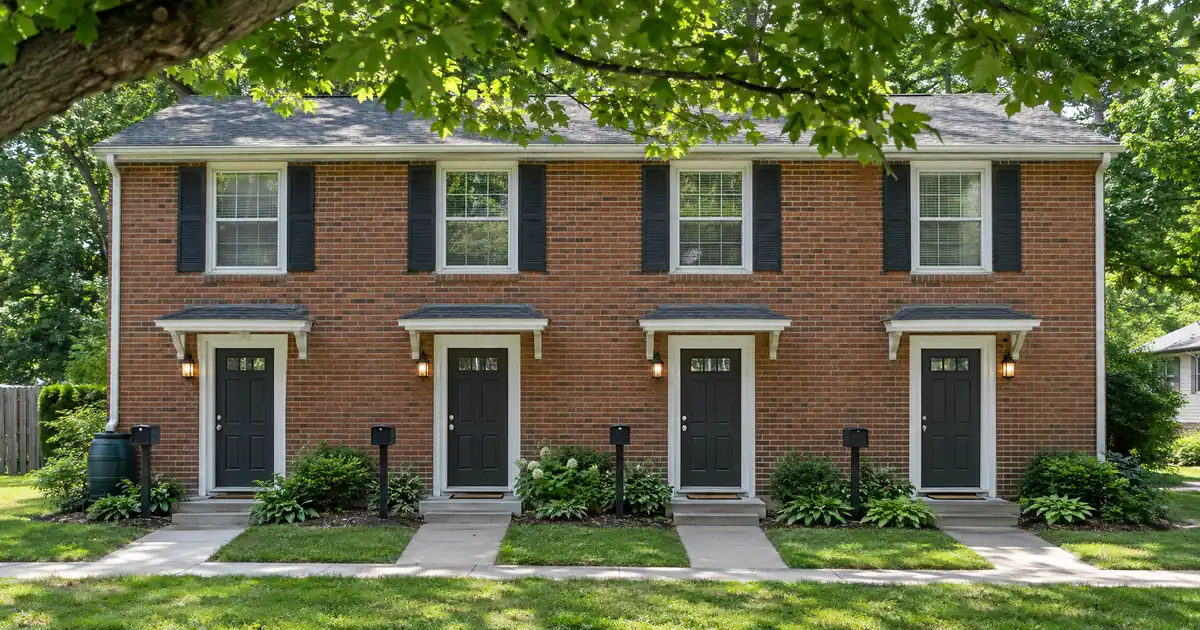
The Quick Read: A VA loan can buy a fourplex with no down payment, as long as you live in one of the four units. The price cannot exceed the appraised value, and with full entitlement the VA sets no loan limit. Rent from the other three units can help you qualify, but the VA only lets part of it count. Reserves, residual income and the lender’s own rules decide how far the deal goes.
What Does the VA Actually Allow on a Four-Unit Building?
A VA loan covers a home with up to four residential units, so a fourplex fits and a fifth unit does not. The VA guarantees the loan, and you must live in the property. That occupancy rule is what separates this from an investment purchase.
VA payment estimate
Starting assumptions reflect an example price with no down payment and a first-use funding fee. Replace them with your own figures.
Editable benchmark: 7.32% as of October 22, 2026 · Freddie Mac 30-year average via FRED®. A conventional market reference, not a VA loan quote.
Illustrative starting assumptions: a $350,000 price, no down payment with full entitlement, a first-use funding fee financed into the loan, a thirty-year term at the current Freddie Mac benchmark, and property taxes and insurance estimated at typical national rates. Every field is editable.
Illustrative estimate only — not a Loan Estimate, approval, quote, or commitment to lend. The rate field carries the weekly Freddie Mac thirty-year conventional benchmark, a market reference and not a VA loan quote; your rate is set by the lender at lock. The funding fee follows VA’s published table for the use and down payment entered; the residual-income figure is VA’s guideline for the region and family size, and the rough residual shown subtracts only the housing payment and the debts entered, while VA also deducts taxes, maintenance and utilities. Taxes, insurance and dues are editable estimates; closing costs are not included. Licensed in sixteen states for consumer mortgages. Lendmire is not affiliated with or acting on behalf of the Department of Veterans Affairs.
The CFPB explains that the VA sets the qualification rules and guarantees the loans. Some VA loans carry no down payment and no private mortgage insurance. The no-down-payment benefit depends on the sales price not exceeding the appraised value.
A few property rules to know:
- Residential first. The building must be mainly a home. A mixed-use building can work with at most one business unit, and the nonresidential space generally has to stay small relative to the building.
- One marketable property. The VA wants a single, readily marketable piece of real estate. Separate parcels or condo-style splits complicate that.
- Two veterans, same ceiling. The program covers up to four units no matter how many veterans buy together. A second veteran on the loan does not add a fifth unit. Joint loans between veterans who are not spouses may need extra review, so raise it with your loan officer early.
If the title made you wonder about renting out a place you will never live in, the answer is one sentence: the VA program is for your primary home, so occupancy decides what it can buy.
The Occupancy Rule: One Unit Is Yours
You sign a statement that you intend to live in the property as your home. In ordinary cases, moving in within a reasonable time after closing satisfies it. Many lenders read that as roughly two months, but the exact standard is worth confirming with your lender.
There are real exceptions. If you are on active duty and cannot move in, a spouse or dependent child may satisfy the occupancy requirement. Timing can also bend for repairs or orders.
What happens after you have lived there? Many owners keep the building and rent all four units later. That is allowed in principle. The catch: your intent at closing must have been genuine. Signing the certification with no plan to live there is misrepresentation, not strategy.
You also do not “use up” the loan for good. The first loan keeps its entitlement tied up while you hold it, so your next purchase runs on the entitlement that remains.
How the Loan Is Underwritten, Step by Step
Underwriting on a fourplex is the same VA process as on a single-family home, plus extra checks around the rent. Across the wholesale programs Lendmire places VA files with, the sequence looks like this.
1. Certificate of Eligibility (COE). The VA decides eligibility. The COE shows your service eligibility and whether your entitlement is full or reduced. Get it first.
2. Credit review. The VA itself sets no minimum credit score. The wholesale programs Lendmire works with start at a 580 decision score. Some lenders set a higher floor, and that is their choice, not a VA rule.
3. Income, debts and residual income. Residual income is what is left of your net income after debts, taxes and shelter costs, to cover family living expenses. It is the controlling test on a VA loan.
4. Rental income analysis. Covered in the next section.
5. Appraisal. The appraiser sets value and checks the property against VA minimum standards.
6. Funding fee and closing. Covered below.
The 41% debt-to-income figure is a guideline, not a cap. A ratio above it needs residual income well above the VA table to compensate. Household size counts, so a larger household faces a higher residual income requirement.
Because the loan is a consumer mortgage, you receive a Loan Estimate and a Closing Disclosure like any other home loan.
How Rent From the Other Units Counts
Rent can help you qualify, but not all of it counts. The VA Lenders Handbook underwriting chapter treats rental income as effective income at 75% of the lease or rental amount, unless a higher percentage is documented. The missing 25% is a built-in cushion for vacancy and repairs. Because the handbook text may change over time, your lender confirms the live rule.
The same chapter asks for two more things. Rental income must be documented and likely to continue. And the file needs a justification on VA Form 26-6393, the loan analysis, showing you have a reasonable likelihood of success as a landlord.
Here is a simple way to picture it. Say the three rented units bring in a combined rent. The lender counts 75% of that figure. Any shortfall between that counted rent and the full housing payment gets added to your monthly obligations. The rest of your debts sit on top.
Two related points trip people up:
- Reserves. When rent is used to qualify, reserves are required. The handbook confirms the requirement. The month count is the lender’s to confirm, so ask for the number up front.
- Offset versus income. If you are keeping a former home as a rental, that rent is only an offset against that mortgage. It is not effective income. Rent from the units in the fourplex you are buying is treated differently.
The practitioner view: the 75% rule is the easy part. Landlord-experience documentation and reserves are where fourplex files stall. A first-time owner with no landlord history should expect questions.
Is It Really No Down Payment?
Yes, with full entitlement, 100% financing is available. The price must not exceed the appraised value, and there is no mortgage insurance of any kind. With full entitlement, there is no VA loan limit. The wholesale programs Lendmire places VA loans with serve amounts up to $4,000,000.
Two cautions. First, “no limit” does not mean “unlimited approval.” Your income, residual income, appraisal and the lender decide the ceiling. Second, if your entitlement is partly tied up from an earlier VA loan, a down payment may be required. For that math, speak with a loan officer rather than guessing from a county figure.
Cash still leaves your pocket even at zero down. Budget for closing costs, a home inspection, reserves, and any repairs the appraisal requires. A fourplex means four units of potential repairs.
The VA Funding Fee
The funding fee is a one-time charge on the loan amount. It can be financed into the loan and is waived for veterans receiving compensation for a service-connected disability, along with other exempt groups. The VA’s funding fee schedule sets the tiers, and they match what Lendmire sees on purchase files:
| Use | Down payment | Fee |
|---|---|---|
| First use | Under 5% | 2.15% |
| First use | 5% to under 10% | 1.5% |
| First use | 10% or more | 1.25% |
| Subsequent use | Under 5% | 3.3% |
| Subsequent use | 5% to under 10% | 1.5% |
| Subsequent use | 10% or more | 1.25% |
Because the fee applies to the loan amount, a fourplex price makes the dollar cost large. That makes your exemption status worth confirming on your COE before you budget.
Appraisal and Minimum Property Requirements
The appraiser does two jobs: setting value and checking that the building meets the VA’s minimum property requirements. These standards are a legal requirement, and they also expose defects that affect value. The appraiser may require repairs as a condition, though not for cosmetic items or normal wear.
On a fourplex, every unit matters, including a vacant one. A unit with a failed system can hold up the whole file. The appraisal is also not a home inspection. The VA suggests you consider a separate inspection, and on a four-unit building that advice earns its fee.
Where the General Rule Breaks
- Fifth unit or heavy commercial space. Outside the program.
- Partial entitlement. A down payment may be needed even at four units. The VA is reported to use a one-unit conforming limit in the entitlement calculation for multi-unit homes, so confirm that with your lender.
- Lender overlays. Higher credit floors, extra reserves, or refusing to count rent are lender choices. They tend to bite hardest on three- and four-unit deals. The CFPB confirms that not all lenders participate in the VA program, so who you ask matters.
- Active-duty occupancy. A spouse or dependent may satisfy it.
- Short-term rental plans. Check the lender’s view before you build your income plan around nightly stays.
- Prepayment. The upside: VA borrowers can prepay without a penalty.
Key Terms Defined
Entitlement: The amount of your VA benefit available to guarantee a loan. Full entitlement means no VA loan limit.
Certificate of Eligibility (COE): The VA document showing you qualify and what entitlement you hold.
Residual income: Net income left each month after debts and shelter costs, to cover family living expenses.
Funding fee: A one-time VA charge on the loan amount, which can be financed and is waived for exempt veterans.
Reserves: Liquid savings a lender wants to see after closing.
Minimum property requirements: The VA’s condition standards for a home it guarantees.
What the Decision Looks Like in Practice
Picture a veteran with full entitlement eyeing a fourplex where three units are already leased. The first step is the COE. The second is a lender who actually does four-unit VA files. Then comes the file: leases, landlord history, reserves, debts and household size.
Whether it works comes down to a short list: entitlement status, documented rent at 75%, reserves, residual income, appraised value versus price, whether the building passes minimum property requirements, and the lender’s overlays. Weak on one can often be balanced by strength on another. Strong residual income and savings are recognized compensating factors, subject to lender guidelines.
If cash for the first purchase is the sticking point, Lendmire’s piece How to Use a VA Cash-Out for a Down Payment and Keep the Home shows another route.
Lendmire’s VA loan programs are arranged through wholesale lenders in the 16 states where it is licensed for consumer lending. Every program figure here is subject to lender guidelines and full file review, and none of it is a commitment to lend.
If you are buying a home and want to see whether a VA loan fits your file, Lendmire can help you compare the options and what each one asks of the file.
Frequently Asked Questions
Can I buy a five-unit building with a VA loan?
No. The program covers homes with up to four residential units. A fifth unit puts the property outside it.
Do I have to live in the fourplex?
Yes. You certify that you intend to occupy one unit as your home. Active-duty buyers who cannot move in may have a spouse or dependent child satisfy the requirement. After a genuine period of occupancy, many owners move out and keep renting.
Does all the rent count toward qualifying?
No. The VA handbook counts 75% of the lease or rental amount unless a higher percentage is documented. Reserves are required when rent is used, and the file needs a landlord-ability justification.
Is the funding fee waived for everyone?
No. It is waived for veterans receiving compensation for a service-connected disability and the other exempt groups. Everyone else pays a fee that depends on use and down payment, and it can be financed.
Will every lender do a VA fourplex loan?
No. Not all lenders participate in the VA program, and overlays on three- and four-unit deals vary. Ask early about credit floors, reserves and how rent is counted.
For your own numbers, request a scenario review with Lendmire.
About Lendmire
Lendmire is a mortgage brokerage (NMLS# 2371349) licensed for consumer mortgage lending in 16 states, arranging FHA, VA, conventional and jumbo purchase and refinance loans through a wholesale lending network. Eligibility is determined by the lender on each file. Scotsman Guide named Lendmire a Top Mortgage Workplace in both 2025 and 2026.
Get Started
Ready to find the right loan for you?
In about 30 seconds you can review financing options available for your home or investment property. No commitment required.
Informational only. Not a Loan Estimate, approval, or commitment to lend. Program availability and eligibility are subject to lender guidelines, credit approval, property review, and underwriting.
References
1. CFPB
2. VA Lenders Handbook, Chapter 4: Underwriting
3. VA News – Funding fee: who pays and who is exempt
This article is part of Lendmire’s VA loan program — full qualification details, guidelines, and scenarios live on the program page.
Related reading: How to Figure the Down Payment on a VA Loan With Partial Entitlement · How Much a Down Payment Saves on a VA Loan Funding Fee · How to House Hack a Fourplex With a VA Loan and No Money Down
Brandon Miller
Founder & CEO, Mortgage Loan Originator, Lendmire LLC
- Mortgage Loan Originator · NMLS# 1129696 · Verify on NMLS Consumer Access
- North Carolina Real Estate Broker · License# 343312 · Verify on NCREC
- North Carolina Insurance Producer · License# 19053198 · Property, Casualty, Life, Health · Verify on NAIC SBS
- Lendmire LLC · Firm NMLS# 2371349 · Verify firm licensure
Disclosures. The information presented in this article is general market commentary, not financial, legal, or tax advice. Lendmire is a mortgage brokerage (NMLS# 2371349) — not a direct lender or depository institution — and loan placement is subject to lender underwriting. Nothing in this content represents a commitment to lend. Loan terms, pricing, and program availability vary based on borrower qualifications, property characteristics, and state of subject property, and are subject to change at any time. Lendmire complies with Equal Housing Opportunity requirements. Consumer access: nmlsconsumeraccess.org.