
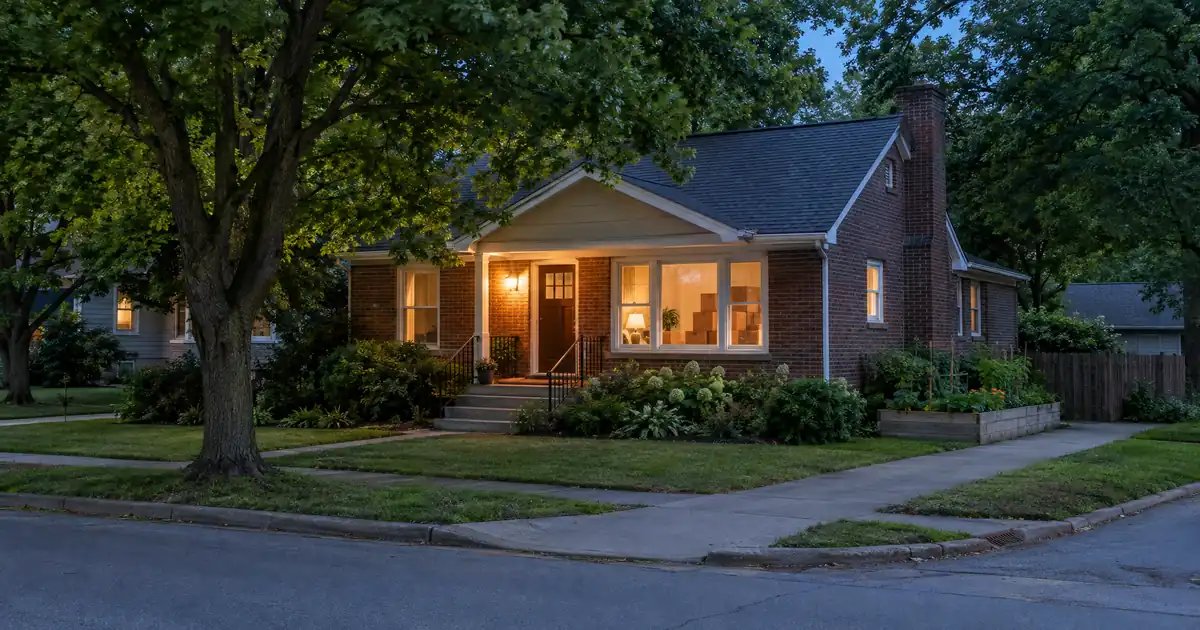
The Quick Read: The VA loan is usually the strongest starting point for an eligible veteran, but it is not the winner every time. VA fits buyers who want little or no money down and no monthly mortgage insurance. FHA fits buyers with thinner credit or savings. Conventional fits buyers with solid credit and a larger down payment. Your own numbers decide it.
Here is the honest answer, option by option.
FHA payment estimate
Starting assumptions reflect an example price and the FHA minimum investment. Replace them with your own figures.
Editable benchmark: 7.32% as of October 22, 2026 · Freddie Mac 30-year average via FRED®. A conventional market reference, not an FHA loan quote.
Illustrative starting assumptions: a $350,000 price, the FHA minimum investment as the down payment, a thirty-year term at the current Freddie Mac benchmark, and property taxes and insurance estimated at typical national rates. Every field is editable.
Illustrative estimate only — not a Loan Estimate, approval, quote, or commitment to lend. The rate field carries the weekly Freddie Mac thirty-year conventional benchmark, a market reference and not an FHA loan quote; your rate is set by the lender at lock. FHA mortgage insurance follows HUD’s published schedule for the term, leverage and loan size entered; taxes, insurance and dues are editable estimates; closing costs are not included; county loan limits are not checked here. Licensed in sixteen states for consumer mortgages. Lendmire is not affiliated with or acting on behalf of FHA, HUD, or the federal government.
VA is built for people who served. It has the lightest cash requirement and no monthly mortgage insurance. You trade that for a one-time funding fee, a service-based eligibility check, and a home that must pass VA property standards.
FHA is open to anyone who qualifies, not just veterans. It forgives more on credit and debt than most options. You pay for that with mortgage insurance that can last a long time.
Conventional has no government backing. It rewards strong credit and real savings. When your down payment is small, it adds private mortgage insurance, but that can be cancelled later.
A veteran can choose any of the three. Being VA-eligible does not lock you in.
Key Takeaways
- VA allows no down payment when the price is at or below the appraised value, with a funding fee instead of monthly mortgage insurance.
- FHA allows financing up to 96.5% of value (a 3.5% minimum investment) at a decision score of 580 or higher on the wholesale programs Lendmire works with.
- Conventional costs less over time for many buyers with strong credit and a bigger down payment, because its mortgage insurance can end.
- Choosing FHA or conventional generally does not spend your VA entitlement, so the benefit stays available later.
- Compare real Loan Estimates for all three. General rules only get you to the starting line.
Side-by-Side
This table shows the structural differences. It leaves out pricing on purpose, because pricing depends on your file and your lender. All figures are subject to lender guidelines and full file review.
| Factor | VA | FHA | Conventional |
|---|---|---|---|
| Who qualifies | Eligible service members and veterans | Any eligible borrower | Any eligible borrower |
| Leverage | No down payment if price ≤ appraisal | Up to 96.5% (3.5% minimum investment) | Smaller down payments possible; varies |
| Credit floor | No VA minimum; lenders set their own | 580+ for maximum financing | Set by lender; often higher |
| Mortgage insurance | One-time funding fee; no monthly insurance | 1.75% upfront plus annual premium | Private insurance if down payment is small |
| Occupancy | Your primary home | Your primary home, 1–4 units | Primary, second home, or rental |
| Underwriting focus | Entitlement, residual income, appraisal | Decision score, ratios 31/43 up to 40/50 | Credit, down payment, debt ratio |
| Appraisal | VA-assigned; must meet property standards | FHA roster appraiser; HUD standards | Lender’s appraisal |
A few notes on the table. Debt-to-income (DTI) means your monthly debts as a share of your gross monthly income. The 31/43 pair is housing cost over total debt, with no compensating factors. Documented strengths like savings can stretch FHA to 40/50 at the top tier. The automated underwriting finding governs most files.
For FHA, the FHA loan programs Lendmire arranges through wholesale lenders start at a 580 decision score. HUD itself allows a lower tier with a bigger down payment, but that tier sits outside what these wholesale programs reach.
How VA Works for a First-Time Buyer
VA loans come from private lenders, with a VA guarantee behind them. Eligibility depends on your length of service, duty status and character of service, per VA Home Loans. You prove it with a Certificate of Eligibility (COE).
Veterans typically request the COE with a copy of their discharge papers (DD214). Active-duty members use a statement of service signed by a commander or personnel officer. Your lender can often pull it for you.
Entitlement is the portion of the VA benefit available to back your loan. A first-time user starts clean, with full entitlement. The VA Buyer’s Guide says there is no loan limit with full entitlement. It also says no down payment is needed as long as the sales price is at or below the home’s appraised value.
Two other VA features matter. First, VA sets no minimum credit score. Lenders set their own, called overlays, and some are stricter than the VA baseline. Second, VA looks at residual income. That is the cash left each month after your obligations, scaled by region and household size. It is weighed alongside DTI, and it often helps buyers with larger families or higher debt.
VA also requires that the loan meet credit, income and occupancy standards from both the VA and your lender, per VA’s eligibility page. The home must be one you will live in.
What the VA Funding Fee Actually Is
VA has no monthly mortgage insurance. It charges a funding fee instead. VA News on the funding fee explains that the fee varies with loan type, military category, first-time versus repeat use, and down payment.
Think of it as a one-time charge, not a monthly one. You can pay it in cash at closing or finance it into the loan. Financing it keeps cash in your pocket on closing day. It also adds to your balance.
Some veterans are exempt, including those who receive VA compensation for a service-connected disability. The exemption needs to show on your COE before closing, so ask early.
When VA Is the Better Fit
VA usually wins when most of these describe you:
- You are eligible and have limited savings for a down payment.
- You want to avoid monthly mortgage insurance for as long as you own the home.
- Your debt load is on the higher side, but your residual income is healthy.
- You are buying a home you will live in, and it is in decent condition.
- You may be exempt from the funding fee.
Picture a service member with a stable income and a modest savings account. Their credit is fine but not outstanding. They want a house near the base. VA lets them buy with no down payment if the appraisal supports the price. They avoid a monthly insurance charge. Conventional would ask for more cash up front, and FHA would add insurance that lasts years.
A first-time veteran buyer also has the cleanest entitlement picture. If you later want to reuse the benefit, Lendmire’s comparison of VA and conventional cash-out for a veteran with restored entitlement shows how restoration works.
Where VA gets tricky. The appraisal is the main hurdle. A VA appraiser is assigned to the file. The appraisal estimates value and notes readily apparent repairs that must be fixed. It is not a home inspection, and the appraiser does not test the furnace or appliances. Hire a home inspector anyway.
If the home appraises below the price, you may need to bring cash for the gap, negotiate the price down, or walk away. Older homes and fixer-uppers can run into property standards. VA does allow repair waivers on some items with the lender’s concurrence, but the home still has to be safe, structurally sound and sanitary.
Some sellers and agents are less familiar with VA’s property rules. A strong pre-approval and a flexible response to repair requests help your offer.
When FHA Is the Better Fit
FHA can beat VA for a veteran in a few situations. They are less common, but they exist.
- Your credit is thin, and the lenders you talk to set a higher VA overlay than FHA’s.
- You want a high-leverage option with flexible debt ratios, and the property would struggle against VA standards.
- You are not eligible for VA, or your entitlement is tied up.
FHA is mortgage insurance from HUD that protects the lender. The FDIC’s summary of FHA’s insurance program describes it that way. It is open to any eligible borrower, not only people with weak credit.
Across the wholesale programs Lendmire places FHA files with, a 580 decision score unlocks maximum financing of 96.5%, with a 3.5% minimum required investment. Seller or interested-party contributions are allowed up to 6% of the price. A non-occupant co-borrower can be added to help the file. The home must be your principal residence, one to four units.
The cost side works in two parts. There is an upfront premium of 1.75% of the base loan, which is financed. There is also an annual premium, charged monthly, that ranges from 0.15% to 0.75% of the balance depending on term, loan amount and LTV. On a thirty-year loan above 90% LTV, the annual premium lasts for the loan term. At or below 90%, it ends after eleven years. Those are program facts, not a quote. Final terms depend on the lender’s guidelines, the property type, and the borrower’s complete credit picture.
That duration is the main trade-off. A veteran with a small down payment could pay FHA premiums for decades. Compare that with VA’s one-time fee.
FHA also has credit-event rules from HUD. For example, HUD sets waiting periods after a chapter 7 discharge or a foreclosure. Those are HUD’s rules, not a promise from any wholesale lender. County loan limits apply, so check yours before you shop.
If your credit is the sticking point, Lendmire’s look at VA and FHA cash-out for a veteran with a thin credit profile shows how the two programs treat the same file.
When Conventional Is the Better Fit
Conventional is the right call more often than veterans expect. It fits when:
- Your credit is strong and your down payment is meaningful.
- You want mortgage insurance that can come off.
- You are buying a second home or a rental later, since conventional can finance those and VA and FHA cannot.
- The home would struggle with VA or FHA property standards.
- The seller is likelier to accept a conventional offer in a tight local market.
Conventional loans have no federal guarantee. When the down payment is small, the lender may arrange private mortgage insurance (PMI). The Consumer Financial Protection Bureau says PMI varies with down payment and credit score. It is generally cheaper than FHA for borrowers with good credit. Most PMI is paid monthly, with little or no payment at closing.
The big difference is that PMI can be cancelled. Once you have paid the loan down enough, you can ask your servicer to drop it. Federal law also ends it automatically later if you stay current. A larger down payment can mean smaller insurance or none.
Run a scenario with a veteran who has a high credit score and a substantial down payment saved. VA would still work. Yet conventional may come out even or ahead, because the funding fee goes away and PMI is minor or absent. For many buyers, the question is whether the funding fee costs more than a small PMI charge.
Conventional also has no VA-style appraisal rulebook. The appraisal still has to support the value. It is just less tied to property condition standards.
Which Option Fits Which Veteran?
Use this as a quick matching guide, then confirm it with real numbers.
| Your situation | Often the best starting point |
|---|---|
| Little savings, eligible, home in good shape | VA |
| Strong credit and a large down payment | Conventional, compare with VA |
| Thin credit, limited savings | FHA or VA, depending on lender overlays |
| Older home needing repairs | Conventional or FHA, then test VA |
| Funding fee waived by disability rating | VA, usually by a wide margin |
| Short planned stay | Compare upfront costs; lower upfront cost wins |
| Long planned stay | Compare how long each insurance charge lasts |
The hold period matters more than most buyers expect. FHA’s annual premium keeps going on many loans. VA’s fee is a one-time cost. PMI ends when you build equity. Your planned stay changes which charge hurts most.
Common Mistakes Veterans Make
Assuming VA is free. There is no monthly mortgage insurance, but the funding fee is real unless you are exempt.
Assuming VA means zero cash, always. If the appraisal comes in below the price, you may need cash. If your entitlement is partial, a down payment may be needed above a limit.
Skipping the home inspection. VA’s appraisal is not an inspection. A separate inspection protects you.
Treating the program minimum as the lender’s minimum. Lenders can set stricter credit floors than HUD or VA.
Comparing programs without a Loan Estimate. The Loan Estimate is the standard form lenders give you after you apply. It lets you compare cost and cash to close on equal terms.
The Order to Do It In
1. Confirm VA eligibility and get your COE.
2. Pull your credit and know your score before you talk to anyone.
3. Decide how much cash you can bring and keep in reserve.
4. Ask for Loan Estimates on VA, FHA and conventional for the same home and price.
5. Compare cash to close, monthly mortgage insurance, and how long each insurance charge lasts.
6. Pick the one that fits your plan for how long you will stay.
Key Terms Defined
Certificate of Eligibility (COE): The VA document that proves you qualify and shows your entitlement and funding fee status.
Entitlement: The portion of your VA benefit available to back a loan.
Funding fee: The one-time VA charge that replaces monthly mortgage insurance.
Upfront premium: The one-time FHA insurance charge, financed into the loan.
Annual premium: The recurring FHA insurance charge, collected monthly.
PMI: Private mortgage insurance on conventional loans with a small down payment.
Residual income: The cash left after monthly obligations, a core part of VA underwriting.
Overlay: A lender’s own rule that is stricter than the program’s baseline.
Debt-to-income (DTI): Your monthly debts as a share of your gross monthly income.
The Balanced Verdict
VA is the best fit for many eligible first-time buyers. It combines low cash needs with no monthly insurance. That edge is real, especially if you qualify for the funding fee waiver.
It is not a lock. Conventional can match or beat VA for a veteran with strong credit and meaningful savings. FHA can work when credit is thin, or when a lender’s VA overlay is tighter than its FHA one. The property itself can tip the choice, since VA and FHA both ask the home to meet standards.
The honest approach is to price all three on one home and one budget. Then pick the one whose cost curve matches how long you plan to stay.
Next Step
If you are buying a home and want to see whether an FHA loan fits your file, Lendmire can help you compare the options and what each one asks of the file. Lendmire is a mortgage broker licensed for consumer lending in 16 states. It arranges loans through wholesale lenders. Qualification is subject to lender guidelines and full file review, and nothing here is a commitment to lend.
Frequently Asked Questions
Can a veteran choose FHA or conventional instead of VA?
Yes. VA eligibility does not require you to use VA. Any eligible borrower can apply for FHA or conventional. Many veterans compare all three and pick whichever fits their credit, savings and plans.
Does using FHA or conventional first use up my VA benefit?
Generally no. Entitlement is tied to VA loans, so choosing another program does not spend it. What you have available stays available for a future VA loan. Ask your lender to confirm your status before you decide.
Is there a minimum credit score for a VA loan?
VA sets no minimum score, but lenders set their own. Some apply stricter overlays than VA’s baseline. On the FHA side, the wholesale programs Lendmire works with start at a 580 decision score.
Does the VA appraisal replace a home inspection?
No. The appraisal estimates value and notes readily apparent repairs. It does not test mechanical systems or appliances. A separate inspection tells you what condition the home is really in.
Which loan has the lowest monthly cost?
It depends on your file. VA has no monthly mortgage insurance. FHA adds an annual premium. Conventional adds PMI only when the down payment is small, and it can be cancelled. Compare Loan Estimates on the same home to see the actual difference.
For your own numbers, request a scenario review with Lendmire.
About Lendmire
Lendmire is a mortgage brokerage (NMLS# 2371349) licensed for consumer mortgage lending in 16 states, arranging FHA, VA, conventional and jumbo purchase and refinance loans through a wholesale lending network. Eligibility is determined by the lender on each file. Scotsman Guide named Lendmire a Top Mortgage Workplace in both 2025 and 2026.
Get Started
Ready to find the right loan for you?
In about 30 seconds you can review financing options available for your home or investment property. No commitment required.
Informational only. Not a Loan Estimate, approval, or commitment to lend. Program availability and eligibility are subject to lender guidelines, credit approval, property review, and underwriting.
References
1. HUD
2. VA Home Loans, Veterans Benefits Administration
3. VA Home Loan Guaranty Buyer’s Guide
4. VA: Eligibility for Home Loan Programs
5. VA News: Funding Fee, Who Pays and Who Is Exempt
6. FDIC’s summary of FHA’s insurance program
7. Consumer Financial Protection Bureau: What Is Mortgage Insurance and How Does It Work?
This article is part of Lendmire’s FHA loan program — full qualification details, guidelines, and scenarios live on the program page.
Related reading: Does an FHA Cash-Out Ever Beat VA for a Veteran in a Conventional Loan? · Conventional vs FHA Cash-Out Requirements on a 2–4 Unit Primary Home · Can a Homeowner With an FHA Loan Do an FHA Cash-Out in Texas?
Brandon Miller
Founder & CEO, Mortgage Loan Originator, Lendmire LLC
- Mortgage Loan Originator · NMLS# 1129696 · Verify on NMLS Consumer Access
- North Carolina Real Estate Broker · License# 343312 · Verify on NCREC
- North Carolina Insurance Producer · License# 19053198 · Property, Casualty, Life, Health · Verify on NAIC SBS
- Lendmire LLC · Firm NMLS# 2371349 · Verify firm licensure
Important disclosures. Lendmire (NMLS# 2371349) is a licensed mortgage brokerage. Lendmire is not a direct lender, depository institution, or financial advisor. All loan inquiries are subject to lender underwriting; this article does not constitute a commitment to lend. Rates, terms, and program guidelines are subject to change without notice and vary by borrower profile, property type, and state. Information in this article is general in nature and is not financial, legal, or tax advice. Equal Housing Opportunity. NMLS Consumer Access: nmlsconsumeraccess.org.