
The Quick Read: Usually no. If you have enough VA entitlement, VA is typically the stronger first choice for a 2-4 unit home you will live in. FHA wins in specific cases: a 3-4 unit building where VA’s reserve and landlord conditions are hard to meet, limited or used-up entitlement, a co-borrower who will not live in the home, or a lender whose VA overlays are stricter than FHA’s rules. This is a judgment call built from agency rules, not a rule that fits every file.
Why VA Usually Wins, and Where That Stops
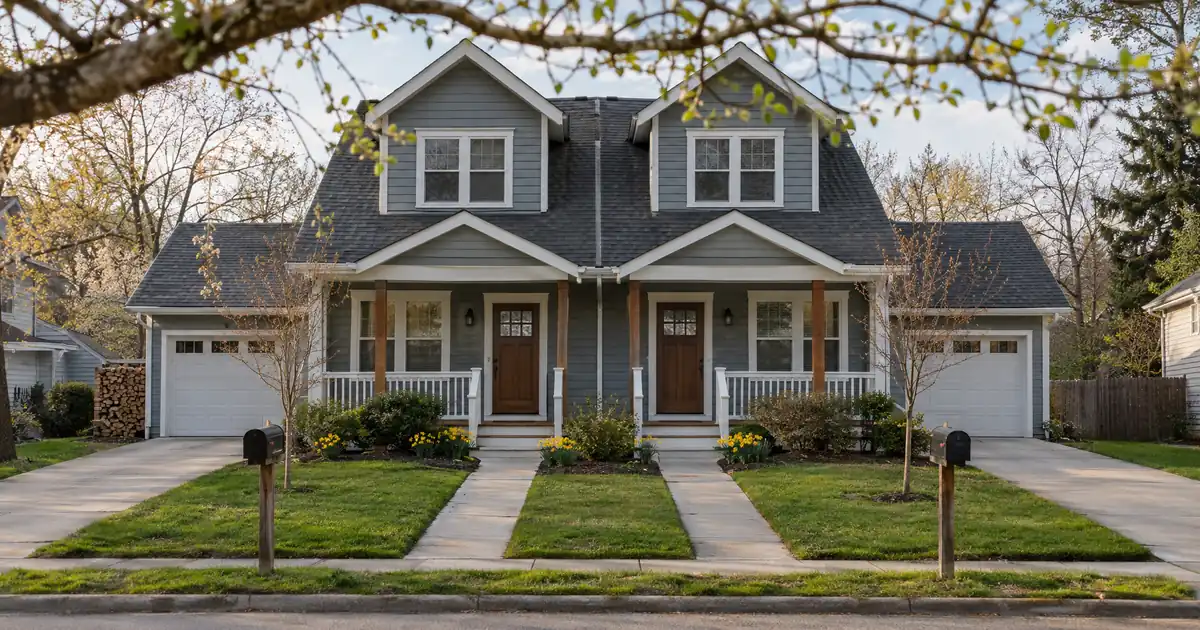
House hacking means buying a small multi-unit building, living in one unit, and letting the rent from the others offset your cost of living. Both VA and FHA allow it on two to four units. Both require that you live there.
FHA payment estimate
Starting assumptions reflect an example price and the FHA minimum investment. Replace them with your own figures.
Editable benchmark: 7.32% as of October 22, 2026 · Freddie Mac 30-year average via FRED®. A conventional market reference, not an FHA loan quote.
Illustrative starting assumptions: a $350,000 price, the FHA minimum investment as the down payment, a thirty-year term at the current Freddie Mac benchmark, and property taxes and insurance estimated at typical national rates. Every field is editable.
Illustrative estimate only — not a Loan Estimate, approval, quote, or commitment to lend. The rate field carries the weekly Freddie Mac thirty-year conventional benchmark, a market reference and not an FHA loan quote; your rate is set by the lender at lock. FHA mortgage insurance follows HUD’s published schedule for the term, leverage and loan size entered; taxes, insurance and dues are editable estimates; closing costs are not included; county loan limits are not checked here. Licensed in sixteen states for consumer mortgages. Lendmire is not affiliated with or acting on behalf of FHA, HUD, or the federal government.
VA is usually the better starting point for a simple reason. It does not charge monthly mortgage insurance, and it does not require a down payment from a veteran with full entitlement. FHA carries a minimum investment of 3.5% at a decision score of 580 or higher, plus mortgage insurance for years. On a small building, that gap shows up in your monthly budget and your cash.
But “usually” is doing real work in that sentence. A building with four units, tired rents, and a first-time landlord is a different file than a clean duplex. Entitlement matters. The people on the loan matter. So does the lender you land with.
Across the FHA files a broker arranges through wholesale lenders, the pattern is consistent. The unit count and the appraiser’s rent figures decide more than the loan’s headline features do. Lendmire’s FHA loan programs are built for this kind of side-by-side comparison. The rest of this piece walks through where each program wins.
What Do Both Loans Share on 2-4 Units?
Both programs treat a house hack as owner-occupied financing. Here is what they have in common:
- You buy a building with two, three, or four units.
- You move into one unit as your principal residence. Typical expectations are moving in within about two months and intending to stay at least a year. Confirm the exact terms with your lender.
- Some rental income from the other units can help you qualify.
- The appraiser reviews the property’s condition and its market rents.
Occupancy is the dividing line from investor financing. A loan for a building you will not live in is a different product with different rules. Neither FHA nor VA works that way. You live there, and that is what earns you the owner-occupant terms.
Where Do They Differ on a Multi-Unit Purchase?
The differences cluster in cost structure, rent treatment, reserves, and who can be on the loan.
| Factor | FHA | VA |
|---|---|---|
| Minimum investment | 3.5% (580+ score) | Often none with full entitlement |
| Maximum financing | 96.5% LTV | Depends on entitlement |
| Mortgage insurance | Upfront 1.75% plus annual | None monthly; one-time funding fee |
| Loan size | County limits apply | Entitlement-based |
| Who can be on the loan | Non-occupant co-borrower allowed | Veteran or spouse generally expected |
| Extra underwriting | Self-sufficiency test (3-4 units) | Residual income; lender overlays |
FHA’s annual premium runs between 0.15% and 0.75% of the balance, depending on term, loan amount, and LTV. On a thirty-year loan above 90% LTV, the annual premium lasts for the full term. At or below 90%, it ends after eleven years. The 1.75% upfront premium is financed into the loan. Leverage, reserves, and pricing vary by lender and program; the final terms follow the full file review.
VA replaces all of that with a one-time funding fee. It varies by down payment and prior use, and veterans receiving disability compensation are generally exempt. The VA funding fee page explains the structure.
Every figure here is subject to lender guidelines and full file review. None of it is a commitment to lend.
How Does Rent Count Toward Qualifying?
Neither program lets you count every dollar of rent. Both haircut it, and both want proof you can handle being a landlord.
On the FHA side, HUD’s Mortgagee Letter 2023-17 lets rent from the subject property count as income on a two- to four-unit dwelling. With limited or no rental history, the lender uses 75 percent of the lesser of two numbers: the appraiser’s fair market rent, or the rent in the lease or rental agreement. Income from commercial space is excluded. The same letter requires documented reserves of three months’ PITI after closing on 3-4 unit properties. PITI stands for principal, interest, taxes, and insurance.
On the VA side, the VA Lenders Handbook, Chapter 4 governs credit underwriting. For an owner-occupied multi-unit purchase, the handbook conditions prospective rent on your reasonable likelihood of success as a landlord and a larger cash-reserve cushion. VA’s current online version lives in KnowVA. Read the current text there before relying on any specific reserve figure you see online.
Here is the practical translation. FHA gives you a clear, documented formula. VA asks the lender to judge your landlord capability, and that judgment varies by lender.
What Is FHA’s Self-Sufficiency Test?
The self-sufficiency test applies only to three- and four-unit FHA purchases. A duplex skips it.
In plain terms, the lender takes the appraiser’s market rent for all units, including the one you will live in. It reduces that total by an allowance for vacancy and maintenance. Then it compares the result to the full housing payment, including mortgage insurance. If the building cannot carry itself on that math, the loan does not work as structured.
HUD’s exact current wording sits in Handbook 4000.1. Check the current section before running your own numbers. Handbook text gets updated.
VA does not publish a self-sufficiency test for 3-4 units in its handbook. Some individual lenders add one as an overlay. That is lender policy, not VA policy. Two VA lenders can reach different answers on the same building.
This is where the “wash” argument falls apart. People say both programs test the building, so it makes no difference. They do not test it the same way. FHA’s test is written down and uniform. VA’s version is a lender-by-lender question.
Can You Treat a Duplex Differently Than a Fourplex?
Yes, and it is one of the biggest swing factors.
A duplex avoids FHA’s self-sufficiency test and its three-month reserve requirement. FHA is easiest here. If you also have a lower decision score or thin cash, the 3.5% minimum investment and flexible ratios can make a duplex work on FHA when a VA lender is being cautious. Terms vary by lender guidelines, property type, leverage, credit profile, and full file review.
A fourplex raises the bar on both loans. FHA asks for the self-sufficiency test and documented reserves. VA asks for landlord capability and a bigger reserve cushion. A fourplex with weak appraised rents can struggle under either program, so the rent number on the appraisal matters more than which loan you pick.
Two details matter on rooms and extra dwellings. HUD treats a renter of a separate unit differently from a boarder renting space inside your own dwelling unit, and Mortgagee Letter 2025-04 revised the boarder-income rules. A renter in an accessory dwelling unit is not a boarder. Under ML 2023-17, a one-unit home with a single accessory unit stays a one-unit property. With two or more units, a separate additional dwelling counts as a unit. That changes which rules apply, so tell your lender about any extra dwelling before the appraisal.
Does Entitlement Change the Answer?
It is the strongest argument for FHA. Entitlement is the amount of VA’s guaranty available to you. Full entitlement means VA generally does not cap the loan size. Partial or used entitlement changes the math, because the lender may require a down payment to cover the gap.
Picture a veteran who still has a prior VA loan open on another home. Their remaining entitlement is limited. A multi-unit building may need more than that entitlement supports without cash down. In that case, FHA’s 3.5% minimum investment and 96.5% maximum financing can be simpler, subject to county loan limits.
The reverse also happens. A veteran with full entitlement and strong cash can use VA with no monthly mortgage insurance. They give up nothing by skipping FHA.
Sequencing matters too. A veteran can sometimes reuse entitlement after selling or after paying off a VA loan, and VA allows a home to become a rental once the occupancy period ends. Details vary, so confirm them with VA or your lender. If you plan to buy again soon, ask how today’s choice affects your next purchase. Lendmire’s article Can a Veteran Do a VA Cash-Out on a 2-4 Unit Primary Home? covers the exit side of the house hack.
Which Loan Fits Which Situation?
| Your situation | Better fit | Why |
|---|---|---|
| Full entitlement, solid profile | VA | No monthly mortgage insurance |
| Partial or used entitlement | FHA often | Defined 3.5% minimum investment |
| Duplex, thin cash | Either; compare | FHA skips the 3-4 unit test |
| 3-4 units, weak appraised rent | Neither easily | Both want reserves and rent support |
| Need a non-occupant co-borrower | FHA | VA generally expects veteran or spouse |
| VA lender adds strict overlays | FHA | Written rules, fewer lender variables |
| Repairs needed on an older building | Compare both | Condition standards apply to each |
The table is a starting point. Real files blur the lines.
What Do Three Realistic Files Look Like?
The duplex with used entitlement. Picture a veteran buying a duplex with a decision score above 580 and one VA loan still open. Entitlement is limited. FHA’s 3.5% minimum investment works, the self-sufficiency test does not apply, and the rent counts at 75% of the lesser figure. FHA is a reasonable choice here, though the annual mortgage insurance is a real cost to compare.
The fourplex with full entitlement. Say you have full entitlement and strong reserves. The building appraises with solid rents. VA is likely the better structure because there is no monthly mortgage insurance. But your lender must be comfortable with your landlord capability. If it is not, move to a different VA lender before switching to FHA.
The fixer-upper triplex. Consider an older triplex that needs work. Both programs apply condition standards through the appraisal. A building with major defects can delay or derail either loan. The appraiser’s rent figures and the repair list decide more than the program does. Talk to your lender about condition before you write an offer.
In the FHA files a broker sees, ratios are rarely the sticking point. The base pair is 31/43 for housing and total debt with no compensating factors, and documented factors can reach 40/50 at the top tier. An automated finding governs most files. Reserves and appraised rent more often decide a 3-4 unit file.
Monthly Cost Versus Upfront Cost
Split these two. Many comparisons blur them.
Upfront, FHA asks for the minimum investment plus the financed 1.75% premium. VA asks for a funding fee, which varies and can be financed into the loan. Disabled veterans who receive compensation are generally exempt.
Monthly, FHA’s annual premium is paid with your payment. VA has none. The difference matters most when rent is helping you qualify, because FHA includes mortgage insurance in the self-sufficiency math. That makes the building harder to pass on FHA than the same building looks on VA.
Cash matters too. VA’s lower required cash usually leaves more in the bank for reserves. Reserves are required on 3-4 units under both programs, so plan for them either way. Under FHA’s 3-4 unit rules, the reserves must be documented after closing, and HUD’s older reference material says gift funds cannot count toward them. Confirm the current rule in the Handbook.
Mistakes Veterans Make on House Hacks
- Defaulting to FHA because a lender steered them. Some lenders know FHA better. Ask for a VA comparison anyway.
- Assuming all rent counts. Under FHA, 75% of the lesser figure counts. VA uses its own factor and conditions.
- Ignoring entitlement. Check your Certificate of Eligibility before choosing.
- Skipping reserves. Both programs ask for reserves on larger buildings.
- Treating overlays as VA policy. A lender’s extra rule is not the VA’s rule. A second opinion from another VA lender can change the answer.
- Confusing house hacking with investor loans. Owner-occupied FHA and VA loans require you to live there. If you do not plan to, neither program applies.
If you later want to pull equity from a house hack, Lendmire’s piece Should an Eligible Veteran Ever Choose an FHA Cash-Out Over VA? covers that decision.
Key Terms Defined
House hacking: Buying a small multi-unit property, living in one unit, and using rent from the others to offset your housing cost.
Entitlement: The portion of VA’s guaranty available to you. It affects how much you can borrow without a down payment.
Self-sufficiency test: An FHA check on 3-4 unit buildings. It tests whether the building’s reduced market rent covers its full payment.
PITI: Principal, interest, taxes, and insurance. It is the full monthly housing payment lenders count.
Reserves: Verified cash left over after closing, measured in months of PITI.
Residual income: A VA test of the money left each month after major obligations. It sits on top of the debt-to-income ratio.
Funding fee: VA’s one-time charge in place of monthly mortgage insurance.
What Should You Do Next?
Start with your entitlement. Get your Certificate of Eligibility and find out how much you have left. Then pick two or three buildings and ask each lender to run both programs on the same property. Compare the rent figures, reserves, monthly cost, and cash to close.
If you are buying a home and want to see whether an FHA loan fits your file, Lendmire can help you compare the options and what each one asks of the file. You can reach the team at 828-256-2183.
Frequently Asked Questions
Can I use FHA if I’m eligible for VA?
Yes. Eligibility for VA does not block you from FHA. Many veterans choose FHA when their entitlement is limited, when they want a non-occupant co-borrower, or when a VA lender’s overlays get in the way. Compare both programs on the same property before you decide.
Does VA have a self-sufficiency test?
Not in the handbook. VA does not publish a self-sufficiency test for 3-4 units. Individual lenders may add one as an overlay, so two VA lenders can answer differently on the same building. FHA’s test is written into HUD policy and applies to 3-4 units, not duplexes.
Can I buy a fourplex with either loan?
Yes, if it qualifies as an owner-occupied purchase. Both programs allow up to four units with you living in one. FHA adds the self-sufficiency test and documented reserves. VA conditions rental income on landlord capability and a larger reserve cushion. Subject to lender guidelines and county limits on the FHA side.
Does FHA mortgage insurance ever go away?
Sometimes. On a thirty-year FHA loan above 90% LTV, the annual premium lasts for the loan term. The upfront 1.75% premium is paid at closing or financed. Premium amounts vary with term, loan amount, and LTV. Exact terms depend on the lender’s guidelines, property type, leverage, and a full review of the borrower’s file.
What if I only have partial entitlement?
Partial entitlement can limit how much VA will back without cash down. FHA may then be simpler, with a 3.5% minimum investment at a decision score of 580 or higher. Ask a VA lender how your remaining entitlement applies to the building, then compare the result with FHA.
For your own numbers, request a scenario review with Lendmire.
About Lendmire
Lendmire, NMLS# 2371349, is a mortgage brokerage with consumer lending licenses in 16 states. FHA, VA, conventional and jumbo purchase and refinance loans are arranged through wholesale lending partners, and each application is reviewed individually by the lender. Scotsman Guide named Lendmire a Top Mortgage Workplace in both 2025 and 2026.
Get Started
Ready to find the right loan for you?
In about 30 seconds you can review financing options available for your home or investment property. No commitment required.
Informational only. Not a Loan Estimate, approval, or commitment to lend. Program availability and eligibility are subject to lender guidelines, credit approval, property review, and underwriting.
References
1. VA funding fee and closing costs
2. HUD Mortgagee Letter 2023-17
3. VA Lenders Handbook, Chapter 4 (PDF)
4. KnowVA
5. HUD Single Family Housing Policy Handbook 4000.1
6. HUD Mortgagee Letter 2025-04
This article is part of Lendmire’s FHA loan program — full qualification details, guidelines, and scenarios live on the program page.
Related reading: FHA Cash-Out Buyout Documentation for an Existing FHA Loan · Can You Get an FHA Loan With a High DTI After a Conventional Denial? · Can You Get an FHA Loan With Minimum Down at a Lower Credit Tier?
Brandon Miller
Founder & CEO, Mortgage Loan Originator, Lendmire LLC
- Mortgage Loan Originator · NMLS# 1129696 · Verify on NMLS Consumer Access
- North Carolina Real Estate Broker · License# 343312 · Verify on NCREC
- North Carolina Insurance Producer · License# 19053198 · Property, Casualty, Life, Health · Verify on NAIC SBS
- Lendmire LLC · Firm NMLS# 2371349 · Verify firm licensure
Compliance and disclosures. Lendmire (NMLS# 2371349) is a licensed mortgage broker and is not a direct lender, depository institution, financial advisor, or tax professional. Content in this article is general market analysis and educational information — not financial, legal, or tax advice for any specific situation. Lendmire does not guarantee loan approval; every transaction is subject to underwriting by the funding lender. Mortgage pricing and loan program guidelines are subject to change at any time without notice and vary by borrower characteristics, property type, and state regulations. Lendmire complies with Equal Housing Opportunity. Licensure verification: NMLS Consumer Access.