
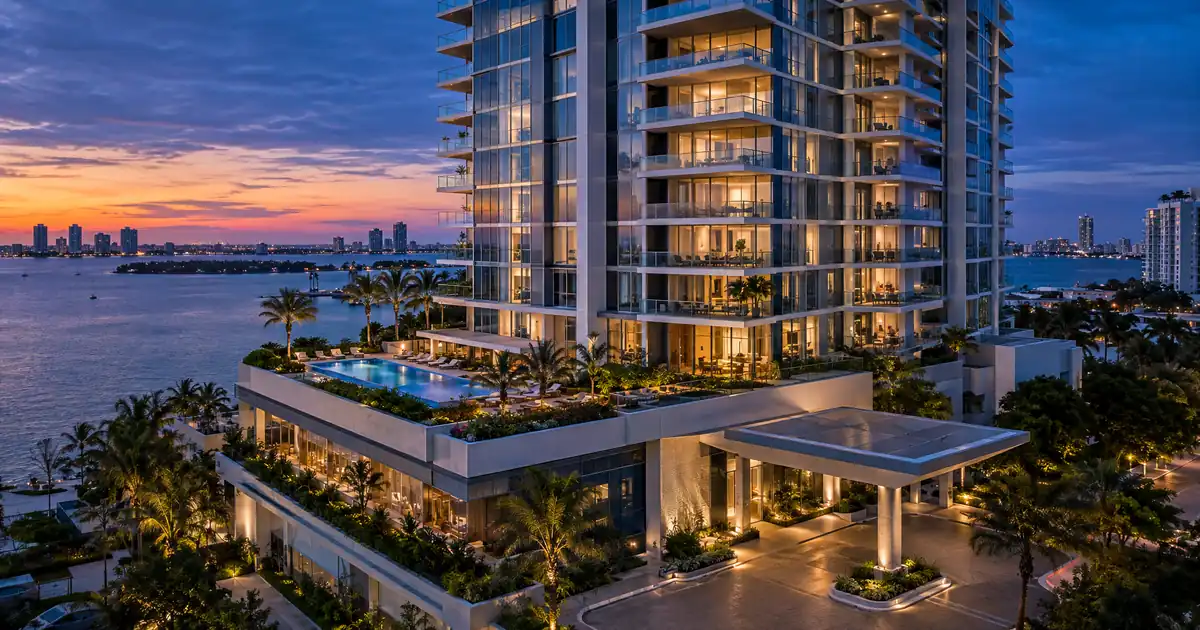
Condotel Units Are Financed On A Super Jumbo Bank Statement Loan — The Quick Read: through select lenders in a wholesale non-QM network, using deposit history instead of traditional personal-income documentation, with the building underwritten on its own checklist and leverage capped lower than a standard condo. A condotel purchase typically tops out around 75% loan-to-value, cash-out sits lower still, and every file above roughly $4,000,000 gets a manual, case-by-case look before it moves forward.
Condotels never make it onto an agency approved list. Fannie Mae’s own guide rules out any project “operated or managed as a hotel, motel, or similar commercial entity” — including buildings where the homeowners association itself is licensed as a hospitality entity, per the Fannie Mae Selling Guide. Freddie Mac’s guide says almost the same thing, word for word in spirit: a project with a hotel or motel license or permit is a “Condominium Hotel,” and Condominium Hotels are ineligible, full stop, per Freddie Mac’s Servicing Guide. That single fact explains everything else here. No agency purchase means no agency rulebook, which means the loan lives entirely inside a lender’s own portfolio, priced and sized on that lender’s own terms.
Why Won’t A Big Bank Just Do This Loan?
Big banks build their mortgage machinery around selling loans to Fannie Mae and Freddie Mac. A condotel can’t be sold that way, so a depository lender that only originates agency-eligible paper has nowhere to put the loan once it closes. Large retail lenders generally decline condotels outright rather than carry the risk on their own books. That’s not a credit judgment about the borrower — it’s a structural limit on what that lender’s business model can hold.
Non-QM and portfolio lenders solve the same problem differently: they intend to hold the loan, or sell it into a private securitization built for exactly this kind of collateral. That’s the whole reason bank statement, DSCR, and asset-qualifier programs exist for condotel buyers in the first place.
Key Terms Defined
Condotel — a condominium unit inside a building that operates, in whole or part, like a hotel: front-desk check-in, nightly or short-term rentals, and sometimes a mandatory rental-pool requirement written into the HOA documents.
Bank statement loan — a mortgage that qualifies a borrower using 12 or 24 months of personal or business bank deposits instead of traditional personal-income documentation or W-2 pay stubs.
Super jumbo — an informal market label, not a federal category, for loan sizes well above a standard jumbo tier, where a lender’s own overlays get noticeably tighter.
Non-warrantable — an agency label meaning a building doesn’t meet Fannie Mae or Freddie Mac’s rules for resale into the secondary market. A condotel is one trigger among several; concentrated investor ownership, HOA litigation, and thin reserves are others.
Expense ratio — the percentage of bank deposits an underwriter subtracts before counting the rest as qualifying income, meant to approximate the borrower’s cost of running the business.
Reserves — liquid funds a borrower must have left over after closing, usually expressed in months of housing payment.
The Two Tracks That Both Have To Clear
A condotel bank statement file runs on two separate underwriting lanes at the same time, and both have to pass. One looks at the person. One looks at the building. Missing either one stalls the file, regardless of how strong the other side looks.
Track one is income. Across the wholesale network, files typically run on 12 or 24 consecutive statements, personal or business, dated close to the note date. Underwriters total every deposit, strip out transfers, refunds, and one-time asset sales, then apply an expense ratio against whatever’s left if the account is a business account. That ratio isn’t one fixed number — most programs use tiers, roughly 20% for a solo service business with no staff, 40% for a small team, and 50% for a larger staff or a product-based business, though an accountant-documented ratio or a capped profit-and-loss method can substitute when the deposits alone tell an incomplete story. Money the borrower moves from their own business account into their own personal account counts in full, not at a discount.
Track two is the building. Since there’s no agency waiver to lean on, the lender builds its own checklist: HOA questionnaire, insurance certificate, reserve study, litigation letter. What actually matters most inside that checklist isn’t the word “condotel” printed anywhere in the marketing materials — it’s whether the rental program is voluntary or mandatory. A voluntary rental pool, where an owner can pull the unit out and live in it or leave it vacant, reads very differently to an underwriter than a mandatory pooling clause baked into the HOA declaration that strips the owner of that choice.
Even Fannie Mae acknowledges this isn’t always black-and-white. Its own guidance notes that a project with “resort” in its legal name isn’t automatically disqualified. That’s true if the name reflects historical use rather than current operation. The agency’s own answer to whether that kills eligibility is, literally, “it depends.”
What Leverage Actually Looks Like
Condotels carry their own property-type ceiling, separate from and usually tighter than the ceiling tied to loan size — and whichever number is lower governs the file. Through select lenders in the network, condotel purchases typically max out around 75% loan-to-value, with cash-out capped lower, roughly 65% on the portfolio non-QM program and roughly 50% on the twelve-month bank portfolio program.
That 75% property cap only matters if the loan-size ladder allows something higher at that balance. Above a certain size, the size ladder itself gets tighter than the property cap, and at that point the size ladder is what actually limits the deal:
| Loan Amount | Investment-Property Size Ladder | Condotel Property Cap | Governing LTV |
|---|---|---|---|
| $300K–$1M | 85% purchase | 75% purchase | 75% |
| $1.5M–$2M | 80% purchase | 75% purchase | 75% |
| $2.5M–$3M | 75% purchase | 75% purchase | 75% |
| $3M–$3.5M | 60% purchase | 75% purchase | 60% |
| $4M–$5M | 65% purchase, case by case | 75% purchase | 65%, case by case |
Below roughly $3,000,000, the condotel cap tends to bind. Above that, the loan-size ladder usually takes over as the tighter constraint, and everything above $4,000,000 is reviewed case by case before it’s even submitted for underwriting — never treat any figure at that size as a flat “up to” number.
A condotel bought as a second home, rather than as a rental, sits on a different ladder entirely — one that runs a few points tighter at every size band than the investment-property ladder shown above, with its own credit-score thresholds attached to each band.
Where A Building Kills The Deal Before The Borrower Even Gets Reviewed
The single most common way a condotel deal dies has nothing to do with the buyer’s income, deposits, or credit. It’s a mandatory rental-pool clause, a reserve study that shows the HOA underfunded, or an insurance certificate with a master deductible above what the lender’s checklist allows. A borrower with strong deposits and a 780 score can still stall at the closing table over a building-level flag none of that changes.
The appraisal adds a second layer of friction unique to this property type. Standard investment-property appraisals lean on Fannie Mae’s Form 1007 rent schedule, which is built around monthly leases. Using nightly short-term-rental comps to back into a monthly figure on that form isn’t a shortcut underwriters accept. It’s explicitly the wrong way to fill it out, and Fannie Mae’s own appraiser guidance says so directly. Form 1007 methodology also excludes business income from the property’s value entirely. It treats furniture, fixtures, and rental revenue as separate from real property value, according to McKissock’s appraisal education materials. Lenders reviewing condotel files instead lean on actual booking history, management agreements, or revenue statements. That’s a different evidence trail than a standard rent schedule was ever designed to produce.
The master insurance policy trips up plenty of buyers too. It covers the building and common areas, not the interior of an individual unit, so a borrower assuming the HOA policy makes them whole is usually wrong. That gap is a documentation item underwriters check, not a reason by itself to decline a file, but it’s worth confirming before an offer goes in rather than after.
One pattern shows up often enough across condotel files to flag directly: the questionnaire almost never gets ordered until after the appraisal is already done. That sequencing means a borrower can be weeks into a purchase — personally cleared on income and credit — before anyone confirms whether the building itself will pass. The single move that avoids the worst version of this timeline is ordering the HOA questionnaire, insurance certificate, and reserve study before writing an offer, not after. This is per reporting on non-warrantable condo financing risk.
Bank Statement Or DSCR — Which One Actually Fits?
A bank statement loan documents the person; a DSCR loan documents the property. They solve different problems and land on different borrowers.
Bank statement underwriting fits an owner with strong, consistent deposits, whether personal or business. This owner would rather show 12 or 24 months of cash flow than dig through two years of traditional personal-income documentation full of write-offs that understate real income. DSCR fits an owner who’d rather qualify on the unit’s own rental income covering the payment, subject to lender guidelines, regardless of what their personal tax picture looks like. It also fits someone eyeing a specific condotel that a big bank already flagged as non-warrantable. A DSCR lender that never intended to sell the loan to an agency in the first place doesn’t weigh that label the same way a conventional lender would.
Lendmire’s complete DSCR loans guide explains this qualification path in more depth. It’s useful for buyers who are weighing property-income financing against a bank statement file. Want to see how the bank statement route handles a condotel specifically? Check Lendmire’s guide on financing a condotel with a super jumbo bank statement loan. It breaks down the documentation flow in more detail. Its companion piece on trust-held condotel titling covers how holding the unit in a trust interacts with the non-warrantable leverage discount described above.
What Credit, Reserves, And Seasoning Actually Look Like
Through select lenders in the wholesale network, the portfolio non-QM program typically runs a 660 credit floor, moving to a 680 floor on the twelve-month bank portfolio program and up to 700 once a loan crosses the super-jumbo overlay lines — roughly $3,500,000 on a primary residence and $3,000,000 on a second home or investment property. Debt-to-income can run up to 50%. Reserves typically scale with size: 3 months of payment on file to $500,000, 6 months to $1,500,000, and 9 months above that, plus two additional months for each other financed property up to a 12-month ceiling. A first-time investor buyer generally needs the full 12 months regardless of loan size.
Above those super-jumbo overlay lines, more conditions typically apply. Lenders want a clean housing history. They also want a 48-month seasoning period on any prior credit event. And cash-out proceeds can’t be used to satisfy the reserve requirement itself. None of this is unique to condotels — the same overlay structure applies to any large bank statement file. But it stacks on top of the condotel-specific leverage caps and building checklist described above. That’s why a $4,500,000 condotel purchase gets reviewed with more scrutiny than a $900,000 one.
Tax treatment on a condotel purchase can depend on how the unit is used and how title is held; owners should keep clean records and talk with a qualified tax professional before relying on any deduction assumption.
Common Misconceptions Worth Clearing Up
People treat “non-warrantable” and “condotel” as the same thing constantly. They’re not. Condotel status is one specific trigger. But high investor-ownership concentration, active HOA litigation, and underfunded reserves can all produce the same non-warrantable label — even on a building that’s never operated a single hotel-style front desk.
Another one worth flagging: a bank statement loan and a DSCR loan often get lumped together as “no-doc” financing because neither one runs a tax return. They measure completely different things — one reads the borrower’s cash flow, the other reads the property’s. Picking the wrong lane for a given file wastes time more than it kills the deal, but it’s worth getting right up front.
DSCR loans, generally, are business-purpose investment products reviewed differently from a standard owner-occupied mortgage — they qualify primarily on the property’s rental income covering the payment, subject to lender guidelines, rather than personal income documentation.
Here’s the consumer-purpose side of this: a borrower buying or refinancing a condotel as a primary or second home using a bank statement loan. Lendmire’s mortgage brokerage operates in 16 states for this. Investors purchasing a condotel purely as a rental have a wider set of options through the DSCR side of the network instead, since that’s a business-purpose product with broader state coverage.
If you’re weighing a condotel purchase and trying to figure out whether the bank statement route or the DSCR route fits your file better, Lendmire can help compare both paths against the property’s building checklist, your deposit history, and your leverage goals before an offer goes in.
Frequently Asked Questions
Can a condotel with a mandatory rental pool still get financed?
Sometimes, but a mandatory pool is one of the harder building-level flags to clear. It removes the owner’s control over occupancy, which underwriters weigh heavily on the building checklist. A voluntary rental program tends to move through review far more smoothly than a mandatory one, and the distinction matters more than the “condotel” label itself.
Does a lower credit score kill a condotel deal even with strong bank deposits?
Strong deposits don’t override a credit floor. Most programs in the network need at least 660 to 680 depending on the specific program, and files above the super-jumbo overlay lines typically need 700. A borrower under those floors usually needs a different program or a smaller loan size before deposits become the deciding factor.
Why does the appraisal take longer or come back differently on a condotel?
Standard rent schedules are built for monthly leases, not nightly rates, so appraisers reviewing condotel or short-term-rental collateral typically pull actual booking history, management agreements, or revenue statements instead. That’s a different evidence trail than a conventional appraisal uses, and it can add steps compared with a standard condo purchase.
Is a condotel automatically a worse investment than a regular condo because of the financing hurdle? Not automatically — but it does mean pricing in a lower leverage ceiling and a longer diligence checklist from the start. Buyers who order the HOA questionnaire, insurance certificate, and reserve study before making an offer typically avoid the scenario where financing surprises show up mid-transaction.
Can I use a condotel’s rental income instead of my own bank deposits to qualify?
That’s the DSCR route rather than the bank statement route — property income covering the payment instead of personal deposit history, subject to lender guidelines. Some condotel buyers end up choosing between the two depending on whether their personal cash flow or the unit’s rental history tells the stronger story.
For current guidelines and terms, see Lendmire’s super jumbo bank statement loan programs page.
Self-employed borrowers can compare both super jumbo programs on Lendmire’s self-employed mortgages page.
About Lendmire
Lendmire (NMLS# 2371349) is a mortgage brokerage built around DSCR investor lending, with programs available in 40 markets, including Washington, D.C. DSCR lenders commonly evaluate rental-income coverage instead of personal income paperwork — a practical fit for LLC-owned and multi-property investors. Terms vary by lender, property, leverage, and program. Scotsman Guide named Lendmire a Top Mortgage Workplace in both 2025 and 2026.
Get Started
Ready to find the right loan for you?
In about 30 seconds you can review financing options available for your home or investment property. No commitment required.
Informational only. Not a Loan Estimate, approval, or commitment to lend. Program availability and eligibility are subject to lender guidelines, credit approval, property review, and underwriting.
References
1. Fannie Mae Selling Guide – Ineligible Projects (B4-2.1-03)
2. Freddie Mac Guide Section 5701.3
3. McKissock Learning – Form 1007 and STR Appraisals
Brandon Miller
Founder & CEO, Mortgage Loan Originator, Lendmire LLC
- Mortgage Loan Originator · NMLS# 1129696 · Verify on NMLS Consumer Access
- North Carolina Real Estate Broker · License# 343312 · Verify on NCREC
- North Carolina Insurance Producer · License# 19053198 · Property, Casualty, Life, Health · Verify on NAIC SBS
- Lendmire LLC · Firm NMLS# 2371349 · Verify firm licensure
Compliance and disclosures. Lendmire (NMLS# 2371349) is a licensed mortgage broker and is not a direct lender, depository institution, financial advisor, or tax professional. Content in this article is general market analysis and educational information — not financial, legal, or tax advice for any specific situation. Lendmire does not guarantee loan approval; every transaction is subject to underwriting by the funding lender. Mortgage pricing and loan program guidelines are subject to change at any time without notice and vary by borrower characteristics, property type, and state regulations. Lendmire complies with Equal Housing Opportunity. Licensure verification: NMLS Consumer Access.


