
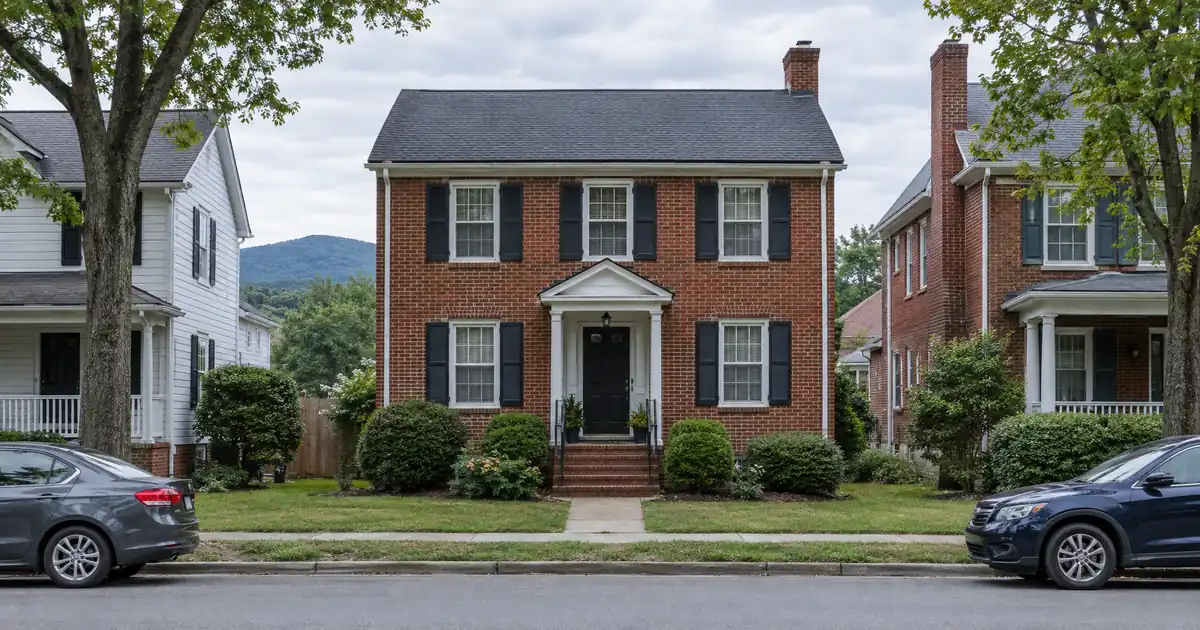
Can a Culpeper rental you already own actually support a cash-out refinance? Sometimes, but the limiting factor is almost never the equity. It’s the rent. Town-level median prices sit near $400,000 per Redfin’s town data, while a typical three-bedroom rents for roughly $1,960 per Prop-Metrics. That ratio decides how much of your equity a lender will let you touch.
The Short Version: A DSCR cash-out refinance in Culpeper, Virginia is underwritten primarily on the property’s rental income measured against its full monthly obligation, and with town rent-to-value running thin, coverage rather than equity is what caps the proceeds.
DSCR Cash-Out Calculator
Run the cash-out numbers in Culpeper, VA
Rate source: Freddie Mac 30-yr average via FRED® — Federal Reserve Bank of St. Louis · effective Sep 24, 2026
Prefilled with starting assumptions — enter your property’s value, balance, taxes, and insurance for a more accurate picture.
Program parameters update from Lendmire’s centralized guideline source. Taxes and insurance are editable estimates.
As of Sep 24, 2026 · General Freddie Mac market benchmark, not a Lendmire loan offer. Property value, balance, taxes, and insurance are editable estimates. Maximum loan-to-value varies by lender, program, property type, and seasoning. Not a Loan Estimate, approval, or commitment to lend. Program availability and eligibility are subject to lender guidelines, credit approval, property review, and underwriting.
- Rent-to-value runs roughly 0.36 to 0.45 percent a month town-wide, so median-priced houses struggle to cover.
- Three-bedroom rents near $1,960 are the best-supported rung.
- Program cash-out ceiling is 75 percent LTV, with about six months of seasoning.
- Small multifamily is only 5.10 percent of housing stock.
- Price signals conflict across town and county, so appraisals may land conservative.
For real estate investors in Culpeper, Virginia, Lendmire helps structure and place DSCR financing through wholesale lenders operating in 41 markets, including D.C. As a non-QM mortgage broker (NMLS# 2371349), it arranges these loans rather than lending directly. The framing below assumes you already own the property and want to know what the next 6 to 24 months could do to your refinance.
Culpeper Market Snapshot
A quick read on the Culpeper investor landscape — figures come from the cited sources below. Confirm current property-level numbers before underwriting.
| Metric | Detail |
|---|---|
| Population | See Town of Culpeper Economic Development for current population information |
What Actually Limits the Cash-Out Here
The binding constraint is coverage. The program ceiling on a cash-out is 75 percent LTV, but a lender also requires the rent to cover the full monthly obligation (principal, interest, taxes, insurance, and any HOA dues), with 1.00 as the standard benchmark. The guide “What Is a DSCR Loan” is worth a read before you model anything.
Run the numbers on a house valued at $400,000 and refinanced at 75 percent LTV. Assume a modeled rent of $1,960 and include taxes and insurance in the obligation. Coverage lands around 0.8x, below the benchmark. Now take the same structure on a $300,000 house with the same rent. Coverage moves into the low 1.0s. These are modeled assumptions, not market-sourced coverage figures, and actual results depend on the loan terms, the appraisal, and the rent schedule the lender accepts.
So the equity isn’t the problem. A $400,000 house may have plenty of it. The rent just doesn’t carry the leverage.
Two of Culpeper’s rent-to-value readings make this concrete. Niche pairs a median home value of $390,000 with a median rent of $1,416, about 0.36 percent a month. Prop-Metrics pairs a $441,000 median price with a $1,880 average rent, about 0.43 percent. Both sit below where a full-leverage cash-out tends to clear, and both are dated aggregator snapshots, so treat them as a range.
The Sub-1.00 Question
If your coverage lands under 1.00x, the first thing to ask is whether you should reach for a workaround at all. Several structures may be available, and a lender would review each: a sub-1.00 program with reduced leverage and stronger credit, an interest-only structure that lowers the monthly obligation, or simply a smaller cash-out at lower LTV. Qualification is subject to lender guidelines, credit approval, and property review.
Sub-1.00 is defensible if the property has a real upside story, such as a below-market lease you can reset or a renovation that lifts rent. It’s a warning sign if you’re using it because the numbers don’t work on any Culpeper house you’d consider. In that case the property, not the loan type, is the variable to revisit. (Conventional can look better for a single rental held personally by a strong W-2 borrower. Here’s the DSCR versus conventional breakdown, and the flip point is usually a third or fourth financed property.)
Three-Bedrooms Carry the Deal
Three-bedroom rentals are where Culpeper’s refinance math is strongest. Prop-Metrics shows 3-bedroom and 2-bedroom units at 41.6 and 39.1 percent of rental stock, so your tenant pool and your appraiser’s comps both live there. Its RentCast-sourced data puts 2-bedrooms near $1,500, 3-bedrooms near $1,960, and 4-bedrooms near $2,780. Zillow’s rental data shows a higher three-bedroom average of $2,250.
That spread matters. A lender’s rent schedule will likely land toward the lower, better-documented figure. If you underwrite to $2,250 and the appraiser’s schedule says $1,960, coverage compresses by roughly 13 percent. Pull comps by bedroom count, not from the blended average.
Two-bedrooms are riskier to underwrite. RentHop shows 2-bedroom rents down 16.61 percent year over year, from $1,817 to $1,515, though that is a small-sample series. A 2-bedroom rent assumption is the softest input in this market.
Where the Submarkets Differ
Culpeper has no reliable neighborhood-level price or rent series, so what follows is qualitative. It describes tenant base and property type, not a per-block price.
Historic downtown. The original grid of ten square blocks holds the older housing stock, and it’s the likeliest place for duplexes and converted homes. That matters because small multifamily is scarce. Per NeighborhoodScout, duplexes, converted homes, and small apartment buildings are only 5.10 percent of housing units, versus 62.59 percent single-family detached. A two- to four-unit property you already own here has few direct comps, which cuts both ways: less competition for tenants, but a thinner appraisal record.
The medical corridor. Near Sunset Lane and Route 29 Business sits UVA Health Culpeper Medical Center, a 70-bed acute care hospital with a 24/7 emergency department. Clinic and hospital staff make a steady long-term tenant pool for 2- and 3-bedroom rentals within a short drive. No employee count is published, so the demand is qualitative.
Route 29 and Route 3 commercial corridors. The Culpeper County comprehensive plan notes that the Route 29 Bypass, Route 3, and expanded industrial parks have partially decentralized the workforce. For a landlord that means tenants spread across the town’s edges rather than clustering near one center.
Eastern County. This is newer suburban growth, with family renters and commuters as the main demand. The caution is resale comps. Redfin lists 49 new homes for sale in the county at a median of $600,000, per its county new-homes data, and that new-build band won’t support valuations on older rental stock.
Brandy Station, Rixeyville, and Catalpa. These rural and semi-rural northern communities have unverified rents and prices. A cash-out on a property out here depends more on the appraiser’s ability to find comps than on any market trend.
The Tenant Base Isn’t Just Commuters
The “DC exurb” story is common to many Virginia towns, and it’s not the most interesting part of Culpeper’s demand. The Town of Culpeper lists automotive components, composite materials, technology, data centers, and telecommunications among its major employer sectors. It also sits inside the Washington-Arlington-Alexandria MSA, which the town credits for a diversified economy.
Two anchors are distinctive. A Library of Congress audio-visual conservation campus, the Packard Campus, sits on a former Federal Reserve site. And the Culpeper Technology Zone has drawn data-center investment, per Wikipedia’s town entry. Neither has a verified headcount, so don’t build a rent assumption on them. Still, a base of technicians, contractors, and federal staff is steadier than pure commuter demand, and it supports the stable, long-term tenancy that DSCR lenders like to see.
A market source, citing Census ACS data, puts Culpeper at 20,437 residents, up 28.5 percent since 2010, with a 60.0 percent homeownership rate. That leaves roughly 40 percent of households renting. The same source shows a typical household income near $91,429 and a median rent around $1,408. Its population figures conflict across pages, so “roughly 20,000 to 21,500” is the safer read. There is no four-year university here, so skip any student-rental assumption.
Appreciation Shouldn’t Fund Your Equity
Culpeper’s price signals disagree, and that affects any cash-out sizing. Redfin’s town page showed a median near $400,000, up 14.6 percent year over year, with homes selling in 73 days. Redfin’s county data showed the opposite direction: a median near $463,000, down 8.2 percent, with 62 days on market versus 38 the year before. Zillow puts the average home value at $459,733, up 3.1 percent. The town series also swung to a $505,000 median on only 11 sales in one month, which is a small-sample warning rather than a trend.
The county series differs from the town’s because it covers a different geography and method. It is also the one an appraiser is more likely to lean on. The stronger planning assumption is a flat-to-softer valuation, not a continuation of the recent town-level spike. Prop-Metrics reports median days on market of 43 and 26.0 percent of listings with a price reduction.
Thinking out loud here: the honest read is a genuine toss-up on direction. If the town series is right, equity builds and a cash-out sized today looks conservative in a year. If the county series is right, a valuation could slip before a refinance closes. The practical answer is to size the cash-out to a value you would accept if it came in 5 to 8 percent lower, and to watch days on market and price-reduction share as your leading indicators.
Seasoning, Reserves, and Credit
The program structure is straightforward. Seasoning is about six months from title recording, the cash-out ceiling is 75 percent LTV, and reserves run about six months of full monthly obligation (more above $1,500,000). Credit tiers start at a 620 floor, typically with better terms at 660, 680, and 700. Loan amounts run up to $3,000,000 on standard programs, with smaller balances routed through select lenders. All of this is subject to lender guidelines and varies by borrower, property, and scenario. The cash-out qualification details and refinancing options cover the mechanics.
One trap: the 75 percent cap is a ceiling, not an entitlement. Your actual proceeds depend on the appraised value, the rent the lender accepts, your reserves, and coverage. On Culpeper files, coverage usually binds first. Also remember that manufactured homes, log homes, and barndominiums fall outside these programs, which matters in the rural parts of the county.
A practitioner note on files from markets like this one. The common friction point is the gap between the rent an owner believes and the rent a lender’s schedule supports, especially when aggregator rent data is volatile on small samples. The cleaner files tend to arrive with a signed lease, a bedroom-count comp set, and a fresh insurance quote already in hand, so coverage isn’t recalculated late.
DSCR vs. conventional financing
Two common ways to finance an investment property in Culpeper, VA. They qualify you differently — here’s how investors weigh them.
Why investors choose it
- Qualifies on the property’s rental income — no personal tax returns, W-2s, or pay stubs needed to document income.
- No personal debt-to-income ceiling to clear, so existing mortgages and obligations don’t cap your borrowing the same way.
- Can be closed in an LLC, keeping the property inside a business entity.
- Built for scaling — not held to the limit on number of financed properties that conventional financing applies.
- Underwriting centers on the deal: generally qualifies when the rent covers the payment, a 1.00x coverage ratio being a common baseline (confirmed in underwriting).
- Designed specifically for investment property, including long-term and, where the program allows, short-term rentals.
Where it’s strong
- Often the lowest ongoing financing cost for a buyer who fully qualifies on personal income — a fit for a first property or a cost-first purchase.
Trade-offs for investors
- Requires full personal income documentation and must fit within a debt-to-income limit — salary, existing debts, and other mortgages all count.
- Typically held in your personal name rather than a business entity.
- Caps how many financed properties you can carry, which can become a ceiling as a portfolio grows.
- Evaluates you as a borrower as much as the property, which usually means more paperwork.
How investors usually choose: a first or single property often optimizes for the lowest financing cost; portfolio builders often optimize for leverage, vesting in an LLC, and scaling past conventional caps. The right answer depends on your goals, the property, and current guidelines — both paths run through select lenders in Lendmire’s wholesale network, with eligibility and terms confirmed in underwriting.
What the Proceeds Do Next
The thesis behind a cash-out is what you do with the money. Pulling equity to buy another Culpeper 3-bedroom below the town median is the coherent version. Older stock in roughly the $300,000 to $400,000 range is where rent-to-value moves toward DSCR-friendly territory. Pulling equity to fund a property in a market where coverage doesn’t pencil is a different decision and worth stress-testing first.
A second version is to use proceeds to convert a downtown older house into a duplex or add a unit, if local rules allow (verify current local rental rules, taxes, and insurance with qualified local professionals). That play targets the scarce small-multifamily niche, though it carries permitting and construction risk that financing doesn’t solve.
If you want to see how your own numbers land, investors can request a scenario quote or reach the team at 828-256-2183. State-level program details are at DSCR loan options for Virginia investors.
Frequently Asked Questions
How do you qualify for a DSCR cash-out refinance in Culpeper, Virginia?
Qualification centers on the property’s rent versus its full monthly obligation, with 1.00 as the standard benchmark, plus about six months of seasoning and a credit score at or above the 620 floor. Reserves of about six months are typical. Because Culpeper rent-to-value is thin, a median-priced house may need lower leverage to clear. All of this is subject to lender guidelines and property review.
What are the requirements for an investment property cash-out loan in Culpeper, VA?
Typical guidance includes a 75 percent LTV ceiling, about six months of ownership, and reserves of roughly six months. Eligible properties are standard single-family, townhome, and small multifamily, while manufactured homes, log homes, and barndominiums are not eligible. Final terms vary by borrower, property, and lender.
Does Culpeper’s thin rent-to-value kill cash-out refinancing?
No, but it shapes it. At roughly 0.36 to 0.45 percent a month town-wide, a median-priced house often lands below 1.00x at full leverage. Buying or holding older 3-bedroom stock below the median, or taking a smaller cash-out, moves coverage toward the benchmark. Sub-1.00 structures may be available through select lenders, with reduced leverage.
Should I count on Culpeper appreciation to build equity for a cash-out?
Not as a base case. Redfin’s town series showed a median up 14.6 percent while its county series showed down 8.2 percent, and the town figure swings on small sales counts. Plan around a flat valuation and treat any gain as upside.
Can Lendmire help investors explore DSCR financing for properties outside Virginia?
Yes. Lendmire arranges DSCR investor loans. Programs are underwritten primarily on property cash flow, so a self-employed investor or an entity-owned portfolio can work through the same structure, subject to program terms.
About Lendmire
A non-QM mortgage broker (NMLS# 2371349), Lendmire arranges DSCR financing for real estate investors in 41 markets, which means 40 states plus Washington, D.C. Because deals are underwritten primarily on property cash flow rather than personal income documentation, the structure suits self-employed buyers and entity-owned portfolios. Lendmire places loans through wholesale investor lenders; it is not a direct lender. The firm is recognized as a 2026 Scotsman Guide Top Workplace and a 2025 Scotsman Guide Top Mortgage Workplace, as covered in the Top Workplace press announcement.
Get Started
Ready to find the right loan for you?
In about 30 seconds you can review financing options available for your investment property. No commitment required.
Informational only. Not a Loan Estimate, approval, or commitment to lend. Program availability and eligibility are subject to lender guidelines, credit approval, property review, and underwriting.
References
1. Redfin, Culpeper housing market
3. Town of Culpeper Economic Development
4. Niche
6. NeighborhoodScout, Culpeper
7. UVA Health Culpeper Medical Center
8. Culpeper County Comprehensive Plan, Economics
9. Redfin — Culpeper County New Homes
10. Redfin, Culpeper County housing market
11. Zillow
12. a 2026 Scotsman Guide Top Workplace
13. a 2025 Scotsman Guide Top Mortgage Workplace
14. the Top Workplace press announcement
This article is part of Lendmire’s investment property cash-out refinance program — full qualification details, guidelines, and scenarios live on the program page.
Related reading: Luxury Rental DSCR Loans In New Jersey · Jersey Shore Vacation Rental Loans: DSCR Financing In Ocean City, Cape May And Long Beach Island · DSCR Cash-out Refinance In New Jersey: Pulling Equity From A Rental
Guides: Investment Property Cash-Out Refinance in Virginia
Brandon Miller
Founder & CEO, Mortgage Loan Originator, Lendmire LLC
- Mortgage Loan Originator · NMLS# 1129696 · Verify on NMLS Consumer Access
- North Carolina Real Estate Broker · License# 343312 · Verify on NCREC
- North Carolina Insurance Producer · License# 19053198 · Property, Casualty, Life, Health · Verify on NAIC SBS
- Lendmire LLC · Firm NMLS# 2371349 · Verify firm licensure
Important disclosures. Lendmire (NMLS# 2371349) is a licensed mortgage brokerage. Lendmire is not a direct lender, depository institution, or financial advisor. All loan inquiries are subject to lender underwriting; this article does not constitute a commitment to lend. Rates, terms, and program guidelines are subject to change without notice and vary by borrower profile, property type, and state. Information in this article is general in nature and is not financial, legal, or tax advice. Equal Housing Opportunity. NMLS Consumer Access: nmlsconsumeraccess.org.