
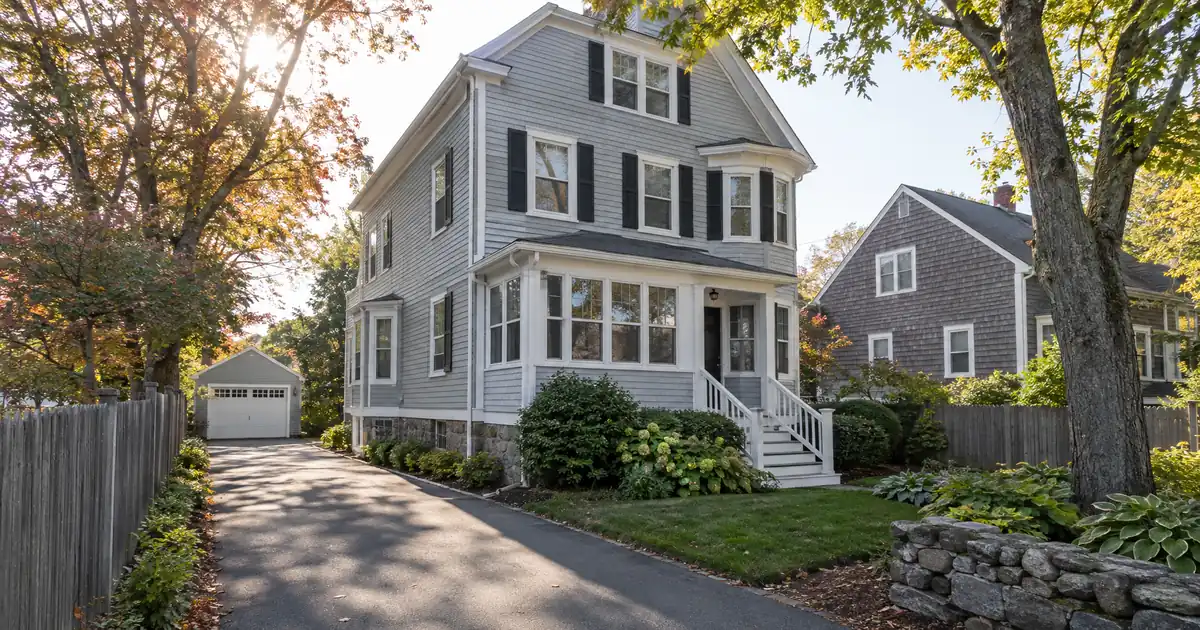
Downtown Beverly’s 12-month median sale price is $535,000, down 3 percent, while the city overall sits at $799,600, up 9.0 percent. Most of the equity in Beverly is on the wrong side of the rent line. A cash out refinance investment property strategy here has to reconcile two markets: one that is appreciating and doesn’t cash-flow, and one that cash-flows and isn’t appreciating. Lendmire, a non-QM mortgage broker, arranges DSCR cash-out files for owners who have already bought and want that equity working elsewhere. This piece covers the extraction side only: appreciation math, the 75 percent ceiling, seasoning, and where the coverage number holds up.
TL;DR: A cash-out refinance on a Beverly, Massachusetts rental is underwritten primarily on the property’s rental income measured against its full monthly obligation, so the deal works from appraisal and rent schedule through payoff and reserve verification, with proceeds set by the 75 percent LTV ceiling rather than by the owner’s target.
DSCR Cash-Out Calculator
Run the cash-out numbers in Beverly, MA
Rate source: Freddie Mac 30-yr average via FRED® — Federal Reserve Bank of St. Louis · effective Sep 24, 2026
Prefilled with starting assumptions — enter your property’s value, balance, taxes, and insurance for a more accurate picture.
Program parameters update from Lendmire’s centralized guideline source. Taxes and insurance are editable estimates.
As of Sep 24, 2026 · General Freddie Mac market benchmark, not a Lendmire loan offer. Property value, balance, taxes, and insurance are editable estimates. Maximum loan-to-value varies by lender, program, property type, and seasoning. Not a Loan Estimate, approval, or commitment to lend. Program availability and eligibility are subject to lender guidelines, credit approval, property review, and underwriting.
- Downtown’s $535,000 median sits far below the city’s $799,600.
- Typical single-family gross rent-to-value is roughly 3.9 percent, per Zillow rents against Redfin prices.
- Modeled two-family coverage lands around 1.05 to 1.15 including taxes and insurance. Zumper shows rents down 8 percent year over year, so appraised rent may come in low.
Beverly Market Snapshot
A quick read on the Beverly investor landscape — figures come from the cited sources below. Confirm current property-level numbers before underwriting.
| Metric | Detail |
|---|---|
| Home prices | $650,300 median property value (Data USA) |
| Typical rents | $2,600 average (Zillow, rental market trends) |
| University enrollment | 4,575 students (Wikipedia, Endicott College) |
| Population | 42,665 population (Census Reporter (ACS 2024 5-yr)) |
| Employment | 1,004 employees (2020) (Wikipedia, Axcelis Technologies) |
Where the Equity Sits
Beverly’s equity is concentrated in higher-priced, low-yield stock, and the cash-out ceiling makes that a coverage problem rather than an equity problem. Owners here are rarely short on value. They are short on rent relative to that value.
Price data varies by source. Redfin puts the citywide median at $799,600, which this article uses as the canonical figure. Zillow’s home value index reads lower at $751,857, up 1.9 percent, and Data USA shows an owner-reported $650,300. The gaps reflect methodology and timing, not disagreement about direction. Values are up.
Rents are not keeping pace. Zillow shows average rent near $2,600, down $100 over the year. Zumper’s average is $2,400, down 8 percent, with a roughly 10 percent seasonal swing between its October low and July high. Rents flat to slightly down against values up about 9 percent is the squeeze. The property may appraise well and still produce thin coverage on the rent schedule.
The mechanics matter. Lenders in the DSCR channel generally look for about 6 months of ownership measured from title recording before a cash-out. The ceiling is 75 percent LTV, and the payoff of the existing loan comes out first. An owner who bought recently at a full price and put down 20 to 25 percent has less room than the headline value suggests. An owner with an older basis has much more. Proceeds depend on rent used for lender review, the full monthly obligation, reserves, and that ceiling. They are never a guaranteed figure.
The Coverage Math, Stripped Down
Single-family homes in Beverly usually don’t clear 1.00 on a cash-out. Two-families and small multifamily can. Coverage is monthly rent divided by the full monthly obligation: principal, interest, taxes, and insurance.
The table below models three property profiles at 75 percent LTV on standard 30-year amortization, with taxes and insurance at Massachusetts averages. Rents and prices are the research figures. The coverage results are modeled assumptions, not market data.
| Profile | Gross rent-to-price | Modeled coverage (full PITIA) |
|---|---|---|
| Typical single-family or condo | About 3.9% | Roughly 0.5x |
| Downtown median unit | About 5.6% | Roughly 0.75x |
| Two-family near $987K | 7.8%-9.0% | Roughly 1.05x-1.15x |
The Downtown row leans on a dated Redfin median rent of $2,500 against a price figure that likely includes condos, so read it directionally. The two-family row uses Redfin’s $987,000 median listing price on multi-family, which rests on only four listings. It also uses 3-bedroom rents between Zillow’s $3,200 average and the $3,875 Rentometer shows. Run the numbers on two units at $3,200 and $3,700, and gross rent lands near 7.8 to 9.0 percent of a $987,000 value before vacancy. That is why the coverage number sits just above 1.00 rather than comfortably clear.
Sub-1.00 is common on the first two rows. Options a lender may review include reduced leverage, a sub-1.00 program with compensating factors, or an interest-only structure. Each is subject to lender guidelines, credit approval, and property review, and none is assured. Most standard DSCR programs are built around a 1.00x benchmark because rent covers the payment at that level. Files below it typically need lower leverage, different pricing, or stronger reserves.
Skip the Single-Family Refi
A single-family cash-out in Beverly is a leverage-reduction exercise, not a coverage play. The housing stock explains why. NeighborhoodScout shows about 50 percent of homes are single-family detached, 18.37 percent are duplexes, converted homes, and small buildings, and 27.55 percent are large apartment complexes. Renters make up 44.74 percent of households. About a third of the homes predate 1939.
That 18 percent small-multifamily slice is where DSCR-fit stock lives. It is also where appraisal review tends to slow down. Pre-1939 construction draws closer attention to condition, systems, and unit configuration. A converted three-family with non-conforming unit counts is a different file than a legal duplex.
Underwrite by unit mix rather than a blended rent. Zillow’s averages step from $2,300 for a 1-bedroom to $2,700, $3,200, and $4,100 for 2-, 3-, and 4-bedrooms. Larger units carry the best rent per dollar of price. A 3-bedroom over a 3-bedroom outperforms a studio stack by a wide margin.
Demand Anchors Behind the Rent Roll
Beverly’s tenant base rests on employers and colleges rather than one dominant industry. That supports long-lease occupancy even when for-sale prices swing.
Census Bureau QuickFacts counts 42,665 residents, a median age of 39, and 53.4 percent of adults holding a bachelor’s degree or higher. Population is essentially flat, so demand comes from job density, not growth. Data USA shows the largest resident employment sectors as health care and social assistance at 3,387 people, educational services at 3,365, and professional, scientific, and technical services at 3,309.
The City of Beverly reports that Cummings Center hosts over 550 tenant companies, including more than 100 life-science firms, across more than 2 million square feet. It calls the campus the North Shore’s largest office and technology complex. Beverly Hospital, part of Beth Israel Lahey Health, anchors health care employment. Axcelis Technologies, a semiconductor-equipment maker, is headquartered in the city. No reliable headcounts surfaced for the hospital or Cummings Center, so this article names them without numbers.
Endicott College sits on a 235-acre campus. Montserrat College of Art and North Shore Community College also have campuses in the city, per the City of Beverly.
On supply, no large rental oversupply wave surfaced in the research. New for-sale product near Cummings Center is 60 ownership condos, not rentals, with larger two-bedrooms priced close to $1 million. That helps appraisal comps for small multi-unit. The city’s development page also lists a 56-unit apartment proposal on Rantoul Street. Its construction status is unconfirmed, and if built it would compete with Downtown units.
Submarkets That Pencil
Downtown is the cash-flow submarket, and the rest of the city is the equity submarket. The two rarely overlap in one property.
Downtown and the Depot. Downtown is the most achievable coverage in the city. Montserrat is here, the MBTA commuter rail runs through, and the core holds close to 400 businesses. Tenants skew toward Boston commuters, young professionals, and college affiliates. The listing sample includes a 2-unit, a 6-unit, and a 7-unit building, so small multifamily beyond duplexes does trade. The drawback is the price trend. A median down 3 percent limits how much equity a cash-out can pull, and appraisers will look hard at recent comps. Coverage is easier to reach here. Proceeds are harder to find.
Cummings Center and the Route 62 corridor. The tenant profile is office, life-science, and health-administration workers. No neighborhood-level sale prices surfaced for this area, so it is a tenant-quality argument, not a numbers argument. Demand exists. The math on a single-family here looks like the citywide row in the table.
Endicott and the northeast coast. This is the higher-end, coastal side of town, and demand leans on college staff and graduate students. It is the appreciation-led half of the city. Expect the citywide coverage profile at best, with proceeds sized by the 75 percent ceiling on a higher appraised value.
Honestly, the choice between them is a genuine toss-up. Downtown wins on coverage. The coastal side wins on equity to extract. An owner holding a paid-down asset in the second area may do better keeping it and pulling cash against a Downtown multi-unit.
What Does a Reviewer Actually Ask For?
The friction on Beverly cash-out files comes from documentation and property details, not from the borrower’s income, which the program doesn’t center on. Underwriting focuses on the property, and a reviewer works through a predictable list.
The loan amount can run up to $3,000,000 on standard programs, with smaller balances routed through select lenders in the network. Credit tiers are typically 620, 660, 680, and 700, with 620 as the floor. Reserves are about 6 months of full monthly obligation, rising to about 9 months above $1,500,000. Those parameters reflect guidelines that can change and are not commitments to lend. Eligibility depends on the borrower, property, and lender.
The typical file needs a current appraisal with a rent schedule, executed leases for every unit, the payoff statement on the existing loan, proof of reserves, and entity documents where the property sits in an LLC, subject to lender program eligibility. Title recording date drives the seasoning clock, so a recent deed transfer between related parties can reset it. Beyond the standard package, the guide “What Is a DSCR Loan” covers the ratio mechanics in detail.
On files from markets structurally like this one, the common friction point is a rent schedule that doesn’t match the appraiser’s market rent. The cleaner files from a documentation standpoint tend to arrive with leases at or near market, unit configurations that match municipal records, and a payoff letter in hand before the appraisal is ordered. Older two- and three-family stock tends to draw the most follow-up questions on unit legality and condition (fixing those before submission saves a review cycle).
The soft rent data argues for underwriting on the low end. Avoid the summer asking rents, and don’t assume an appraiser will accept a listing price as market rent. Proceeds from a completed cash-out typically become the capital for the next acquisition, and the purchase-side math is covered under Massachusetts DSCR financing. For how the refinance products differ, see Lendmire’s refi programs and the refi options. For a comparison with bank underwriting, read the guide “Where DSCR and Conventional Diverge”.
Owners with a specific property can run the numbers with Lendmire or call 828-256-2183. As a general reminder, verify current local rental rules, taxes, insurance, and flood-zone status with qualified local professionals. Redfin flags that 16 percent of Beverly properties face severe flood risk over 30 years.
Frequently Asked Questions
How do you qualify for a DSCR cash-out refinance in Beverly?
Qualification centers on the property’s rent used for lender review against its full monthly obligation, with 1.00 as the common baseline. Beyond that, lenders typically review about 6 months of ownership from title recording, a credit score of at least 620, reserves of about 6 months, and a combined loan-to-value of 75 percent or less. Terms vary by lender and borrower.
DSCR vs. conventional financing
Two common ways to finance an investment property in Beverly, MA. They qualify you differently — here’s how investors weigh them.
Why investors choose it
- Qualifies on the property’s rental income — no personal tax returns, W-2s, or pay stubs needed to document income.
- No personal debt-to-income ceiling to clear, so existing mortgages and obligations don’t cap your borrowing the same way.
- Can be closed in an LLC, keeping the property inside a business entity.
- Built for scaling — not held to the limit on number of financed properties that conventional financing applies.
- Underwriting centers on the deal: generally qualifies when the rent covers the payment, a 1.00x coverage ratio being a common baseline (confirmed in underwriting).
- Designed specifically for investment property, including long-term and, where the program allows, short-term rentals.
Where it’s strong
- Often the lowest ongoing financing cost for a buyer who fully qualifies on personal income — a fit for a first property or a cost-first purchase.
Trade-offs for investors
- Requires full personal income documentation and must fit within a debt-to-income limit — salary, existing debts, and other mortgages all count.
- Typically held in your personal name rather than a business entity.
- Caps how many financed properties you can carry, which can become a ceiling as a portfolio grows.
- Evaluates you as a borrower as much as the property, which usually means more paperwork.
How investors usually choose: a first or single property often optimizes for the lowest financing cost; portfolio builders often optimize for leverage, vesting in an LLC, and scaling past conventional caps. The right answer depends on your goals, the property, and current guidelines — both paths run through select lenders in Lendmire’s wholesale network, with eligibility and terms confirmed in underwriting.
What are the requirements for an investment property loan in Beverly, Massachusetts?
Expect an appraisal with a rent schedule, leases, a payoff or purchase contract, proof of reserves, and entity documents if the property is LLC-held. Loan amounts run up to $3,000,000 on standard programs. Manufactured homes, log homes, and barndominiums fall outside these programs.
Can a Beverly single-family rental support a cash-out?
Sometimes, but usually at reduced leverage. Typical gross rent-to-value near 3.9 percent leaves modeled coverage well under 1.00 at the full 75 percent ceiling. Owners can explore lower-leverage structures, sub-1.00 programs, or an interest-only option, each subject to lender review.
Why does Downtown Beverly matter for cash-out sizing?
Downtown’s cash flow is better, but its median price is down 3 percent, so a fresh appraisal may not show much appreciation. The result is a property that clears coverage more easily but yields smaller proceeds than a coastal-side asset of similar rent.
For current guidelines and terms, see Lendmire’s DSCR loan programs page.
The Bottom Line
If you only take one thing from this piece, it’s this: in Beverly, the equity sits in the coastal-side and citywide stock while the coverage sits in Downtown’s two-to-seven-unit buildings, so a cash-out only pencils cleanly when the rent roll, not the appraised value, is the asset being underwritten.
About Lendmire
A non-QM mortgage broker (NMLS# 2371349), Lendmire arranges DSCR financing for real estate investors in 41 markets: 40 states plus Washington, D.C. Because deals are underwritten primarily on property cash flow rather than personal income documentation, the structure suits self-employed buyers and entity-owned portfolios. Lendmire places loans through wholesale investor lenders and is not a direct lender. The firm was recognized by Scotsman Guide in 2025 and named a top-ranked workplace in 2026.
Get Started
Ready to find the right loan for you?
In about 30 seconds you can review financing options available for your investment property. No commitment required.
Informational only. Not a Loan Estimate, approval, or commitment to lend. Program availability and eligibility are subject to lender guidelines, credit approval, property review, and underwriting.
References
1. Homes.com — Downtown Beverly Neighborhood Multi Family Homes for Sale
3. Zillow rents
4. Zumper
5. Data USA
6. Wikipedia, Endicott College
7. Census Reporter (ACS 2024 5-yr)
8. Wikipedia, Axcelis Technologies
10. Redfin — Beverly Rental Market
11. Redfin’s $987,000 median listing price on multi-family
15. City of Beverly
16. Endicott College
17. City of Beverly
18. boston.com — Major North Shore Office Park Is Adding 60 New Condos
19. beverlyma.gov — Private Development
20. Redfin
21. recognized by Scotsman Guide in 2025
22. Scotsman Guide — Top Workplaces 2026
This article is part of Lendmire’s investment property cash-out refinance program — full qualification details, guidelines, and scenarios live on the program page.
Related reading: Luxury Rental DSCR Loans In New Jersey · Jersey Shore Vacation Rental Loans: DSCR Financing In Ocean City, Cape May And Long Beach Island · DSCR Cash-out Refinance In New Jersey: Pulling Equity From A Rental
Guides: Investment Property Cash-Out Refinance in Massachusetts
Brandon Miller
Founder & CEO, Mortgage Loan Originator, Lendmire LLC
- Mortgage Loan Originator · NMLS# 1129696 · Verify on NMLS Consumer Access
- North Carolina Real Estate Broker · License# 343312 · Verify on NCREC
- North Carolina Insurance Producer · License# 19053198 · Property, Casualty, Life, Health · Verify on NAIC SBS
- Lendmire LLC · Firm NMLS# 2371349 · Verify firm licensure
Disclosures. The information presented in this article is general market commentary, not financial, legal, or tax advice. Lendmire is a mortgage brokerage (NMLS# 2371349) — not a direct lender or depository institution — and loan placement is subject to lender underwriting. Nothing in this content represents a commitment to lend. Loan terms, pricing, and program availability vary based on borrower qualifications, property characteristics, and state of subject property, and are subject to change at any time. Lendmire complies with Equal Housing Opportunity requirements. Consumer access: nmlsconsumeraccess.org.