
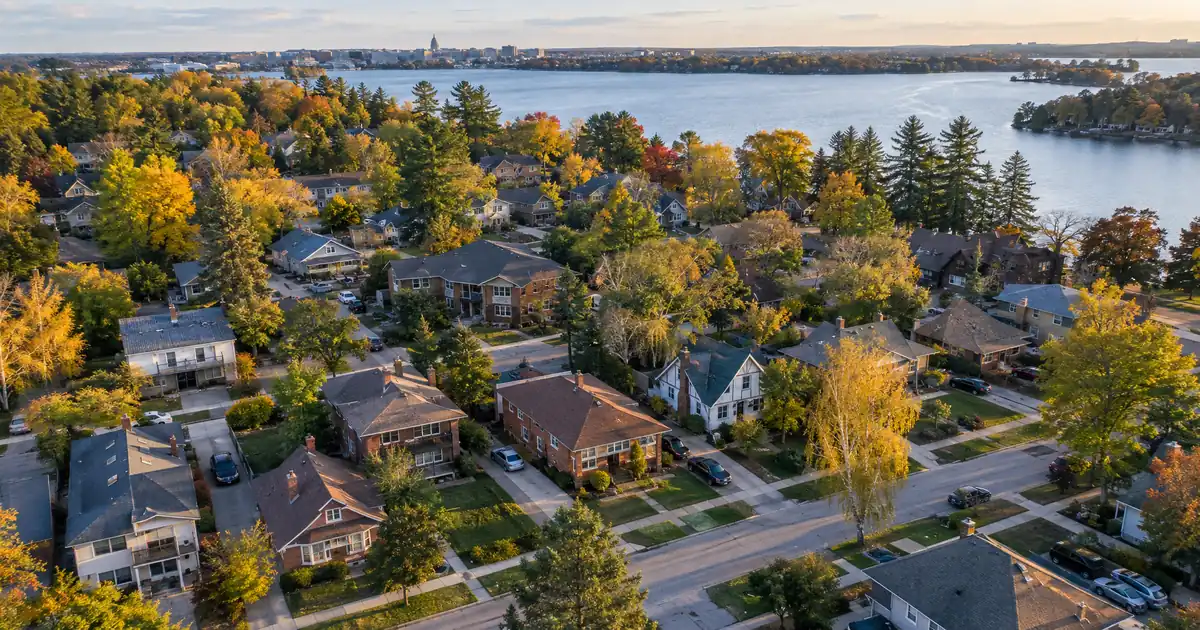
A fourplex a few blocks from Camp Randall in the Vilas neighborhood advertises coin-laundry income and game-day parking revenue alongside its rents, per a Homes.com Dane County listing. That ancillary income is the kind of number a cash-out lender may cap or exclude. The rent roll carries the refinance, and the rent roll depends on how many doors sit on the parcel. That is the core of Madison cash-out math.
TL;DR: A Madison cash-out refinance on an investment property is underwritten primarily on the property’s rental income measured against its full monthly obligation, which favors owners of duplexes through small multifamily over owners of a single house at citywide prices.
DSCR Cash-Out Calculator
Run the cash-out numbers in Madison, WI
Rate source: Freddie Mac 30-yr average via FRED® — Federal Reserve Bank of St. Louis · effective Sep 24, 2026
Prefilled with starting assumptions — enter your property’s value, balance, taxes, and insurance for a more accurate picture.
Program parameters update from Lendmire’s centralized guideline source. Taxes and insurance are editable estimates.
As of Sep 24, 2026 · General Freddie Mac market benchmark, not a Lendmire loan offer. Property value, balance, taxes, and insurance are editable estimates. Maximum loan-to-value varies by lender, program, property type, and seasoning. Not a Loan Estimate, approval, or commitment to lend. Program availability and eligibility are subject to lender guidelines, credit approval, property review, and underwriting.
- Redfin puts the Madison median sale price at $445K, so one house rarely carries a large refinance on its own rent.
- Cash-out LTV tops out at 75 percent, with about six months of seasoning from title recording.
- Lower-tier rentals run the tightest vacancy in the city, at 4.6 percent per the City of Madison.
- Underwrite on in-place rents. Rent growth has cooled to 1-2 percent a year.
Madison Market Snapshot
A quick read on the Madison investor landscape — figures come from the cited sources below. Confirm current property-level numbers before underwriting.
| Metric | Detail |
|---|---|
| Typical rents | $1,660 (Alero Madison Realty blog) |
| University enrollment | 51,865 total (Cap Times, UW-Madison enrollment) |
| Vacancy | 4.8% stabilized (City of Madison Housing) |
Why Unit Count Sets the Ceiling
A single-family rental at Madison prices seldom supports a meaningful cash-out. The proceeds are limited by the property’s rent against its full monthly obligation, not by how much the house has appreciated. Stacked units change that ratio.
Start with the two anchor numbers. Redfin reports a median sale price of $445K, up 2.4 percent year over year. RentCafe puts the average Madison apartment rent at $1,847. Divide one by the other and you get roughly 0.41 percent monthly gross rent-to-value. That is an illustration only, since the two figures measure different things (a price median across sales against an apartment-heavy rent average). A local brokerage analysis, Alero Madison Realty, cites a $435,000 price against $1,660 median rent, closer to 0.38 percent. Both readings say the same thing: thin.
Run the numbers on a modeled house. Assume a $435,000 property renting for $1,660, refinanced at 75 percent LTV. Coverage, including taxes and insurance, lands around 0.55-0.6. That is well below the 1.00 baseline most standard DSCR programs are built around, because at that level the rent covers the payment. Some lenders review lower ratios, but those files usually need lower LTV, stronger compensating factors, or different pricing.
Now change one input. Assume a duplex at the same price, two doors at $1,660 each. Coverage moves to about 1.1 on the same full-obligation basis. Nothing about the appreciation changed. Only the number of rent streams did.
Homes.com showed 30 multifamily listings in Madison, priced from $395,000 to $5,100,000. The entry price for a duplex or fourplex therefore sits close to the citywide single-family median. Rent per dollar of value improves with each added door, and that is why the Madison cash-out conversation is really a small-multifamily conversation.
Seasoning, LTV, and Reserves, Step by Step
Three constraints decide how much equity comes out: seasoning, the LTV ceiling, and reserves. Each is mechanical. Walk through them in order.
Step one is seasoning. Most programs Lendmire works with look for about six months of ownership, measured from the date title was recorded. A fourplex bought three months ago is not yet eligible for a cash-out, however much value the investor added.
Step two is the LTV ceiling. Cash-out is capped at 75 percent of appraised value, lower than the purchase-side ceiling. Take a hypothetical Madison fourplex appraising at $600,000 with an existing balance. The new loan cannot exceed 75 percent of that value, and the existing payoff comes out of that number first. What remains is the potential proceeds, and it is not guaranteed. The calculator converts the percentages to dollars, so the arithmetic stays in percentages here.
Step three is coverage and reserves. Qualifying rent used for lender review is measured against the full monthly obligation (principal, interest, taxes, insurance, and any HOA dues), with 1.00 as the common baseline. Reserves typically run about six months of that obligation, with more required on larger balances. Credit tiers run from a 620 floor upward through 660, 680, and 700, and standard programs cover balances up to $3,000,000. Vesting in an LLC is common, subject to lender program eligibility. For the full process, see the cash-out qualification details and Lendmire’s primer on DSCR loans.
DSCR files in markets like this one typically look the same on paper. The appraisal comes in reasonable, but the rent schedule decides the loan size. Owners who bought a small multifamily with below-market in-place rents often find the lease-based rent is the limiting factor, not the value. Operators who reach the cash-out step with leases current and rents documented tend to have the cleanest files. Owners still relying on a pro forma tend to have the messiest.
Where the Stacked Units Sit
Cash-out candidates in Madison cluster where multi-door stock exists: near campus, on the East side, across the Isthmus, and on the north and south sides for lower-priced duplexes. Submarket rent data here is patchy and portal-driven, so the neighborhood picture below is qualitative and rests on listing evidence.
Vilas and near-campus. Fourplex listings blocks from Camp Randall and UW target student and young-professional tenants. UW-Madison enrolled 51,865 students in the most recent fall, and the university cited an on-campus housing shortage behind flat enrollment. Most students live off campus, which gives the tenant pool depth. Lenders vary on student-heavy buildings, though, and the game-day parking and laundry income is exactly what they tend to discount.
East side (Grandview Commons, Hawthorne). A listing on the same Homes.com page shows a four-unit building here marketed as cash flowing with off-street parking, and Redfin’s East Side page lists an eight-unit building. In-place rents below market at renewal are the usual angle. Treat “cash flowing” as a seller’s word. The rent roll and the lender’s coverage math are what count.
Isthmus and Marquette. Historic, walkable, and lake-adjacent, this area has seven-unit listings that show real multifamily depth. One claims below-market rents and no vacancy history. That is a seller claim and unverified.
North side (Sherman, Burr Oaks). Zumper lists Sherman at $1,525 a month among the city’s most affordable neighborhoods, across all listing types. These are workforce duplex candidates. An agent’s listing cites a $1,900 “median market rent” and room to raise one side by $500. Color, not proof.
South Madison. Redfin’s regional table shows a median list price of $347,450, the lowest in that table. It is the natural price-to-rent candidate, though no reliable rent figure is available. Investors should build the rent side from actual leases.
West side and Near West. Redfin shows West Side near $439,950 and Near West near $624,900. Proximity to the hospitals and Epic supports demand, but the price level makes small multifamily coverage harder. This is a stretch for cash-out unless the rents are exceptional.
The stronger play might be the East side over the Isthmus for cash-out sizing. The Isthmus has the mystique, but the East side often offers newer stock and easier appraisal comps. Investors chasing appreciation could argue the other way.
Tenant Demand Under the Rent Roll
Madison’s rental demand is anchored by three large employers and one large campus. UW-Madison is the flagship, and UW Health runs a 505-bed regional referral center with a Level I trauma center. Epic Systems, headquartered next to Madison in Verona, and state government round out the base. Fifty-three percent of Madisonians rent, per the City of Madison’s housing snapshot, and owner-occupied vacancy sits at just 0.6 percent, below the national 1.1 percent.
Tenure tilts toward renting and ownership vacancy is nearly zero. That is why small rental stock holds occupancy even as new apartments arrive.
Where the Cash-Out Case Gets Tested
Vacancy is the first place to look. The city’s rental snapshot cites CoStar data showing stabilized vacancy of 4.8 percent against a healthy range of 5-7 percent, and it was 1.9 percent in 2022. The lowest-quality tier (one and two stars) runs the tightest at 4.6 percent. The 3-star tier sits at 6.5 percent and the 4- and 5-star tier at 6.9 percent, according to the same report. The city attributes the gap to pent-up demand for lower-cost housing. Older duplexes and fourplexes are therefore in the strongest tier, though deferred maintenance is the trade-off.
Supply is the second test. The Greater Madison Chamber of Commerce, citing CoStar, reports 5,837 multifamily units under construction in the region, higher than any point before the pandemic but below the 2021-2022 peaks. Metro vacancy rose from 5.9 percent to 6.2 percent, and asking-rent growth fell from 2.5 percent to 1.4 percent. The Chamber notes that rent increases typically return when vacancy falls under 4 percent.
Here’s the catch. A value-add thesis that assumes large rent bumps after purchase is weak right now. Underwrite the refinance on today’s rents, not on a rent trajectory from a few years back. The proceeds should be sized to in-place income (which is what the lender will do anyway).
One more demand point. UW-Madison enrollment is large and steady, and the university has said it did not seek to grow. That is stable demand, not surging demand. Near-campus buildings can be underwritten on that basis. Underwriting them for growth is a stretch.
DSCR vs. conventional financing
Two common ways to finance an investment property in Madison, WI. They qualify you differently — here’s how investors weigh them.
Why investors choose it
- Qualifies on the property’s rental income — no personal tax returns, W-2s, or pay stubs needed to document income.
- No personal debt-to-income ceiling to clear, so existing mortgages and obligations don’t cap your borrowing the same way.
- Can be closed in an LLC, keeping the property inside a business entity.
- Built for scaling — not held to the limit on number of financed properties that conventional financing applies.
- Underwriting centers on the deal: generally qualifies when the rent covers the payment, a 1.00x coverage ratio being a common baseline (confirmed in underwriting).
- Designed specifically for investment property, including long-term and, where the program allows, short-term rentals.
Where it’s strong
- Often the lowest ongoing financing cost for a buyer who fully qualifies on personal income — a fit for a first property or a cost-first purchase.
Trade-offs for investors
- Requires full personal income documentation and must fit within a debt-to-income limit — salary, existing debts, and other mortgages all count.
- Typically held in your personal name rather than a business entity.
- Caps how many financed properties you can carry, which can become a ceiling as a portfolio grows.
- Evaluates you as a borrower as much as the property, which usually means more paperwork.
How investors usually choose: a first or single property often optimizes for the lowest financing cost; portfolio builders often optimize for leverage, vesting in an LLC, and scaling past conventional caps. The right answer depends on your goals, the property, and current guidelines — both paths run through select lenders in Lendmire’s wholesale network, with eligibility and terms confirmed in underwriting.
The equity story cuts both ways. The Redfin median rose 2.4 percent year over year, while Zillow shows an average home value of $413,037, up 2.2 percent. Modest appreciation means most of the extractable equity comes from the original entry price, forced rent growth, or time held, not from the market lifting everything.
Turning Proceeds Into the Next Deal
Cash-out proceeds are capital, and the useful question is where the capital goes next. In Madison, the usual moves are a second small multifamily, a reserve top-up, or paying down a higher-cost obligation. The last option deserves more thought than it gets, since a refinance that improves the file can also make the next purchase easier.
Sequence matters. A refinance resets the seasoning clock on that property, and the next purchase brings its own coverage math. Investors planning a portfolio build should map the timing before they list anything. For structure and terms, see refinance details, or compare with a bank route in the comparison. To see how a specific rent roll converts, see how the DSCR math pencils on the state hub, or call Lendmire at 828-256-2183. Program details and eligibility are subject to lender overlays, and investors should verify current local rules, taxes, and insurance with qualified local professionals.
Madison Against Milwaukee
The research brief holds no head-to-head data on other Wisconsin cities, so this is a judgment, not a sourced comparison. For an investor sizing a cash-out on stacked units, Madison’s tight lower-tier vacancy, near-empty owner-occupied inventory, and a student and health-care demand base give it the edge right now. Milwaukee may reward investors who prioritize lower entry prices over occupancy stability.
Frequently Asked Questions
How do you qualify for a DSCR cash-out refinance in Madison?
Qualification centers on the property’s rent against its full monthly obligation, with 1.00 as the common baseline. A credit score of at least 620, about six months of seasoning, reserves of about six months, and a loan at or below 75 percent LTV are the typical marks. Some lenders review lower coverage with compensating factors. Final eligibility depends on lender guidelines, credit, and property review.
What are the requirements for an investment property loan in Madison, Wisconsin?
Expect an appraisal, a lease or market-rent schedule, proof of reserves, and a credit review, with the property’s income doing the qualifying work. Standard programs cover balances up to $3,000,000, and LLC vesting is common, subject to program terms. Manufactured homes, log homes, and barndominiums fall outside these programs.
How long must I own a Madison property before a cash-out?
About six months from the title recording date on most programs. A property bought and renovated within that window generally waits until seasoning is met. Terms vary by lender, so confirm before planning a timeline around the refinance.
Will Camp Randall game-day parking or laundry income count toward coverage?
Often not, or only in part. Ancillary income tends to be excluded or capped, so a Vilas fourplex is best underwritten on its rent roll alone. Any ancillary income that counts is a bonus, not the basis.
For current guidelines and terms, see Lendmire’s DSCR loan programs page.
About Lendmire
Lendmire (NMLS# 2371349) is a DSCR-focused mortgage broker that helps arrange investor financing across 41 markets, including Washington, D.C., through wholesale and investor-lending channels. Lenders generally review DSCR eligibility around the property’s rental income rather than personal income documentation, subject to lender guidelines. That structure suits self-employed investors, LLC operators, and portfolios above four financed properties. Scotsman Guide named Lendmire a Top Mortgage Workplace in both 2025 and 2026.
Get Started
Ready to find the right loan for you?
See your offer in seconds. No credit pull, no obligation.
Informational only. Not a Loan Estimate, approval, or commitment to lend. Program availability and eligibility are subject to lender guidelines, credit approval, property review, and underwriting.
References
1. Redfin, Madison housing market
3. Cap Times, UW-Madison enrollment
4. City of Madison, rental housing market
5. RentCafe, Madison average rent
6. Homes.com, Madison multifamily
7. Zumper
8. UW Health
9. City of Madison, housing snapshot
10. Greater Madison Chamber of Commerce, Metro Metrics
11. Zillow
12. 2025
13. 2026
This article is part of Lendmire’s investment property cash-out refinance program — full qualification details, guidelines, and scenarios live on the program page.
Related reading: Cash Out Refinance Investment Property: DSCR in Madison · DSCR Cash Out Refinance in Oconomowoc, Wisconsin: How the Rent Math Clears at 75% LTV Near Pabst Farms · DSCR Cash Out Refinance in Greenfield, Wisconsin: Pulling Equity From the Older Duplex Blocks
Guides: Investment Property Cash-Out Refinance in Madison, WI · Investment Property Cash-Out Refinance in Wisconsin
Brandon Miller
Founder & CEO, Mortgage Loan Originator, Lendmire LLC
- Mortgage Loan Originator · NMLS# 1129696 · Verify on NMLS Consumer Access
- North Carolina Real Estate Broker · License# 343312 · Verify on NCREC
- North Carolina Insurance Producer · License# 19053198 · Property, Casualty, Life, Health · Verify on NAIC SBS
- Lendmire LLC · Firm NMLS# 2371349 · Verify firm licensure
Disclosure information. Lendmire is a state-licensed mortgage brokerage under NMLS# 2371349. Lendmire is not a depository institution, direct lender, or financial advisor — all loans referenced are placed through wholesale lender partners and are subject to each lender's underwriting standards. This article is provided for general informational purposes and is not a commitment to lend, nor does it constitute financial, legal, or tax advice. Loan programs, terms, rates, and qualification standards change without notice and depend on borrower profile, property type, and the state in which the subject property is located. Equal Housing Opportunity provider. NMLS Consumer Access: nmlsconsumeraccess.org.