
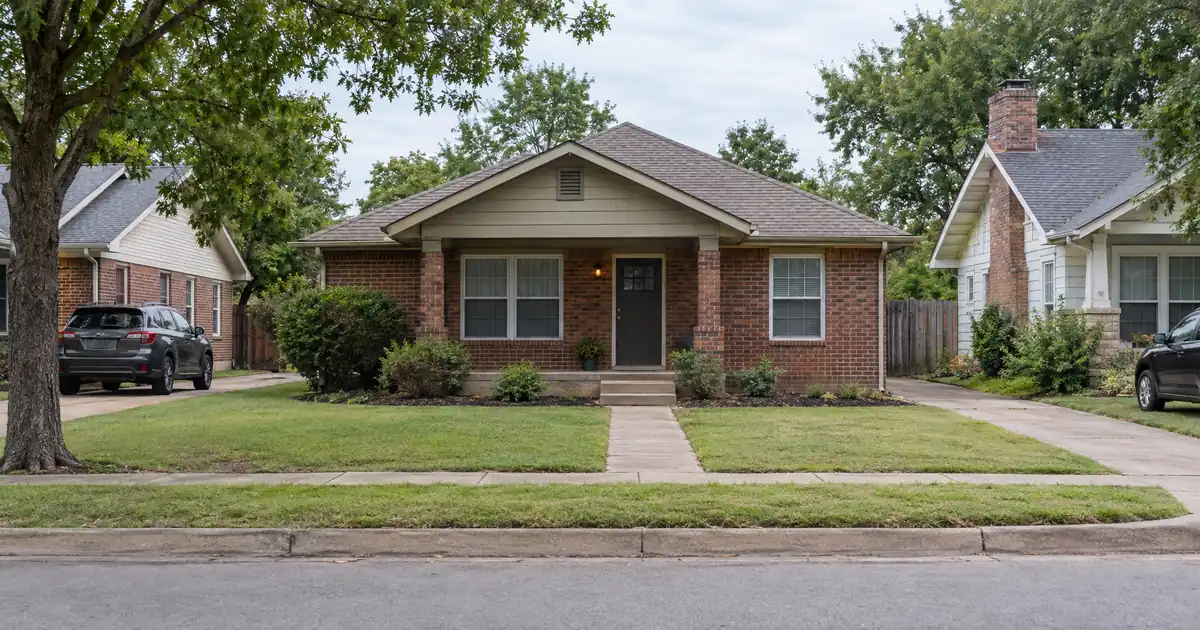
Two Norman owners hold paper equity. One has a three-bedroom house in the northwest part of town. The other has a duplex north of the university. The math favors the duplex. The house carries a higher value against one rent check, while the duplex stacks two rent checks against a lower combined value, and the DSCR cash-out refinance only works when the rent covers the monthly obligation. That is the mechanism this article walks through, including where the equity comes from in a market where citywide prices are flat.
At a Glance: A cash-out refinance on a Norman, Oklahoma rental is underwritten primarily on the property’s rental income measured against its full monthly obligation, then limited by a loan-to-value ceiling and a seasoning period measured from title recording. The file clears when documented rent, reserves, and appraised value all support the new balance.
DSCR Cash-Out Calculator
Run the cash-out numbers in Norman, OK
Rate source: Freddie Mac 30-yr average via FRED® — Federal Reserve Bank of St. Louis · effective Sep 24, 2026
Prefilled with starting assumptions — enter your property’s value, balance, taxes, and insurance for a more accurate picture.
Program parameters update from Lendmire’s centralized guideline source. Taxes and insurance are editable estimates.
As of Sep 24, 2026 · General Freddie Mac market benchmark, not a Lendmire loan offer. Property value, balance, taxes, and insurance are editable estimates. Maximum loan-to-value varies by lender, program, property type, and seasoning. Not a Loan Estimate, approval, or commitment to lend. Program availability and eligibility are subject to lender guidelines, credit approval, property review, and underwriting.
- Small multifamily is only about 8.88 percent of Norman housing units, per NeighborhoodScout.
- OU’s Norman campus reached 32,662 students last fall.
- Three-bedroom houses run thin against value. Duplex rent stacking carries the coverage ratio.
- Flat citywide values mean cash-out equity comes from purchase discount or renovation.
Norman, Oklahoma rental property investors can tap DSCR programs that Lendmire arranges, available across 41 markets, including Washington, D.C. Lendmire (NMLS# 2371349) is a DSCR-focused mortgage broker. It places these files with wholesale lenders, and the lenders decide on eligibility. For the basics of how the ratio works, see the DSCR fundamentals. This piece stays on the extraction side: you already own the property and want the capital out.
Norman Market Snapshot
A quick read on the Norman investor landscape — figures come from the cited sources below. Confirm current property-level numbers before underwriting.
| Metric | Detail |
|---|---|
| University enrollment | 32,000+ fall 2025 enrollment (City of Norman) |
| Employment | ~13,000 ou employees (City of Norman) |
Why the Duplex Beats the House on Coverage
On a Norman file, a duplex usually produces a stronger coverage ratio than a single-family rental at a similar total value. A single rent check sits against a full loan balance on a house, while a duplex splits that balance across two rent checks. The citywide numbers show the gap.
Zillow puts the average Norman home value at $265,617, up 1.0 percent over the past year. An investor guide from Oak & Prairie Homes cites Zillow snapshots of $1,600 to $1,750 for three-bedroom houses. Divide that rent by that value and you land near 0.6 percent gross monthly rent-to-value. That is arithmetic for illustration, not a published ratio. It is also low for a DSCR file, and it gets lower once taxes and insurance go into the denominator.
Now look at unit-level rents. RentCafe shows two-bedroom apartments at $1,166 and three-bedroom units at $1,775. Two 2BR units in one building total $2,332, which is more than the single 3BR figure. The building also costs less per rentable bedroom than a house of the same total value, so coverage improves.
Run the numbers on a modeled duplex. Assume a $250,000 value (a modeled figure, not a sourced price) and a 75 percent LTV cash-out, with two units renting at the low end of the sampled listing asks near $1,000 each. Using a 30-year amortization with taxes and insurance included, that sits around 1.3x. A three-bedroom house in the east-central ZIP asking roughly $1,350 against a value near $220,000 lands right around 1.0, likely a shade under. A southwest-side house asking $1,500 to $1,670 against a value above $310,000 comes out well under 1.0 at full leverage.
Those rents come from listing portals, not appraisals. Treat them as direction.
Where Does the Equity Come From When Prices Are Flat?
In Norman, cash-out equity comes mostly from the purchase price you paid or the work you put in, not from market appreciation. Zillow shows a 1.0 percent annual gain, while Redfin shows an average price of $283K, down 2.1 percent year over year. The two sources disagree on direction, and neither shows a market that builds equity on its own.
Think of the equity as having three sources:
- Purchase discount. You bought below what the property appraises for after repairs.
- Renovation value. You raised rent and condition, and the appraiser can see both.
- Principal paydown. Slow, but real on a longer hold.
Appreciation is a bonus here, not the plan. Underwrite the plan without it.
Another issue is the comp pool. Zillow’s Norman duplex and triplex page shows only about 12 multi-unit listings for sale at a point in time. That is a small sample. When an appraiser has few multi-unit comps, the value can come in lighter than the owner expects, and the cash-out proceeds drop with it. The fix is documentation. A reconsideration request works best when it includes recent in-neighborhood sales, a condition schedule, and the lease-in-place rent roll. Appraisal reconsideration is a routine step on thin-comp files, not an emergency move.
Housing stock explains the thin pool. NeighborhoodScout reports that single-family detached homes are roughly 61.91 percent of Norman’s units, large apartment complexes about 22.02 percent, and duplexes, converted homes, and small buildings about 8.88 percent, per the same NeighborhoodScout page. Small multifamily is scarce, and scarcity cuts both ways. It supports occupancy on the units that exist. It also limits the comparable sales an appraiser can lean on.
The Submarkets That Pencil (and Two That Don’t)
The core near OU and the east-central and west ZIPs pencil best for cash-out coverage. The northwest and southwest sides lean toward appreciation, with thinner coverage. The research here is mostly qualitative, so neighborhoods get described by tenant base and rent-to-value, not by invented price points.
Near-campus core and north of OU. A summary of the City of Norman’s housing plan says almost all new duplex development happened near the core and north of the university. The primary document is the City of Norman Housing Market Analysis. This is where duplex stock clusters, and where a stacked-rent refinance is most likely to find comparable sales.
ZIP 73071, east and central Norman. Zillow’s duplex page lists a value near $219,679 here, with three-bedroom house asks near $1,350 per the Zillow rentals page. That gives roughly 0.6 percent gross monthly rent-to-value, the strongest of the three ZIPs sampled. Duplex units in the same ZIP showed asks from about $850 to $1,350 in an ApartmentFinder sample. The range is wide, so a verified rent schedule matters more here than anywhere.
ZIP 73069, west and campus side. Zillow’s value estimate here sits above the east-side ZIP, with three-bedroom and four-bedroom house asks in current listings landing in a fairly tight band. A two-bedroom/two-bath duplex unit also showed an ask in line with those house rents. That is workable coverage, and it sits close to student and staff demand.
ZIP 73072, southwest. A Zillow value near $314,348 against three-bedroom asks of $1,500 to $1,670 gives roughly 0.5 percent. Coverage is thinner and the appeal leans toward appreciation. Honestly, this one is a toss-up depending on the investor’s goal. The cash-out coverage case is weaker here, though a buyer focused on long-term value could argue otherwise.
Northwest Norman and the northeast corridor. Upscale, newer stock in the northwest produces low rent-to-value, which makes it a poor DSCR cash-out fit. The northeast corridor skews toward rural-style ranch properties. One category to flag: barndominiums fall outside these DSCR programs entirely, so that stock is not a refinance candidate here.
East and southeast Norman. Apartment-heavy and near employers such as Hitachi. One supply note: Oak & Prairie’s ZIP analysis, citing KFOR, mentions 75 income-restricted apartments planned near East Imhoff Road. The same page notes a west-side site with 642 multifamily units. New supply near an existing small rental can affect lease-up, so watch it.
What Keeps the Tenants Coming
Norman’s tenant demand rests on three anchors: a growing university, a federal weather cluster, and a regional hospital system. Together they give a long-term rental market a base, though each carries a caveat.
The first anchor is the University of Oklahoma. The City of Norman calls OU the city’s largest employer, with nearly 13,000 employees. Norman campus enrollment grew from 30,873 to 32,662 students between the last two falls. OU’s news office reports a record freshman class of 6,437, the sixth straight record year. That is steady, documented demand for near-campus rentals. The catch: it is student-driven, so underwrite to the lease in place, not to a growth story.
The second is the National Weather Center on OU’s campus, which Visit Norman credits with more than 550 scientists, meteorologists, engineers, students, and staff. That adds a technical, federally linked tenant group beside the student base. Federal workforce news has created uncertainty, and KGOU reported on rumors surrounding the center, finding little evidence of a closure. Treat it as a stabilizer, not a guarantee.
The third is health care. Norman Regional Health System says it employs over 3,000 staff and more than 350 credentialed physicians and advanced practitioners. A workforce-analytics site, Revelio Labs, counts 2,693 employees, down about 1.1 percent year over year. The figures conflict. Call it a stable second source of long-term tenants, not a growth driver.
The wider base is solid. Census Bureau QuickFacts puts Norman at 131,008 residents, and RentCafe reports 47 percent of households (24,365) are renter-occupied. That is a large renter pool for a city this size.
Working DSCR brokers see a recurring pattern in campus-adjacent markets: leases cluster around the academic calendar. A refinance that closes mid-cycle can land on a rent roll full of month-to-month tenants or expiring terms. Files that document the lease cycle up front, with the lease dates and the rent schedule both in view, give the lender fewer questions to ask.
How the Cash-Out File Runs
The cash-out file has a short list of moving parts, and most delays come from gaps in them. Here is the sequence, with the program guideposts the network typically applies. All of these are subject to lender guidelines, credit approval, and property review.
1. Confirm seasoning. Programs generally want about six months of ownership, measured from title recording. The settlement statement documents it. Files that assume seasoning away get kicked back.
2. Pin the leverage ceiling. Cash-out LTV on these programs caps at 75 percent. Some programs trim 2-to-4-unit properties and condos further, often to around 70 percent, so a duplex may carry a lower ceiling than a single-family house. Confirm the program before you pencil proceeds.
3. Build the rent evidence. Lease agreements, a rent roll, and the appraiser’s rent schedule all feed the rent used for lender review. On campus-cycle properties, include current lease terms so the lender sees the in-place number.
4. Test the coverage. Divide the rent used for lender review by the full monthly obligation, which covers principal, interest, taxes, insurance, and any HOA dues. On select programs, 1.00 is a common floor because rent covers the obligation at that level. Some lenders review lower ratios, but those files usually need lower leverage, stronger compensating factors, or more cash in the deal.
5. Document reserves. Programs commonly look for about six months of PITIA in reserves, rising to about nine months above $1,500,000. Equity available depends on rent used for lender review, PITIA, reserves, and the 75 percent ceiling, so it is not a guaranteed cash figure.
6. Assemble entity papers. If the property sits in an LLC, the operating agreement and good-standing evidence need to line up with the title, subject to lender program eligibility.
Credit tiers run from 620 up through 660, 680, and 700, with 620 as the floor. Loan sizes go up to $3,000,000 on standard programs. The 620 floor does not give you the best leverage. Higher tiers generally open more room. For a side-by-side with conventional investor loans, see conventional vs DSCR on investor loans. The short version: conventional underwriting asks for personal income documents, while DSCR underwriting focuses on the property.
Where the Proceeds Go
The proceeds are the point. In a flat market, the cash-out buys the next property instead of waiting for appreciation to do it. A common sequence in a market like Norman is to buy a duplex below its after-repair value, stabilize the rents, refinance at the 75 percent ceiling or lower, and use the proceeds as the next down payment. Then repeat.
DSCR vs. conventional financing
There are two common ways to finance an investment property in Norman, OK, and they qualify you differently — here’s how investors weigh them.
Why investors choose it
- Qualifies on the property’s rental income — no personal tax returns, W-2s, or pay stubs needed to document income.
- No personal debt-to-income ceiling to clear, so existing mortgages and obligations don’t cap your borrowing the same way.
- Can be closed in an LLC, keeping the property inside a business entity.
- Built for scaling — not held to the limit on number of financed properties that conventional financing applies.
- Underwriting centers on the deal: generally qualifies when the rent covers the payment, a 1.00x coverage ratio being a common baseline (confirmed in underwriting).
- Designed specifically for investment property, including long-term and, where the program allows, short-term rentals.
Where it’s strong
- Often the lowest ongoing financing cost for a buyer who fully qualifies on personal income — a fit for a first property or a cost-first purchase.
Trade-offs for investors
- Requires full personal income documentation and must fit within a debt-to-income limit — salary, existing debts, and other mortgages all count.
- Typically held in your personal name rather than a business entity.
- Caps how many financed properties you can carry, which can become a ceiling as a portfolio grows.
- Evaluates you as a borrower as much as the property, which usually means more paperwork.
How investors usually choose: a first or single property often optimizes for the lowest financing cost; portfolio builders often optimize for leverage, vesting in an LLC, and scaling past conventional caps. The right answer depends on your goals, the property, and current guidelines — both paths run through select lenders in Lendmire’s wholesale network, with eligibility and terms confirmed in underwriting.
Because the cash-out ceiling sits at 75 percent, the investor has to work backward from the next deal. How much cash does the next property need, and does the first property’s appraised value support that proceeds figure at a coverage ratio that clears? If the duplex covers comfortably, there may be room to take less than the maximum and keep the balance lower. That keeps the file healthier through the next rent cycle.
For a deeper take on the structure itself, pulling equity out covers the mechanics. Investors who want to talk through the numbers on a specific duplex can reach the team at 828-256-2183, and the state-level view sits on Lendmire’s Oklahoma DSCR platform. One generic reminder: verify current local rental rules, taxes, and insurance with qualified local professionals before you commit.
Six to Twenty-Four Months Out
The next stretch in Norman most likely looks like steady rents and flat to modest values, with the best equity still made at the purchase and renovation stage. RentCafe shows average apartment rent up 2.4 percent, from $1,248 to $1,278, per the RentCafe market page. That is a modest gain, not a surge. Meanwhile Zillow and Redfin disagree on direction for values, which argues against any plan that needs appreciation to work.
The demand side has more room. OU has posted six straight record freshman classes, and the weather-center and hospital anchors give the market a base beyond students. The supply side is the watch item: new income-restricted and multifamily projects on the east and west sides could press rents on competing small properties. The qualified call is this. Duplexes near the OU core, bought at a discount and documented clean, should keep clearing coverage and supporting cash-out. Higher-priced single-family houses on the northwest and southwest sides will keep needing lower leverage or more rent to do the same.
Frequently Asked Questions
How do you qualify for a DSCR cash-out refinance in Norman, Oklahoma?
The property has to show enough rent to cover its full monthly obligation, with 1.00 as the common baseline. You also need about six months of ownership from title recording, a credit score at or above the 620 floor, and about six months of PITIA in reserves. Final eligibility depends on lender guidelines, credit approval, and property review.
What are the requirements for a cash-out refinance on a Norman duplex?
Expect a 75 percent LTV ceiling at most, and possibly lower, since some programs trim 2-to-4-unit properties further. The file needs a rent roll or leases, an appraisal with a rent schedule, entity documents if an LLC holds title, and the reserve evidence. Thin multi-unit comps can limit the appraised value, so a reconsideration packet with nearby sales may help.
How much equity can I pull from a Norman rental if prices are flat?
Less than you might hope, and it depends on how you bought. With citywide values moving only about 1.0 percent up on Zillow and 2.1 percent down on Redfin, equity comes from purchase discount or renovation more than market gains. The 75 percent LTV ceiling, the coverage ratio, and the reserve requirement all cap the number. None of it is a guaranteed figure. Exact terms depend on the lender’s guidelines, property type, leverage, and a full review of the borrower’s file.
Does Norman’s thin duplex market hurt a cash-out appraisal?
It can, because a thin duplex market limits the evidence an appraiser has to work with. Small multifamily is only about 8.88 percent of housing units, and Zillow shows roughly 12 duplex and triplex listings at a point in time. Fewer comparable sales give the appraiser less to work with. Documenting recent in-neighborhood sales, property condition, and in-place rents helps support the value.
What down-payment ranges may DSCR lenders review for Norman investment-property purchases?
Lenders commonly review about 20 to 25 percent down on purchases, depending on credit, property type, and program. Lendmire is a mortgage broker arranging DSCR investor loans with loan amounts up to $3,000,000 on standard programs. Cash-out refinances are capped separately at 75 percent LTV.
For current guidelines and terms, see Lendmire’s DSCR loan programs page.
About Lendmire
Lendmire is a non-QM mortgage brokerage (NMLS# 2371349) that arranges DSCR investor loans in 41 markets, including Washington, D.C., through wholesale and investor-lending channels. The lender evaluates DSCR loans mainly on the property’s rental income instead of personal income, subject to lender guidelines. That suits LLC-owned portfolios, self-employed investors, and operators who have outgrown conventional loan caps. The firm is a 2026 Scotsman Guide Top Workplace and a 2025 Scotsman Guide Top Mortgage Workplace, and the 2026 Top Workplace recognition announcement is public.
Get Started
Ready to find the right loan for you?
See your offer in seconds. No credit pull, no obligation.
Informational only. Not a Loan Estimate, approval, or commitment to lend. Program availability and eligibility are subject to lender guidelines, credit approval, property review, and underwriting.
References
2. City of Norman, Data and Demographics
5. RentCafe, Norman average rent
6. Redfin
8. City of Norman Housing Market Analysis
11. 75 income-restricted apartments planned near East Imhoff Road
13. Visit Norman, National Weather Center
14. KGOU reported on rumors surrounding the center
15. Norman Regional Health System
16. Revelio Labs
17. Census Reporter, Norman profile
18. a 2026 Scotsman Guide Top Workplace
19. a 2025 Scotsman Guide Top Mortgage Workplace
20. 2026 Top Workplace recognition announcement
This article is part of Lendmire’s investment property cash-out refinance program — full qualification details, guidelines, and scenarios live on the program page.
Related reading: Cash Out Refinance Investment Property Norman Oklahoma · DSCR Loans in Norman, Oklahoma: Investor Financing for Campus Corner, Brookhaven, South Norman Rentals & Real Estate Investors · DSCR Cash Out Refinance in Cornelius, North Carolina: Hospital Jobs and a Built-Out Town
Guides: Investment Property Cash-Out Refinance in Norman, OK · Investment Property Cash-Out Refinance in Oklahoma
Brandon Miller
Founder & CEO, Mortgage Loan Originator, Lendmire LLC
- Mortgage Loan Originator · NMLS# 1129696 · Verify on NMLS Consumer Access
- North Carolina Real Estate Broker · License# 343312 · Verify on NCREC
- North Carolina Insurance Producer · License# 19053198 · Property, Casualty, Life, Health · Verify on NAIC SBS
- Lendmire LLC · Firm NMLS# 2371349 · Verify firm licensure
Legal disclosures. Lendmire (NMLS# 2371349) is a state-licensed mortgage brokerage that arranges financing through wholesale lender relationships. Lendmire is not a direct lender, depository institution, or registered financial advisor. The discussion above is general informational content about real estate financing — it is not financial, legal, or tax advice, and readers should consult licensed professionals for guidance on their individual circumstances. Loan inquiries are subject to lender underwriting; this article does not represent a commitment to lend. Loan terms, rates, and qualification standards vary by borrower, property, and state, and are subject to change at any time. Equal Housing Opportunity. NMLS Consumer Access: nmlsconsumeraccess.org.