
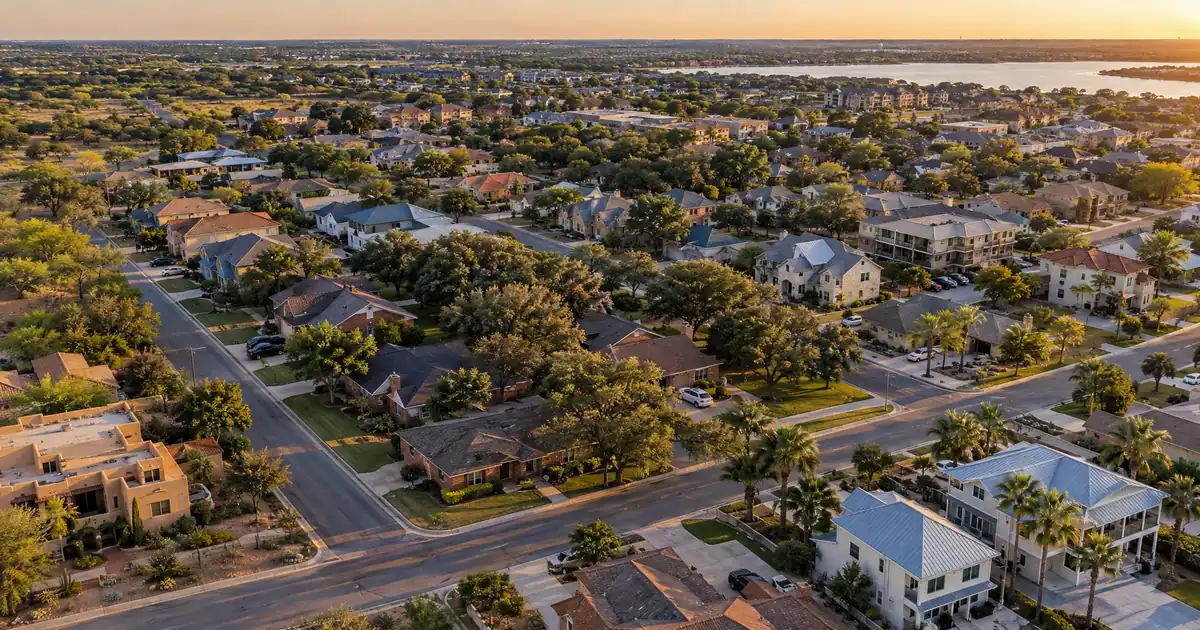
The neighborhoods with the most equity to pull in McKinney are not the ones with the biggest price tags. Investors assume Stonebridge Ranch and the Craig Ranch corridor, with their master-planned amenities, are where a cash-out refinance pays. The data points the other way. Coverage math favors the older, cheaper, central-west stock, and headline home values are now falling, not rising.
DSCR Cash-Out Calculator
Run the cash-out numbers in Mckinney, TX
Rate source: Freddie Mac 30-yr average via FRED® — Federal Reserve Bank of St. Louis · effective Sep 24, 2026
Prefilled with starting assumptions — enter your property’s value, balance, taxes, and insurance for a more accurate picture.
Program parameters update from Lendmire’s centralized guideline source. Taxes and insurance are editable estimates.
As of Sep 24, 2026 · General Freddie Mac market benchmark, not a Lendmire loan offer. Property value, balance, taxes, and insurance are editable estimates. Maximum loan-to-value varies by lender, program, property type, and seasoning. Not a Loan Estimate, approval, or commitment to lend. Program availability and eligibility are subject to lender guidelines, credit approval, property review, and underwriting.
The Quick Read:
A DSCR cash-out refinance in McKinney, Texas is underwritten primarily on the property’s rental income measured against its full monthly obligation. With local values softening, the binding constraint is usually appraised value times the 75 percent ceiling, not the borrower’s income or the size of the rent roll.
- Redfin shows the median sale price down 4.5 percent year over year, so appraisals set the ceiling.
- ZIP 75069 shows about 0.54 percent gross rent-to-price on three-bedrooms, versus 0.49 percent in 75071.
- Cash-out typically caps at 75 percent LTV, with about six months of ownership seasoning from title recording.
- Modeled at full PITIA, single-family coverage at maximum leverage lands below 1.00. Lower leverage closes the gap.
Mckinney Market Snapshot
A quick read on the Mckinney investor landscape — figures come from the cited sources below. Confirm current property-level numbers before underwriting.
| Metric | Detail |
|---|---|
| Home prices | 796 sales in July (Redfin, McKinney housing market) |
| Employment | 600+ jobs (City of McKinney news release) |
Where the Equity Actually Sits: Eldorado, Westridge, and the 75069 Side
The established mid-market, centered on Eldorado, Westridge, and the Greens of McKinney, is the strongest cash-out territory in the city. Entry prices are the lowest of the named submarkets, rent-to-price ratios run a step ahead of newer ZIPs, and the ZIP with the most equity-tapping history is 75069.
Start with price. NorthTexasNumbers, a regional data aggregator, places established areas like Eldorado in the $300,000 to $400,000 range. Treat that as directional, not a comp. On rents, Rent.com lists average one-bedroom apartment asking rents of $1,375 in Eldorado, $1,524 in Westridge, and $1,526 in the Greens of McKinney. Those are apartment listing averages, not single-family rents, but they show the ladder: Eldorado sits lowest on both price and rent.
The ZIP-level numbers sharpen it. Prop-Metrics shows a 75069 median price of $429,000, with two-bedroom rent of $1,850 and three-bedroom rent of $2,300. Its 75071 page shows a $482,000 median price against three-bedroom rent of $2,380. Lendmire Research’s arithmetic on those figures gives a gross rent-to-price ratio of about 0.54 percent in 75069 and 0.49 percent in 75071. These are aggregator estimates, and the rents predate the latest price moves. Still, the direction holds. Older stock pencils better.
Run the numbers on a three-bedroom house at the 75069 median of $429,000 with a modeled rent of $2,300. Model the coverage at full PITIA, meaning principal, interest, taxes, and insurance. At 75 percent LTV, the ratio lands around 0.8. At 60 percent, it improves to roughly 0.9. It reaches about 1.00 only near 50 percent leverage. Those bands are rounded down on purpose.
That is a sub-1.00 result at the maximum cash-out ceiling. The standard baseline for most DSCR programs is 1.00x, since rent covers the payment at that level. Some lenders review lower ratios, but usually with stronger compensating factors, lower leverage, different pricing, or more reserves. Paths a lender may review here include a sub-1.00 program, an interest-only structure, or simply a smaller cash-out request. Eligibility depends on lender guidelines, credit profile, reserves, and property review.
One more datapoint on 75069. Older HUD-based figures in the same Prop-Metrics data show 12 percent of loans there were cash-out refinances, against 5 percent in 75071. Investor loan share was low in both, 2 percent and 4 percent respectively. Thin investor volume means few investor comps, so appraisers lean on owner-occupant sales. That’s a fact worth knowing before ordering the appraisal.
Why Craig Ranch and Stonebridge Are Harder Than They Look
Craig Ranch and Stonebridge Ranch carry the highest rents and the highest prices, and price wins that race. Coverage compresses at these price points, and leverage at the 75 percent ceiling leaves little cushion.
Craig Ranch, the newer master-planned pocket near the SH-121 corridor, commands the city’s top one-bedroom apartment average at $1,834, per Rent.com. Its commuter access to Plano’s Legacy West and Frisco’s The Star explains the premium. A local-agent page puts nearby Watters Branch homes from the high $300s to the high $400s, though it’s undated, so treat it as qualitative. Townhomes near Craig Ranch are probably the better fit than detached homes, since the rent premium is highest there, but no sourced townhome-level figures exist to prove it.
Stonebridge Ranch, including Adriatica Village, is a different story. Movoto reports a listing median of $647,000 in May, down 4 percent year over year. Renters make up 25 percent of households, according to Homes.com. One-bedroom apartments average $1,605. Rent does not scale with price here. A house priced far above the citywide median does not rent for a proportionally higher amount, so at 75 percent LTV, full PITIA (principal, interest, taxes, insurance, and HOA dues) can outrun market rent by a wide margin. Texas property taxes and insurance weigh heavily on the qualifying payment at this price point. Worked through with full PITIA across a range of rate environments, coverage lands at roughly a third to two-fifths of the payment, or about 0.36x to 0.39x, which is far below even the 1.00 select-program floor. Closing that gap would take substantially more equity or a much lower loan amount, so most deals here would not approach break-even and the sub-1.00 conversation is a hard one. One private HOA structure covering clubs, lakes, and sub-villages also adds dues to the qualifying payment, which pushes coverage lower still.
Skip these areas for a max-leverage cash-out unless the property was bought well below current value.
The Story Neighborhoods With Thin Data
Historic Downtown, East McKinney, and Trinity Falls have strong narratives and no reliable price-or-rent data, so treat them as case-by-case rather than as submarkets with a coverage number.
The city says Historic Downtown holds more than 200 locally owned shops, galleries, and restaurants, and loft-style apartments cluster near the courthouse-turned-performing-arts-center. The renter profile skews toward young professionals. East McKinney and the Mill District, where the grain mill, TUPPS Brewery, and the Chestnut Square farmers market anchor the revival, offer older, transitional housing stock. Trinity Falls and North McKinney are newer growth areas with trails and green space.
Neither research pass found a defensible price or rent for any of the three. So no coverage number is offered here. An investor with a rental in one of these areas should expect the appraiser and the lender’s rent schedule to do the work, and should bring a signed lease.
The Appreciation Problem: Is There Equity to Pull?
Prices in McKinney have corrected, not climbed. Cash-out proceeds are set by today’s appraised value times the 75 percent ceiling, minus the existing loan, and both major sources show that value falling.
Redfin puts the median sale price for the three months to July at $511,000, down 4.5 percent year over year, with homes selling after about 45 days. It counted 796 homes sold in July, down from 840 the year before. Price per square foot is $205, down 2.4 percent. Zillow shows a lower average home value of $480,265, down 6.1 percent, with homes going pending in around 33 days. Different methodologies, same direction: a market that has cooled from its 2021-22 peak, softening by roughly 4 to 6 percent over the past year. Movoto’s listing-based days-on-market number (114 versus 48 a year earlier) conflicts with Redfin’s, so treat DOM as source-dependent.
What does that mean for someone holding a rental? Picture an investor who bought a house near the ZIP 75069 median at peak-era pricing. If value has slipped 5 percent since, a 75 percent LTV cash-out is now measured against a lower number. That equals about 71 percent of the original price. Subtract the existing balance and the proceeds may be small or zero. Investors who bought below market, or who added value through rehab, are the ones positioned for a cash-out that returns real capital.
Six months of ownership, measured from title recording, is the typical seasoning window. Passing it does not create equity. It only makes the file eligible for a lender to review.
Working DSCR brokers see a recurring pattern in suburban markets that have cooled after a strong run: the file’s income side is fine, and the appraisal is where it breaks. The cleanest file from a documentation standpoint has complete leases, entity documents, title, and property details ready for lender review. Even then, the appraised value can move the answer more than any other input. Stress-testing at flat-to-lower value before ordering the appraisal saves a wasted fee.
Who Actually Rents Here: The Demand Anchors
McKinney’s rental demand rests on a growing, high-income employment base, not a single employer. That supports occupancy and lease renewal on well-priced homes, though it has not translated into rising rents.
Per Census-derived figures at Texas Demographics, the population is about 210,600, and median household income is $124,215. U.S. News reports a higher population, near 218,190, reflecting a different estimate vintage. According to KXAN’s reporting on Census estimates, McKinney ranked among the top five Texas cities by residents added in a single year, with more than 11,000. Growth like that has not been steady price appreciation lately, but it supports occupancy.
Resident employment leans white-collar. Data USA shows 14,655 residents in professional, scientific, and technical services, 13,277 in health care and social assistance, and 11,929 in finance and insurance. Those sectors point toward stable, longer leases rather than transient turnover.
The McKinney Economic Development Corporation lists employers including Raytheon Intelligence & Space (now RTX), Globe Life, Independent Financial, Encore Wire, Amazon, Simpson Strong-Tie, and LifePath Systems. No headcounts are published on that page, and none are stated here. Where numbers exist, per Bisnow, Globe Life plans to relocate more than 3,000 employees and its headquarters to McKinney, and Encore Wire is running a $500 million expansion adding an estimated 120 jobs. The City of McKinney reports LITEON’s $919 million manufacturing campus with more than 600 new jobs. It also lists a planned 20,000-seat, $300 million amphitheater and a $200 million surf resort under construction. That adds up to a city with new employment and entertainment investment landing at the same time as softer home prices.
Education and healthcare add a modest base. Collin College is headquartered in McKinney, and its McKinney campus, opened in 1986, houses the Cary A. Israel Health Sciences Center, the primary nursing campus. The district serves roughly 60,000 students annually across all campuses. No four-year university sits in town, so student renter demand is small. Baylor Scott & White Medical Center – McKinney lists 192 beds, and U.S. News ranks it 21st in Texas.
(Anchors like these support occupancy. They don’t guarantee rent growth, and the rent data shows none.)
The Apartment Overhang and What It Does to Small Landlords
McKinney has new-supply pressure in large apartment complexes, and concessions from new Class A buildings compete directly with small-landlord units. Underwrite a vacancy and concession cushion, particularly for anything near lease-up product.
According to a local brokerage’s summary of the City’s affordable housing assessment (HXC Real Estate, a secondary source), simple multifamily vacancy stood at 15.7 percent in one recent quarter, but stabilized vacancy was 8.0 percent, against 9.4 percent for the DFW metro. About 12 percent of McKinney’s multifamily units were built in a single year-long stretch, versus 4 percent across Dallas. CoStar-based research from Matthews says Allen/McKinney and Frisco/Prosper are under the most pressure from heavy new supply. The primary City document was not located, so hold those percentages loosely.
Rents sit in a flat-to-down band. The same HXC summary of Zumper data shows apartments averaging $1,657 against houses at $2,500. Point2Homes reports apartments down 1.7 percent year over year, and renters occupy 35 percent of the 23,980 units it counts. A three-bedroom house competes on a different footing than a new apartment, so a house rental is less exposed. The thing to underwrite is flat rent.
Small multifamily is the open question. No sourced data shows a duplex, triplex, or fourplex rent-to-value edge here, and none should be assumed. The stronger play might be smaller single-family homes and townhomes in the established mid-market over anything at Stonebridge prices, though an investor holding a small multifamily property in the right spot could argue the opposite.
Structuring the Cash-Out (and What If the Number Comes in Under 1.00)
A McKinney cash-out file lives or dies on four inputs: appraised value, the 75 percent LTV ceiling, rent used for lender review against full PITIA, and reserves. All of it is subject to lender guidelines and property review.
Typical program guidance runs like this, subject to lender review: a 75 percent LTV ceiling on cash-out, about six months of ownership seasoning, a 1.00 DSCR baseline, and credit tiers running from a 620 floor up through 660, 680, and 700. Reserves are generally about six months of PITIA. Loan sizes run up to $3,000,000 on standard programs, and smaller balances route through select lenders in the network. Equity available depends on rent used for program review, PITIA, reserves, and that ceiling. It is not a guaranteed cash figure. Manufactured homes, log homes, and barndominiums fall outside these programs. Titling in an LLC is common, subject to lender program eligibility.
If the file comes in under 1.00, as many McKinney single-family files will at maximum leverage, the structure choices look like this:
1. Reduce the cash-out. Lower leverage lifts coverage, as the 75069 example showed.
2. Interest-only structuring. Some programs offer it, and a lender would review it.
DSCR vs. conventional financing
Two common ways to finance an investment property in Mckinney, TX. They qualify you differently — here’s how investors weigh them.
Why investors choose it
- Qualifies on the property’s rental income — no personal tax returns, W-2s, or pay stubs needed to document income.
- No personal debt-to-income ceiling to clear, so existing mortgages and obligations don’t cap your borrowing the same way.
- Can be closed in an LLC, keeping the property inside a business entity.
- Built for scaling — not held to the limit on number of financed properties that conventional financing applies.
- Underwriting centers on the deal: generally qualifies when the rent covers the payment, a 1.00x coverage ratio being a common baseline (confirmed in underwriting).
- Designed specifically for investment property, including long-term and, where the program allows, short-term rentals.
Where it’s strong
- Often the lowest ongoing financing cost for a buyer who fully qualifies on personal income — a fit for a first property or a cost-first purchase.
Trade-offs for investors
- Requires full personal income documentation and must fit within a debt-to-income limit — salary, existing debts, and other mortgages all count.
- Typically held in your personal name rather than a business entity.
- Caps how many financed properties you can carry, which can become a ceiling as a portfolio grows.
- Evaluates you as a borrower as much as the property, which usually means more paperwork.
How investors usually choose: a first or single property often optimizes for the lowest financing cost; portfolio builders often optimize for leverage, vesting in an LLC, and scaling past conventional caps. The right answer depends on your goals, the property, and current guidelines — both paths run through select lenders in Lendmire’s wholesale network, with eligibility and terms confirmed in underwriting.
3. A sub-1.00 program. These exist in the network but typically ask for stronger compensating factors, more reserves, or different pricing.
None of these is a promise. Each is reviewed by the lender against the borrower, property, and program.
While other non-QM platforms add state-specific overlays that shrink usable LTV, the 75 percent ceiling is the figure to plan around here, and the broker’s job is to compare lender channels against it. To run a specific property, reach the team at 828-256-2183. Before any rental decision, verify current local rental rules, taxes, and insurance with qualified local professionals. For the wider tradeoffs, conventional vs DSCR on investor loans lays them out, and Lendmire’s DSCR walkthrough explains how the ratio is built from rent over full monthly obligation.
Frequently Asked Questions
How do you qualify for a DSCR cash-out refinance in McKinney, Texas?
The property has to show enough rent against its full monthly obligation, typically at or above the 1.00 baseline, and the request has to fit under the 75 percent LTV ceiling. The borrower also needs to have owned the property about six months and hold roughly six months of PITIA in reserves. Pricing and available terms vary by lender, borrower profile, property type, and full underwriting review. Given softening local values, the appraisal is usually the deciding step. Final eligibility rests with the lender.
What are the requirements for an investment property cash-out loan in McKinney, Texas?
Expect a leased or lease-ready one-to-four-unit rental, entity or personal title documents, insurance, a lender-ordered appraisal, and reserves. Typical guidance is a 75 percent maximum LTV, about six months of seasoning, and credit tiers from 620 up to 700. Eligibility for LLC-titled properties depends on program guidelines. Manufactured homes, log homes, and barndominiums are not eligible.
Will falling McKinney prices block a cash-out refinance?
Not automatically, but they shrink it. Both Redfin and Zillow show values down roughly 4 to 6 percent year over year. So the 75 percent ceiling applies to a lower appraised number, and investors who bought near the peak may find little equity to pull. Buyers who purchased below market or added value through rehab are better placed.
Can a self-employed investor buying in Mckinney be reviewed for DSCR financing?
Yes, DSCR files are generally reviewed on the property’s rental income rather than the borrower’s W-2 history, which suits self-employed investors. Lendmire arranges DSCR investor loans. Every scenario stays subject to eligibility review and program guidelines.
Does Globe Life’s headquarters move mean McKinney rents will rise?
Not on the current evidence. Per Bisnow, Globe Life plans to relocate more than 3,000 employees, which supports occupancy over time. But rent data still shows flat-to-down movement, with apartments down 1.7 percent year over year. Underwrite at current rents and treat any lift as upside.
For current guidelines and terms, see Lendmire’s DSCR loan programs page.
The Choice in McKinney
Every McKinney holder with equity to pull faces the same fork. One path is to take the cash-out now at reduced leverage, accepting a smaller check and a thinner return on the next deal, in exchange for a file that clears coverage and appraises against a value that is still adjusting downward. The other is to wait for the price correction to settle while Globe Life, LITEON, and the new amphitheater and surf resort build out the local economy, keeping the existing loan in place but risking that a rebound never arrives on the timeline the next deal needs.
For broader investor-financing rules and property-type coverage across the state, see Texas DSCR loans.
For how equity extraction works on an investment property, see cash-out refinance on an investment property.
About Lendmire
Lendmire, NMLS# 2371349, is a non-QM mortgage broker serving real estate investors in 41 markets, including Washington, D.C., through DSCR investor loan programs. Qualification is generally reviewed around the subject property’s rental income rather than the borrower’s W-2 history, a practical fit for LLC-titled portfolios and self-employed investors. All scenarios remain subject to the lender’s review and program guidelines. The firm has earned two consecutive Scotsman Guide Top Mortgage Workplace recognitions: a 2026 Scotsman Guide Top Workplace and one recognized by Scotsman Guide in 2025.
Get Started
Ready to find the right loan for you?
In about 30 seconds you can review financing options available for your investment property. No commitment required.
Informational only. Not a Loan Estimate, approval, or commitment to lend. Program availability and eligibility are subject to lender guidelines, credit approval, property review, and underwriting.
References
1. Redfin — McKinney Housing Market
2. 75071
3. mckinneytexas.org — Newsflash
4. Prop-Metrics
5. Rent.com
6. Movoto
7. Homes.com
8. Zillow
10. KXAN’s reporting on Census estimates
11. Data USA
12. McKinney Economic Development Corporation
13. Bisnow
14. Collin College
15. Baylor Scott & White Medical Center – McKinney
16. HXC Real Estate
17. Matthews
18. Point2Homes
19. a 2026 Scotsman Guide Top Workplace
20. recognized by Scotsman Guide in 2025
This article is part of Lendmire’s investment property cash-out refinance program — full qualification details, guidelines, and scenarios live on the program page.
Related reading: Luxury Rental DSCR Loans In New Jersey · Jersey Shore Vacation Rental Loans: DSCR Financing In Ocean City, Cape May And Long Beach Island · DSCR Cash-out Refinance In New Jersey: Pulling Equity From A Rental
Guides: Investment Property Cash-Out Refinance in McKinney, TX · Investment Property Cash-Out Refinance in Texas
Brandon Miller
Founder & CEO, Mortgage Loan Originator, Lendmire LLC
- Mortgage Loan Originator · NMLS# 1129696 · Verify on NMLS Consumer Access
- North Carolina Real Estate Broker · License# 343312 · Verify on NCREC
- North Carolina Insurance Producer · License# 19053198 · Property, Casualty, Life, Health · Verify on NAIC SBS
- Lendmire LLC · Firm NMLS# 2371349 · Verify firm licensure
Important disclosures. Lendmire (NMLS# 2371349) is a licensed mortgage brokerage. Lendmire is not a direct lender, depository institution, or financial advisor. All loan inquiries are subject to lender underwriting; this article does not constitute a commitment to lend. Rates, terms, and program guidelines are subject to change without notice and vary by borrower profile, property type, and state. Information in this article is general in nature and is not financial, legal, or tax advice. Equal Housing Opportunity. NMLS Consumer Access: nmlsconsumeraccess.org.