
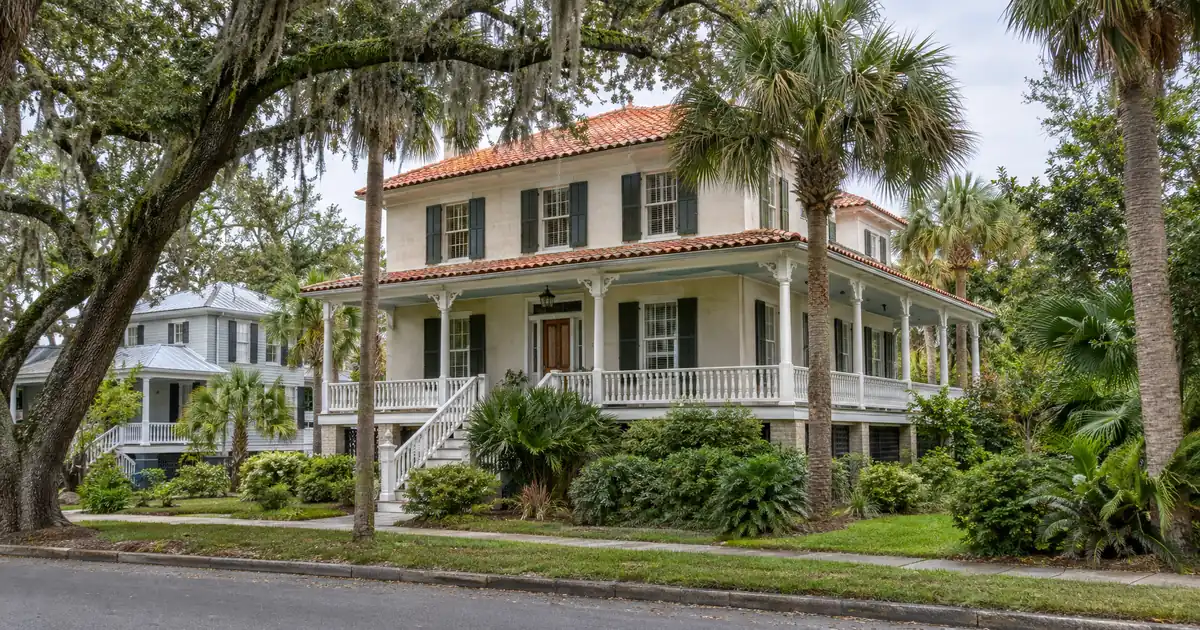
A rental in Yulee hits the DSCR math like this. Picture a single-family house valued near $350,000, roughly the Yulee median per Palm3Realty’s neighborhood breakdown. It has been owned long enough to season and is leased at a modeled $2,600 a month. At 75 percent loan-to-value, and counting taxes and insurance in full PITIA, that file lands near 1.15x. Not spectacular. Clean. The property clears the baseline, and the cash-out proceeds go to work somewhere else.
Now move the same exercise onto the island, and the picture changes.
DSCR Cash-Out Calculator
Run the cash-out numbers in Amelia Island, FL
Rate source: Freddie Mac 30-yr average via FRED® — Federal Reserve Bank of St. Louis · effective Sep 24, 2026
Prefilled with starting assumptions — enter your property’s value, balance, taxes, and insurance for a more accurate picture.
Program parameters update from Lendmire’s centralized guideline source. Taxes and insurance are editable estimates.
As of Sep 24, 2026 · General Freddie Mac market benchmark, not a Lendmire loan offer. Property value, balance, taxes, and insurance are editable estimates. Maximum loan-to-value varies by lender, program, property type, and seasoning. Not a Loan Estimate, approval, or commitment to lend. Program availability and eligibility are subject to lender guidelines, credit approval, property review, and underwriting.
At a Glance: A cash-out refinance on an Amelia Island, Florida rental is underwritten primarily on the property’s rental income measured against its full monthly obligation, with leverage capped at 75 percent of appraised value and the appraisal setting how much equity is actually accessible.
- Yulee-area single-family, valued near the $350,000 local median, models around 1.15x with full PITIA at 75 percent LTV.
- Island-core homes near the $649,000 median list price often model below 1.00x on long-term rent.
- Roughly 16.8 months of supply means appraisers will lean on closed comps, not asking prices.
- Fernandina Beach rental vacancy sits near 5 percent, with 1.09 rental units per renter household.
- Seasoning runs about six months from title recording; reserves run about six months of PITIA.
Amelia Island Market Snapshot
A quick read on the Amelia Island investor landscape — figures come from the cited sources below. Confirm current property-level numbers before underwriting.
| Metric | Detail |
|---|---|
| Home prices | $636,000 median (Momentum Realty – 32034 Real) |
| Recent appreciation | 9.67% decade (Steadily) |
| University enrollment | 665 students (Nassau County Economic) |
| Population | 101,000+ county residents (Nassau County Economic) |
| Employment | ~600 employees (Smurfit WestRock Fernandina) |
| Vacancy | 5% (Affordable Housing Online) |
Yulee and the Mainland Corridor: Where the Coverage Clears
The mainland side of Nassau County is where cash-out refinances pencil best. Single-family prices generally run from the high $200,000s to the low $500,000s across Yulee, Wildlight, and the SR 200/A1A corridor, with much of the newer construction sitting in planned subdivisions off those two roads. Compare that to the island, where the ZIP 32034 median sale price sits around $636,000, per Momentum Realty’s ZIP-level data, at roughly $364 per square foot.
The gap matters because rent does not scale with price the way value does. Single-family rental comps in the area range from about $2,100 a month for older homes near the mainland up to $4,500 and beyond for oceanfront and resort-adjacent houses. A house that costs half as much does not rent for half as much. That compression is the whole story of DSCR on this island.
The tenant base on the mainland is also different. Workforce households, Jacksonville commuters, and families make up demand here, and they do not care much about beach season. Nassau County’s economic development board puts the county at 101,000-plus residents inside a Jacksonville-area labor pool of more than 906,000 working-age adults. Tenants can pull from a metro, not a village.
One honest caveat. A single-family house at the Yulee median, with 75 percent leverage and full taxes and insurance, hovers around the 1.00 to 1.15 range depending on the lease. It does not clear comfortably by default. Yulee is where coverage is most likely to work, not where it is automatic. Investors who own a duplex or a house with a separate unit will find the number gets easier. Owners of a bare single-family at a soft rent should run the file before promising themselves proceeds.
Apartment-style product tells the same story from the other side. The Lofts at Wildlight sits near I-95, and Vintage Amelia Island lists at $1,532 and up for one-bedrooms and $1,902 and up for two-bedrooms. Across the county, Apartment List shows averages of $1,560 and up for a one-bedroom and $1,932 and up for a two-bedroom. Those figures are a useful floor when testing what a small multifamily or a rented-out unit can support.
What Happens When the Island Core Hits the Math?
Most island-core rentals do not clear 1.00x on long-term rent alone. Historic Fernandina Beach, Amelia Island Plantation, and the Summer Beach area are appreciation-led holdings, and the coverage ratio reflects it.
Run the numbers on a modeled example. Take a home valued at the $649,000 median list price, per Krista Fracke’s MLS-based market page, rented at an assumed $3,800 a month. At 75 percent LTV, with taxes and insurance counted, coverage lands in the low 0.9s. Push the value to Fernandina Beach’s roughly $780,000 median, per Steadily’s market overview, and even a $4,500 rent stays under the line. The rent is real. The price is just higher than the rent can carry.
That is not a dead end, but it is a harder file. Some lenders in the network review sub-1.00 scenarios, and options can include reduced leverage, an interest-only structure, stronger credit, or added reserves. Each of those reshapes the return, and eligibility depends on lender guidelines, credit approval, and property review. Investors should treat sub-1.00 as a structure question, not a default yes.
Island homes also skew old. Stock runs from 1920s Victorians in the downtown historic district to 1980s beach cottages, and the older the property, the more the appraiser and the lender will scrutinize condition. Oceanfront houses and restored Victorians downtown routinely clear $1 million, which pushes some files into the larger-balance end of the program. Standard programs run up to $3,000,000, though reserves step up to about nine months of PITIA once a loan crosses $1,500,000.
For cash flow, the honest advice is to skip the island’s top-tier pockets. Plantation and Summer Beach are lovely places to own and mediocre places to run a debt-coverage ratio. The Summer Beach area shows rental comps at prices that look impressive until they are set against the value underneath them.
Amelia Park: The Appreciation Pocket
Amelia Park is a New Urbanist neighborhood with front porches, sidewalks, and walkable access to downtown. It draws families and professionals who want that setup close to the historic district. It is also the island’s clearest appreciation story. According to Steadily, the Amelia Park/Coastal Oaks pocket has gained value around 15.56 percent annually, well above the roughly 9.67 percent annual decade average for Fernandina Beach as a whole.
That is the equity-extraction angle in one neighborhood. An investor who owned there through that run has a large gap between basis and value. The catch is that appreciation and coverage rarely arrive together. A house that has risen that fast tends to carry a price the rent has not caught up with. The refinance can pull real proceeds out, but the DSCR will likely need help from leverage, structure, or a stronger lease.
The workable plan is a barbell. Hold the appreciation asset for the value it keeps building, then use a cash-out at up to 75 percent LTV to fund a coverage-first purchase on the mainland. One property builds equity. The other pays for itself. Together they are steadier than either alone.
The Appraisal Problem
Here the seasoning and the LTV cap stop being abstract. The cash-out ceiling is 75 percent, and the number that ceiling applies to is the appraised value, not the list price and not what the neighbor’s house is asking.
The island market is soft at the top. Momentum Realty’s neighborhood briefing shows a luxury-tier median sold price around $1.75 million, prices down about 21 percent over the past year, and roughly 16.8 months of supply. It also shows values still up about 120 percent over the past decade. Both facts are true at once. Listings are asking about 8 percent more per square foot than recent sales have closed at.
For a cash-out, that gap is the whole game. An owner who assumes full markup capture from current asking prices will be disappointed. Appraisers have deep, current comps to pull from, and they will weight what closed. Underwrite the refinance to recent sales, not to the listing page.
Seasoning matters too. Most programs look for about six months of ownership measured from title recording before a cash-out. An investor who just closed a purchase and wants to pull proceeds immediately will hit that wall. Reserves of about six months of PITIA round out the file, and credit tiers start at a 620 floor, with better positioning at 660, 680, and 700. These are guideline ranges, not promises, and all of them are subject to lender guidelines and borrower, property, and loan-scenario specifics.
DSCR files in markets like this one typically look the same way. Coverage is fine on the workforce side and thin on the resort side, the appraisal is the swing variable, and the investors who do best come in with a clean lease, documented rent, and a realistic view of value. Files that stall are usually the ones priced off a listing rather than a sale. A short conversation about comps before ordering anything saves a lot of disappointment.
DSCR financing for Amelia Island, Florida investors runs through wholesale lenders that Lendmire works with across 41 markets, including D.C. Lendmire, NMLS# 2371349, is a DSCR-focused mortgage broker, and it arranges these loans instead of funding them. Owners weighing a refinance can review my scenario or read Lendmire’s DSCR guide for the mechanics.
Two Tenant Pools, Not One
Amelia Island has a demand quirk most Florida coastal towns lack. It is not tourism-only.
On one side sits the resort economy. The Ritz-Carlton and the Omni Amelia Island Resort anchor hospitality employment, and that workforce needs housing near the island. On the other side sits a paper-and-timber industrial base that has been in Nassau County for close to eight decades. The Smurfit Westrock mill and its integrated box plant employ around 600 people, according to Smurfit Westrock. RYAM’s Fernandina plant has 300 direct employees and supports 1,229 local jobs, per the Fernandina Observer. Industrial wages and hospitality wages rarely overlap, so the two pools rent different things in different places.
Healthcare adds a third layer. Baptist Medical Center Nassau is a 54-bed acute care hospital with 25 specialties and Magnet designation, which brings in nurses, technicians, and physicians on multi-year contracts. Florida State College at Jacksonville runs a Nassau Center in Yulee, part of a system serving up to 37,556 students annually, and the nearest four-year university is a 30-to-40-minute drive to Jacksonville. That is not a student-housing market. It is an employment market.
The practical read for a cash-out: tenants with long-tenure, non-seasonal jobs are what protect coverage between leases. Fernandina Beach shows a rental vacancy rate near 5 percent and 1.09 rental units per renter household, per Affordable Housing Online, which is tight enough to support rent durability. Vacancy data specific to Amelia Island is thin, so a local property manager is a better check than any web aggregator.
Where the Proceeds Go
A cash-out is only worth doing if the money has a job. On this island, three uses make sense.
Mainland single-family. Lower basis, steadier tenants, and coverage that can clear the baseline. This is the natural landing spot for equity pulled from an island appreciation asset.
Two-to-four-unit properties in Fernandina Beach and the broader county. Small multifamily is thin on the island itself, and most true multifamily stock sits on the mainland corridor. When a fourplex or duplex does trade in Fernandina Beach, multiple rent streams against one PITIA turn a borderline number into a comfortable one. It is the cleanest fix for the coverage problem above.
DSCR vs. conventional financing
Two common ways to finance an investment property in Amelia Island, FL. They qualify you differently — here’s how investors weigh them.
Why investors choose it
- Qualifies on the property’s rental income — no personal tax returns, W-2s, or pay stubs needed to document income.
- No personal debt-to-income ceiling to clear, so existing mortgages and obligations don’t cap your borrowing the same way.
- Can be closed in an LLC, keeping the property inside a business entity.
- Built for scaling — not held to the limit on number of financed properties that conventional financing applies.
- Underwriting centers on the deal: generally qualifies when the rent covers the payment, a 1.00x coverage ratio being a common baseline (confirmed in underwriting).
- Designed specifically for investment property, including long-term and, where the program allows, short-term rentals.
Where it’s strong
- Often the lowest ongoing financing cost for a buyer who fully qualifies on personal income — a fit for a first property or a cost-first purchase.
Trade-offs for investors
- Requires full personal income documentation and must fit within a debt-to-income limit — salary, existing debts, and other mortgages all count.
- Typically held in your personal name rather than a business entity.
- Caps how many financed properties you can carry, which can become a ceiling as a portfolio grows.
- Evaluates you as a borrower as much as the property, which usually means more paperwork.
How investors usually choose: a first or single property often optimizes for the lowest financing cost; portfolio builders often optimize for leverage, vesting in an LLC, and scaling past conventional caps. The right answer depends on your goals, the property, and current guidelines — both paths run through select lenders in Lendmire’s wholesale network, with eligibility and terms confirmed in underwriting.
Paying down or restructuring. For owners already sitting on sub-1.00 island files, some proceeds can go toward the structure itself, reducing leverage on a tight property to bring it back into range.
The refinance decision also depends on what the owner actually holds. A straight rate-and-term move is a different animal than pulling equity, and the differences between the two are worth understanding before choosing. Cash-out refinance details cover seasoning and proceeds in more depth. Investors comparing structures can also weigh conventional loans against DSCR loans, since DSCR files rely on the property’s rent rather than personal income documentation, subject to program terms. Florida-specific programs sit on the Florida DSCR investor loans page.
One reminder belongs here. Local rules, taxes, and insurance on a barrier island vary by parcel and change often, and each affects the monthly obligation. Confirm them with qualified local professionals before underwriting anything. For a specific property, call Lendmire at 828-256-2183.
Frequently Asked Questions
How do you qualify for a DSCR cash-out refinance in Amelia Island, Florida?
The property has to show rent that covers its full monthly obligation, with a 1.00 coverage baseline on standard programs. Beyond that, expect a credit floor of 620, about six months of ownership from title recording, and reserves near six months of PITIA. Leverage tops out at 75 percent of appraised value, and all of it is subject to lender guidelines.
What are the requirements for an investment property loan in Amelia Island?
Pricing and available terms vary by lender, borrower profile, property type, and full underwriting review. Manufactured homes, log homes, and barndominiums fall outside these programs entirely. Loan sizes run up to $3,000,000 on standard programs, and smaller balances route through select lenders in the network.
Why does the island core often model below 1.00x when Yulee does not?
Island prices climb much faster than rents. A house valued near $649,000 rented at an assumed $3,800 models in the low 0.9s with full taxes and insurance, while a Yulee house near $350,000 at a modeled $2,600 rent lands around 1.15x. Sub-1.00 island files can sometimes be reviewed with lower leverage, interest-only structures, or added reserves, but that is a lender decision.
Will a 16.8-months-of-supply market hurt my cash-out appraisal?
It makes conservative underwriting sensible. Listings are asking roughly 8 percent more per square foot than recent closings, so appraisers will lean on closed comps. Owners should assume value tracks recent sales, not current asking prices, and size the proceeds accordingly. Equity available is never a guaranteed cash figure.
Can an LLC-owned Amelia Island rental be reviewed for DSCR financing?
Yes, subject to lender program eligibility. Lendmire arranges DSCR investor loans, and qualification rests on the property’s rental income rather than personal income documentation, making the structure a common fit for LLC-held rentals.
For current guidelines and terms, see Lendmire’s DSCR loan programs page.
Before You Order the Appraisal
Amelia Island is a 13-mile barrier island reached only by bridge, with a preserved Victorian downtown that cannot be rebuilt. That scarcity is why island values have held up over the past decade even as the luxury tier has cooled. It is also why the equity in an island rental is often worth more than the rent it earns.
So the question is a practical one. If your Amelia Island property has doubled on paper but only barely covers its own payment, is it time to harvest that equity and move it to the mainland side of the bridge?
About Lendmire
Lendmire, NMLS# 2371349, is a mortgage brokerage focused on investor financing, arranging DSCR loans in 40 states plus Washington, D.C., 41 markets total. Qualification is based on the property’s income rather than personal income documentation, subject to lender guidelines, which suits LLC-held rentals and growing portfolios. The firm has been recognized as a 2026 Scotsman Guide Top Mortgage Workplace and a 2025 Scotsman Guide Top Workplace, and details are in the 2026 industry recognition release.
Get Started
Ready to find the right loan for you?
In about 30 seconds you can review financing options available for your investment property. No commitment required.
Informational only. Not a Loan Estimate, approval, or commitment to lend. Program availability and eligibility are subject to lender guidelines, credit approval, property review, and underwriting.
References
1. Momentum Realty’s ZIP-level data
4. Nassau County’s economic development board
8. Krista Fracke’s MLS-based market page
9. Momentum Realty’s neighborhood briefing
11. Baptist Medical Center Nassau
12. a 2026 Scotsman Guide Top Mortgage Workplace
13. a 2025 Scotsman Guide Top Workplace
14. EIN Presswire — Lendmire Recognized as a 2026 Top Workplace by Scotsman Guide
This article is part of Lendmire’s investment property cash-out refinance program — full qualification details, guidelines, and scenarios live on the program page.
Related reading: Cash Out Refinance Investment Property Amelia Island Florida · Super Jumbo DSCR Loans In Amelia Island: What The Rental Must Earn · Cash Out Refinance Investment Property in Singer Island, Florida: The 2026 DSCR Financing Guide to Ocean Drive
Guides: Investment Property Cash-Out Refinance in Florida
Brandon Miller
Founder & CEO, Mortgage Loan Originator, Lendmire LLC
- Mortgage Loan Originator · NMLS# 1129696 · Verify on NMLS Consumer Access
- North Carolina Real Estate Broker · License# 343312 · Verify on NCREC
- North Carolina Insurance Producer · License# 19053198 · Property, Casualty, Life, Health · Verify on NAIC SBS
- Lendmire LLC · Firm NMLS# 2371349 · Verify firm licensure
Required disclosures. Lendmire (NMLS# 2371349) operates as a licensed mortgage broker, not a direct lender or depository. The discussion in this article is general in nature and should not be relied upon as financial, legal, or tax advice — every investment scenario is unique and should be reviewed by a qualified professional. Any loan inquiry is subject to lender underwriting, and this article is not a commitment to lend or a guarantee of approval. Mortgage rates, loan terms, and program guidelines vary by borrower, property, and state, and may change without notice. Equal Housing Opportunity. Verify licensure at NMLS Consumer Access.