
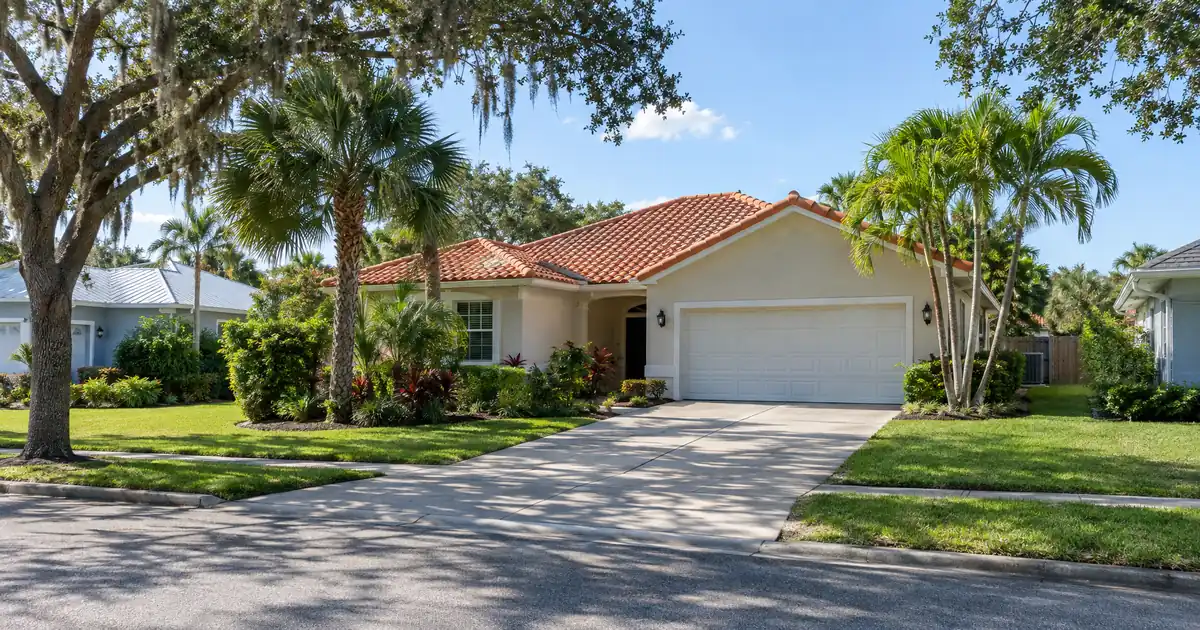
Two Stuart owners sit on similar equity and want to pull cash out. One holds a small building in Port Salerno. The other holds a duplex in Golden Gate. The math favors Port Salerno on rent-to-value, and it isn’t close. Golden Gate wins only when the property has two units stacking rent against one loan. Lendmire, a DSCR-focused mortgage broker, sees that split constantly in small coastal Florida markets. That split decides how much equity can move on a cash-out refinance investment property file in Stuart.
At a Glance: A Stuart, Florida cash-out refinance is underwritten primarily on the property’s rental income measured against its full monthly obligation, including taxes and insurance. The lender then applies a 75% loan-to-value ceiling and a seasoning requirement. Coverage, not appreciation alone, decides how much cash comes out.
DSCR Cash-Out Calculator
Run the cash-out numbers in Stuart, FL
Rate source: Freddie Mac 30-yr average via FRED® — Federal Reserve Bank of St. Louis · effective Sep 24, 2026
Prefilled with starting assumptions — enter your property’s value, balance, taxes, and insurance for a more accurate picture.
Program parameters update from Lendmire’s centralized guideline source. Taxes and insurance are editable estimates.
As of Sep 24, 2026 · General Freddie Mac market benchmark, not a Lendmire loan offer. Property value, balance, taxes, and insurance are editable estimates. Maximum loan-to-value varies by lender, program, property type, and seasoning. Not a Loan Estimate, approval, or commitment to lend. Program availability and eligibility are subject to lender guidelines, credit approval, property review, and underwriting.
- Port Salerno’s average rent runs about 0.72% of median price, per NeighborhoodScout figures.
- Golden Gate’s ratio sits near 0.50%, which strains single-unit coverage at 75% LTV.
- Cash-out LTV tops out at 75%, with seasoning of about six months.
- Stuart’s median price is up 8.3% year over year per Redfin; rents are flat. Every figure here varies by lender and program — guidelines, property type, leverage, and credit profile all apply.
Stuart Market Snapshot
A quick read on the Stuart investor landscape — figures come from the cited sources below. Confirm current property-level numbers before underwriting.
| Metric | Detail |
|---|---|
| Home prices | $307K median (Redfin, Stuart housing market) |
| Typical rents | $2,119 avg (NeighborhoodScout, Golden Gate) |
Port Salerno: Where the Coverage Math Holds
Port Salerno is the strongest cash-out market in Stuart on a rent-per-dollar-of-price basis. NeighborhoodScout reports a median price of $274,626 and an average rent of $1,988. That works out to roughly 0.72% of price per month, about 45% more rent per dollar of value than Golden Gate delivers (the ratio is a calculation on third-party estimates, so treat it as directional).
The stock matters here. NeighborhoodScout describes housing as primarily small apartment buildings and single-family homes, with many residences built between 1970 and 1999. Apartments.com lists Port Salerno, Willoughby, and the Martin County Golf and Country Club area among Stuart’s most affordable neighborhoods. Affordable entry plus workable rents is the profile a 75% LTV cash-out needs. Final terms depend on lender guidelines, property type, leverage, and the borrower’s complete credit picture.
Run the numbers on a modeled single-family rental at the neighborhood median with rent at the average. At 75% LTV, coverage measured on full PITIA (principal, interest, taxes, and insurance) lands around 1.1x. That clears the 1.00 baseline, but with little room. Most standard programs are built around 1.00x because rent covers the payment at that level. Some lenders will look below it, though usually with lower leverage, stronger reserves, or different pricing. Every assumption in this example is a model, not a quote, and actual eligibility depends on lender guidelines, credit profile, and property review.
Older 1970-1999 construction cuts both ways. Small buildings there tend to carry more units per dollar, which helps coverage. They also invite closer scrutiny at appraisal, and condition can trim the value that the 75% ceiling applies to.
Golden Gate: Duplex Income Against One Loan
Golden Gate tells the opposite story for single-unit owners. NeighborhoodScout shows a median price of $426,710 against an average rent of $2,119, a ratio near 0.50%. A single-family rental at that price, financed at 75% LTV with full taxes and insurance in the payment, produces coverage in the mid-0.7s. That is well under 1.00x. Skip it as a cash-out candidate unless the owner brings a much lower loan balance. These specifics are subject to lender guidelines and a full review of property, leverage, and credit.
Duplexes and triplexes change the picture. A Redfin Golden Gate listing shows a duplex with 3-bed, 1-bath units renting for $2,000 and $1,885 a month, about $3,885 combined. It is a single listing, so it illustrates the stacking rather than proving a market average. The point is structural: a lender measures the whole building’s rent against one mortgage payment.
Here is a modeled scenario, with the price assumed rather than sourced. Picture a duplex valued at $450,000 with combined rent of $3,885. At 75% LTV with taxes and insurance included, coverage runs about 1.3x. Push the assumed value to $600,000 at the same rent and it drops to roughly 1.0x. Price sensitivity is brutal in this pocket. Homes.com shows Stuart multifamily listings spanning $299,900 to $790,000, so both cases sit inside the real range. Terms vary by lender guidelines, property type, leverage, credit profile, and full file review.
Tenant demand near in-town Golden Gate comes from healthcare employment, and the Redfin listing itself flags proximity to Cleveland Clinic. Cleveland Clinic Martin North sits in downtown Stuart, and the health system also runs Martin South and Martin Tradition hospitals. No sourced headcount exists here, so the demand read is qualitative. That said, hospital-adjacent duplexes tend to lease steadily, which supports an underwriter’s confidence in the rent figure.
The Three-Bedroom Premium
Bedroom count moves rent more than most owners expect. Apartments.com puts average Stuart rent near $2,047 for a two-bedroom and $2,572 or more for a three-bedroom, a gap of roughly $525 a month. RentCafe shows an overall average of $2,016 and $2,521 for a three-bedroom, though its sample covers buildings with 50 or more units. Prop-Metrics, citing RentCast, reports $2,350 for two-bedrooms and $3,020 for three-bedrooms in ZIP 34994, which leans toward houses.
Sources conflict, and that’s normal in a market this small. The spread between roughly $2,000 apartment averages and roughly $3,000 house rents is the apartment-versus-house split. For a duplex owner, 3-bed units are the better coverage story than 2-bed units. For a cash-out, use the conservative number, because the lender’s rent figure and the tenant’s actual lease can differ.
What Price Appreciation Actually Buys You
Stuart’s equity story is real but lopsided. Redfin reports the median sale price up 8.3% year over year at $307K, with a competitiveness score of 20 out of 100. Homes.com places the median higher, at $445,000 and up 6%, reflecting a different methodology and property mix. This article uses the Redfin figure as the citywide reference and treats the Homes.com number as a contrast point.
Rents tell a different story. RentCafe shows average rent down 1.78% year over year, while Apartments.com shows a 0.8% gain, so rents are roughly flat. Prices are outrunning rent.
That tension defines the strategy. A cash-out here is supported by equity growth, not rent growth. Underwrite coverage on today’s lease income, not projected increases. An owner who bought a small building in Port Salerno and has held for a while may have appreciation that shows up in the appraisal but not in the rent roll, a gap that the RentCafe and Apartments.com readings above help illustrate. The coverage minimum then becomes binding before the 75% ceiling becomes binding on value.
Think in two constraints. Value sets the maximum loan at 75% LTV. Rent sets the maximum loan that clears the coverage minimum. Whichever is smaller controls the proceeds. In Port Salerno at the median, the LTV cap is the tighter constraint at full leverage. That means value, not rent, sets the proceeds there, and the cash-out refinance details show how the two limits interact. Equity available depends on rent used for lender review, PITIA, reserves, and the ceiling. It is never a guaranteed figure. Exact terms depend on the lender’s guidelines, property type, leverage, and a full review of the borrower’s file.
What Does the Seasoning Clock Mean for Stuart Owners?
The seasoning requirement is about six months of ownership, measured from title recording. An owner who bought recently and put work into a Port Salerno building cannot pull cash out until that clock runs. Owners who have held for years have no seasoning issue and can go straight to the coverage and appraisal questions.
Renovated value-add plays add friction. Local listings include duplexes with month-to-month tenants and rents described as below market, and a new-construction duplex with 3-bed, 2-bed units. Under-market rent can look like upside, but a DSCR appraisal typically leans on market rent. The owner should confirm which figure the lender will use and plan for lease-up before applying.
The Appraisal Problem in a Thin Market
Small multifamily in Stuart trades slowly. Homes.com shows multifamily listings averaging 183 days before selling, and the site’s own median price figures diverge between $445,000 and $491,408. That divergence is a liquidity signal, not a vacancy rate (no reliable vacancy figure was found for Stuart).
For a cash-out borrower, thin comps mean a conservative appraised value is a real possibility. A lower value lowers the 75% ceiling, which limits how much cash comes out. Owners of duplexes and fourplexes should assume the appraiser will reach for the nearest defensible comp rather than the most flattering one.
DSCR vs. conventional financing
Two common ways to finance an investment property in Stuart, FL. They qualify you differently — here’s how investors weigh them.
Why investors choose it
- Qualifies on the property’s rental income — no personal tax returns, W-2s, or pay stubs needed to document income.
- No personal debt-to-income ceiling to clear, so existing mortgages and obligations don’t cap your borrowing the same way.
- Can be closed in an LLC, keeping the property inside a business entity.
- Built for scaling — not held to the limit on number of financed properties that conventional financing applies.
- Underwriting centers on the deal: generally qualifies when the rent covers the payment, a 1.00x coverage ratio being a common baseline (confirmed in underwriting).
- Designed specifically for investment property, including long-term and, where the program allows, short-term rentals.
Where it’s strong
- Often the lowest ongoing financing cost for a buyer who fully qualifies on personal income — a fit for a first property or a cost-first purchase.
Trade-offs for investors
- Requires full personal income documentation and must fit within a debt-to-income limit — salary, existing debts, and other mortgages all count.
- Typically held in your personal name rather than a business entity.
- Caps how many financed properties you can carry, which can become a ceiling as a portfolio grows.
- Evaluates you as a borrower as much as the property, which usually means more paperwork.
How investors usually choose: a first or single property often optimizes for the lowest financing cost; portfolio builders often optimize for leverage, vesting in an LLC, and scaling past conventional caps. The right answer depends on your goals, the property, and current guidelines — both paths run through select lenders in Lendmire’s wholesale network, with eligibility and terms confirmed in underwriting.
Lendmire’s deal desk notes that files from small coastal markets like this one tend to slow down on the same items: an appraisal that comes in under the owner’s expectation, rents that don’t match lease documentation, and reserve verification that was left until late. The cleaner files usually arrive with signed leases, a rent schedule that matches them, and reserve statements already assembled. That preparation helps regardless of which neighborhood the property sits in.
Why the Local Economy Supports Renter Demand
Stuart is small. Census Reporter shows a population of 18,520, and RentCafe puts 41% of households as renters. The city is part of the Port St. Lucie MSA and is the largest of Martin County’s five incorporated municipalities, per Wikipedia.
The Business Development Board of Martin County reports that 72% of local products and services are sold outside the county, and that workforce availability and affordable housing rank among businesses’ top challenges. That housing complaint is the demand story in one line. Employers who cannot fill roles blame housing costs, which is what supports long-term workforce rentals.
Sector breadth helps. Healthcare, aerospace and manufacturing, marine trades, and tourism all operate locally. Daher plans about $30 million of facility investment to assemble aircraft in Stuart. No sourced employer headcounts turned up, so the read here is directional. It is still a steadier base than a single-industry town.
Palm City, the Islands, and the Waterfront Tier
Palm City, west of Stuart, is described by local brokers as residential. Listings show small multifamily exists there, including a fourplex of 2-bed, 1-bath units. No reliable price or rent figure was found, so it is a market to research and not one to underwrite from this data.
Jensen Beach and Hutchinson Island lean toward condos and vacation stock. North River Shores and Sewall’s Point are high-end waterfront, and Apartments.com ranks North River Shores and Downtown Stuart among the priciest for rent. Those are low-yield, appreciation-oriented areas. With high leverage, high-priced waterfront property often struggles to produce coverage that clears 1.00x on long-term rent, which is the standard floor for most programs.
Honestly, the stronger play might be the modest neighborhoods over the postcard ones. Appreciation investors could argue the other way, but a cash-out file lives or dies on the coverage number.
How the Proceeds Get Used
A DSCR cash-out is a capital-recycling tool. The proceeds typically fund the next acquisition’s down payment, reserves, or renovation. For Stuart owners, the natural redeployment is toward the highest rent-to-value stock: pull equity from an appreciated property, then place it into a Port Salerno-style building with better coverage.
Program guidance points to a few boundaries, all subject to lender guidelines and program terms. Credit tiers typically run from a 620 floor up through 660, 680, and 700, and stronger scores generally improve leverage and pricing options. Reserves are usually around six months of PITIA, rising to about nine months above $1,500,000. Loan amounts go up to $3,000,000 on standard programs, with smaller balances routed through select lenders. Manufactured homes, log homes, and barndominiums fall outside these programs.
Holding the property in an LLC is common, subject to lender program eligibility. The DSCR fundamentals page explains the ratio, and the guide “Where DSCR and Conventional Diverge” explains how the differences from a conventional loan come down to documentation. Coverage rests on property income instead of traditional personal-income documentation. Investors comparing lender types can browse refi programs, and the state-level picture for DSCR loans in Florida covers overlays that affect Stuart files. Investors ready to price a file can talk to Lendmire or call 828-256-2183. Verify current local rental rules, taxes, and insurance with qualified local professionals before committing.
Frequently Asked Questions
How do you qualify for a DSCR cash-out refinance in Stuart, Florida?
Qualification centers on the property’s rent covering its full monthly obligation, with a 1.00 minimum DSCR as the standard benchmark. The loan also has to fit under the 75% LTV ceiling, and the borrower needs about six months of ownership plus roughly six months of PITIA in reserves. Credit typically starts at a 620 floor. Final eligibility depends on lender guidelines and property review.
What are the requirements for an investment property loan in Stuart, Florida?
Expect a credit score at or above the program floor, documented rental income, reserves, and an appraisal supporting value. Duplexes, triplexes, fourplexes, and single-family rentals fit standard programs. Manufactured homes, log homes, and barndominiums do not. Program terms shift by lender, so requirements are guidance and not a commitment to lend.
Does a Stuart duplex cover better than a single-family rental?
Usually yes, though it depends on price. Two units stacking around $3,885 in combined rent against one loan produce much higher coverage than a single unit at similar value. At modeled values near $450,000 the ratio can sit above 1.2x, but at a much higher value it falls toward 1.0x. The modeled figures include taxes and insurance and are not quotes.
Why would Stuart’s rising prices not raise my cash-out amount?
Prices are up 8.3% per Redfin while rents are flat, so value grows faster than income. The 75% LTV cap may allow a larger loan than rent can support. In that case, coverage caps the proceeds, and a conservative appraisal in a thin multifamily market can lower the ceiling further.
For current guidelines and terms, see Lendmire’s DSCR loan programs page.
Get Started
Ready to find the right loan for you?
In about 30 seconds you can review financing options available for your investment property. No commitment required.
Informational only. Not a Loan Estimate, approval, or commitment to lend. Program availability and eligibility are subject to lender guidelines, credit approval, property review, and underwriting.
About Lendmire
Lendmire is a non-QM mortgage brokerage (NMLS# 2371349) arranging DSCR investor loans in 41 markets, including Washington, D.C. Eligibility is generally reviewed around property-level rental income rather than personal income, subject to lender and program guidelines, which suits self-employed investors and LLC-owned portfolios. The brokerage is a 2026 Scotsman Guide Top Workplace and was recognized by Scotsman Guide in 2025 as well.
If you only take one thing from this piece, it’s this: in Stuart, coverage rather than appreciation sets your cash-out ceiling, so the small Port Salerno building and the stacked-rent Golden Gate duplex will pull out far more than the high-priced single-family house.
References
1. Freddie Mac 30-yr average via FRED® — Federal Reserve Bank of St. Louis
3. Redfin
4. NeighborhoodScout, Golden Gate
6. Redfin
7. Homes.com
8. RentCafe
9. Wikipedia
10. Business Development Board of Martin County
This article is part of Lendmire’s investment property cash-out refinance program — full qualification details, guidelines, and scenarios live on the program page.
Related reading: DSCR Cash Out Refinance in Stuart, Florida: How Port Salerno Rents Clear a 1.0 DSCR at 75% LTV · DSCR Cash Out Refinance in Naples, Florida: What It Takes to Refinance a Naples Rental · Cash Out Refinance Investment Property in Boca Raton, Florida
Guides: Investment Property Cash-Out Refinance in Florida
Brandon Miller
Founder & CEO, Mortgage Loan Originator, Lendmire LLC
- Mortgage Loan Originator · NMLS# 1129696 · Verify on NMLS Consumer Access
- North Carolina Real Estate Broker · License# 343312 · Verify on NCREC
- North Carolina Insurance Producer · License# 19053198 · Property, Casualty, Life, Health · Verify on NAIC SBS
- Lendmire LLC · Firm NMLS# 2371349 · Verify firm licensure
Disclosure information. Lendmire is a state-licensed mortgage brokerage under NMLS# 2371349. Lendmire is not a depository institution, direct lender, or financial advisor — all loans referenced are placed through wholesale lender partners and are subject to each lender's underwriting standards. This article is provided for general informational purposes and is not a commitment to lend, nor does it constitute financial, legal, or tax advice. Loan programs, terms, rates, and qualification standards change without notice and depend on borrower profile, property type, and the state in which the subject property is located. Equal Housing Opportunity provider. NMLS Consumer Access: nmlsconsumeraccess.org.