
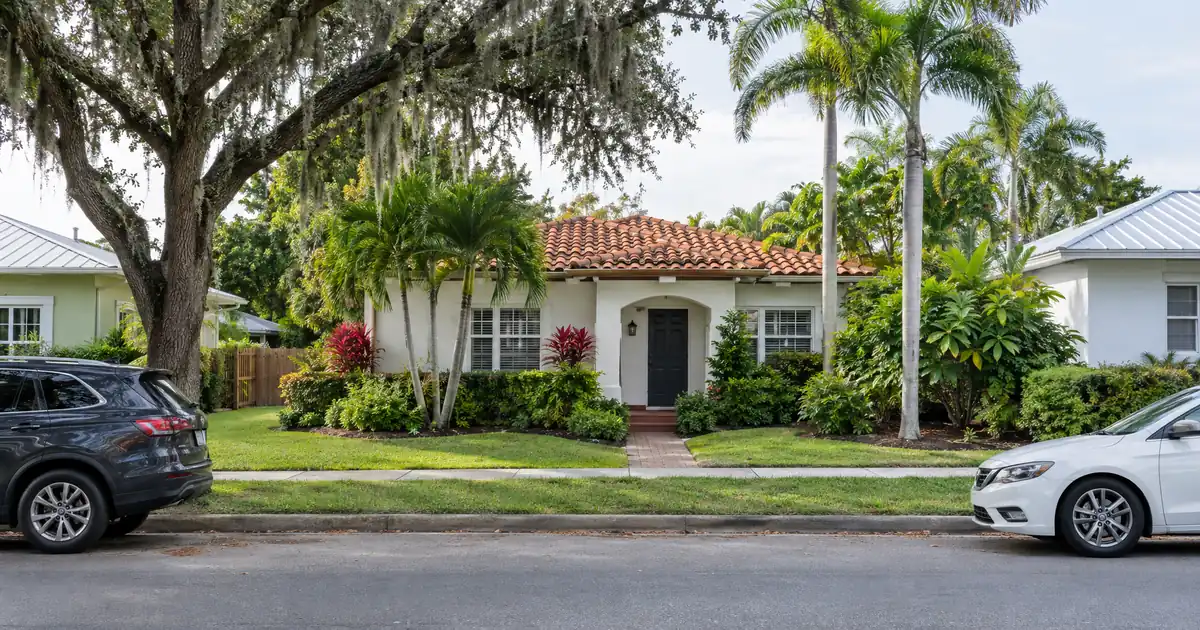
Can you pull cash out of a Plantation rental without a traditional personal-income documentation driving the file? Usually, yes, if the rent covers the full monthly obligation and the appraisal supports the value. A DSCR cash-out refinance on an investment property is underwritten on the property’s income and equity, capped at 75 percent loan-to-value, and Plantation’s mix of corporate employers and modest-priced multi-unit stock gives the numbers something to work with.
The catch is that Plantation’s equity picture is murkier than the headlines suggest. Investors in Plantation, Florida work with Lendmire (NMLS# 2371349) to place DSCR financing through wholesale lenders reaching 41 markets, including D.C. The real work here is deciding which of your properties can actually carry a cash-out, and what the appraiser is going to say about value.
DSCR Cash-Out Calculator
Run the cash-out numbers in Plantation, FL
Rate source: Freddie Mac 30-yr average via FRED® — Federal Reserve Bank of St. Louis · effective Sep 24, 2026
Prefilled with starting assumptions — enter your property’s value, balance, taxes, and insurance for a more accurate picture.
Program parameters update from Lendmire’s centralized guideline source. Taxes and insurance are editable estimates.
As of Sep 24, 2026 · General Freddie Mac market benchmark, not a Lendmire loan offer. Property value, balance, taxes, and insurance are editable estimates. Maximum loan-to-value varies by lender, program, property type, and seasoning. Not a Loan Estimate, approval, or commitment to lend. Program availability and eligibility are subject to lender guidelines, credit approval, property review, and underwriting.
The Short Version: A DSCR cash-out refinance in Plantation, Florida is underwritten primarily on the property’s rental income measured against its full monthly obligation, and in a city where the median property value sits at $483,500, coverage is won or lost on property type.
- Median single-family rent near $3,900 against a 17.4 price-to-rent ratio puts SFRs in middle-of-the-road coverage territory.
- Listed multi-family inventory trades well below median single-family pricing, which improves coverage.
- Cash-out is capped at 75 percent LTV, with about 6 months of seasoning from title recording.
- Appreciation reads differently by source, so the appraisal, not a home-value index, sets your proceeds.
- Plantation Acres and Jacaranda need extra caution on value swings and vacancy.
How the Equity Pull Works, Step by Step
The mechanics are simple once you see the sequence. The lender orders an appraisal, applies a 75 percent ceiling to that value, subtracts your existing payoff, and what’s left is the ceiling on proceeds. Then the rent test decides whether you can actually use that room.
Walk through it in order.
Step one: seasoning. Most files in this program need about 6 months of ownership measured from title recording before a cash-out, subject to lender guidelines. If you bought recently, the clock matters more than the market.
Step two: value. The appraiser sets the number. Suppose you own a Plantation rental and the appraisal supports a value near the city’s median. If your existing loan sits at 60 percent of that value, you have 15 points of LTV room before hitting the cap. The calculator converts that into dollars. The point is that proceeds are a function of the appraisal and your current payoff, not a figure anyone can promise in advance.
Step three: coverage. DSCR is monthly rent divided by the full monthly obligation: principal, interest, taxes, insurance and any HOA dues. Most standard programs are built around a 1.00 benchmark because rent covers the payment at that level. Some lenders will look below it, but that usually means lower leverage, stronger credit or more cash reserves. Note that a cash-out resets the loan balance, so a property that covered comfortably at purchase can look thinner after you pull equity. That is the trade you are making.
Step four: reserves and credit. Expect about 6 months of PITIA in reserves (about 9 months above $1,500,000), with credit tiers starting at a 620 floor and improving at 660, 680 and 700. Standard programs run up to $3,000,000; smaller balances route through select lenders in the network. Everything here is subject to lender guidelines, and the guide “What Is a DSCR Loan” covers the basics if you want the fundamentals. For how this stacks up against bank paper, see conventional vs DSCR on investor loans.
Appreciation Says Two Different Things Here
Plantation’s price trend depends on who you ask. Zillow’s index puts average home value at $498,950, down 3.8 percent year over year. Redfin’s city page shows a median sale price of $595K, up 10.2 percent. Same city, opposite direction.
The gap comes from methodology. An index smooths a whole housing stock, while a median sale price reflects what happened to close in a given period, so a few large Plantation Acres sales can swing it. PropertyShark’s Q1 read landed at $450K for the city, down 5.3 percent, with condos at a $210K median and sliding 10.6 percent.
What does that mean for a cash-out? Don’t plan your proceeds off a headline. Plan them off a range. An owner who bought in a softer stretch and sees an index dipping may still find the appraisal comes in supportive, and an owner counting on double-digit gains may get a rude surprise. Days on market have stretched toward 70 in recent reads, with buyers facing little competition, and appraisers notice that.
Honestly, this is a market where appreciation helps the refinance story but can’t carry it. The rent side has to work on its own.
Where the Coverage Clears (Hint: Not the Median Single-Family)
Plantation’s single-family rentals work, but they are not a screaming cash-flow story. Homes.com puts median SFR rent at $3,900 and the price-to-rent ratio at 17.4, which sits in the balanced band.
Run the numbers on a modeled example. Assume a single-family rental valued near the $483,500 median, rent at that $3,900 median, and a cash-out at the full 75 percent. Including taxes and insurance at Florida-average loadings, that lands around 1.2x. It clears the 1.00 benchmark, but without much cushion if insurance moves or a vacancy hits. That’s a modeled assumption, not a quote.
Small multifamily is where the math gets better. Homes.com lists multi-family homes in Plantation between $245,000 and $419,900, well under its cited citywide median of $479,950. A Broadview Park fourplex example had three units leased at $2,200, $2,200 and $2,500 against a submarket multi-family median of $525,000. Even counting only those three leased units and modeling a 75 percent cash-out, coverage including taxes and insurance stays well above 1.5x. Multi-unit stacks rent rolls against a single mortgage.
DSCR files in markets like this one typically look the same: an owner with a single-family hold and thin-but-passing coverage, and a second owner with a small multi-unit where coverage has real room. The multi-unit owner usually has more flexibility on leverage, reserves and structure. When a file sits near the line, brokers often see lenders respond to a stronger credit tier or lower leverage rather than a pricing adjustment alone. Bring the lease documents and an honest view of vacancy, and the lender’s review goes more smoothly.
Reach Lendmire at 828-256-2183 if you want a scenario run against your own numbers, or see how the math pencils.
Submarket by Submarket
East Plantation Estates and Broadview-style workforce pockets. This is the strongest value tier for a cash-out. RentCafe shows East Plantation Estates at $2,338 a month, below the $2,480 citywide average it reports. Lower rents sit closer to lower price points, which keeps the coverage math workable. Broadview Park adds commuter demand near U.S. 441 and I-595, pulling tenants who work in nearby industrial and logistics jobs. It is a steady tenant base that depends on jobs rather than on the housing cycle.
Midtown and Historic Plantation. The original planned core overlaps the 850-acre Midtown business district, per the Greater Fort Lauderdale Alliance. Walkable retail and office proximity draws renters, and older multi-unit stock is more likely to turn up here than in the newer single-family pockets. Appraisers tend to read this area well because comps exist. Equity here is usually the easiest to document.
Village Townhouses. Rents in this RentCafe-tracked submarket run about $2,774 a month on the headline figure, with a 2-bedroom range between $2,740 and $3,754. Townhome and condo files add warrantability and HOA questions, which affect both eligibility and the coverage ratio. Skip it if the HOA load is heavy, because the condo segment’s softness shows up directly in appraised value.
Jacaranda (proceed carefully). The average rental price here is $3,714, a single analytics source, so treat it directionally. The same source shows an 11.3 percent vacancy rate, well above average. High rent with high vacancy is a real tension: if your underwriting assumes full occupancy, the actual income may disappoint. Jacaranda works for a well-maintained property with documented leases. It is not a place to bank on the headline rent.
Plantation Acres. This is the premium, large-lot pocket, and its values are volatile. One read showed typical home values near $822,030 and up 25.4 percent. A later market update showed a median sale price of $910,000, but a 43.7 percent decline from the prior year and price per square foot at $359. Those cannot both be a clean trend. For a cash-out, that volatility cuts both ways: a strong appraisal unlocks real proceeds, while a soft one leaves you stuck. The estate-style rentals that live here also carry higher balances, where the 9-month reserve tier above $1,500,000 can come into play. The stronger play might be Midtown-area small multifamily for coverage, though owners already holding Acres property could argue for pulling equity while comps are supportive.
Who’s Paying the Rent
Plantation’s tenant base leans on employment, not seasonality. The city’s population sits near 96,293, and Data USA shows employment growing 2.31 percent to 51.7k workers, with health care and social assistance the largest sector at 6,753 residents, followed by retail trade and professional services. About 34 percent of residents rent.
The corporate names help. Chewy is headquartered in Plantation, with a reported 18,100 employees. Motorola Solutions opened a new R&D and customer experience center in the city, and TradeStation is headquartered here too. The City of Plantation lists Florida Power and Light, Bascom Palmer Eye Institute, the University of Miami Sylvester Cancer Center, Plantation General Hospital and Westside Regional Medical Center among major employers. The Greater Fort Lauderdale Alliance counts roughly 5,400 businesses in the city.
The edge case is Nova Southeastern University, which sits just across the border rather than inside Plantation. NSU enrolled 20,910 students, and 63 percent live off campus. That is a renter pool for smaller units, even if the campus isn’t in city limits.
What this means for your refinance file: a long-term lease with a tenant tied to a hospital, a headquarters or a university is easy for a lender to underwrite. Keep the leases current and organized.
Recycling the Proceeds
The point of pulling equity is to redeploy it. In Plantation, that often means using proceeds from an appreciated single-family hold to buy a small multi-unit where coverage is stronger. Owners looking at the equity recycle pathway should run both sides: what the refinance does to coverage on the existing property, and what the new acquisition will earn.
DSCR vs. conventional financing
Two common ways to finance an investment property in Plantation, FL. They qualify you differently — here’s how investors weigh them.
Why investors choose it
- Qualifies on the property’s rental income — no personal tax returns, W-2s, or pay stubs needed to document income.
- No personal debt-to-income ceiling to clear, so existing mortgages and obligations don’t cap your borrowing the same way.
- Can be closed in an LLC, keeping the property inside a business entity.
- Built for scaling — not held to the limit on number of financed properties that conventional financing applies.
- Underwriting centers on the deal: generally qualifies when the rent covers the payment, a 1.00x coverage ratio being a common baseline (confirmed in underwriting).
- Designed specifically for investment property, including long-term and, where the program allows, short-term rentals.
Where it’s strong
- Often the lowest ongoing financing cost for a buyer who fully qualifies on personal income — a fit for a first property or a cost-first purchase.
Trade-offs for investors
- Requires full personal income documentation and must fit within a debt-to-income limit — salary, existing debts, and other mortgages all count.
- Typically held in your personal name rather than a business entity.
- Caps how many financed properties you can carry, which can become a ceiling as a portfolio grows.
- Evaluates you as a borrower as much as the property, which usually means more paperwork.
How investors usually choose: a first or single property often optimizes for the lowest financing cost; portfolio builders often optimize for leverage, vesting in an LLC, and scaling past conventional caps. The right answer depends on your goals, the property, and current guidelines — both paths run through select lenders in Lendmire’s wholesale network, with eligibility and terms confirmed in underwriting.
There’s a sequencing trap. A cash-out resets your balance, your reserves and your coverage ratio. If the property you refinance drops to 1.05x after the pull, you’ve used up your cushion to buy the next one. Better to refinance a property with comfortable coverage than to squeeze a thin one. For state-level context, Lendmire’s hub on DSCR loans in Florida is a good place to start.
One more point on condos. With the condo median near $210K and sliding, equity pulled from a condo position will be thinner than the headline suggests, and lenders review the project too. Keep expectations modest.
Before you underwrite anything, verify current local rental rules, property taxes and insurance with qualified Florida professionals. Those items swing the carry, and they sit outside what a financing article can settle.
Frequently Asked Questions
How do you qualify for a DSCR cash-out refinance in Plantation?
You need a property whose rent covers its full monthly obligation, typically at or above 1.00x, plus about 6 months of ownership from title recording and a credit score that starts at a 620 floor. Leverage caps at 75 percent LTV on a cash-out, and reserves run about 6 months of PITIA. Final eligibility depends on lender guidelines, credit, property review and appraisal.
What are the requirements for an investment property loan in Plantation, Florida?
Lenders look at the property’s rental income, the borrower’s credit tier, the LTV, and reserves. Eligible property types generally include single-family rentals, two- to four-unit properties, and warrantable condos and townhomes. Manufactured homes, log homes and barndominiums fall outside these programs. Qualification is subject to lender overlays.
Can a self-employed investor buying in Plantation be reviewed for DSCR financing?
Yes. Lendmire arranges DSCR investor loans and eligibility is generally reviewed around the property’s rental income rather than personal income documents. That suits self-employed investors, subject to lender and program guidelines.
Is Plantation Acres a good place to pull equity?
It can be, but the value data is noisy. Sale-price medians there have swung sharply in both directions, so the appraisal is the deciding factor. Owners considering a cash-out on an Acres property should expect a wider range of outcomes than in Midtown or East Plantation Estates.
Does a small multifamily in Plantation cover better than a single-family?
Usually, yes. Listed multi-family inventory trades well below median single-family pricing while stacking several rents, which lifts coverage. A single-family at median rent and price models closer to 1.2x including taxes and insurance, per the modeled example above.
About Lendmire
Lendmire is a non-QM mortgage brokerage (NMLS# 2371349) arranging DSCR investor loans in 41 markets, including Washington, D.C. Eligibility is generally reviewed around property-level rental income rather than personal income, subject to lender and program guidelines, which suits self-employed investors and LLC-owned portfolios. Lendmire was recognized as a 2026 Scotsman Guide Top Mortgage Workplace and a 2025 Scotsman Guide Top Mortgage Workplace.
Get Started
Ready to find the right loan for you?
In about 30 seconds you can review financing options available for your investment property. No commitment required.
Informational only. Not a Loan Estimate, approval, or commitment to lend. Program availability and eligibility are subject to lender guidelines, credit approval, property review, and underwriting.
References
2. Zillow’s index puts average home value at $498,950
4. Homes.com: Plantation Houses for Rent
5. Homes.com lists multi-family homes in Plantation
6. A Broadview Park fourplex example
7. RentCafe shows East Plantation Estates at $2,338 a month
8. Greater Fort Lauderdale Alliance: Plantation
9. 96,293
10. Motorola Solutions opened a new R&D and customer experience center
11. City of Plantation History
12. NSU enrolled 20,910 students
13. a 2026 Scotsman Guide Top Mortgage Workplace
14. a 2025 Scotsman Guide Top Mortgage Workplace
This article is part of Lendmire’s investment property cash-out refinance program — full qualification details, guidelines, and scenarios live on the program page.
Related reading: Luxury Rental DSCR Loans In New Jersey · Jersey Shore Vacation Rental Loans: DSCR Financing In Ocean City, Cape May And Long Beach Island · DSCR Cash-out Refinance In New Jersey: Pulling Equity From A Rental
Guides: Investment Property Cash-Out Refinance in Plantation, FL · Investment Property Cash-Out Refinance in Florida
Brandon Miller
Founder & CEO, Mortgage Loan Originator, Lendmire LLC
- Mortgage Loan Originator · NMLS# 1129696 · Verify on NMLS Consumer Access
- North Carolina Real Estate Broker · License# 343312 · Verify on NCREC
- North Carolina Insurance Producer · License# 19053198 · Property, Casualty, Life, Health · Verify on NAIC SBS
- Lendmire LLC · Firm NMLS# 2371349 · Verify firm licensure
Disclosures. The information presented in this article is general market commentary, not financial, legal, or tax advice. Lendmire is a mortgage brokerage (NMLS# 2371349) — not a direct lender or depository institution — and loan placement is subject to lender underwriting. Nothing in this content represents a commitment to lend. Loan terms, pricing, and program availability vary based on borrower qualifications, property characteristics, and state of subject property, and are subject to change at any time. Lendmire complies with Equal Housing Opportunity requirements. Consumer access: nmlsconsumeraccess.org.