
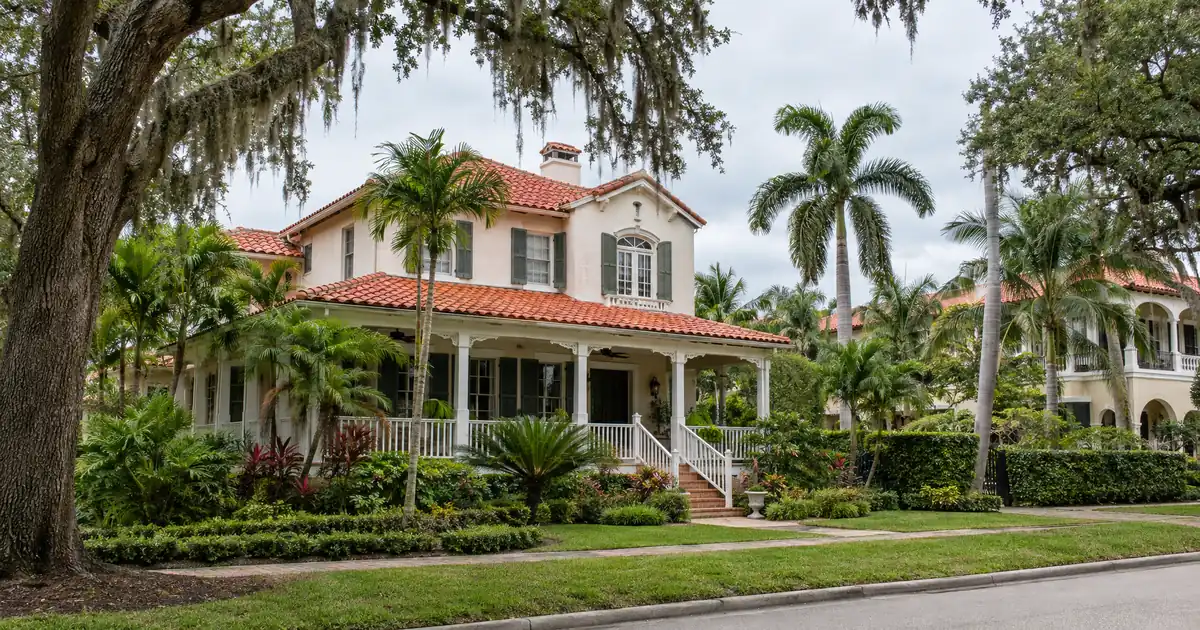
A duplex in Golden Gate City hits the DSCR math like this: two units renting near $1,900 each, a post-appreciation value close to $500,000, and a cash-out refinance sized at Florida’s 70 percent overlay. Run the combined rent against a fully loaded payment — principal, interest, taxes, and insurance — and the coverage ratio lands in the high 1.20s. That’s the kind of number a lender’s file reviewer likes to see. Six miles west, on a barrier-island lot in 34102, the same exercise produces a very different result. Naples is not one market.
TL;DR: A DSCR cash-out refinance on a Naples, Florida investment property is underwritten primarily on the property’s in-place or market rent measured against its full monthly obligation, not the owner’s personal income, and Florida cash-out deals follow the standard program cap of 75 percent loan-to-value.
DSCR Cash-Out Calculator
Run the cash-out numbers in Naples, FL
Rate source: Freddie Mac 30-yr average via FRED® — Federal Reserve Bank of St. Louis · effective Sep 17, 2026
Prefilled with starting assumptions — enter your property’s value, balance, taxes, and insurance for a more accurate picture.
Program parameters update from Lendmire’s centralized guideline source. Taxes and insurance are editable estimates.
As of Sep 17, 2026 · General Freddie Mac market benchmark, not a Lendmire loan offer. Property value, balance, taxes, and insurance are editable estimates. Maximum loan-to-value varies by lender, program, property type, and seasoning. Not a Loan Estimate, approval, or commitment to lend. Program availability and eligibility are subject to lender guidelines, credit approval, property review, and underwriting.
- Inland zip 34116 averages $451,488 in home value, down 3.5 percent year over year — cash-out equity is thinner there than the coastal core.
- Coastal zip 34102 averages $1,309,977, down 4.0 percent — bigger equity base, weaker rent-to-value ratio.
- Citywide average rent sits at $1,873, per RentCafe, against a market that is 82 percent owner-occupied.
- Standard seasoning before cash-out is roughly six months of ownership from title recording.
- Florida cash-out refinances follow the same standard limits as every other state, with leverage capped at 75 percent LTV and no state-specific overlay.
Naples Market Snapshot
A quick read on the Naples investor landscape — figures come from the cited sources below. Confirm current property-level numbers before underwriting.
| Metric | Detail |
|---|---|
| Home prices | $1.2M median (Redfin Naples Housing Market) |
| Typical rents | $1,873 avg (RentCafe Average Rent Naples FL) |
| University enrollment | Fgcu 15,000 students (SWFL Relocation Guide) |
| Employment | 7,017 employees (SWFL Relocation Guide) |
| Vacancy | 5.3% (NeighborhoodScout) |
Golden Gate City Is Where the Cash-Out Math Actually Works
Golden Gate City is the strongest cash-out submarket in Naples, and it isn’t close. Average rent in the neighborhood runs $2,478 per NeighborhoodScout, while a separate listings aggregator puts the neighborhood average closer to $1,654, ranging from $1,528 to $2,438 depending on unit type — a spread that reflects the mix of single-family homes and smaller multi-unit product in the area. Either figure, set against zip 34116’s $451,488 average value, produces a gross rent-to-price ratio that coastal Naples can’t touch.
The mechanics matter here. An investor who bought a Golden Gate City single-family a couple of years ago, seasoned past the roughly six-month ownership requirement, and watched the property appreciate into the upper end of the neighborhood’s value range now has a cash-out path. At 75 percent LTV — the standard cash-out ceiling, which applies in Florida just as in every other state — the modeled coverage on a single unit renting near the neighborhood average against a fully loaded payment (principal, interest, taxes, insurance) lands close to break-even, sometimes dipping just under 1.00x depending on the exact purchase basis and financing environment at closing. That’s workable but tight. A single-family refinance in this zip can clear the lender’s minimum DSCR floor of 1.00, but it isn’t padded. Every figure here varies by lender and program — guidelines, property type, leverage, and credit profile all apply.
Duplexes change the equation. Stack two rent rolls in the same $1,500-$2,200 range against one loan payment, and the coverage math moves from marginal to comfortable — often into the mid-to-high 1.20s. That’s not a coincidence; it’s the entire logic behind small multifamily in workforce zip codes.
Why the Duplex Beats the Single-Family Here
Small multi-unit product in East Naples and the 34112/34113 corridor trades close to single-family price points in the same submarket — a four-bed, four-bath multi-family listing in 34113 near $525,000, another in 34112 near $440,000, against zip-level single-family averages of $390,066 in 34112 and $405,139 in 34104 per Zillow’s duplex-triplex listings. When a duplex sells for only modestly more than a single-family in the same zip, but delivers two rent rolls instead of one, the aggregate income clears DSCR thresholds that a single-family at a comparable price point struggles to reach.
Run the numbers on a two-unit property near $440,000 in 34112, each side renting around $1,900. Combined monthly rent of roughly $3,800 against a fully loaded payment modeled off a 70 percent cash-out LTV comes in with coverage in the mid-1.20s to low-1.30s — comfortably above the 1.00x floor most standard DSCR programs are built around. A single-family at the same price point, carrying one rent check instead of two, typically lands somewhere in the high-0.80s to low-0.90s on the same leverage. Same neighborhood, same price tier, different result — because DSCR math cares about aggregate income, not unit count.
This isn’t a marginal preference. It’s the structural reason duplex and triplex product in East Naples deserves more attention from cash-out investors than it usually gets.
Skip the Coastal Core for This Play.
Old Naples, Aqualane Shores, and Park Shore (34102) sit at an average home value of $1,309,977, down 4.0 percent year over year. Redfin’s broader city figure shows a median sale price near $1.2 million with a price per square foot of $676 — both metrics reflecting a market where rents haven’t kept pace with acquisition cost. A property that pulled in citywide average rent of $1,873 against a $1.3 million valuation produces a rent-to-price ratio well under 0.2 percent. No amount of leverage math fixes that gap.
That doesn’t mean cash-out refinancing is off the table in these zips — it means the thesis has to shift. An owner in Old Naples with substantial appreciation and a low remaining basis isn’t refinancing for cash-flow coverage; the equity is there to redeploy into inland acquisitions where the rent-to-value math actually clears. Coastal Naples functions as an equity source in this strategy, not a coverage-producing asset in its own right. Worth sizing the deal that way from the start rather than discovering it at underwriting.
The Employer Base Behind the Renters Who Actually Pay Rent
Naples’ renter pool splits into two groups that rarely get discussed as separate demand drivers. One is seasonal and retiree-driven — the population behind the city’s self-titled “Golf Capital of the World” branding and its second-most golf holes per capita nationally. The other is a workforce tenant base anchored by Arthrex, the Naples-headquartered orthopedic device manufacturer employing 4,440 workers regionally, plus the NCH Healthcare System’s roughly 3,940-7,017 employees (figures vary by source and year) across its two hospitals and 35 medical locations.
Rental communities in 34104 and 34112 lean on this directly — one listing in the corridor markets itself explicitly by proximity to Naples Community Hospital and NCH Baker Hospital. That’s not incidental. A workforce single-family or duplex in the commute radius of a hospital system employing thousands of shift workers has a tenant base that behaves nothing like the seasonal snowbird renter driving demand near the beach. Twelve-month leases, steady turnover, less exposure to the winter-season pricing swings that show up in Zumper’s monthly rent data.
Working DSCR brokers see a recurring pattern in markets with this kind of bifurcated renter base: the coastal file looks great on the appraisal and terrible on the rent schedule, while the inland file looks unremarkable on paper and clears coverage without drama. The stronger file is usually the one nobody wants to brag about at closing.
Naples’ population sits near 19,115 as of the most recent decennial count, per the Census Bureau, with the broader Naples-Marco Island metro at roughly 375,752, per Wikipedia’s Census-sourced figures. Small city, big equity concentration — and only 18 percent of households are renter-occupied against 82 percent owner-occupied, the tightest tenure split of any comparable Gulf Coast market in this review.
That scarcity cuts both ways. Fewer rental units means less competition for the ones that exist. It also means appraisers have thinner rent-comp sets to pull from in workforce zips, which is where a documented rent roll or executed lease matters more than usual on the file.
Vacancy Is a Luxury-Apartment Problem, Not a Single-Family One.
Regional apartment vacancy in Southwest Florida is running around 20 percent by CoStar’s estimate, with some commercial brokers believing one in five to one in three units sit empty in certain Lee County buildings, per WGCU. That number sounds alarming until it’s contextualized: it’s describing new Class A apartment towers, not workforce single-family or small multifamily.
Collier County’s own affordable housing data tells the opposite story at the tier that actually matters for DSCR investors. Median rent countywide runs $2,230, but the affordable-unit vacancy rate is 1.2 percent, per Gulfshore Business’s coverage of the county’s workforce housing data. The same report cites a shortage of about 49,399 units countywide and notes 52,749 workers commute into Collier daily — nearly 30 percent from Lee County — because they can’t afford to live where they work. A separate Collier Community Foundation analysis puts the deficit at more than 9,000 rental units for households earning 0 to 60 percent of area median income.
That’s a structural, multi-year shortage at the exact tier where DSCR-financed workforce housing sits. It also means rent comps used for cash-out qualification in Golden Gate City or 34112 aren’t likely to soften just because luxury apartment towers on the coast are carrying higher vacancy. Those are two different rental markets occupying the same county line.
The Appreciation-vs-Cash-Flow Split, Made Concrete
Land economics in Collier County draw the bifurcation in raw numbers. Inland lots in Golden Gate Estates run $90,000 to more than $250,000 for one to five acres, while coastal parcels in Naples or Marco Island can exceed $500,000 for less than half an acre, per a Marco News investigation. That gap explains why the two submarkets produce opposite refinance strategies.
Coastal Naples is appreciation-led. Land is constrained, comps are thin near the top, and rent never quite catches up to price. An owner refinancing there is monetizing scarcity, not income. Inland Golden Gate, Golden Gate Estates, and the 34104/34112/34116 corridor are cash-flow-led — cheaper land, workforce rent levels, and a duplex-friendly price point that actually clears a DSCR floor. Final terms depend on lender guidelines, property type, leverage, and the borrower’s complete credit picture.
This is the calculation every Naples cash-out file eventually forces: is the goal to extract equity for redeployment, or to hold a coverage-positive asset that carries itself? Coastal answers the first question. Inland answers the second. Trying to make one submarket do both jobs is usually where the file gets disappointing.
What Actually Derails a Naples DSCR Cash-Out File
The recurring friction point isn’t the appraisal — Naples has plenty of comps in most zips. It’s the rent schedule on properties that were previously owner-occupied or seasonally rented. A file coming off a snowbird-occupied single-family with no lease history forces the lender to rely on a market-rent appraisal addendum instead of an executed lease, and that addendum needs to actually reflect the workforce-zip rent level, not the coastal comp set the appraiser might default to if the assignment isn’t scoped carefully.
The other recurring issue: seasoning documentation. Six months from title recording sounds simple, but investors who bought through an LLC and then re-titled or transferred the entity mid-hold sometimes reset the clock in the lender’s eyes. Clean, unbroken title history from the settlement statement forward is the single easiest thing to get right and the thing that most often gets missed.
Reserve documentation on higher-balance coastal files also comes up more than it should. Above $1,500,000 in loan amount, reserve requirements step up to roughly nine months of PITIA instead of six — a coastal 34102 cash-out easily crosses that threshold, and files that assume the standard six-month reserve figure get kicked back for a documentation gap that’s entirely avoidable if it’s flagged up front. These specifics are subject to lender guidelines and a full review of property, leverage, and credit.
DSCR loans generally qualify on the property’s income rather than the borrower’s traditional personal-income documentation — Lendmire’s primer on DSCR loans covers the mechanics, and for investors weighing this against a standard conventional refinance, the guide “Where DSCR and Conventional Diverge” lays out the tradeoffs. For LLC-titled Naples holdings specifically, DSCR cash-out is generally the more practical route, subject to program eligibility on the entity documentation side.
Naples investors comparing this refinance against acquisition financing can find the purchase-side breakdown separately; this piece is strictly the equity-extraction side of the file. For a fuller look at how proceeds typically get sized and used, the investor refinance breakdown and the refi options both cover that ground, and Florida DSCR investor loans covers the state-level overlay landscape beyond Naples specifically.
DSCR vs. conventional financing
Two common ways to finance an investment property in Naples, FL. They qualify you differently — here’s how investors weigh them.
Why investors choose it
- Qualifies on the property’s rental income — no personal tax returns, W-2s, or pay stubs needed to document income.
- No personal debt-to-income ceiling to clear, so existing mortgages and obligations don’t cap your borrowing the same way.
- Can be closed in an LLC, keeping the property inside a business entity.
- Built for scaling — not held to the limit on number of financed properties that conventional financing applies.
- Underwriting centers on the deal: generally qualifies when the rent covers the payment, a 1.00x coverage ratio being a common baseline (confirmed in underwriting).
- Designed specifically for investment property, including long-term and, where the program allows, short-term rentals.
Where it’s strong
- Often the lowest ongoing financing cost for a buyer who fully qualifies on personal income — a fit for a first property or a cost-first purchase.
Trade-offs for investors
- Requires full personal income documentation and must fit within a debt-to-income limit — salary, existing debts, and other mortgages all count.
- Typically held in your personal name rather than a business entity.
- Caps how many financed properties you can carry, which can become a ceiling as a portfolio grows.
- Evaluates you as a borrower as much as the property, which usually means more paperwork.
How investors usually choose: a first or single property often optimizes for the lowest financing cost; portfolio builders often optimize for leverage, vesting in an LLC, and scaling past conventional caps. The right answer depends on your goals, the property, and current guidelines — both paths run through select lenders in Lendmire’s wholesale network, with eligibility and terms confirmed in underwriting.
Investors can call Lendmire at 828-256-2183 to see what the numbers look like before assuming a coastal property will pencil the way a workforce duplex does — the two rarely run the same math.
Frequently Asked Questions
How do you qualify for a DSCR cash-out refinance in Naples, Florida?
Qualification centers on the property’s rent measured against its full monthly payment, not the owner’s personal income documentation. A lender typically wants six months of seasoning from title recording, a rent schedule or lease showing achievable market rent, and enough equity to support a loan-to-value at or below Florida’s 70 percent cash-out overlay. Credit tiers commonly used across the network start around a 620 floor, with better pricing and leverage available at higher tiers, subject to lender program eligibility.
What are the requirements for an investment property cash-out refinance in Naples, Florida?
Beyond the standard DSCR floor of 1.00x, Naples files typically need reserves of about six months of PITIA (closer to nine months above $1,500,000 in loan amount), documentation of the six-month seasoning period, and — for previously owner-occupied or seasonally rented coastal properties — a market-rent appraisal addendum rather than an executed lease. Requirements vary by lender and property type, and qualification is subject to lender guidelines and property review.
Why does a duplex in East Naples clear DSCR coverage more easily than a single-family home in the same zip?
Because two rent rolls stack against one loan payment. A single-family in 34104 or 34112 renting in the low-$2,000s against its own payment typically lands somewhere in the high-0.80s to low-0.90s coverage ratio at cash-out leverage. A duplex at a similar price point, with two units each renting in a comparable range, typically pushes combined coverage into the mid-1.20s or higher — the same underlying rent economics, applied to more units per loan.
Is Naples’ apartment vacancy problem a concern for a single-family or duplex cash-out refinance?
Not directly. The roughly 20 percent regional apartment vacancy figure describes new Class A apartment towers in Southwest Florida, not workforce single-family or small multifamily housing. Collier County’s affordable-tier vacancy sits closer to 1.2 percent, reflecting a market that’s undersupplied at the rent levels most DSCR-financed rentals actually target.
For current guidelines and terms, see Lendmire’s DSCR loan programs page.
About Lendmire
Lendmire (NMLS# 2371349) is a mortgage brokerage built around DSCR investor lending, with programs available in 41 markets, including Washington, D.C. DSCR lenders commonly evaluate rental-income coverage instead of personal income paperwork — a practical fit for LLC-owned and multi-property investors. Terms vary by lender, property, leverage, and program. Scotsman Guide named Lendmire a Top Mortgage Workplace in both 2025 and 2026.
Get Started
Ready to find the right loan for you?
In about 30 seconds you can review financing options available for your investment property. No commitment required.
Informational only. Not a Loan Estimate, approval, or commitment to lend. Program availability and eligibility are subject to lender guidelines, credit approval, property review, and underwriting.
References
1. Zillow Home Value Index — Zip 34116
2. Zillow Home Value Index — Zip 34102
3. RentCafe — Average Rent Market Trends, Naples, FL
4. Redfin Naples Housing Market
8. NeighborhoodScout — Golden Gate
9. Zillow — East Naples/34112 Duplex & Triplex Listings
10. Gulfshore Business — Southwest Florida Job Growth
11. U.S. Census Bureau QuickFacts — Naples city, Florida
12. WGCU News — SW Florida Apartment Vacancy
13. Gulfshore Business — Collier County Workforce Housing
14. Marco News — Priced Out of Paradise
15. 2025
16. 2026
This article is part of Lendmire’s investment property cash-out refinance program — full qualification details, guidelines, and scenarios live on the program page.
Related reading: Cash Out Refinance Investment Property in Naples, Florida: What It Takes to Refinance a Naples Rental · Investment Property Loans in Naples, FL: How Investors Qualify Past the $1.3 Million Median · Luxury Rental DSCR Loans In Naples: Complete Guide
Guides: Investment Property Cash-Out Refinance in Naples, FL · Investment Property Cash-Out Refinance in Florida
Brandon Miller
Founder & CEO, Mortgage Loan Originator, Lendmire LLC
- Mortgage Loan Originator · NMLS# 1129696 · Verify on NMLS Consumer Access
- North Carolina Real Estate Broker · License# 343312 · Verify on NCREC
- North Carolina Insurance Producer · License# 19053198 · Property, Casualty, Life, Health · Verify on NAIC SBS
- Lendmire LLC · Firm NMLS# 2371349 · Verify firm licensure
Important disclosures. Lendmire (NMLS# 2371349) is a licensed mortgage brokerage. Lendmire is not a direct lender, depository institution, or financial advisor. All loan inquiries are subject to lender underwriting; this article does not constitute a commitment to lend. Rates, terms, and program guidelines are subject to change without notice and vary by borrower profile, property type, and state. Information in this article is general in nature and is not financial, legal, or tax advice. Equal Housing Opportunity. NMLS Consumer Access: nmlsconsumeraccess.org.