
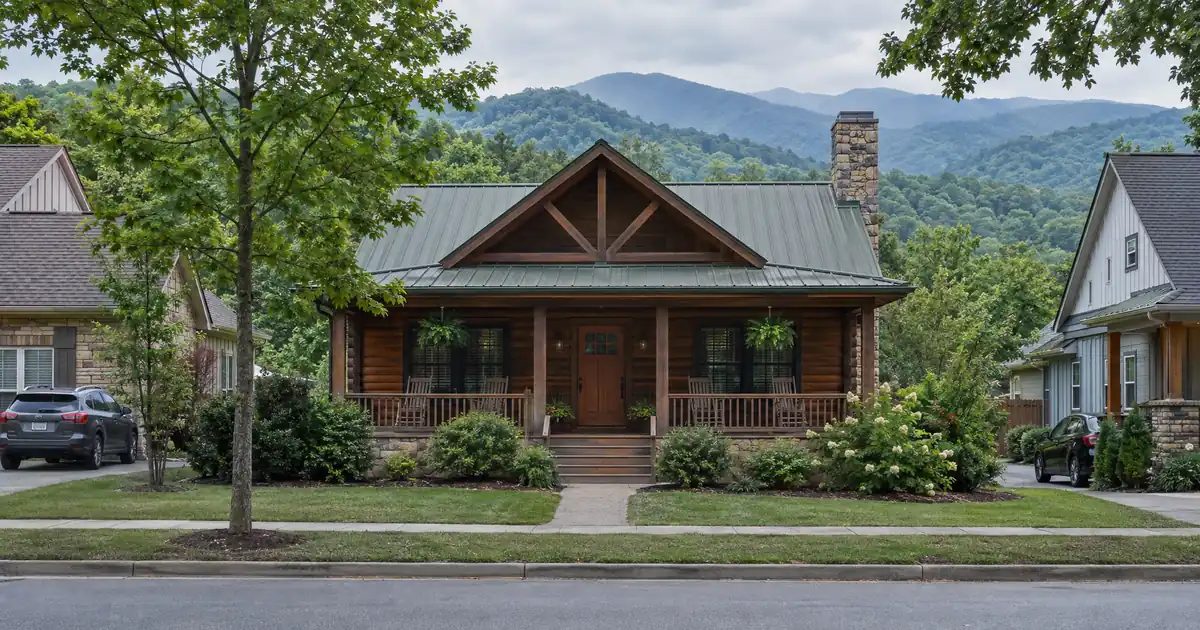
A rental in Townsend hits the DSCR math like this. A three-bedroom, 1,512-square-foot house shows up on a Zillow rental sample at $2,200 a month. The twelve-month median sale price in town is $440,000, per Homes.com. Put a 75 percent cash-out loan against that value, load in full PITIA with taxes and insurance, and coverage lands in the mid-0.8s. Not 1.00. Not close.
That is the Townsend problem in one paragraph. The town sells a view of the quiet side of the Smokies, and the price reflects it. The rent reflects a house.
DSCR Cash-Out Calculator
Run the cash-out numbers in Townsend, TN
Rate source: Freddie Mac 30-yr average via FRED® — Federal Reserve Bank of St. Louis · effective Oct 1, 2026
Prefilled with starting assumptions — enter your property’s value, balance, taxes, and insurance for a more accurate picture.
Program parameters update from Lendmire’s centralized guideline source. Taxes and insurance are editable estimates.
As of Oct 1, 2026 · General Freddie Mac market benchmark, not a Lendmire loan offer. Property value, balance, taxes, and insurance are editable estimates. Maximum loan-to-value varies by lender, program, property type, and seasoning. Not a Loan Estimate, approval, or commitment to lend. Program availability and eligibility are subject to lender guidelines, credit approval, property review, and underwriting.
The Quick Read:
A Townsend, Tennessee cash-out refinance suits investors who already hold equity and can pair it with rents that carry the debt: the file is underwritten primarily on the property’s rental income measured against its full monthly obligation, which favors multi-unit stock in nearby Maryville over Townsend’s tourism-priced single-family homes.
- Townsend’s twelve-month median sale price is $440,000, per Homes.com, against a sampled $2,200 rent.
- Modeled coverage on that pairing sits in the mid-0.8s, including taxes and insurance.
- Maryville rents run $962 to $1,683 per Apartments.com. A modeled duplex clears 1.3x.
- Cash-out tops out at 75 percent LTV, after roughly six months of seasoning from title recording.
- Small multifamily is only 1.57 percent of Townsend housing units, per NeighborhoodScout.
Lendmire (NMLS# 2371349) is a DSCR-focused mortgage broker arranging DSCR investor loans across 40 states plus Washington, D.C. The brokerage sees plenty of equity-rich owners in tourism-adjacent markets who assume the paper gain translates into proceeds. Sometimes it does. In Townsend it mostly doesn’t, and the reasons are worth walking through, along with where the same equity can work harder. Tennessee-wide program context lives on the page for DSCR loan options for Tennessee investors.
Why the Townsend Math Stalls
Townsend is a gateway town of well under 1,000 residents, and its rental stock is priced as a second-home market rather than a workforce one. Census Reporter counts about 701 people, with a median household income of $85,921 (the margin of error is wide). Other sources put the population lower, between 550 at the 2020 census per Wikipedia and 628 in Data Commons. Whatever the exact count, the sample is tiny, and every price statistic should be read that way.
Take the price data. Homes.com shows a $440,000 median with 14 percent year-over-year growth and about 70 days on market. Movoto shows a median sold price of $554,950 and 93 days. Redfin shows $263K, down 29.1 percent, which tells you more about sample size than about value. This article uses the Homes.com figure throughout. Treat the other two as evidence that a handful of sales can swing the median by hundreds of thousands of dollars.
Rents are less noisy but no kinder. Zillow lists 2-bedroom rentals around $1,800 and 3-bedrooms between $1,800 and $2,200, and some listings have sat for 114 to 424 days. Long sit times at asking rent usually mean the asking rent is too high for the actual tenant pool. A $2,200 ask against a $440,000 value is roughly 0.5 percent monthly rent-to-value. That is an illustration from two listing-level figures, not a market statistic, but the direction is clear. DSCR programs are built around a 1.00x benchmark on rent against full PITIA, and 0.5 percent rent-to-value rarely gets there at 75 percent leverage.
Run the numbers on it. Modeled on the assumptions above ($2,200 rent, $440,000 value, 75 percent LTV, thirty-year amortization, taxes and insurance included), coverage falls into the mid-0.8s. A file like that does not clear the standard 1.00x baseline. Paths that a lender might review include a sub-1.00 program, an interest-only structure, or a lower LTV that shrinks the cash-out. Each of those means smaller proceeds, tighter pricing, or both, and all of it sits subject to lender guidelines, credit approval, and property review. If the goal is maximum cash out, a Townsend single-family house is the wrong collateral.
The tourism engine that sets those prices is real. WATE reports Blount County visitor spending of nearly $611 million, up 6 percent, ranking eighth in Tennessee. Townsend is one of three gateways to Cades Cove, and Blount County Industry calls tourism the town’s primary industry. That demand supports values. It does not produce year-round tenants paying $3,000 a month.
What the 75 Percent Ceiling Means for Equity Here
Cash-out proceeds are the output of four inputs: value, the 75 percent LTV ceiling, the payoff of the existing loan, and whether the rent carries the new debt. In Townsend, the first input looks generous and the last one fails.
On the standard programs Lendmire works with, cash-out refinance caps at 75 percent LTV, and ownership typically needs about six months of seasoning measured from title recording. The 80 percent figure that applies to purchases does not apply here. Reserves of about six months of PITIA are typical, rising to about nine months on balances above $1,500,000. Credit tiers generally step through 620, 660, 680, and 700, with 620 as the floor, and better scores tend to open up higher leverage. Loan amounts run up to $3,000,000 on standard programs, with smaller balances routed through select lenders in the network. All of that varies by borrower, property, and lender, and it is not a commitment to lend. The mechanics of the coverage ratio are laid out in “What Is a DSCR Loan”.
Now the appreciation question. The investor who bought in Townsend a few years ago may well sit on a large paper gain, given the 14 percent annual figure Homes.com reports. The trouble is that a one-year gain on a tiny sample is a weak foundation for a refinance. Zoom out to Blount County, where Zillow puts the average home value at $379,002, up only 0.6 percent over the past year. Redfin’s county data showed a $392K median in a late-year snapshot, down 4.4 percent, with 60 days on market versus 54 a year earlier. Statewide, Redfin shows a Tennessee median of $393,767, up 3.6 percent.
The read: prices are flat to slightly soft around the county, with Townsend running hotter on thin volume. A refinance should be underwritten on in-place rent and the basis already in the property, not on a hope that the appraisal pulls equity out of thin air. Investors who added value through renovation have the cleanest argument, since the lender is looking at an appraised number and a rent that justifies it. For a broader look at the refinance paths available, see these investor refinance options.
(One honest wrinkle: a high appraisal in a low-volume town is exactly the number a lender’s reviewer will test hardest against comparable sales.)
Maryville and Alcoa: Same Equity, Better Coverage
The strongest long-term-rental play in this part of Blount County sits about a county road away from Townsend. Maryville and Alcoa have the employer base, the hospital, the airport, and the small multi-unit stock that make DSCR coverage work.
The demand side is concrete. Blount County government lists its largest employers as Clayton Homes, DENSO Manufacturing Tennessee, Blount Memorial Hospital, county government and schools, McGhee Tyson ANG Base, Arconic, Newell Rubbermaid, Vanderbilt Mortgage and Finance, and Maryville City Schools. The Blount Chamber adds ProNova Solutions, Amazon, Smith and Wesson, and Cirrus Aircraft, and counts more than 100 manufacturing plants in the county. Livability puts DENSO at about 4,000 workers. Blount Memorial, now branded Prisma Health Blount Memorial, runs 304 beds in Maryville, and vendor estimates put its payroll at roughly 1,000 or more. That mix of factory, hospital, and airport payroll yields tenants on year-round leases rather than weekend bookings.
Homes.com shows Maryville multi-family listings from $390,000 to $1,650,000 and a median home price near $400,812. Asking rents on Apartments.com run from $962 to $1,683, with a $1,225 average and $1,683 for a 3-bedroom. Professionally managed communities in the area ask $1,195 for a 1-bed, $1,250 for a 2-bed, and $1,450 for a 3-bed at one Maryville property, per Redfin’s rental listings. These are asking rents, not duplex comps.
Here is the modeled version. Assume a Maryville duplex purchased or valued near $400,000, with two 3-bedroom units at the $1,683 listing average, for gross rent of about $3,366. At 75 percent LTV on a cash-out, thirty-year amortization, and full taxes and insurance, coverage lands around 1.3x. Those are modeled assumptions, not a sourced duplex comp, and a less generous rent of about $3,000 trims that figure to roughly 1.15x to 1.2x, which is thinner but can still clear the floor on select programs. Compare that with the mid-0.8s on the Townsend house at a higher price. Two rent streams against one loan is the whole story. A Maryville duplex priced close to a Townsend single-family home covers its debt where the Townsend house cannot.
For a buyer or existing owner, the price bands inside Maryville matter. A local brokerage guide from Kings of Real Estate places prices from the low $200,000s in established neighborhoods like Eagleton Village to $700,000 and up in premium areas such as Chilhowee Hills. The low end is where $1,200 to $1,700 rents sit against the thinnest price tags, which is the best rent-to-value in the county. It is a brokerage blog, so verify the bands against current comps. Skip the premium end for cash-flow purposes. The rents don’t scale with the price.
One more data point, with a caveat. A broker listing for a three-unit property in the Maryville area advertises a cap rate above 8 percent and full occupancy, per Annie Maloney’s multi-family listings. That is marketing, not a verified market cap rate. Check the rent roll and the expenses before anything else. Still, an advertised figure in that range shows the kind of income density that supports a lender’s coverage requirement.
What a Deal Desk Sees on Files Like This
In tourism-adjacent markets like this one, the common friction point is the collateral, not the borrower. The brokerage’s deal desk tends to see files where the owner’s equity is real but the subject property’s rent was priced for a different tenant than the one actually in place. The cleaner files from a documentation standpoint pair a current lease, a rent that matches the local tenant pool, and a clear payoff on the existing loan. When the numbers fall short on the subject, borrowers often use a second, better-covering property as the refinance collateral and keep the tourism asset out of the structure entirely.
Cabin Clusters (Read the Fine Print)
Townsend’s “multi-unit” stock is not what the phrase usually implies. A Redfin multi-family search for Blount County surfaces a Townsend listing of four remodeled 1940s cabins plus an extra building. That is the kind of property the town actually has: cabin-style, priced and underwritten as a vacation asset, not a conventional duplex or fourplex.
Two problems follow. First, vacation-driven rents do not translate into a long-term-rental coverage ratio the way a fourplex’s leases do, so the DSCR on a cabin cluster tends to come up short at its asking price. Second, eligibility itself is a question. Log homes fall outside these DSCR programs, so a log-built cabin is off the table regardless of coverage, and construction type should be settled before anyone spends time on the numbers. Ownership patterns reinforce the point: a broker page, Innovate Real Estate, describes a town where roughly 45 percent of homes sit vacant, which is consistent with seasonal and second-home use. That figure is qualitative, so don’t build a model on it.
And the mix of housing? NeighborhoodScout reports that single-family detached homes make up 74.61 percent of units and duplexes and small converted buildings only 1.57 percent. The same page shows a 20.9 percent “large apartment” share that looks implausible for a town this size, so ignore that one. The practical takeaway is that there is almost no conventional small-multifamily inventory to refinance in Townsend itself.
Seymour, Alcoa, and the Rest of the Commuter Ring
Livability describes Townsend as a small bedroom community for workers commuting elsewhere in Blount County or to Knoxville, with US-321 as the main thoroughfare. The tourism core along that road (the Heritage Center, River Walk, and shops) is where values are highest and rents least reliable. The Tuckaleechee Cove and Little River area carries the same second-home character.
Seymour adds apartment supply. Redfin’s listings show Smoky Crossing at $1,538 for a 2-bed and $1,954 for a 3-bed, which brackets what a newer, managed product asks. Alcoa sits next to McGhee Tyson airport, per the Blount Chamber, and shares the employer pull with Maryville.
For an investor, the geography suggests a simple ranking, from strongest fit to weakest, and it is an inference from the employer data rather than a sourced finding.
1. Duplexes and fourplexes in Maryville and Alcoa, where employer-driven demand meets the lowest price per rent dollar.
2. Workforce single-family homes and ADU-equipped lots near Maryville and Seymour.
3. Townsend cabin-style single-family homes, which are tourism-oriented and weakest on coverage at current prices.
This ranking is an inference from the employer data, not a sourced finding.
A property manager’s marketing page, Rand Property Management, says Blount County rents have followed a steadier path than neighboring Knox County’s rapid and sometimes volatile increases. It is a marketing source, but the claim fits the employer mix. Steady rents argue for a cash-flow-led refinance underwritten on in-place leases, not on rent growth.
Putting the Proceeds to Work
The point of pulling equity is redeployment, and this market suggests a sequence. An owner of a Townsend asset with a large paper gain and thin coverage has two practical options: hold it and refinance something else, or sell. If the Townsend property is not the right collateral, a lender may look at another owned asset. Where an investor owns a paid-down duplex or small multi-unit in the Maryville area, a DSCR cash-out refinance at no more than 75 percent LTV can release capital after the seasoning window, and the loan amount is sized by rent coverage as much as by value.
The proceeds then fund the next Maryville or Alcoa acquisition, which is where the rent-to-value case is best. Entity ownership is common on these files, subject to lender program eligibility, which suits investors holding multiple small properties in LLCs. A comparison with W-2-based underwriting is in Lendmire’s DSCR-versus-conventional breakdown, though the short version is that DSCR files lean on the property’s income, not the borrower’s pay stubs.
Local rules, taxes, and insurance vary by town and county, so check them with qualified local professionals before committing to a structure. That includes anything involving ADUs or unit conversions.
To run a specific Townsend-area scenario, request a scenario review or call 828-256-2183.
Frequently Asked Questions
How do you qualify for a DSCR cash-out refinance on a Townsend, Tennessee rental?
Qualification centers on the property’s rent measured against its full PITIA, with 1.00x as the usual baseline, plus credit, reserves, and seasoning. Typical guidance runs a 620 credit floor, about six months of reserves, and roughly six months of ownership from title recording. In Townsend, the rent side is the hurdle, since a roughly $2,200 rent against a $440,000 value rarely reaches that baseline. Terms vary by lender and borrower.
DSCR vs. conventional financing
There are two common ways to finance an investment property in Townsend, TN, and they qualify you differently — here’s how investors weigh them.
Why investors choose it
- Qualifies on the property’s rental income — no personal tax returns, W-2s, or pay stubs needed to document income.
- No personal debt-to-income ceiling to clear, so existing mortgages and obligations don’t cap your borrowing the same way.
- Can be closed in an LLC, keeping the property inside a business entity.
- Built for scaling — not held to the limit on number of financed properties that conventional financing applies.
- Underwriting centers on the deal: generally qualifies when the rent covers the payment, a 1.00x coverage ratio being a common baseline (confirmed in underwriting).
- Designed specifically for investment property, including long-term and, where the program allows, short-term rentals.
Where it’s strong
- Often the lowest ongoing financing cost for a buyer who fully qualifies on personal income — a fit for a first property or a cost-first purchase.
Trade-offs for investors
- Requires full personal income documentation and must fit within a debt-to-income limit — salary, existing debts, and other mortgages all count.
- Typically held in your personal name rather than a business entity.
- Caps how many financed properties you can carry, which can become a ceiling as a portfolio grows.
- Evaluates you as a borrower as much as the property, which usually means more paperwork.
How investors usually choose: a first or single property often optimizes for the lowest financing cost; portfolio builders often optimize for leverage, vesting in an LLC, and scaling past conventional caps. The right answer depends on your goals, the property, and current guidelines — both paths run through select lenders in Lendmire’s wholesale network, with eligibility and terms confirmed in underwriting.
What are the requirements for an investment property loan in Townsend, Tennessee?
For a cash-out refinance, expect a 75 percent LTV ceiling, a minimum DSCR near 1.00 on most standard programs, and reserves of about six months of PITIA. Eligible collateral matters as well: manufactured homes, log homes, and barndominiums fall outside these programs, which is relevant in a cabin-heavy town. Final eligibility depends on lender guidelines, credit approval, and property review.
Can Lendmire help structure DSCR financing for small multifamily investment properties in Townsend?
Yes, with a caveat on geography. Lendmire arranges DSCR investor loans, and standard programs support balances up to $3,000,000 with smaller balances routed through select lenders. Townsend itself has almost no conventional small multifamily, so most of these files involve duplexes and fourplexes in nearby Maryville or Alcoa.
Why does a cabin or single-family house in Townsend struggle on coverage?
Price is set by tourism and second-home demand, while long-term rent is set by local tenants. Homes.com shows a $440,000 median sale price, and sampled long-term asking rents sit between $1,800 and $2,200. On modeled full PITIA, with Tennessee’s property tax and insurance burden included, that gap produces a coverage ratio in the mid-0.8s to low-0.9s at 75 percent LTV, which is below 1.00 and short of what most programs look for. A lower LTV, an interest-only structure, or a sub-1.00 program may be reviewed, though each shrinks proceeds or tightens terms.
Is a Maryville duplex a better cash-out candidate than a Townsend house?
On modeled math, usually yes. A duplex near the Maryville median home price of about $400,812, with two 3-bedroom units at the $1,683 listing average, models near 1.3x including taxes and insurance. The Townsend house sits in the mid-0.8s. Maryville also draws on DENSO, Blount Memorial, and airport-area payroll, which supports year-round occupancy.
For current guidelines and terms, see Lendmire’s DSCR loan programs page.
The Bottom Line on Townsend
Townsend’s equity is real and its rents are ordinary, and the lender only counts the rents. The asymmetric opportunity sits a few miles down the valley: older two-to-four-unit buildings in Maryville and Alcoa, carrying two or three rent streams backed by DENSO, Blount Memorial, and the airport payroll.
About Lendmire
A non-QM mortgage broker (NMLS# 2371349), Lendmire arranges DSCR financing for real estate investors in 41 markets: 40 states plus Washington, D.C. Because deals are underwritten primarily on property cash flow rather than personal income documentation, the structure suits self-employed buyers and entity-owned portfolios. The brokerage places loans through wholesale investor lenders and is not a direct lender. It has been named a top-ranked workplace in 2026 and a 2025 Scotsman Guide Top Mortgage Workplace.
Get Started
Ready to find the right loan for you?
In about 30 seconds you can review financing options available for your investment property. No commitment required.
Informational only. Not a Loan Estimate, approval, or commitment to lend. Program availability and eligibility are subject to lender guidelines, credit approval, property review, and underwriting.
References
2. Homes.com
5. Wikipedia
6. Data Commons
7. Movoto
8. Redfin
9. WATE
11. Zillow
14. Blount Chamber
15. Livability
16. Prisma Health Blount Memorial
17. Homes.com
20. Annie Maloney’s multi-family listings
21. Redfin multi-family search
23. Livability
24. Blount Chamber
26. Scotsman Guide — Top Workplaces 2026
27. a 2025 Scotsman Guide Top Mortgage Workplace
This article is part of Lendmire’s investment property cash-out refinance program — full qualification details, guidelines, and scenarios live on the program page.
Related reading: Cash Out Refinance Investment Property in Townsend, Tennessee · DSCR Cash Out Refinance in Port Townsend, Washington State: The 2026 DSCR Financing Guide to Uptown · Cash Out Refinance Investment Property in Maryville, Tennessee: The 2026 DSCR Guide to Broadway Avenue
Guides: Investment Property Cash-Out Refinance in Tennessee
Brandon Miller
Founder & CEO, Mortgage Loan Originator, Lendmire LLC
- Mortgage Loan Originator · NMLS# 1129696 · Verify on NMLS Consumer Access
- North Carolina Real Estate Broker · License# 343312 · Verify on NCREC
- North Carolina Insurance Producer · License# 19053198 · Property, Casualty, Life, Health · Verify on NAIC SBS
- Lendmire LLC · Firm NMLS# 2371349 · Verify firm licensure
Disclosure information. Lendmire is a state-licensed mortgage brokerage under NMLS# 2371349. Lendmire is not a depository institution, direct lender, or financial advisor — all loans referenced are placed through wholesale lender partners and are subject to each lender's underwriting standards. This article is provided for general informational purposes and is not a commitment to lend, nor does it constitute financial, legal, or tax advice. Loan programs, terms, rates, and qualification standards change without notice and depend on borrower profile, property type, and the state in which the subject property is located. Equal Housing Opportunity provider. NMLS Consumer Access: nmlsconsumeraccess.org.