
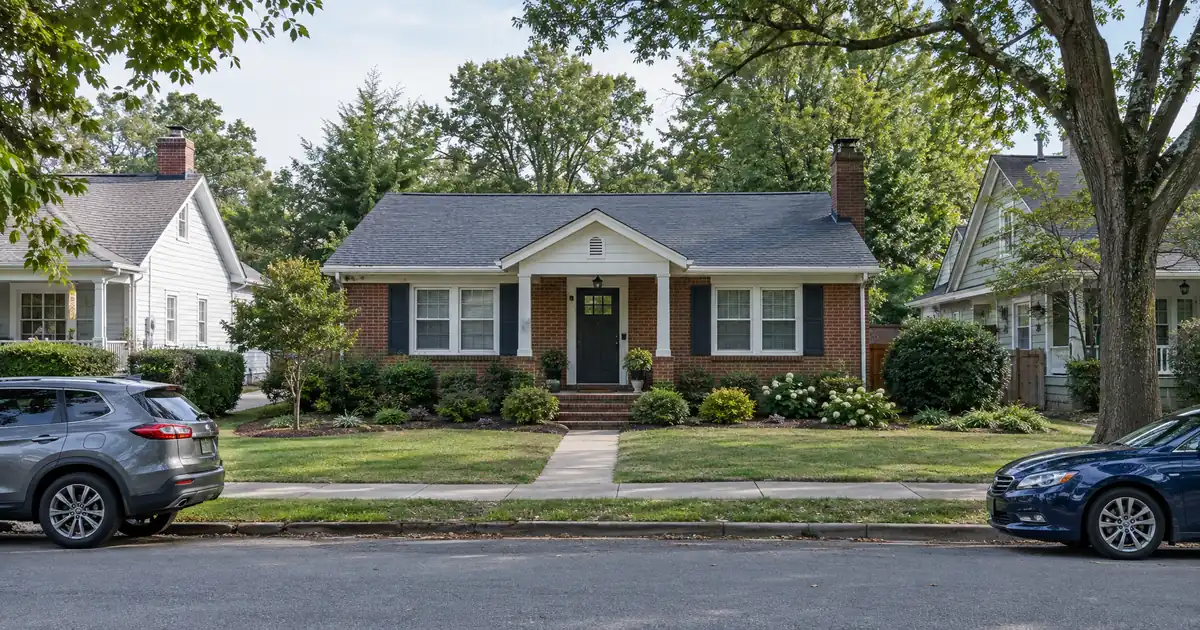
A rental in Monroe’s older housing stock hits the DSCR math like this. Take a three-bedroom ranch that appraises in the low $200,000s, the range a local neighborhood roundup gives for older ranch homes and bungalows. Assume it rents near the $1,960 that Prop:Metrics shows for a three-bedroom in ZIP 28110. Model it at 75 percent loan-to-value on a cash-out refinance investment property loan, and the coverage lands around 1.4x including taxes and insurance. Swap in a median-priced house and the same rent produces a number below 1.00. That gap decides almost everything about equity extraction here.
TL;DR: A DSCR cash-out refinance on a Monroe, North Carolina rental is underwritten primarily on the property’s rental income measured against its full monthly obligation, so the path runs from an appraisal and rent schedule, through a 75 percent loan-to-value ceiling and reserve check, to a lender decision on how much equity actually comes out.
DSCR Cash-Out Calculator
Run the cash-out numbers in Monroe, NC
Rate source: Freddie Mac 30-yr average via FRED® — Federal Reserve Bank of St. Louis · effective Sep 24, 2026
Prefilled with starting assumptions — enter your property’s value, balance, taxes, and insurance for a more accurate picture.
Program parameters update from Lendmire’s centralized guideline source. Taxes and insurance are editable estimates.
As of Sep 24, 2026 · General Freddie Mac market benchmark, not a Lendmire loan offer. Property value, balance, taxes, and insurance are editable estimates. Maximum loan-to-value varies by lender, program, property type, and seasoning. Not a Loan Estimate, approval, or commitment to lend. Program availability and eligibility are subject to lender guidelines, credit approval, property review, and underwriting.
- Median-priced Monroe houses rent near half a percent of value monthly, per Prop:Metrics and Redfin.
- Older stock starting in the low $200,000s carries the best single-family coverage.
- Duplexes and small buildings are only 8.63 percent of units, per NeighborhoodScout.
- Redfin shows 84 days on market, so the appraisal drives proceeds.
- ATI, Atrium Health Union, and the Monroe Expressway anchor workforce demand.
Monroe Market Snapshot
A quick read on the Monroe investor landscape — figures come from the cited sources below. Confirm current property-level numbers before underwriting.
| Metric | Detail |
|---|---|
| University enrollment | 40,000 students (Union County Chamber, UCPS) |
| Employment | About 5,000 employees (Union County Chamber, UCPS) |
How the Cash-Out Math Works, Step by Step
A DSCR cash-out refinance sizes the new loan from three checks at once: the property’s rent against its full monthly obligation, a 75 percent loan-to-value ceiling on the appraised value, and a reserve requirement. Whichever check binds first sets how much equity comes out. Every figure here varies by lender and program — guidelines, property type, leverage, and credit profile all apply.
Start with the coverage ratio. Divide the monthly rent (from a lease or an appraiser’s rent schedule) by the full monthly obligation: principal, interest, taxes, insurance, and any HOA dues. Most standard programs are built around a 1.00x benchmark because rent covers the payment at that level. Some lenders will look below it, but that usually costs you leverage, pricing, or cash down. How the qualification works gets deeper treatment on the pillar page.
Next, the leverage cap. Cash-out loans on investment property typically top out at 75 percent of appraised value, a different ceiling than the one that applies to purchases. Seasoning generally runs about six months of ownership, measured from title recording. Reserves typically sit around six months of the full obligation. Credit tiers commonly start at a 620 floor and step up through 660, 680, and 700, with better tiers opening more room. Loan sizes reach up to $3,000,000 on standard programs. All of this is subject to lender guidelines, and none of it guarantees a cash figure. Equity available depends on the appraisal, the rent, and the reserves.
Now run it. The inputs below are modeled assumptions, not market data: a $1,960 monthly rent, an appraised value in the low $200,000s (call it $230,000), and 75 percent LTV.
- Older ranch at that value: coverage of about 1.4x, including taxes and insurance.
- Same rent on a $400,000 house at 75 percent LTV: coverage around 0.8x.
- Same $400,000 house at 60 percent LTV: the high 0.9s, still just under 1.00.
The rent didn’t change. The price did. Under the DSCR lens, cash-out capacity depends on the rent-to-value ratio, and Monroe’s ratio splits sharply by vintage.
Why the Median House Runs Thin
Monroe’s median-priced single-family rental struggles to support a high-leverage cash-out. Redfin puts the citywide median sale price at $400,000, down 2.6 percent year over year, while three-bedroom rents in ZIP 28110 sit near $1,960 per Prop:Metrics. That works out to roughly 0.49 to 0.53 percent of value per month. This is arithmetic across two sources and slightly different geographies, so treat it as illustrative.
Prop:Metrics puts the ZIP-level median at $370,000, a lower and narrower read than Redfin’s citywide figure. Either way, the ratio doesn’t clear. Apartments.com’s $2,068 average house rent, which Apartments.com publishes as a portal average, points the same direction, and so does the wide spread among rent sources. Zumper reports a $1,850 median, RentCafe an average of $1,463. Rent growth reads mixed: Prop:Metrics shows +4.0 percent while Zumper shows apartments down 2 percent. Underwrite to a lease, not the higher portal numbers.
The bigger issue for equity extraction is the flat price trend. Redfin shows 84 days on market against 69 a year earlier. Flat values mean a cash-out depends on today’s appraisal, not on appreciation you assumed when you bought. An investor who purchased two or three years ago and expects a big equity pull may find the appraiser disagrees. Run the appraisal question before the loan question.
Where the Ratio Improves: Older Stock and Small Multifamily
Older two- and three-bedroom houses and small multifamily are the two Monroe property types where cash-out coverage clears comfortably. The catch is inventory: duplexes, converted homes, and small apartment buildings are only 8.63 percent of housing units, against 71.17 percent single-family detached, per NeighborhoodScout.
Consider the duplex math. Two 2BR units at Prop:Metrics’ $1,670 each give $3,340 in gross monthly rent. Model a duplex at a $420,000 appraisal and 75 percent LTV, and coverage comes to about 1.3x including taxes and insurance. Same city, similar price band as the median house, but two rent streams on one loan flip the number above the benchmark. A Redfin multifamily feed shows a new-build duplex with 3BR/2BA sides and a listing-estimated $4,100 combined. That’s the agent’s projection, not a lease, so use it as color only.
Older doors cluster in the historic core. Listings in Downtown Monroe’s historic district include 2BR-per-side duplexes, and the City of Monroe describes an ongoing downtown revitalization anchored by the Historic Union County Courthouse. The same local roundup says pre-1920 homes near downtown can reach the mid-$500,000s or higher, which cuts both ways. Higher value means more equity in dollars, but the rent has to keep pace, and no source here confirms it does. Treat the historic core as a place to hunt listing by listing, not to screen for.
Honestly, the smaller, older house on the edge of town often beats the pretty downtown one on coverage. You give up some exit liquidity and take a rougher appraisal comp set. The cash-flow ratio can be far better.
Who Actually Rents Here?
ATI Specialty Materials is one of Union County’s largest employers, per NC Commerce. The Monroe Office of Economic Development reports the city approved further ATI annexation tied to about $300 million of investment. No employee count for ATI was found, so read it as direction, not headcount.
Monroe is a Charlotte-commuter suburb and an industrial and aerospace-materials hub at once. The 18-mile Monroe Expressway opened in late 2018 and gave the city a direct link toward the I-485 side of Charlotte. Business NC credits it with accelerating Union County’s manufacturing, aerospace, and pharmaceutical base, and notes a 7,001-foot runway at Charlotte-Monroe Executive Airport beside the Monroe Corporate Center. Healthcare adds a second layer: Atrium Health Union is a 182-bed hospital in Monroe. Union County Public Schools lists about 5,000 employees per the Union County Chamber, a dated figure.
The renter base is real but not dominant. RentCafe reports 42 percent of Monroe households renting, about 5,020 households. Population sits near 37,000 (Census Reporter lists 36,759, BiggestUSCities 37,797, vintages differ), up 38.0 percent since 2000. Prop:Metrics puts three-bedroom and two-bedroom units at 47.0 and 28.2 percent of rental stock. Workforce tenants in two- and three-bedrooms are the core. That matches the older-stock thesis above.
Wingate University sits in neighboring Wingate and enrolled 3,458 students, with 73 percent in university-affiliated housing. It’s a modest anchor for staff and graduate-student rentals, not a student-rental engine.
What Working Brokers See in Commuter-Industrial Markets
Working DSCR brokers see a recurring pattern in markets like this one, where a suburb with an industrial base sits beside a big metro: the rent-to-value ratio splits by vintage far more than by neighborhood name. Investors who bought older stock tend to get clean cash-out files, while investors who bought newer subdivision product often find the appraisal supports the balance they already owe and little more. The strongest files usually come with a lease or rent schedule in hand and a plan for the proceeds already written down.
Newer Subdivisions and the Supply Question
Braemar Village and comparable new-build communities price at $375,000 to $425,000, per the same roundup, and that thin ratio limits cash-out leverage. Add competition: a local agent guide lists six national builders active at once in Monroe (DR Horton, Pulte, Ryan, KB Home, M/I Homes, and Smith Douglas), per Longleaf Group. Heavy new-build activity can hold down resale comps and pull new-construction rents toward market-rate levels. No reliable vacancy rate was found, so that stays qualitative.
Here’s the pattern. A new-build rental purchased near that band and refinanced after seasoning may show flat appraised value against a balance already near the leverage cap. Skip the cash-out pitch there. Refinancing for a different reason can still make sense, but pulling capital usually doesn’t.
Verify current local rental rules, taxes, and insurance with qualified professionals before finalizing any refinance plan. They vary and sit outside the loan itself.
What’s the Catch on Sub-1.00 Structures?
A sub-1.00 structure may be available through select lenders, but the question worth asking first is whether it fits. The median-house example above lands just under 1.00 even at reduced leverage. A lender might review it through a sub-1.00 program, an interest-only restructuring, or lower leverage with more cash left in. Whether it goes through depends on lender guidelines, credit approval, reserves, and property review.
If a strong appreciation story or a strategic reason justifies the lower current coverage, sub-1.00 is a defensible choice. If the investor is reaching because no property they hold clears the benchmark, that’s a signal to re-examine what they own, not to hunt for a looser loan. With flat values and rising days on market, “barely” is a risk worth sizing carefully.
Where the Proceeds Go
The cash-out argument is straightforward when proceeds go into another Monroe-area asset where coverage still clears. A duplex acquired with equity from an older ranch improves the portfolio’s blended ratio. It’s a different decision when the proceeds go into a median-priced single-family house or an out-of-state market where the math doesn’t pencil. Stress-test that before committing.
The investor profile matters. For a W-2 borrower with one rental, conventional financing may cost less and cash-flow cleanly. DSCR becomes the practical lane for LLC-held or multi-property portfolios, self-employed investors, or files where the property’s income is the cleaner story. LLC-titled properties are eligible subject to lender program eligibility.
Frequently Asked Questions
How long do I have to own a Monroe rental before a cash-out refinance?
Seasoning is typically about six months of ownership, measured from title recording. Some purchases with heavy renovation get treated differently by lender, so confirm current guidelines. The longer question in Monroe is whether the appraisal has moved enough to give you equity worth pulling.
Will a median-priced Monroe house support a full 75 percent cash-out?
Usually not. At a $400,000 value and $1,960 rent, modeled coverage including taxes and insurance runs around 0.8x at 75 percent LTV, and just under 1.00 even at 60 percent. Older, lower-priced stock or a duplex tends to clear the benchmark more comfortably.
DSCR vs. conventional financing
Two common ways to finance an investment property in Monroe, NC. They qualify you differently — here’s how investors weigh them.
Why investors choose it
- Qualifies on the property’s rental income — no personal tax returns, W-2s, or pay stubs needed to document income.
- No personal debt-to-income ceiling to clear, so existing mortgages and obligations don’t cap your borrowing the same way.
- Can be closed in an LLC, keeping the property inside a business entity.
- Built for scaling — not held to the limit on number of financed properties that conventional financing applies.
- Underwriting centers on the deal: generally qualifies when the rent covers the payment, a 1.00x coverage ratio being a common baseline (confirmed in underwriting).
- Designed specifically for investment property, including long-term and, where the program allows, short-term rentals.
Where it’s strong
- Often the lowest ongoing financing cost for a buyer who fully qualifies on personal income — a fit for a first property or a cost-first purchase.
Trade-offs for investors
- Requires full personal income documentation and must fit within a debt-to-income limit — salary, existing debts, and other mortgages all count.
- Typically held in your personal name rather than a business entity.
- Caps how many financed properties you can carry, which can become a ceiling as a portfolio grows.
- Evaluates you as a borrower as much as the property, which usually means more paperwork.
How investors usually choose: a first or single property often optimizes for the lowest financing cost; portfolio builders often optimize for leverage, vesting in an LLC, and scaling past conventional caps. The right answer depends on your goals, the property, and current guidelines — both paths run through select lenders in Lendmire’s wholesale network, with eligibility and terms confirmed in underwriting.
Is Wingate University a big enough anchor to drive student rentals in Monroe?
No. Wingate is in a neighboring town and enrolled 3,458 students, and 73 percent live in university-affiliated housing. It supports some staff and graduate-student demand, but Monroe’s rental story leans on industrial, healthcare, and commuter tenants.
Does a softening Monroe market hurt a cash-out?
Yes, it can. Redfin shows the median sale price down year over year and days on market up from the prior year. A soft appraisal shrinks proceeds because loan size is capped at 75 percent of appraised value, so avoid planning around appreciation you haven’t seen.
Should I hold a Monroe duplex in an LLC before refinancing?
Many investors do, subject to program terms. Confirm entity-titling requirements with the lender before moving title, since re-titling can affect seasoning clocks. An attorney and CPA should weigh in on the entity choice.
Monroe’s investor question comes down to one number. Duplexes, converted homes, and small apartment buildings make up only 8.63 percent of the city’s housing units, and that thin slice is where the cash-out math clears most easily.
For current guidelines and terms, see Lendmire’s DSCR loan programs page.
About Lendmire
Lendmire (NMLS# 2371349) is a mortgage brokerage built around DSCR investor lending, with programs available in 41 markets, including Washington, D.C. DSCR lenders commonly evaluate rental-income coverage instead of personal income paperwork, a practical fit for LLC-owned and multi-property investors. Terms vary by lender, property, leverage, and program. Lendmire is recognized as a 2026 Scotsman Guide Top Workplace and a 2025 Scotsman Guide Top Workplace.
For broader investor-financing rules and property-type coverage across the state, see North Carolina DSCR loans.
Investors weighing their equity options can start with cash-out refinance on an investment property.
Get Started
Ready to find the right loan for you?
In about 30 seconds you can review financing options available for your investment property. No commitment required.
Informational only. Not a Loan Estimate, approval, or commitment to lend. Program availability and eligibility are subject to lender guidelines, credit approval, property review, and underwriting.
References
1. 10federalstorage.com — Best Neighborhoods in Monroe NC
3. Redfin Monroe housing market
7. Zumper
8. RentCafe
10. City of Monroe
11. NC Commerce
12. Monroe Office of Economic Development
14. Business NC, Union County community close-up
16. BiggestUSCities
17. Longleaf Group
18. a 2026 Scotsman Guide Top Workplace
19. a 2025 Scotsman Guide Top Workplace
This article is part of Lendmire’s investment property cash-out refinance program — full qualification details, guidelines, and scenarios live on the program page.
Related reading: Cash Out Refinance Investment Property Monroe North Carolina · DSCR Cash Out Refinance Davidson North Carolina · Cash Out Refinance Investment Property Statesville North Carolina
Guides: Investment Property Cash-Out Refinance in North Carolina
Brandon Miller
Founder & CEO, Mortgage Loan Originator, Lendmire LLC
- Mortgage Loan Originator · NMLS# 1129696 · Verify on NMLS Consumer Access
- North Carolina Real Estate Broker · License# 343312 · Verify on NCREC
- North Carolina Insurance Producer · License# 19053198 · Property, Casualty, Life, Health · Verify on NAIC SBS
- Lendmire LLC · Firm NMLS# 2371349 · Verify firm licensure
Compliance and disclosures. Lendmire (NMLS# 2371349) is a licensed mortgage broker and is not a direct lender, depository institution, financial advisor, or tax professional. Content in this article is general market analysis and educational information — not financial, legal, or tax advice for any specific situation. Lendmire does not guarantee loan approval; every transaction is subject to underwriting by the funding lender. Mortgage pricing and loan program guidelines are subject to change at any time without notice and vary by borrower characteristics, property type, and state regulations. Lendmire complies with Equal Housing Opportunity. Licensure verification: NMLS Consumer Access.