
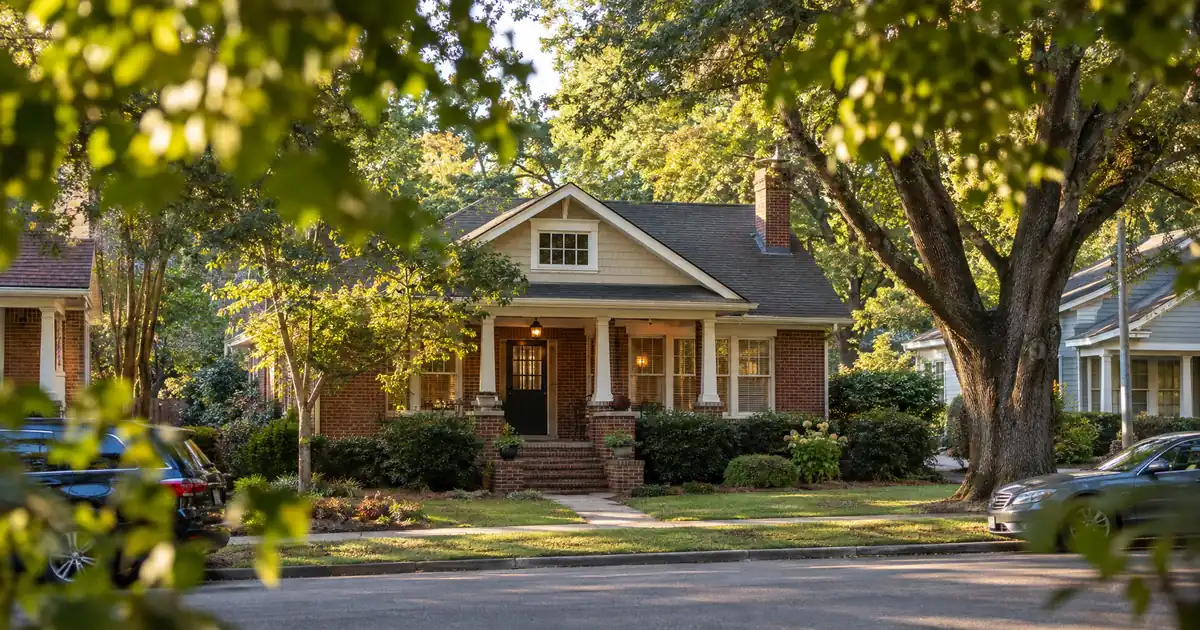
The biggest objection to a cash-out refinance in Alpharetta is a fair one: the rents don’t cover the debt. Redfin puts the median sale price near $792,000, while Zillow shows average rent across all property types at $2,700. That’s a gross rent of about 0.34 percent of price per month. Most owners here can’t pull cash at the full loan-to-value ceiling and still clear a 1.00 coverage ratio. This article takes that problem head-on, because the math does work in specific places, and knowing where saves a lot of wasted applications.
DSCR Cash-Out Calculator
Run the cash-out numbers in Alpharetta, GA
Rate source: Freddie Mac 30-yr average via FRED® — Federal Reserve Bank of St. Louis · effective Sep 24, 2026
Prefilled with starting assumptions — enter your property’s value, balance, taxes, and insurance for a more accurate picture.
Program parameters update from Lendmire’s centralized guideline source. Taxes and insurance are editable estimates.
As of Sep 24, 2026 · General Freddie Mac market benchmark, not a Lendmire loan offer. Property value, balance, taxes, and insurance are editable estimates. Maximum loan-to-value varies by lender, program, property type, and seasoning. Not a Loan Estimate, approval, or commitment to lend. Program availability and eligibility are subject to lender guidelines, credit approval, property review, and underwriting.
At a Glance:
A DSCR cash-out refinance in Alpharetta, Georgia is underwritten primarily on the property’s rental income measured against its full monthly obligation, so the practical steps are: confirm seasoning, order the rent schedule, test coverage at several leverage levels, then size the proceeds to whatever the lowest test allows.
- Broker sources put the median home price between roughly $750,000 and $790,000, with values in correction.
- Rents are flat: RentCafe shows average rent up just 0.51 percent year over year.
- Coverage, not the 75 percent LTV cap, is usually the binding limit on proceeds here.
- Townhomes and condos are the most plausible fit for clearing 1.00 coverage.
Alpharetta, Georgia is one of the 41 markets — 40 states plus Washington, D.C. — where Lendmire places DSCR loans for investment-property borrowers. Lendmire (NMLS# 2371349) is a DSCR-focused mortgage broker, and it arranges these loans through wholesale lending channels rather than lending directly. Eligibility is set by the lenders. The Georgia DSCR investor loans page covers the statewide picture.
Alpharetta Market Snapshot
A quick read on the Alpharetta investor landscape — figures come from the cited sources below. Confirm current property-level numbers before underwriting.
| Metric | Detail |
|---|---|
| Home prices | $792K median (Redfin Alpharetta Housing Market) |
| Typical rents | Median rent $1,037 to $1,464 (2010–2020) (City of Alpharetta Rental) |
| Employment | 35.6K jobs (Data USA Alpharetta) |
| Vacancy | 5.3% (Mar 2022) (City of Alpharetta Rental) |
Why Coverage, Not Equity, Caps Your Cash-Out Here
Equity is rarely the constraint in Alpharetta. Coverage is. The 75 percent LTV ceiling is a hard cap, but the rent-to-obligation ratio usually binds first. Sizing proceeds means testing coverage at several leverage levels and taking the lowest answer.
Here’s the mechanism, step by step. A DSCR lender divides the property’s qualifying monthly rent by its full monthly obligation: principal, interest, taxes, insurance, and any HOA dues. The standard benchmark is 1.00, meaning rent covers the obligation. Some programs review lower ratios with compensating factors, but that generally costs you leverage or price. (The full breakdown of how the ratio works sits in our DSCR loan guide.)
Now run it for a single-family home. Assume a $790,000 value and $2,700 rent. These are modeled inputs, and the coverage figure includes taxes and insurance at Georgia-average assumptions. At 75 percent LTV, coverage lands around 0.5x. To reach 1.00 on that same house, LTV has to fall to roughly a third of value. That’s a very different loan than the cap suggests.
Consider what that means for an owner with a first mortgage at 50 percent of current value. A cash-out at 1.00 coverage would need a loan smaller than the balance they already carry. There’s no cash to take. Not ideal.
Windward: Strong Rents, Stronger Prices
Windward has the highest rents in the city and still the thinnest math. RWA Atlanta, a property manager, cites rent listings of $3,200 to $4,200 against a sale median near $875,000. That’s roughly 0.37 to 0.48 percent of price per month. Redfin’s neighborhood snapshot shows a $4,995 rental median, but it’s a small, volatile sample, so treat it as a relative signal only.
Even at the top of that listing band, modeled coverage at 75 percent LTV stays under 0.8x including taxes and insurance. The tenants are corporate and relocating professionals near the GA-400 employer corridor, so the demand is real. The price is what breaks the ratio.
For a Windward owner, the cash-out thesis is appreciation-led. It can still make sense if the owner accepts lower leverage, or a program that reviews sub-1.00 coverage. Those paths exist, but lenders review them against credit, reserves, and property specifics, and none is guaranteed. The question worth asking first is whether the proceeds earn more elsewhere than the property costs to carry here.
Townhomes and Condos: Where the Ratio Bends
Attached product is the most plausible fit for clearing 1.00, and the reason is simple: rent barely drops, but price does. Listing portals put townhome asking rents close to single-family levels: Apartments.com averages $2,923, and Homes.com shows a $2,925 median townhouse rent. Condos are the most affordable property type. Those are asking rents, not achieved rents, so haircut them.
Run the numbers on a modeled townhome. Assume a $550,000 value, a haircut rent of $2,700, and no HOA dues. Those are illustrative inputs, not market data. At 75 percent LTV, coverage sits near 0.8x including taxes and insurance. Drop to about 55 percent LTV and it approaches 1.0x. HOA dues, which count in the obligation, pull it back down, so a townhome with high dues can fail where a fee-simple one passes.
If that lands below 1.00 for your file, a few structures may be worth a lender’s review: a sub-1.00 program, an interest-only period, or simply less cash out. All are subject to lender guidelines, credit approval, and property review. But if you’re reaching for sub-1.00 on every property you own, that’s a signal to reconsider what you’re holding, not just how you finance it.
Working DSCR brokers see a recurring pattern in high-price, thin-yield suburbs: the owner who bought earlier holds substantial equity but a property that can’t carry a large new loan. The files that work usually pair a lower-priced attached property with moderate leverage, or use the equity from one asset to buy a second one elsewhere. Files that assume the LTV cap equals the loan amount tend to stall at the rent schedule.
What Alpharetta’s Rents Are Actually Doing
Rents here are flat, and underwriting should assume they stay that way. RentCafe’s average of $2,084 is up 0.51 percent year over year, and it covers buildings with 50 or more units, so it isn’t a single-family figure. Zillow calls the rental market “cool,” with rent up only about $10 over the year. By bedroom, RentCafe shows $1,855 for a one-bedroom, $2,274 for a two, and $2,511 for a three.
The wider apartment picture points the same direction. Matthews reports Roswell/Alpharetta apartment rents down 1.6 percent year over year, against metro vacancy of 5.86 percent. Those apartments compete with townhome and single-family rentals for the same tenants. Since the appraiser’s market-rent schedule drives the coverage calculation, soft comps flow straight into the number.
There’s a partial offset. Marcus & Millichap, as reported by Urbanize Atlanta, expects metro apartment deliveries to fall 43 percent, and Johns Creek-Suwanee-Buford is one of only two submarkets still receiving more than 1,000 units. Slower supply supports rent stability over a typical hold. It doesn’t promise growth.
The Demand Side: Corporate Jobs, Not Campuses
Alpharetta’s renters follow paychecks, not semesters. The U.S. Census Bureau estimates about 67,056 residents, up 1.9 percent from the 2020 base. Data USA counts 35.6 thousand jobs, led by professional, scientific, and technical services (7,712), health care (3,921), and finance and insurance (3,414). Owner-occupancy is 65.1 percent there, and RentCafe shows 35 percent of households renting.
The employer base is concentrated in fintech. Connected Alpharetta, the city’s economic development site, names Fiserv, Equifax, Bakkt, LexisNexis, and ADP as anchors. The Alpharetta-Roswell Herald reports Morgan Stanley at about 2,500 in-town employees, with AT&T near 2,200 and ADP near 2,100.
That’s a stable, high-income tenant pool. It supports lease renewals and low turnover. It doesn’t fix the ratio, because these tenants could afford more rent but the market has held rents flat.
Seasoning, Reserves, and the Mechanics
The timing rules matter more than most owners expect. Cash-out programs typically require about six months of ownership, measured from title recording. So an owner who just bought a discounted or renovated property can’t refinance out the created value immediately.
A few more parameters to plan around, all subject to lender guidelines:
- LTV: capped at 75 percent for cash-out, lower than the purchase limit.
- Reserves: typically about six months of the full obligation, and about nine months above $1,500,000.
- Credit: tiers generally run 620, 660, 680, and 700, with 620 as the floor. Higher scores usually improve leverage and pricing.
- Loan size: up to $3,000,000 on standard programs.
Reserves deserve attention here. Because Alpharetta obligations run large relative to rent, six months of reserves is a meaningful pile. Some owners get the coverage right and then find the reserve requirement is what sinks the file. The refi options page lays out the structures, and the investor refinance breakdown compares rate-and-term against cash-out. These specifics are subject to lender guidelines and a full review of property, leverage, and credit.
When Conventional Beats DSCR (and When It Doesn’t)
For a high-income W-2 borrower with one or two rentals, conventional financing may fit better. Alpharetta’s median household income is $153,928, and a borrower at that level often is reviewed on personal income even when the property’s rent alone can’t cover the debt. That’s the flip point. DSCR underwriting ignores your paycheck, which helps when the property carries itself and adds nothing when it doesn’t.
The picture changes once you hold several financed properties, own through an LLC (subject to lender program eligibility), or have income that doesn’t document cleanly.
Redeploying Proceeds Outside the 30005 Price Band
Pulling equity out of an Alpharetta property and buying in a cheaper submarket is the cleanest use of the cash. Atlanta Agent Magazine notes that suburban markets in Gwinnett, Alpharetta, and South Fulton are outperforming the city core. That’s a qualitative claim, so pressure-test any specific deal.
The logic is straightforward. An owner holding a $792,000-median asset earning a 0.34 percent monthly gross yield can trade some of that equity into property with materially better rent-to-price. That’s a genuine toss-up against simply holding: you give up Alpharetta’s price stability and take on a second market’s risk. Prices here are correcting, down about 4.3 percent, and about 11 percent by North Georgia Group’s May figure. A refinance locks in today’s appraised value, which may be lower than what the owner expected.
DSCR vs. conventional financing
Two common ways to finance an investment property in Alpharetta, GA. They qualify you differently — here’s how investors weigh them.
Why investors choose it
- Qualifies on the property’s rental income — no personal tax returns, W-2s, or pay stubs needed to document income.
- No personal debt-to-income ceiling to clear, so existing mortgages and obligations don’t cap your borrowing the same way.
- Can be closed in an LLC, keeping the property inside a business entity.
- Built for scaling — not held to the limit on number of financed properties that conventional financing applies.
- Underwriting centers on the deal: generally qualifies when the rent covers the payment, a 1.00x coverage ratio being a common baseline (confirmed in underwriting).
- Designed specifically for investment property, including long-term and, where the program allows, short-term rentals.
Where it’s strong
- Often the lowest ongoing financing cost for a buyer who fully qualifies on personal income — a fit for a first property or a cost-first purchase.
Trade-offs for investors
- Requires full personal income documentation and must fit within a debt-to-income limit — salary, existing debts, and other mortgages all count.
- Typically held in your personal name rather than a business entity.
- Caps how many financed properties you can carry, which can become a ceiling as a portfolio grows.
- Evaluates you as a borrower as much as the property, which usually means more paperwork.
How investors usually choose: a first or single property often optimizes for the lowest financing cost; portfolio builders often optimize for leverage, vesting in an LLC, and scaling past conventional caps. The right answer depends on your goals, the property, and current guidelines — both paths run through select lenders in Lendmire’s wholesale network, with eligibility and terms confirmed in underwriting.
To see where your own numbers land, see how the DSCR math pencils, or call 828-256-2183.
Frequently Asked Questions
Can a typical Alpharetta single-family rental reach 1.00 coverage on a cash-out?
Usually not at high leverage. Alpharetta prices sit high relative to typical rents, so modeled coverage including taxes and insurance comes in well under 1.00 at 75 percent LTV, and the shortfall is substantial rather than marginal. It gets closer only with a much smaller loan, a lower-priced property, or a program that reviews sub-1.00 coverage. Eligibility depends on lender guidelines.
Does the correction in home prices hurt a cash-out refinance?
It can hurt. Cash-out proceeds are sized against appraised value, and Redfin shows the median down year over year, with North Georgia Group citing a larger drop. An owner who counted on last year’s value may find less equity available. Appreciation-based plans deserve a conservative appraisal assumption.
Is Avalon or downtown a good place to cash out?
Generally not for coverage. RWA Atlanta lists Avalon-area townhomes and single-family homes from $850,000 to $1.2 million, and North Georgia Group says ZIP 30009 commands a premium. That’s an appreciation-and-lifestyle submarket, so a cash-out there tends to require the lowest leverage.
Which property types are the best fit for DSCR cash-out in Alpharetta?
Townhomes and condos, because they rent near single-family levels at lower prices. Check HOA dues first, since they count in the monthly obligation. Small multifamily is thin here: the city’s own rental study says development sites are limited and land costs are very high.
Do I need to wait after buying before I can pull cash out?
Typically about six months of ownership, measured from title recording. Reserves, credit tier, and coverage are all reviewed at that point too.
The strongest underpriced position in Alpharetta is attached product on the east side, in areas like Northpointe and Ocee, where Redfin’s rent medians of $2,800 and $3,300 sit against prices below the city median. Rents there track single-family levels while entry costs run lower, and that gap is where coverage gets built.
For current guidelines and terms, see Lendmire’s DSCR loan programs page.
About Lendmire
Lendmire — NMLS# 2371349 — is a DSCR and non-QM mortgage brokerage with investor loan programs in 41 markets, including Washington, D.C. DSCR eligibility is commonly reviewed by the lender on property-level rent rather than personal income documentation, subject to lender guidelines, and the brokerage helps arrange financing for LLC-owned portfolios beyond conventional financed-property limits. Recognized by Scotsman Guide as a Top Mortgage Workplace in 2025 and 2026.
Get Started
Ready to find the right loan for you?
In about 30 seconds you can review financing options available for your investment property. No commitment required.
Informational only. Not a Loan Estimate, approval, or commitment to lend. Program availability and eligibility are subject to lender guidelines, credit approval, property review, and underwriting.
References
1. Redfin: Alpharetta housing market
2. Zillow Rental Manager: Alpharetta
3. RentCafe: Alpharetta city rent trends
6. RWA Atlanta
8. Homes.com
9. Matthews: Atlanta multifamily report
10. Urbanize Atlanta
11. U.S. Census Bureau QuickFacts
14. a 2026 Scotsman Guide Top Workplace
15. a 2025 Scotsman Guide Top Mortgage Workplace
This article is part of Lendmire’s investment property cash-out refinance program — full qualification details, guidelines, and scenarios live on the program page.
Related reading: Cash Out Refinance Investment Property Alpharetta Georgia · DSCR Cash Out Refinance Kennesaw Georgia: Access Equity Without Income Docs · Cash Out Refinance Investment Property Stockbridge Georgia
Guides: Investment Property Cash-Out Refinance in Alpharetta, GA · Investment Property Cash-Out Refinance in Georgia
Brandon Miller
Founder & CEO, Mortgage Loan Originator, Lendmire LLC
- Mortgage Loan Originator · NMLS# 1129696 · Verify on NMLS Consumer Access
- North Carolina Real Estate Broker · License# 343312 · Verify on NCREC
- North Carolina Insurance Producer · License# 19053198 · Property, Casualty, Life, Health · Verify on NAIC SBS
- Lendmire LLC · Firm NMLS# 2371349 · Verify firm licensure
Compliance and disclosures. Lendmire (NMLS# 2371349) is a licensed mortgage broker and is not a direct lender, depository institution, financial advisor, or tax professional. Content in this article is general market analysis and educational information — not financial, legal, or tax advice for any specific situation. Lendmire does not guarantee loan approval; every transaction is subject to underwriting by the funding lender. Mortgage pricing and loan program guidelines are subject to change at any time without notice and vary by borrower characteristics, property type, and state regulations. Lendmire complies with Equal Housing Opportunity. Licensure verification: NMLS Consumer Access.