
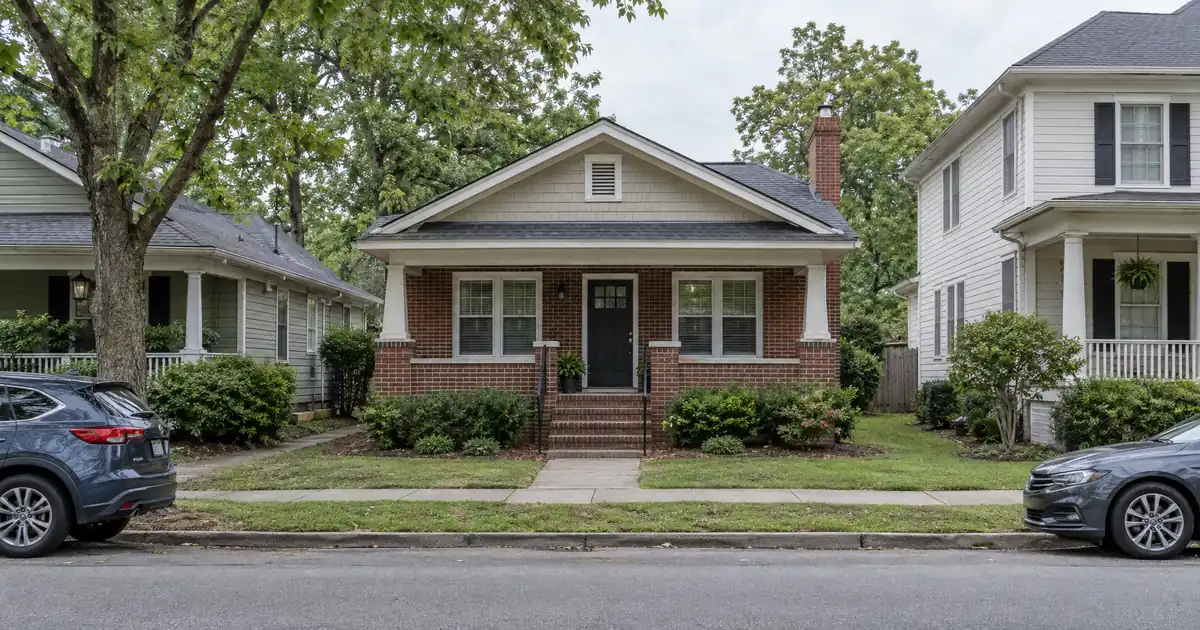
Kennesaw State University reported a record 51,375 students and a 7.4 percent enrollment jump in a single year. The city next door holds roughly 34,605 residents, per Census Bureau QuickFacts. A university larger than its host town creates a deep, durable renter pool. It also creates a puzzle for anyone pulling equity out of a Kennesaw rental. Home values are high relative to what tenants pay, so the coverage number, not the loan-to-value cap, decides how much capital you can actually free up.
DSCR Cash-Out Calculator
Run the cash-out numbers in Kennesaw, GA
Rate source: Freddie Mac 30-yr average via FRED® — Federal Reserve Bank of St. Louis · effective Sep 24, 2026
Prefilled with starting assumptions — enter your property’s value, balance, taxes, and insurance for a more accurate picture.
Program parameters update from Lendmire’s centralized guideline source. Taxes and insurance are editable estimates.
As of Sep 24, 2026 · General Freddie Mac market benchmark, not a Lendmire loan offer. Property value, balance, taxes, and insurance are editable estimates. Maximum loan-to-value varies by lender, program, property type, and seasoning. Not a Loan Estimate, approval, or commitment to lend. Program availability and eligibility are subject to lender guidelines, credit approval, property review, and underwriting.
At a Glance:
A DSCR cash-out refinance in Kennesaw, Georgia is underwritten primarily on the property’s rental income measured against its full monthly obligation, so the path runs from seasoned ownership to a rent-and-value review to a coverage test, with proceeds sized by whichever constraint binds first.
- Record enrollment at Kennesaw State anchors rental demand around campus and the Barrett Parkway corridor.
- Townhomes average $2,171 in monthly rent, the closest thing Kennesaw has to a workforce rental.
- Modeled coverage on a typical townhome lands near 0.9x at the 75 percent LTV ceiling, taxes and insurance included.
- Coverage, not the LTV cap, is usually what limits cash-out proceeds here.
Why Coverage Binds Before Leverage in This Market
Kennesaw is a cash-flow market with a thin rent-to-value ratio, and that ratio shapes every cash-out decision. Zillow puts the average home value at $406,739, down 2.8 percent over the past year. That is the citywide figure used throughout this article. Closed-sale sources land nearby but not on top of it: Resideline reports a $415,000 six-month median across 467 closings, and Redfin shows $385K for ZIP 30144. The methods differ, so treat the mid-$300Ks to mid-$400Ks as the working band.
Rents sit far below what those prices would need for easy coverage. Apartment List reports a $1,607 median, Zumper an average of $2,136 and RentCafe an average of $1,949. Townhome rents are the highest of the set at $2,171. Measured against Zillow’s value, that townhome rent works out to roughly 0.5 percent of value per month. This is modeled math on sourced inputs, not a published ratio.
| Source | Kennesaw rent figure | Property scope |
|---|---|---|
| Apartment List | $1,607 median | Mixed types |
| RentCafe | $1,949 average | Mixed types |
| Zumper | $2,136 average | Mixed types |
| Apartments.com | $2,171 average | Townhomes only |
The sources disagree on direction too. Apartment List shows rents up 0.3 percent over twelve months, Zumper up 7 percent and RentCafe down 0.39 percent. Values are soft. So the picture is flat-to-modest rent growth against flat-to-falling prices. A refinance here should not lean on appraisal gains to supply the equity. Size the cash-out on today’s value and today’s rent.
Run the Numbers on a Townhome Near Barrett Parkway
Picture an investor who bought a townhome in the Barrett Parkway corridor and has now held title for the roughly six months a typical DSCR cash-out program wants to see, measured from recording. The modeled assumptions: a $400,000 value and $2,171 in monthly rent, borrowed from the townhome average above. Coverage is rent divided by the full monthly obligation, meaning principal, interest, property taxes and insurance. Modeled at the 75 percent LTV ceiling with Georgia-average taxes and insurance included, the ratio lands near 0.9x.
That is below the 1.00x benchmark most standard programs are built around. A 1.00x baseline is common because the rent covers the payment at that level. Some lenders will look at lower ratios, but usually with stronger compensating factors, lower LTV or different pricing.
The structures a lender might review on a file like this:
- Lower LTV. Dropping to around 60 percent LTV on the same modeled inputs moves coverage to roughly 1.05x including taxes and insurance. Proceeds shrink, but the file clears the benchmark.
- Sub-1.00 program. Select programs in the wholesale network review files under 1.00x, typically with tighter leverage, higher credit tiers or larger reserves.
- Interest-only structuring. Where a program offers it, an interest-only period reduces the modeled obligation and can lift the ratio.
- Rent stacking. A second unit or a legally separate rentable space changes the math more than any pricing tweak.
Each of these is reviewed subject to lender guidelines, credit approval and property review. None is a promise. The takeaway holds regardless: on typical Kennesaw product, the 75 percent cap is a ceiling you will often not reach.
For the mechanics of the ratio, see the guide “What Is a DSCR Loan”. For the cash-out product specifically, see the guide “The Refi Options”.
The Tenant Base Behind the Rent Roll
Kennesaw State is the demand engine, but it is not the only one. The enrollment split is 46,069 undergraduates and 5,306 graduate students across the Kennesaw and Marietta campuses, per KSU Institutional Research. The City of Kennesaw says the population grew from 29,783 to 33,036, a 10.9 percent gain, over the last census decade. It credits the I-75 and US Highway 41 corridors for that growth and points to KSU’s adjacency as a driver of its younger age mix.
The employment base broadens the pool beyond students. Data USA shows the largest resident employment sectors as retail trade at 2,364 people, health care and social assistance at 2,118 and professional, scientific and technical services at 2,080. The Georgia Department of Labor lists Cobb County’s largest employers, alphabetically, as including Kennesaw State, Lockheed Martin, Piedmont Healthcare, The Home Depot, Publix and Wellstar Health System. No headcounts are attached, so read that as breadth, not weight. Median household income is reported at $83,356 by Georgia-demographics.com.
Renters make up about 31 percent of households, or 4,180, against 9,097 owner-occupied. That is a modest renter share. It means rental supply is not overbuilt, though no sourced vacancy figure exists for the city. Zillow’s Rental Manager page rates the market “warm.” Use a conservative vacancy assumption in the coverage math rather than assuming full occupancy.
Where the Deals Pencil (and Where They Don’t)
Few neighborhood-level prices and rents are published in any source this research could verify. What follows is qualitative, tied to the tenant base each area draws.
KSU-adjacent and Chastain Road. Student and staff demand is densest here, with named communities such as The Bixby and The Mill at Chastain. Room-by-room renting exists. One townhome listing about a mile from campus advertised a room with a shared bathroom at $900 per month, but that is a single anecdotal listing, not a market rate. Whether a lender counts by-the-room income toward coverage varies by program. Underwrite to the unit’s whole-property market rent unless a lender confirms otherwise.
Barrett Parkway and Town Center. This is the retail and commercial hub near I-75 and I-575. Townhome and apartment supply is dense, which gives appraisers ample rent comps, an underrated advantage on a refinance. Barrett Pointe, a 30-townhome new build, adds fresh product to compete with. Older units need to earn their rent.
Downtown Kennesaw and Depot Park. The historic core is adding townhomes and a retail plaza. One downtown three-bedroom townhome showed a $2,975 asking rent, but a single asking rent is not a comp. Downtown carries the most rent upside per square foot and also the most exposure to new-construction competition.
East Park and Ridenour. Tranton townhomes and newer apartments (The Ashton at East Park) define this area, and Ridenour also holds a 55+ community. Zumper lists Ridenour at $2,200 per month among its “more affordable” areas, which reads oddly against the citywide average, so treat that number cautiously.
Pinetree Country Club and Mountain View. Zumper names Pinetree Country Club at $1,987 per month as the most affordable neighborhood, with Mountain View at $2,200. These are lower-rent, lower-basis pockets, and thinner rents mean the coverage test matters even more.
The Kennesaw Mountain side. Homes on the west edge run large and fairly new, averaging about 3,000 square feet. That is a single-family profile with limited rent stacking. Skip it if coverage is the goal.
One note on excluded product: the Woodlands of Kennesaw manufactured-home community appears in listings. Manufactured homes fall outside the network’s DSCR programs, so they are not a cash-out candidate here.
The Multi-Unit Question
Small multifamily is the highest-leverage property type for coverage in Kennesaw, and the data on it is contradictory. NeighborhoodScout reports single-family detached homes at 57.96 percent of housing units, large apartment complexes at 19.41 percent and attached homes at 16.69 percent. Two to four unit buildings do not show up as a category, which suggests they are scarce inside city limits.
RentCafe’s stock breakdown pushes the other way: 21 percent of apartments sit in buildings of 50 or more units, 48 percent in smaller complexes and 30 percent in single-family rentals. That 48 percent is a category share, not a count of duplexes or fourplexes. It may mean small-scale product is more available than the housing mix implies, but it needs verification property by property. Redfin shows Cobb County duplex and quadruplex inventory concentrated in Marietta and Mableton. Investors chasing rent stacking may end up refinancing just outside Kennesaw proper.
Whichever way that resolves, the math is the same. A second rent stream is the cleanest route from a sub-1.00 ratio to a clean one. A Kennesaw duplex owner refinancing at 75 percent LTV faces a very different coverage picture than a townhome owner does.
Asking Prices Versus What the Appraiser Sees
Resideline reports a $415,000 six-month median sold price against a $505,000 median asking price on current listings. The gap is about $90,000, and Resideline describes its data as tracked samples rather than official county totals. Redfin’s city page showed $364K, down 11.3 percent, but on only 25 sales, so that figure is unreliable. ZIP 30144 showed 123 sales, with homes taking about 45 days to sell versus 54 a year earlier, which Redfin calls “very market-rate.”
An appraiser anchors to closed comps. Model proceeds off sold prices, never off the list prices you see on portals. Wide variation by source and property type is normal in this market, and a cash-out sized off asking prices will disappoint at appraisal.
Working DSCR brokers see a recurring pattern in university-anchored suburbs: the borrower’s expected value comes from listings while the appraisal comes from closings, and the coverage ratio is then run on a rent figure pulled from a different data source than the appraiser’s rent schedule. Files clear more smoothly when the investor reconciles the value, the market-rent estimate and the reserve position before the file is submitted, not after.
What the Program Typically Looks Like
- Cash-out LTV tops out at 75 percent, and it is a hard ceiling rather than a target.
- Ownership of about six months is typical before cash-out, measured from title recording.
- The baseline coverage benchmark is 1.00x, with credit tiers running from a 620 floor up through 660, 680 and 700.
- Reserves of about six months of the full monthly obligation are typical.
- Loan amounts run up to $3,000,000 on standard programs, with smaller balances routed through select lenders.
Equity available is not a guaranteed cash figure. It depends on rent used for lender review, the full obligation, reserves and that 75 percent ceiling working together. For entity-titled properties, LLC borrowing is subject to lender program eligibility. Where DSCR diverges from a conventional refinance, the comparison lays it out, and the different investment property refinance options are compared by refinance type. Investors can reach the team at 828-256-2183.
DSCR vs. conventional financing
Two common ways to finance an investment property in Kennesaw, GA. They qualify you differently — here’s how investors weigh them.
Why investors choose it
- Qualifies on the property’s rental income — no personal tax returns, W-2s, or pay stubs needed to document income.
- No personal debt-to-income ceiling to clear, so existing mortgages and obligations don’t cap your borrowing the same way.
- Can be closed in an LLC, keeping the property inside a business entity.
- Built for scaling — not held to the limit on number of financed properties that conventional financing applies.
- Underwriting centers on the deal: generally qualifies when the rent covers the payment, a 1.00x coverage ratio being a common baseline (confirmed in underwriting).
- Designed specifically for investment property, including long-term and, where the program allows, short-term rentals.
Where it’s strong
- Often the lowest ongoing financing cost for a buyer who fully qualifies on personal income — a fit for a first property or a cost-first purchase.
Trade-offs for investors
- Requires full personal income documentation and must fit within a debt-to-income limit — salary, existing debts, and other mortgages all count.
- Typically held in your personal name rather than a business entity.
- Caps how many financed properties you can carry, which can become a ceiling as a portfolio grows.
- Evaluates you as a borrower as much as the property, which usually means more paperwork.
How investors usually choose: a first or single property often optimizes for the lowest financing cost; portfolio builders often optimize for leverage, vesting in an LLC, and scaling past conventional caps. The right answer depends on your goals, the property, and current guidelines — both paths run through select lenders in Lendmire’s wholesale network, with eligibility and terms confirmed in underwriting.
Recycling the Proceeds
The point of a cash-out is what the money does next. In Kennesaw the sound uses are deals that improve coverage rather than dilute it: a second unit, a lower-basis townhome or a property outside city limits with real rent stacking. Using proceeds to buy another thin-coverage single-family house repeats the same constraint at higher cumulative exposure.
Two things cut against aggressive recycling. Values are flat to soft, so equity built by price growth is not coming. And rent trends conflict across sources, so a deal that only works if Zumper’s 7 percent is the true figure is a fragile deal. Model on the lowest credible rent. If the file still clears, the refinance is on solid footing.
The stronger play may be a smaller refinance at lower LTV that clears 1.00x cleanly, rather than a maximum-proceeds request that lands in sub-1.00 review. Investors who want every available dollar could argue the other way, but the coverage math doesn’t reward that.
Frequently Asked Questions
How do you qualify for a DSCR cash-out refinance in Kennesaw?
The property has to show enough rent used for lender review against its full monthly obligation, and the investor generally needs about six months of ownership, credit at or above a 620 floor and about six months of reserves. Because Kennesaw’s rent-to-value ratio is thin, many townhome and single-family files sit near or below the 1.00x benchmark at high LTV. Qualification remains subject to lender guidelines and property review.
What are the requirements for an investment property loan in Kennesaw, Georgia?
Expect a rent schedule or appraisal-based market rent, a property type on the eligible list, reserves and a credit tier that fits the program. Manufactured homes, log homes and barndominiums are not eligible, which rules out some Kennesaw-area communities. Loan sizes run up to $3,000,000 on standard programs, and terms vary by lender.
Which Kennesaw rent number belongs in the coverage math?
Use the conservative, property-specific figure, not a citywide average. Published averages range from $1,607 to $2,171 depending on source and property type, and the lender’s appraisal rent schedule is what typically governs. Townhome files should be run against townhome comps rather than apartment-complex benchmarks.
Can by-the-room rent near KSU count toward coverage?
Sometimes, but it depends on the program and the lender’s view of the lease structure. Room-level demand near campus is real, though the only rate in the research is a single $900 listing, not a market figure. Confirm treatment with the lender before building a file around it.
What can slow down a Kennesaw DSCR cash-out refinance?
A gap between expected value and appraised value, a coverage ratio under 1.00x at the requested LTV and thin reserves are the usual friction points. Lendmire arranges DSCR investor loans and can restructure a Kennesaw request toward a lower LTV or a program that reviews sub-1.00 coverage. Final terms rest with the lender.
Investors should verify current local rental rules, taxes and insurance with qualified local professionals before committing to a plan.
What to Watch Over the Next Two Quarters
- KSU’s next enrollment report. Another gain on top of the 7.4 percent jump would reinforce campus-adjacent demand. A flat number would test how much of the townhome rent story depends on students.
- Zillow’s value trend against rent data. A continued slide in the 2.8 percent annual decline, with rents flat, would push coverage lower and shrink proceeds at any LTV.
- New townhome deliveries at Barrett Pointe, East Park and downtown. Watch whether asking rents hold near the $2,171 townhome average as new product competes with older units.
For current guidelines and terms, see Lendmire’s DSCR loan programs page.
About Lendmire
Lendmire, NMLS# 2371349, is a mortgage brokerage focused on investor financing, arranging DSCR loans in 40 states plus Washington, D.C. — 41 markets total. Qualification is based on the property’s income rather than personal income documentation, subject to lender guidelines, making it a fit for LLC-held rentals and scaling portfolios.
For broader investor-financing rules and property-type coverage across the state, see Georgia DSCR loans.
Get Started
Ready to find the right loan for you?
See your offer in seconds. No credit pull, no obligation.
Informational only. Not a Loan Estimate, approval, or commitment to lend. Program availability and eligibility are subject to lender guidelines, credit approval, property review, and underwriting.
References
1. experience.kennesaw.edu — Fall 2025 Enrollment
3. Apartments.com — Townhomes Kennesaw GA
4. Zillow
7. Data USA
8. Georgia Department of Labor
9. Zumper
11. Redfin
12. Scotsman Guide — Top Workplaces 2026
13. a 2025 Scotsman Guide Top Mortgage Workplace
This article is part of Lendmire’s investment property cash-out refinance program — full qualification details, guidelines, and scenarios live on the program page.
Related reading: DSCR Cash Out Refinance Alpharetta Georgia: Access Equity Without Income Docs · Cash Out Refinance Investment Property Stockbridge Georgia · DSCR Cash Out Refinance Dunwoody Georgia: How Investors Access Equity Without Income Docs
Guides: Investment Property Cash-Out Refinance in Georgia
Brandon Miller
Founder & CEO, Mortgage Loan Originator, Lendmire LLC
- Mortgage Loan Originator · NMLS# 1129696 · Verify on NMLS Consumer Access
- North Carolina Real Estate Broker · License# 343312 · Verify on NCREC
- North Carolina Insurance Producer · License# 19053198 · Property, Casualty, Life, Health · Verify on NAIC SBS
- Lendmire LLC · Firm NMLS# 2371349 · Verify firm licensure
Compliance and disclosures. Lendmire (NMLS# 2371349) is a licensed mortgage broker and is not a direct lender, depository institution, financial advisor, or tax professional. Content in this article is general market analysis and educational information — not financial, legal, or tax advice for any specific situation. Lendmire does not guarantee loan approval; every transaction is subject to underwriting by the funding lender. Mortgage pricing and loan program guidelines are subject to change at any time without notice and vary by borrower characteristics, property type, and state regulations. Lendmire complies with Equal Housing Opportunity. Licensure verification: NMLS Consumer Access.