
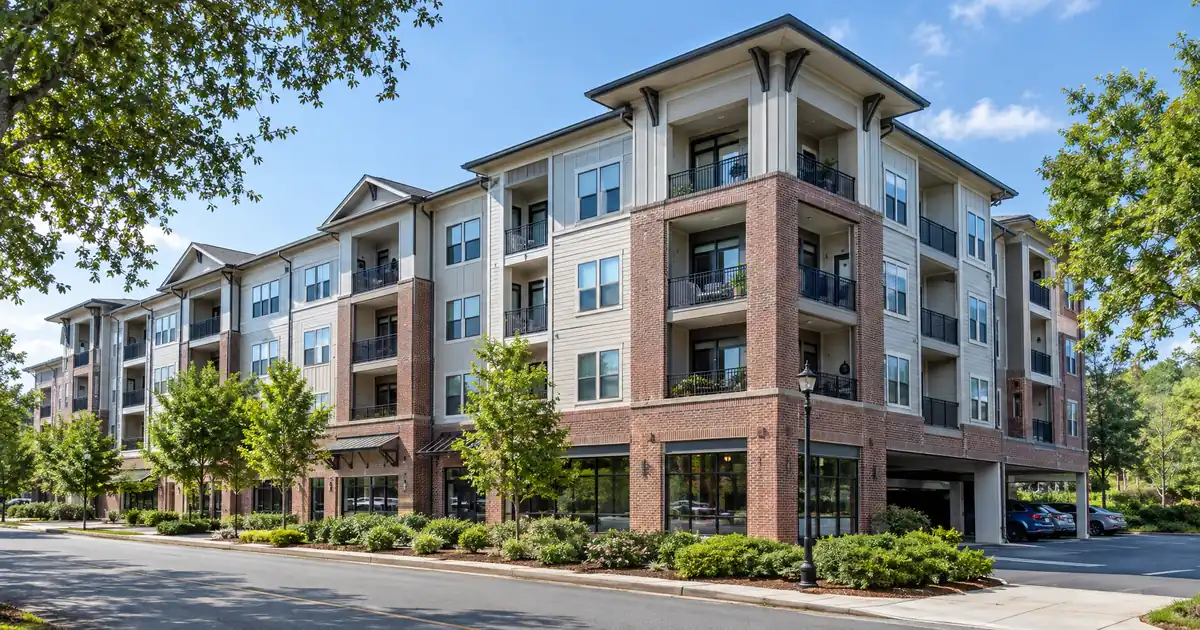
Picture an out-of-state investor scrolling Greensboro listings for the first time. The photos are lakefront docks and Craftsman porches. NeighborhoodScout puts the median home value at $503,423, and Zumper shows a median rent of $1,850. The investor sees healthy equity and decent rent and starts sketching a cash out refinance plan for an investment property in Greensboro, Georgia. What that investor misses is that the two numbers describe different housing. Lake-influenced values set the first, and in-town workforce houses set the second.
Lendmire (NMLS# 2371349) is a DSCR-focused mortgage broker. Greensboro, Georgia rental property investors can tap DSCR programs that Lendmire arranges, available across 41 markets, including Washington, D.C. This piece covers the equity-extraction side only: what you can pull out of a property you already own, and where this small county seat makes that harder than the headline numbers suggest.
DSCR Cash-Out Calculator
Run the cash-out numbers in Greensboro, GA
Rate source: Freddie Mac 30-yr average via FRED® — Federal Reserve Bank of St. Louis · effective Sep 24, 2026
Prefilled with starting assumptions — enter your property’s value, balance, taxes, and insurance for a more accurate picture.
Program parameters update from Lendmire’s centralized guideline source. Taxes and insurance are editable estimates.
As of Sep 24, 2026 · General Freddie Mac market benchmark, not a Lendmire loan offer. Property value, balance, taxes, and insurance are editable estimates. Maximum loan-to-value varies by lender, program, property type, and seasoning. Not a Loan Estimate, approval, or commitment to lend. Program availability and eligibility are subject to lender guidelines, credit approval, property review, and underwriting.
The Quick Read: Cash-out refinancing on a Greensboro, Georgia rental is underwritten primarily on the property’s rental income measured against its full monthly obligation. The local tension is plain: resort-influenced values sit far above the rents an in-town house can command, so coverage and appraisal comps decide how much equity is reachable.
- In-town 3BR Fair Market Rent is $1,159, far below lake-area asking rents.
- City median household income is $39,541 against a roughly $503K median value.
- Cash-out tops out at 75 percent LTV after about six months of seasoning.
- Duplex-through-fourplex stock is thin: five county multifamily listings in a month.
- I-20 Exit 130 and a 25-bed hospital sit inside city limits.
Greensboro Market Snapshot
A quick read on the Greensboro investor landscape — figures come from the cited sources below. Confirm current property-level numbers before underwriting.
| Metric | Detail |
|---|---|
| Employment | 501–1,000 employees (Indeed) |
| Vacancy | 3.7% rental (Wikipedia, Greensboro, Georgia) |
Why the Headline Numbers Mislead
Greensboro’s city population is about 3,648, and it sits roughly halfway between Atlanta and Augusta on I-20. The city limits run along SR 44 to take in Exit 130. That is a county seat with a real highway node, but it is still a town of a few thousand people.
Value data here is noisy. NeighborhoodScout’s $503,423 is the figure this article uses for the city. Other sources run higher because they measure the wider ZIP, which includes lake communities. Ownwell shows a $608,350 median for ZIP 30642, and Redfin’s ZIP median is $728K, down 17.1 percent year over year. That swing reflects a thin sample of luxury sales, not a clean trend. Redfin also shows homes going pending in around 114 days and selling about 5 percent under list. Not a frothy market.
Appreciation is the honest unknown. NeighborhoodScout describes long-run appreciation as above average, but no verified cumulative figure came through. For equity extraction that matters: the investor who bought a modest in-town house well below today’s values may have real room under the 75 percent cap. The investor who bought near the top of a lake-adjacent run may not.
What Does In-Town Rent Actually Support?
In-town workforce houses rent near HUD Fair Market Rent levels, not resort levels. Fair Market Rent for a 3BR in Greene County is $1,159, against $1,850 for the all-property median and the $3,500 that Homes.com shows for single-family homes skewed by lake inventory. Underwrite a workforce 3BR in the low-to-mid $1,100s to $1,300 range. Anything higher needs a real comp behind it.
Here is the modeled math, using assumptions rather than sourced market data. Coverage below is rent divided by full PITIA (taxes and insurance included), at 75 percent LTV and a 7.03 percent assumed note rate.
- Illustrative mixed-source ratio. Dividing the $1,850 median rent by the $503,423 median value gives about 0.37 percent a month. Those sources don’t describe the same house, but the gap is the point. Coverage on that combination lands around 0.6x including taxes and insurance.
- A modeled in-town house. Assume a $250,000 appraised value and $1,250 rent, which is 0.50 percent of value. Coverage comes out in the low 0.8s at 75 percent LTV.
- What clears 1.00. A property near the low $200Ks renting at the top of the FMR-adjacent band hovers right around 1.00. Anything pricier at those rents falls under it.
Most standard DSCR programs are built around a 1.00 benchmark, since rent covers the payment at that level. Below it, some lenders review sub-1.00 scenarios, but the file usually needs lower leverage, stronger credit and deeper reserves. An investor sitting at 0.83 might request a cash-out at a lower LTV, where coverage improves, or ask a lender to review an interest-only structure. Both paths are subject to lender guidelines, credit approval and property review.
Here’s the catch. Cash-out proceeds shrink for the same reason coverage does. The 75 percent ceiling is a cap, not a target, and in Greensboro the DSCR often sets the real limit well below it.
The Places That Pencil (and the Ones That Don’t)
No verified neighborhood-level rents or prices exist for Greensboro, so the ranking below is qualitative. It follows housing stock and tenant base, not invented per-submarket numbers.
Downtown and the historic core. This is the strongest candidate for a DSCR cash-out. About 22.84 percent of city housing predates the late 1930s, and older in-town stock carries the lowest basis in the market. Renters here skew toward county and school staff and other local workers. Robinson Park and the courthouse square give the area a stable anchor. The trade-off: older houses mean capex, and a lender may scrutinize condition. Budget for it before you refinance.
The Lake Oconee Parkway and Exit 130 corridor. Newer growth area, inside city limits. St. Mary’s Good Samaritan Hospital is a 25-bed critical access hospital with a 24-hour ER near the interchange, and medical residents rotate through on a regular basis per Lake Oconee Life. The hospital is small, so call it a steady but modest driver. Hospitality is bigger: Reynolds Lake Oconee is headquartered in Greensboro with 501 to 1,000 employees. Workers at that scale create real demand for moderately priced houses near the interstate.
Reynolds Lake Oconee and the waterfront communities. Skip them for cash flow. The resort community spans roughly 12,000 acres with six courses and four marinas, and the homes are priced for second-home owners. Rents at those prices can’t carry a cash-out. Waterfront homes with boat ramps are the same story.
Union Point and Madison. Union Point is about seven miles east on US-278, and Madison is about nineteen miles west. They are plausible lower-basis alternatives, but no data came through on either. Treat them as places to research, not places to assume.
Worth saying plainly: this market has no student-rental layer. The nearest university, UGA, is roughly 34 miles north, and Greensboro demand is a workforce story.
How the Cash-Out Mechanics Work Here
Seasoning is about six months of ownership, measured from title recording. After that, the ceiling is 75 percent LTV, the benchmark coverage is 1.00, and reserves typically run about six months of PITIA. Credit tiers start at a 620 floor and improve from there on most files. All of this is subject to lender guidelines, and “The Refi Options” guide notes that the details vary by borrower and property.
Working DSCR brokers see a recurring pattern in small resort-adjacent markets: the borrower anchors on a value that includes lake-influenced sales, then the file meets an in-town rent comp that tells a different story. The investors who get clean outcomes usually run the coverage math on the lease first and the appraisal second. Reversing that order is where files stall.
If you hold the property in an LLC, structure matters too. Entity-titled loans are available depending on program guidelines, and the guide “Where DSCR and Conventional Diverge” is worth a read if you’ve been limited by conventional financed-property caps.
One property-type note. Manufactured homes, log homes and barndominiums fall outside these DSCR programs. In a rural county, that rules out more inventory than an investor from a metro market might expect.
Appraisal Risk in a Thin-Comp Town
Expect a conservative appraisal. Greensboro has few in-town sales, and the nearest comps may be lake properties that don’t match your house. A lender may apply a lower LTV on thin-comp rural properties, and some lenders restrict them entirely. That’s an inference from the market’s structure, not a sourced rule, so confirm lender appetite before ordering anything.
Meanwhile the tenure mix is healthy. Roughly 40.03 percent of homes are renter-occupied and single-family detached homes are 65.67 percent of units, with three- and four-bedroom the most common sizes. That makes workforce single-family the most appraisable DSCR asset in town. Vacancy reads tight on the latest decennial count: a 3.7 percent rental vacancy rate inside the city. A county-level aggregator suggested a looser picture outside town, so have the appraiser confirm vacancy on your actual comps.
Multi-unit is the other wrinkle. Only five multifamily listings turned up countywide in a month. If you own a duplex or fourplex already, you hold something scarce. A single apartment listing shows asking rents of $866 for a 1BR, $971 for a 2BR and $1,102 for a 3BR per ApartmentFinder. That is one property, not a submarket average, but it suggests underwriting small units at roughly $900 to $1,100 each. Stacked units carry better coverage than a single house at the same basis.
Who Rents Here
Employment is diversified for a town this size. Data USA counts 389 resident workers in educational services, 349 in manufacturing and 212 in accommodation and food services, with employment up 3.31 percent in the latest year. The county also maintains an industrial park with rail access. Income is modest, though: poverty sits at 21.7 percent, and the city’s median age is 43.8. Rents stay tied to local wages, which is why the $1,850 figure deserves skepticism at the upper end. Zumper’s reported 31 percent rent drop is inventory noise, not a signal.
When the Answer Flips
The decision turns on a few situations.
- Low basis, older in-town house. Cash-out works. Coverage has room, and the proceeds can fund the next deal.
- Higher basis, in-town rent. Coverage falls short of 1.00. A lower LTV, a stronger credit profile or a sub-1.00 program review may apply, and the cash shrinks.
- A lake-adjacent asset. This is a genuine toss-up. The value may support the LTV, but the rent rarely supports the coverage. Test both before committing.
- A small multi-unit. The stronger play, if you already own one. The rent-per-dollar-of-basis math beats a single house, though exit liquidity is thin.
The proceeds themselves decide whether it’s worth it. A cash-out that trades cheap in-town equity for a debt load the rent can’t carry has just moved the problem. Refinancing options are broader than a single cash-out, and it is often smarter to compare structures first. Investors can compare DSCR options or call 828-256-2183 to talk through a specific file. Before any refinance, verify current local rental rules, taxes and insurance with qualified local professionals.
DSCR vs. conventional financing
There are two common ways to finance an investment property in Greensboro, GA, and they qualify you differently — here’s how investors weigh them.
Why investors choose it
- Qualifies on the property’s rental income — no personal tax returns, W-2s, or pay stubs needed to document income.
- No personal debt-to-income ceiling to clear, so existing mortgages and obligations don’t cap your borrowing the same way.
- Can be closed in an LLC, keeping the property inside a business entity.
- Built for scaling — not held to the limit on number of financed properties that conventional financing applies.
- Underwriting centers on the deal: generally qualifies when the rent covers the payment, a 1.00x coverage ratio being a common baseline (confirmed in underwriting).
- Designed specifically for investment property, including long-term and, where the program allows, short-term rentals.
Where it’s strong
- Often the lowest ongoing financing cost for a buyer who fully qualifies on personal income — a fit for a first property or a cost-first purchase.
Trade-offs for investors
- Requires full personal income documentation and must fit within a debt-to-income limit — salary, existing debts, and other mortgages all count.
- Typically held in your personal name rather than a business entity.
- Caps how many financed properties you can carry, which can become a ceiling as a portfolio grows.
- Evaluates you as a borrower as much as the property, which usually means more paperwork.
How investors usually choose: a first or single property often optimizes for the lowest financing cost; portfolio builders often optimize for leverage, vesting in an LLC, and scaling past conventional caps. The right answer depends on your goals, the property, and current guidelines — both paths run through select lenders in Lendmire’s wholesale network, with eligibility and terms confirmed in underwriting.
One Ratio Worth Remembering
Lendmire’s Georgia DSCR loan programs cover the state, but Greensboro is a rent-ceiling market, not a value-ceiling one. The figure that frames it best is the gap between the $1,159 a 3BR commands at Fair Market Rent and the $503,423 median value sitting over the same town. Close to a 0.6 percent monthly rent-to-value with full taxes and insurance is where coverage starts to clear 1.00 at 75 percent LTV, and most of Greensboro’s headline housing doesn’t get there.
Frequently Asked Questions
How do you qualify for a DSCR loan in Greensboro, Georgia?
Qualification centers on the property’s rent against its full PITIA, with 1.00 as the common baseline. Lenders also review credit (tiers start around a 620 floor), reserves of roughly six months and property condition. In Greensboro, the in-town rent level is usually the binding constraint, so run coverage on realistic lease figures first. Everything remains subject to lender guidelines. See the guide “What Is a DSCR Loan”.
What are the requirements for a cash-out refinance on an investment property in Greensboro, Georgia?
Typically about six months of ownership from title recording, a maximum of 75 percent LTV, coverage near 1.00 or better and roughly six months of reserves. Greensboro adds a practical step: a thin-comp appraisal. A conservative value can cut proceeds more than the LTV cap does.
Will lake-area sales help appraise an in-town rental?
Rarely, since lake and resort sales sit in a different price tier, and a careful appraiser will look for in-town comps first. When those are sparse, the value can come in lower than the ZIP-level medians suggest. Ask the lender about rural or thin-comp property policies before ordering an appraisal.
Is a duplex or fourplex easier to cash out in Greensboro than a single-family house?
Often, yes, on coverage, since several rent streams sit on one basis. The obstacle is supply and comps: multifamily stock is scarce here, so the appraiser may need to reach outside town. If you already own one, that scarcity is an asset.
What down-payment ranges may DSCR lenders review for Greensboro investment-property purchases?
Lendmire arranges DSCR investor loans. On most purchase files lenders review about 20 to 25 percent down, with cash-out refinances capped at 75 percent LTV. Final terms depend on the lender, the credit profile and the property.
For current guidelines and terms, see Lendmire’s DSCR loan programs page.
About Lendmire
Lendmire — NMLS# 2371349 — is a DSCR and non-QM mortgage brokerage with investor loan programs in 41 markets, including Washington, D.C. Lenders commonly review DSCR eligibility around property-level rent rather than personal income documentation, subject to lender guidelines, and the brokerage helps arrange financing for LLC-owned portfolios beyond conventional financed-property limits. Recognized by Scotsman Guide as a 2026 Scotsman Guide Top Workplace and a 2025 Scotsman Guide Top Mortgage Workplace.
Get Started
Ready to find the right loan for you?
In about 30 seconds you can review financing options available for your investment property. No commitment required.
Informational only. Not a Loan Estimate, approval, or commitment to lend. Program availability and eligibility are subject to lender guidelines, credit approval, property review, and underwriting.
References
2. Zumper
3. $1,159
4. $39,541
5. Redfin — Greene County Cheap Homes
7. Wikipedia — Greensboro, Georgia
8. City of Greensboro, Georgia
9. $608,350 median for ZIP 30642
10. Redfin ZIP 30642
11. Homes.com
12. St. Mary’s Good Samaritan Hospital
13. Lake Oconee Life
14. ApartmentFinder
15. Data USA
16. a 2026 Scotsman Guide Top Workplace
17. a 2025 Scotsman Guide Top Mortgage Workplace
This article is part of Lendmire’s investment property cash-out refinance program — full qualification details, guidelines, and scenarios live on the program page.
Guides: Investment Property Cash-Out Refinance in Georgia
Brandon Miller
Founder & CEO, Mortgage Loan Originator, Lendmire LLC
- Mortgage Loan Originator · NMLS# 1129696 · Verify on NMLS Consumer Access
- North Carolina Real Estate Broker · License# 343312 · Verify on NCREC
- North Carolina Insurance Producer · License# 19053198 · Property, Casualty, Life, Health · Verify on NAIC SBS
- Lendmire LLC · Firm NMLS# 2371349 · Verify firm licensure
Required disclosures. Lendmire (NMLS# 2371349) operates as a licensed mortgage broker, not a direct lender or depository. The discussion in this article is general in nature and should not be relied upon as financial, legal, or tax advice — every investment scenario is unique and should be reviewed by a qualified professional. Any loan inquiry is subject to lender underwriting, and this article is not a commitment to lend or a guarantee of approval. Mortgage rates, loan terms, and program guidelines vary by borrower, property, and state, and may change without notice. Equal Housing Opportunity. Verify licensure at NMLS Consumer Access.