
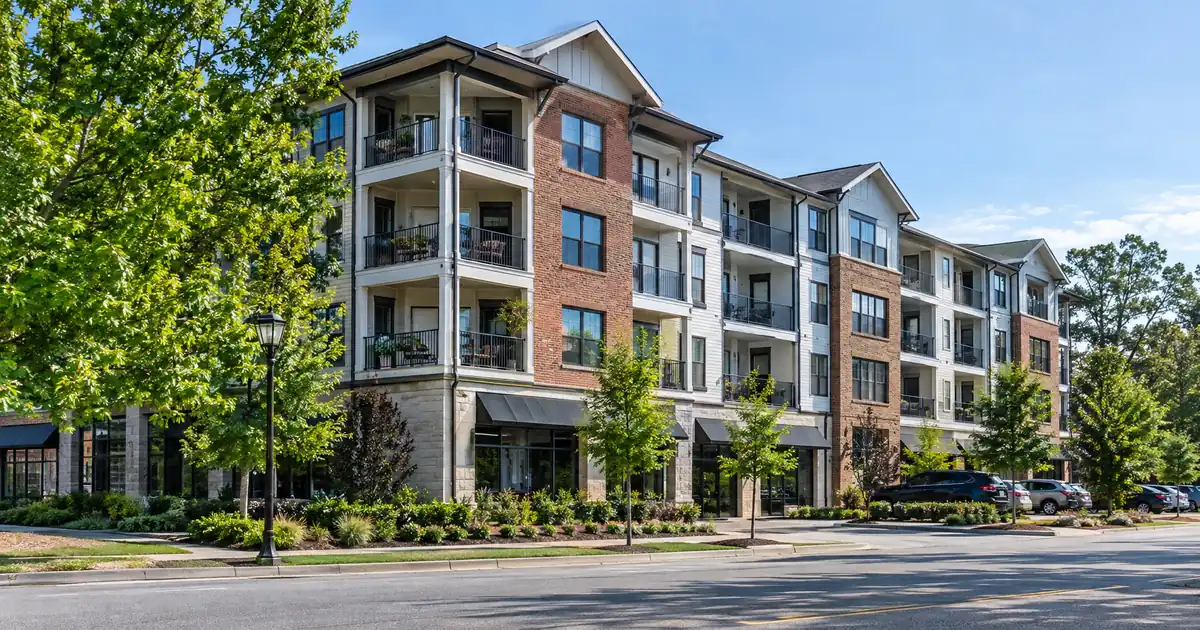
An out-of-state investor scrolling Greensboro listings sees a county-seat town on I-20 with a Ritz-Carlton next door and a median home value near $503,423. Then the rent data shows up: Zumper puts the median at $1,850. What that investor misses is that the value and the rent are describing two different markets. Lake Oconee resort money sets the first number. In-town workforce housing sets the second.
That gap decides everything about pulling equity out of a Greensboro rental. Greensboro, Georgia rental property investors can tap DSCR programs that Lendmire arranges, available across 41 markets, including Washington, D.C. Lendmire (NMLS# 2371349) is a DSCR-focused mortgage broker, and qualification runs through the property’s rent rather than personal income, subject to lender guidelines. Here is how the cash-out math works in a town of about 3,600 people where the numbers don’t line up neatly.
DSCR Cash-Out Calculator
Run the cash-out numbers in Greensboro, GA
Rate source: Freddie Mac 30-yr average via FRED® — Federal Reserve Bank of St. Louis · effective Sep 24, 2026
Prefilled with starting assumptions — enter your property’s value, balance, taxes, and insurance for a more accurate picture.
Program parameters update from Lendmire’s centralized guideline source. Taxes and insurance are editable estimates.
As of Sep 24, 2026 · General Freddie Mac market benchmark, not a Lendmire loan offer. Property value, balance, taxes, and insurance are editable estimates. Maximum loan-to-value varies by lender, program, property type, and seasoning. Not a Loan Estimate, approval, or commitment to lend. Program availability and eligibility are subject to lender guidelines, credit approval, property review, and underwriting.
The Quick Read: A cash-out refinance in Greensboro, Georgia is underwritten on the rent a property can support against its full monthly obligation, so the wide gap between resort-driven values and workforce-level rents, more than the equity itself, decides how much a lender will review for proceeds.
- HUD Fair Market Rent for a three-bedroom in Greene County is $1,159.
- Median city home value of $503,423 against $1,850 median rent leaves thin coverage.
- Cash-out is capped at 75 percent LTV after about 6 months of ownership.
- Roughly 22.84 percent of city housing predates 1939, and that older stock carries the lowest basis.
- Reynolds Lake Oconee is luxury-priced and rarely works for rental coverage.
Greensboro Market Snapshot
A quick read on the Greensboro investor landscape — figures come from the cited sources below. Confirm current property-level numbers before underwriting.
| Metric | Detail |
|---|---|
| Employment | 501–1,000 employees (Indeed) |
| Vacancy | 3.7% rental (Wikipedia, Greensboro, Georgia) |
Two Markets Sharing One ZIP Code
Greensboro’s headline values describe lake-country real estate, while its rents describe a small-town workforce. The City of Greensboro reports a census population of 3,648, and Census Reporter shows a median household income of $39,541 in the city against $86,272 for Greene County. Home values sit at roughly $500,000 to $730,000, depending on whether you trust NeighborhoodScout, Ownwell ($608,350) or Redfin’s ZIP-level $728K, which is down 17.1 percent year over year on a thin luxury sample.
Don’t lean on any one of those numbers. Sources conflict, the samples are small, and a handful of lake sales can swing a ZIP median by double digits. Treat the value data as a range, and treat the rent data with the same suspicion. Homes.com shows a $3,800 median across only 19 listings, mostly lake-area houses. Zumper’s $1,850 comes with a warning about limited inventory, and its 31 percent year-over-year rent drop is noise.
A more useful anchor is the HUD Fair Market Rent table for Greene County, which Affordable Housing Hub summarizes at $911 for a two-bedroom and $1,159 for a three-bedroom. That is the realistic benchmark for an in-town workforce house, and it sits far below the resort band. Underwrite to that, not to the headline medians.
How the Cash-Out Math Runs
Cash-out proceeds in Greensboro are set by the lowest of three constraints: the 75 percent LTV ceiling, the 1.00 minimum DSCR, and the appraised value. Rent against the full monthly obligation, including taxes and insurance, is usually what binds first.
The program basics are simple. Lenders in the network typically want about 6 months of ownership measured from title recording. Cash-out tops out at 75 percent LTV, and the 80 percent purchase figure does not carry over. Coverage is measured as monthly rent divided by principal, interest, taxes and insurance, with a 1.00x baseline common on standard programs. Credit tiers start around a 620 floor, and reserves typically run about six months of the monthly obligation. All of it is subject to lender guidelines, credit review and property review. For the mechanics in more depth, see the guide “What Is a DSCR Loan”, and for the refinance sequence, see the guide “The Refi Options”.
Now run the numbers, using modeled assumptions rather than market data. Say you own an in-town three-bedroom valued at $200,000, renting for $1,250. That figure is a modeled rent near the top of the local workforce band, not a sourced comp. At 75 percent LTV, including taxes and insurance, coverage lands right around 1.0x, and rounding down is the safe read. It could easily print slightly under. At 60 percent LTV the same house moves into roughly 1.2x territory, but the cash-out shrinks accordingly.
Now the lake-priced version. Take a home valued at the $503,423 city median with the $1,850 median rent. Including taxes and insurance at 75 percent LTV, coverage comes out around 0.6x. No amount of creative structuring turns that into a clean file.
When a property prints below 1.00x, a few paths exist that a lender may review: a sub-1.00 program, an interest-only structure, or a lower leverage tier. Each usually comes with stronger credit, more reserves or a more conservative loan amount. Whether any of them fits depends on lender guidelines, credit approval and the property itself. In Greensboro, sub-1.00 is common enough at market values that it should be planned for, not treated as an edge case.
Here is the tension in this market: appreciation and cash flow point in opposite directions. Value data trends upward on lake demand, but in-town rents are capped by local wages. Equity can be abundant while coverage is thin, and coverage is what gets a cash-out file through.
Downtown and the In-Town Stock
The historic core is where the cash-out math is most likely to work. Downtown Greensboro has shaded sidewalks, antique shops, Robinson Park and Festival Hall, according to Greene County School System community resources. The housing is older, with about 22.84 percent built before 1939 and single-family detached homes making up 65.67 percent of units. Three- and four-bedroom homes are the most common sizes.
That profile suits a lower-basis DSCR hold. Demand comes from local workforce households, county government and hospital staff, and long-term tenants. Renters are about 40 percent of households, so there is a real tenant base. The 1,516 housing units and 3.7 percent rental vacancy in the last decennial census, as Wikipedia summarizes it, support stable occupancy in town, though that is a dated snapshot.
The catch is thin comps. In a town this small, an appraiser working a cash-out on an in-town house may have to reach for comparable sales, and that can produce a conservative value. This is inference rather than sourced data, but it matches how rural and thin-comp files tend to behave.
Working DSCR brokers see a recurring pattern in small-town markets shaped by a nearby resort economy: the equity looks large on paper, but the appraisal and the workforce-level rent decide the actual proceeds. Files that pencil are usually older, lower-basis houses held for a while, with the borrower accepting a lower LTV for cleaner coverage. Files that struggle are usually lake-adjacent houses where value is high and rent is not.
The Exit 130 Corridor
Greensboro’s city limits run along SR 44 to include I-20 Exit 130, and the corridor is the newer growth node. St. Mary’s Good Samaritan Hospital, a 25-bed critical access hospital with a 24-hour ER, is here on Lake Oconee Parkway. Lake Oconee Life reports that it hosts rotating medical residents. That gives the corridor steady healthcare demand and occasional interest in 12-month leases from rotating professionals.
Be realistic about scale, though. A 25-bed hospital is a modest employer, and no verified headcount exists. Moderately priced homes here can make the coverage math work better than the lake side, but there is no verified submarket rent or price data. Treat it as a candidate to test, not a proven winner. If an investor already holds a rental near the corridor, six months of seasoning plus a modest cash-out could work.
Skip Reynolds Lake Oconee for Coverage
Reynolds Lake Oconee is headquartered in Greensboro. It is a private resort of about 12,000 acres with six golf courses and four marinas, and Indeed lists it at 501 to 1,000 employees. It matters to the local economy. It does not matter to your DSCR file.
The homes inside are luxury-priced and mostly second-home owned. Waterfront and lake-access communities elsewhere in the city follow the same logic: owner-occupant and vacation product, high basis, thin rental coverage. If you own one, a cash-out is likely a low-leverage, strong-compensating-factors conversation rather than a standard one. If you’re shopping, skip it for long-term rental cash flow. The equity story there is real, but the coverage story isn’t.
Who Actually Rents Here
Demand tracks jobs. Data USA shows resident employment concentrated in educational services (389 workers), manufacturing (349) and accommodation and food services (212), with employment up 3.31 percent year over year. Add the resort, county government, the hospital and light industry, and you get a workforce renter pool that pays workforce rents.
No college is in town. The University of Georgia in Athens is roughly 34 miles north, so student demand is not a local driver, and any DSCR model that assumes it is wrong.
Multi-unit stock is scarce. Redfin showed only five multifamily listings in the county in a recent month. One in-town apartment community lists asking rents of $866 for a one-bedroom, $971 for a two-bedroom and $1,102 for a three-bedroom. That is a single property, not a submarket average, but it suggests underwriting small-unit income at roughly $900 to $1,100 per door. Duplex through fourplex stacking can help coverage, but finding one is the hard part.
When the Answer Flips
This one is a genuine toss-up for many owners. If the property is a low-basis in-town house held for years, cash-out can work cleanly, and the proceeds become a down payment on the next deal. If the property is a lake-area house bought at a high basis, the same refinance may produce little or nothing under standard coverage rules.
A few situations flip the call:
- Rent over the FMR band. If a house genuinely leases above workforce levels, coverage improves quickly. Confirm with actual lease comps rather than portal medians.
- Very recent purchase. If you closed less than about six months ago, seasoning is the constraint, not coverage.
- Reinvesting out of town. Some investors pull equity from a Greensboro property and deploy it in a deeper-rent market. That works if coverage on the Greensboro file clears first. Otherwise you’re rebuilding the plan.
- Vacancy data disagrees. The city’s rental vacancy was low at the last census, while some county-level aggregators show much higher figures without clear sourcing. Have the appraiser confirm vacancy on the actual comps rather than picking a side.
Investors should verify current local rental rules, taxes and insurance with qualified local professionals. To see where a specific property lands, use compare DSCR options or call 828-256-2183. Investors comparing conventional and DSCR paths can start with the guide “Where DSCR and Conventional Diverge”. More on the state’s programs sits with Lendmire’s Georgia DSCR loan programs.
Frequently Asked Questions
How do you qualify for a DSCR cash-out refinance in Greensboro, Georgia?
Qualification centers on the property’s rent versus its full monthly obligation, including taxes and insurance. Typical guidance includes about 6 months of ownership, a 1.00x baseline coverage, a credit floor near 620 and reserves around six months. Cash-out is capped at 75 percent LTV. Final eligibility depends on lender guidelines, credit review and the appraisal.
DSCR vs. conventional financing
Two common ways to finance an investment property in Greensboro, GA. They qualify you differently — here’s how investors weigh them.
Why investors choose it
- Qualifies on the property’s rental income — no personal tax returns, W-2s, or pay stubs needed to document income.
- No personal debt-to-income ceiling to clear, so existing mortgages and obligations don’t cap your borrowing the same way.
- Can be closed in an LLC, keeping the property inside a business entity.
- Built for scaling — not held to the limit on number of financed properties that conventional financing applies.
- Underwriting centers on the deal: generally qualifies when the rent covers the payment, a 1.00x coverage ratio being a common baseline (confirmed in underwriting).
- Designed specifically for investment property, including long-term and, where the program allows, short-term rentals.
Where it’s strong
- Often the lowest ongoing financing cost for a buyer who fully qualifies on personal income — a fit for a first property or a cost-first purchase.
Trade-offs for investors
- Requires full personal income documentation and must fit within a debt-to-income limit — salary, existing debts, and other mortgages all count.
- Typically held in your personal name rather than a business entity.
- Caps how many financed properties you can carry, which can become a ceiling as a portfolio grows.
- Evaluates you as a borrower as much as the property, which usually means more paperwork.
How investors usually choose: a first or single property often optimizes for the lowest financing cost; portfolio builders often optimize for leverage, vesting in an LLC, and scaling past conventional caps. The right answer depends on your goals, the property, and current guidelines — both paths run through select lenders in Lendmire’s wholesale network, with eligibility and terms confirmed in underwriting.
What are the requirements for an investment property loan in Greensboro, GA?
Expect a property review, an appraisal, proof of rent through a lease or market rent estimate, reserves and a credit profile that fits the tier. Thin comps in a town of about 3,600 people can lead lenders to apply conservative leverage. Manufactured homes, log homes and barndominiums fall outside these programs.
Why does a Greensboro cash-out often produce less than the equity suggests?
Equity is calculated from value, but proceeds are limited by coverage. If a house is valued like lake real estate but rents at workforce levels near the $1,159 three-bedroom Fair Market Rent, the ratio can fall below 1.00x. Lower leverage or a sub-1.00 program may be reviewed, but proceeds shrink either way.
Can a Reynolds Lake Oconee or waterfront home qualify for DSCR cash-out?
It can be reviewed, but coverage is usually thin because the basis is high and the rent ceiling is not. Modeled at the city median value and median rent, coverage lands around 0.6x including taxes and insurance. These properties tend to suit owners with strong compensating factors and a willingness to accept lower leverage.
What down-payment ranges may DSCR lenders review for Greensboro investment-property purchases?
Purchase files typically review about 20 to 25 percent down, with the exact figure depending on credit, coverage and property type. Lendmire arranges DSCR investor loans, and standard programs can reach loan amounts up to $3,000,000. Terms are subject to lender guidelines.
One Last Number
Greensboro’s median household income is $39,541, and its median home value is $503,423, which is the whole DSCR problem in one pairing.
For current guidelines and terms, see Lendmire’s DSCR loan programs page.
About Lendmire
Lendmire — NMLS# 2371349 — is a DSCR and non-QM mortgage brokerage with investor loan programs in 41 markets, including Washington, D.C. DSCR eligibility is commonly reviewed by the lender on property-level rent rather than personal income documentation, subject to lender guidelines, and the brokerage helps arrange financing for LLC-owned portfolios beyond conventional financed-property limits. Recognized by Scotsman Guide as a Top Mortgage Workplace in 2025 and 2026.
Get Started
Ready to find the right loan for you?
In about 30 seconds you can review financing options available for your investment property. No commitment required.
Informational only. Not a Loan Estimate, approval, or commitment to lend. Program availability and eligibility are subject to lender guidelines, credit approval, property review, and underwriting.
References
2. Zumper
4. Indeed
5. Wikipedia
6. City of Greensboro, Georgia
7. Ownwell
8. Redfin’s
9. Homes.com
10. Greene County School System
11. St. Mary’s Good Samaritan Hospital
12. Lake Oconee Life
14. Data USA
15. ApartmentFinder — Georgia Greene County Apartments
16. a 2026 Scotsman Guide Top Workplace
17. a 2025 Scotsman Guide Top Mortgage Workplace
This article is part of Lendmire’s investment property cash-out refinance program — full qualification details, guidelines, and scenarios live on the program page.
Related reading: Cash Out Refinance Investment Property Greensboro Georgia · DSCR Cash Out Refinance Waycross Georgia
Guides: Investment Property Cash-Out Refinance in Georgia
Brandon Miller
Founder & CEO, Mortgage Loan Originator, Lendmire LLC
- Mortgage Loan Originator · NMLS# 1129696 · Verify on NMLS Consumer Access
- North Carolina Real Estate Broker · License# 343312 · Verify on NCREC
- North Carolina Insurance Producer · License# 19053198 · Property, Casualty, Life, Health · Verify on NAIC SBS
- Lendmire LLC · Firm NMLS# 2371349 · Verify firm licensure
Important disclosures. Lendmire (NMLS# 2371349) is a licensed mortgage brokerage. Lendmire is not a direct lender, depository institution, or financial advisor. All loan inquiries are subject to lender underwriting; this article does not constitute a commitment to lend. Rates, terms, and program guidelines are subject to change without notice and vary by borrower profile, property type, and state. Information in this article is general in nature and is not financial, legal, or tax advice. Equal Housing Opportunity. NMLS Consumer Access: nmlsconsumeraccess.org.