
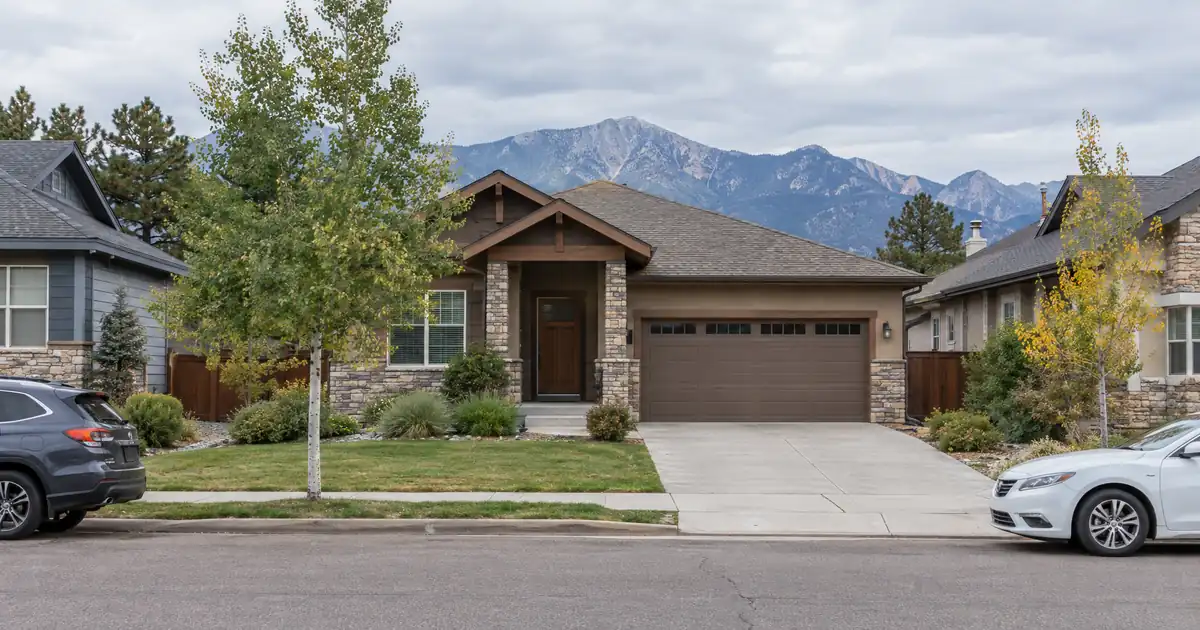
Most Colorado Springs investors assume the equity is larger than it is and the rent is higher than it is. Both assumptions fail at the coverage test. Zillow puts the average home value at $450,850, down 2.0 percent over the past year, while Rental Beast reports single-family rents at $2,145. Those two numbers decide how much cash a 75 percent loan-to-value ceiling can actually release.
TL;DR: A DSCR cash-out refinance in Colorado Springs, Colorado is underwritten primarily on the property’s rental income measured against its full monthly obligation. The investor’s owned equity is tested against a 75 percent LTV ceiling and a seasoning requirement, and the rent has to cover the new, larger debt.
DSCR Cash-Out Calculator
Run the cash-out numbers in Colorado Springs, CO
Rate source: Freddie Mac 30-yr average via FRED® — Federal Reserve Bank of St. Louis · effective Sep 24, 2026
Prefilled with starting assumptions — enter your property’s value, balance, taxes, and insurance for a more accurate picture.
Program parameters update from Lendmire’s centralized guideline source. Taxes and insurance are editable estimates.
As of Sep 24, 2026 · General Freddie Mac market benchmark, not a Lendmire loan offer. Property value, balance, taxes, and insurance are editable estimates. Maximum loan-to-value varies by lender, program, property type, and seasoning. Not a Loan Estimate, approval, or commitment to lend. Program availability and eligibility are subject to lender guidelines, credit approval, property review, and underwriting.
- Single-family rent runs roughly 0.43 percent of price per month per Rental Beast.
- Full-PITIA coverage on maximum-leverage single-family cash-outs models below 1.00x.
- Southeast and Fountain-area pricing gives the best rent-to-value math in the sources.
- Fort Carson, Peterson and the Air Force Academy anchor tenant demand.
- Space Command’s departure is a headline risk, not a collapse scenario.
Lendmire (NMLS# 2371349) places DSCR investor financing for Colorado Springs, Colorado through non-QM wholesale channels that cover 41 markets, including Washington, D.C. Its role here is narrow. The brokerage structures the request and routes it to a lender, and the lender reviews eligibility and decides. What follows is the analysis an owner should run before asking.
Colorado Springs Market Snapshot
A quick read on the Colorado Springs investor landscape — figures come from the cited sources below. Confirm current property-level numbers before underwriting.
| Metric | Detail |
|---|---|
| Typical rents | $1,950 average (Zillow Rental Manager) |
| Cap rates | 5–7% (Strategic Property Advisors) |
| University enrollment | 12,000+ students (UCCS transfer page) |
| Vacancy | 7.6% to 7% (Colorado Springs Gazette) |
The Equity Is Thinner Than the Headline
Start with the price. Sources disagree, and the disagreement matters. Zillow’s $450,850 is an average home value. The Colorado Springs Gazette cites a record local median of $500,000 from the Pikes Peak Association of Realtors, with the January figure just shy of $470,000. Those are different measures (average value versus median sale price), and this article uses Zillow’s figure as the citywide reference. Anyone quoting the $500,000 number to a lender should expect an appraiser to work from comparable closed sales, not a headline.
Appreciation is the real constraint. The Gazette dates the cooling-off period to 2023, and a statistics page from Great Colorado Homes describes prices as mostly flat for more than four years. An owner who bought before the cooling has the equity. An owner who bought near the peak has mostly amortization. Cash-out DSCR underwriting doesn’t care which story produced the balance. It cares about the appraised value and the rent.
The program mechanics are straightforward. The ceiling is 75 percent LTV on a cash-out, not the 80 percent that applies to purchases. Seasoning is about six months of ownership measured from title recording. Reserves typically run about six months of PITIA, rising to about nine months above $1,500,000. Credit tiers generally run 620, 660, 680 and 700, with 620 as the floor. Standard programs go up to $3,000,000. All of it is subject to lender guidelines, borrower profile and property review.
Available proceeds are the residue after all of that. Appraised value times 75 percent, less the existing payoff, less reserves, and only if the rent clears the coverage test on the new balance. The third condition is the binding one in this city.
Where Rent Meets the Coverage Test
Single-family coverage is the weak link in Colorado Springs, and the source data makes the case plainly. Rental Beast’s single-family rent of $2,145 works out to about 0.43 percent of a $500,000 price per month, or about 0.48 percent against Zillow’s $450,850. The 1 percent rule isn’t close. (It hasn’t been close in this market for a while.)
Rent figures vary by methodology, and each needs its own attribution. Apartment List shows a median rent of $1,347, down 2.5 percent year over year. RentCafe shows an average apartment rent of $1,531, down 0.53 percent, with three-bedrooms averaging $2,062. Zillow’s rental data puts the all-property average at $1,950 and tags the market “cool.” Rental Beast reports that rents turned positive quarter over quarter across property types and that concessions fell below year-ago levels. Flat to slightly soft, then, with a tentative stabilization.
Run the numbers on a modeled case. These are assumptions, not market data: a $450,000 single-family rental at the citywide median single-family rent of $2,145, refinanced at the 75 percent ceiling, with a 30-year amortization and taxes and insurance included in PITIA. Coverage lands in the low 0.8x range. Drop leverage to roughly 60 percent and the same property approaches 1.0x. The owner gives up proceeds to buy coverage.
Where an owner lands below 1.00x, the paths are known. A sub-1.00 program may exist with lower leverage, stronger credit or larger reserves. An interest-only structure changes the monthly obligation being tested. The simplest path is accepting a lower loan amount. Each of these is something a lender would review on its merits, and none is a promise. The standard benchmark is 1.00x because rent covers the obligation at that level. Some lenders will look below it, typically with compensating factors and different pricing. The guide “What Is a DSCR Loan” is worth a read before modeling your own file.
Duplexes Fix What Single-Family Breaks
No reliable local pricing exists for duplexes, triplexes or fourplexes in the research. No median, no rent band. So this section stays qualitative, and any specific multi-unit figure an investor sees quoted should be treated as a listing claim until comps say otherwise.
The logic still holds. A single-family house carries one rent against one price. A fourplex carries four. The rent-to-price ratio on small multifamily usually runs higher than on detached homes at these price points, which is the standard way DSCR investors pull coverage back toward 1.0x. Whether that applies to a given Colorado Springs building depends on the comps, the unit mix and the condition.
Supply gives a modest tailwind. The Gazette reports roughly 1,350 new apartment units expected in the coming delivery year and 1,700 the year after, which is a light pipeline for a metro this size. Apartment vacancy, per 1876 Analytics via the Gazette, fell from 7.6 percent to 7 percent, with average rents easing from $1,420 to $1,410. That covers apartments only. No current single-family or small-multifamily vacancy source turned up, and it would be wrong to fill the gap with guesses.
DSCR files in markets like this one typically look a certain way. The value is fine, the rent is fine, and the ratio is the problem. The files that move forward tend to be the ones where the owner has already decided which variable to give up (proceeds, leverage or property mix) before the appraisal comes back, not after. Owners who model two or three leverage levels up front usually spend less time re-cutting the request later.
Neighborhood Rent-to-Value, Ranked by What Pencils
Neighborhood data here comes from broker blogs and aggregators. It is directional, and so is everything below. Where sources conflict, the conflict is stated.
East and southeast: Powers Corridor and Cimarron Hills. Strategic Property Advisors cites a Powers median of $439,900 to $457,000 and three-bedroom leases of $2,200 to $2,600, with broker-estimated cap rates of 5 to 7 percent. Model it at a value near the middle of that price range and a rent near the middle of that lease range, and coverage at the 75 percent ceiling sits around 0.9x including taxes and insurance. Near 65 percent leverage it reaches roughly 1.0x. Tenant demand is tied to the Peterson employment base. Cimarron Hills is described by the same source as among the most affordable and yield-driven submarkets, though no reliable price turned up.
Southeast, Fountain and Security-Widefield. Evernest lists Southeast homes at a median list price of $349K. Pair that with the citywide three-bedroom median rent of $2,095 and modeled coverage at 75 percent leverage lands right around 1.0x, slightly above on favorable appraisals. It’s the cleanest math in the set. A Fountain-area yield claim of 7 to 8 percent from a broker blog is too thin to rely on, and another aggregator’s $187,543 figure for the same area conflicts with everything else, so it gets no weight. Both the lower price and the lower appraisal ceiling cut the same way: less equity per property, but a ratio that can actually clear.
Briargate and Northgate. These are the premium submarkets with the thinnest yields. NeighborhoodScout shows a Briargate Southeast median of $488,259 and average rent of $2,865, which models to roughly 1.0x at the 75 percent ceiling. The Locale Group cites a much lower $385,175 median and broker cap rates of 4 to 5 percent, with Northgate at $460,925 and the same cap range. The price conflict is large enough that appraisal, not a blog, settles which one applies. Stronger tenant profile, more appreciation history, less cash flow.
Downtown. Evernest’s median list price is $425K. Demand skews toward young professionals. It sits between the two groups on price and offers no sourced rent figure worth modeling.
The stronger play for a cash-out is probably the south and southeast, where the ratio clears without heavy leverage give-backs. Owners in Briargate have the better asset and the harder refinance. That is a genuine toss-up for anyone whose goal is appreciation over monthly cash flow.
The Tenant Base Is Federal (and One Headquarters Is Leaving)
Colorado Springs demand rests on installations. Per the Gazette’s base-employment tally, Fort Carson employs 32,410 active-duty, reserve, civilian and contractor personnel. Space Operations Command at Peterson accounts for 15,000, and the Air Force Academy employs 10,482. The city’s population is 494,743 per Data Commons, with a median age of 35.7 and unemployment at 4.2 percent. RentCafe counts 79,251 renter-occupied households, about 39 percent of the total. The Colorado Springs Chamber & EDC cites a defense and aerospace workforce above 100,000, though the page is dated and the figure is best read as scale.
The risk is the same fact. Demand is concentrated in one sector. CPR News reports that Space Command is leaving for Huntsville and will likely not grow beyond its current 1,500 employees. Military Times notes Colorado has sued over the move, and WHNT reports operational status in Huntsville not arriving until 2031. So the phase-out is gradual.
The offsetting data is specific. The Gazette reports that Peterson and Cheyenne Mountain employ about 8,200 people and carry a $2.6 billion economic impact, and that the Space Force plans to expand locally despite the headquarters loss. AFCEA Signal Media reports a relocating acquisition office worth roughly $4 billion with about 2,500 civilian jobs, and a rise in junior officers at Peterson from about 600 to 1,800 next year. Whether that converts to rental demand, and when, is unconfirmed. The east side near Peterson is the obvious beneficiary if it does. Note that the 8,200 and 15,000 figures cover different scopes and shouldn’t be compared directly.
On the rent side, a housing allowance for an E-5 with dependents in the Colorado Springs area is $2,358 per month per MilPayTools, corroborated by Garrison Ledger. It exceeds the $2,145 median single-family rent. That supports a rent assumption near the bases and gives tenants room to absorb increases. A military community guide claims off-post households keep $100 to $400 a month of allowance after rent in the south-side neighborhoods. That is directional, not a survey. The allowance is identical across the area, so the cheaper south side gets the best ratio of rent to value.
Stress-test the demand concentration. A lender reviewing a cash-out will see the same concentration. The prudent underwrite assumes rents hold flat, not that they climb.
What the Proceeds Are For
Cash-out proceeds only make sense if the next asset covers itself. Pulling equity from a 0.85x coverage property to buy another 0.85x property compounds the problem. The better sequence pulls at modest leverage from a property that clears 1.0x, then deploys into a south-side single-family or a small multifamily where coverage is stronger.
Owners of one or two properties should compare refi programs against the economics of holding the existing loan, and read the cash-out refinance walkthrough before committing. The program-to-program comparison covers where DSCR fits against conventional investment financing. For entity-titled rentals, LLC vesting is reviewed subject to lender program eligibility. DSCR loan options for Colorado investors lay out the state-level program picture.
Verify current local rental rules, taxes and insurance with qualified local professionals before sizing any refinance. That covers the ground this article deliberately doesn’t.
Frequently Asked Questions
How do you qualify for a DSCR loan in Colorado Springs?
Qualification rests mainly on the property’s rent measured against its full PITIA, with 1.00x as the common benchmark. A lender also reviews credit, reserves, property type and appraised value. On a cash-out, the 75 percent LTV ceiling and about six months of seasoning apply, all subject to lender guidelines.
What are the requirements for an investment property loan in Colorado Springs, Colorado?
Typical requirements include credit in the 620-and-up range, reserves around six months of PITIA and eligible property types. Manufactured homes, log homes and barndominiums fall outside these DSCR programs. Loan amounts generally go up to $3,000,000 on standard programs.
DSCR vs. conventional financing
Two common ways to finance an investment property in Colorado Springs, CO. They qualify you differently — here’s how investors weigh them.
Why investors choose it
- Qualifies on the property’s rental income — no personal tax returns, W-2s, or pay stubs needed to document income.
- No personal debt-to-income ceiling to clear, so existing mortgages and obligations don’t cap your borrowing the same way.
- Can be closed in an LLC, keeping the property inside a business entity.
- Built for scaling — not held to the limit on number of financed properties that conventional financing applies.
- Underwriting centers on the deal: generally qualifies when the rent covers the payment, a 1.00x coverage ratio being a common baseline (confirmed in underwriting).
- Designed specifically for investment property, including long-term and, where the program allows, short-term rentals.
Where it’s strong
- Often the lowest ongoing financing cost for a buyer who fully qualifies on personal income — a fit for a first property or a cost-first purchase.
Trade-offs for investors
- Requires full personal income documentation and must fit within a debt-to-income limit — salary, existing debts, and other mortgages all count.
- Typically held in your personal name rather than a business entity.
- Caps how many financed properties you can carry, which can become a ceiling as a portfolio grows.
- Evaluates you as a borrower as much as the property, which usually means more paperwork.
How investors usually choose: a first or single property often optimizes for the lowest financing cost; portfolio builders often optimize for leverage, vesting in an LLC, and scaling past conventional caps. The right answer depends on your goals, the property, and current guidelines — both paths run through select lenders in Lendmire’s wholesale network, with eligibility and terms confirmed in underwriting.
What credit score ranges may DSCR lenders review for a Colorado Springs rental property?
Lenders typically review tiers at 620, 660, 680 and 700, with 620 as the floor and better tiers generally supporting higher leverage.
Does the Space Command move change how a cash-out on a Colorado Springs rental gets reviewed?
Not directly. Appraisers work from comparable sales and rents, and the headquarters accounts for roughly 1,500 of the area’s federal jobs. Prudent underwriting still assumes flat rents given the concentration in defense employment.
Which Colorado Springs submarkets give a cash-out the best chance of clearing 1.00x?
The southeast and Fountain-area submarkets model best because entry prices near $349K sit against citywide rents above $2,000. Powers sits near 0.9x at the 75 percent ceiling and clears 1.0x with lower leverage. Briargate models near 1.0x on aggregator figures, though its sources conflict.
The Next Move
The math in this market doesn’t reward optimism. It rewards an owner who has already priced the ratio at several leverage levels, chosen the submarket where the ratio clears, and accepted that proceeds are whatever the rent supports. So which property in your portfolio clears 1.0x on its own, and is that the one you’d pull equity from?
For current guidelines and terms, see Lendmire’s DSCR loan programs page.
About Lendmire
Lendmire, NMLS# 2371349, is a mortgage brokerage focused on investor financing, arranging DSCR loans in 40 states plus Washington, D.C. (41 markets total). Qualification is based on the property’s income rather than personal income documentation, subject to lender guidelines, which suits LLC-held rentals and growing portfolios. The firm has been recognized as a top-ranked workplace in 2026 and a top-ranked workplace in 2025 by Scotsman Guide. Call 828-256-2183 or ask Lendmire to review the file.
Get Started
Ready to find the right loan for you?
In about 30 seconds you can review financing options available for your investment property. No commitment required.
Informational only. Not a Loan Estimate, approval, or commitment to lend. Program availability and eligibility are subject to lender guidelines, credit approval, property review, and underwriting.
References
1. Zillow Home Values, Colorado Springs
2. Rental Beast Colorado Springs Report
4. Strategic Property Advisors
6. 1876 Analytics via the Gazette
7. Colorado Springs Gazette, real estate outlook
9. RentCafe
10. Evernest
12. The Locale Group
13. Colorado Springs Gazette, base employment
14. Data Commons, Colorado Springs
15. Colorado Springs Chamber & EDC
16. CPR News, Space Command move
17. Military Times
18. WHNT
19. Gazette
21. MilPayTools
22. Garrison Ledger
23. Scotsman Guide — Top Workplaces 2026
24. Scotsman Guide — Top Workplaces 2025
This article is part of Lendmire’s investment property cash-out refinance program — full qualification details, guidelines, and scenarios live on the program page.
Related reading: Luxury Rental DSCR Loans In New Jersey · Jersey Shore Vacation Rental Loans: DSCR Financing In Ocean City, Cape May And Long Beach Island · DSCR Cash-out Refinance In New Jersey: Pulling Equity From A Rental
Guides: Investment Property Cash-Out Refinance in Colorado Springs, CO · Investment Property Cash-Out Refinance in Colorado
Brandon Miller
Founder & CEO, Mortgage Loan Originator, Lendmire LLC
- Mortgage Loan Originator · NMLS# 1129696 · Verify on NMLS Consumer Access
- North Carolina Real Estate Broker · License# 343312 · Verify on NCREC
- North Carolina Insurance Producer · License# 19053198 · Property, Casualty, Life, Health · Verify on NAIC SBS
- Lendmire LLC · Firm NMLS# 2371349 · Verify firm licensure
Important disclosures. Lendmire (NMLS# 2371349) is a licensed mortgage brokerage. Lendmire is not a direct lender, depository institution, or financial advisor. All loan inquiries are subject to lender underwriting; this article does not constitute a commitment to lend. Rates, terms, and program guidelines are subject to change without notice and vary by borrower profile, property type, and state. Information in this article is general in nature and is not financial, legal, or tax advice. Equal Housing Opportunity. NMLS Consumer Access: nmlsconsumeraccess.org.