
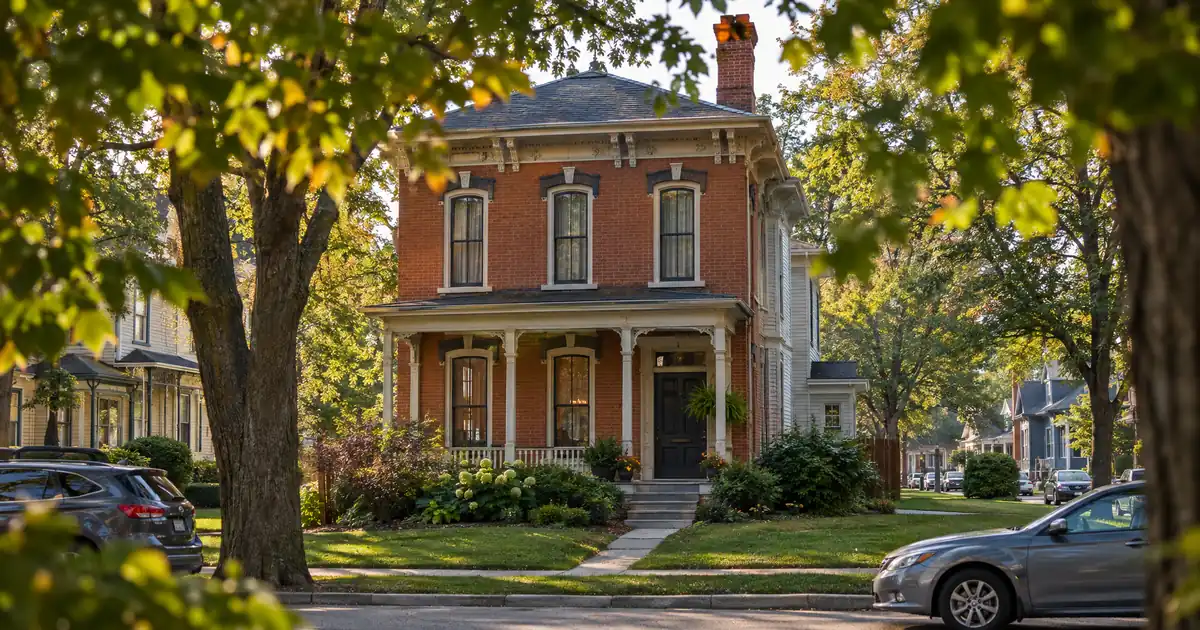
Muncie’s multi-family listings currently run from $95,000 to $219,900, according to Homes.com. That is a full two-to-four-unit building priced below what a starter house costs in many Midwest metros. For an investor who already owns one of those buildings, the cash-out question is not “can I buy cheap?” but “how much equity can the rent roll and the appraisal actually support?”
Lendmire (NMLS# 2371349) is a multi-state mortgage brokerage that helps Muncie, Indiana investors arrange DSCR financing across 41 markets, including Washington, D.C. This article skips the purchase side. It covers what happens after you own the property: seasoning, the loan-to-value ceiling, how the rent roll gets tested, and where the released capital goes.
DSCR Cash-Out Calculator
Run the cash-out numbers in Muncie, IN
Rate source: Freddie Mac 30-yr average via FRED® — Federal Reserve Bank of St. Louis · effective Sep 24, 2026
Prefilled with starting assumptions — enter your property’s value, balance, taxes, and insurance for a more accurate picture.
Program parameters update from Lendmire’s centralized guideline source. Taxes and insurance are editable estimates.
As of Sep 24, 2026 · General Freddie Mac market benchmark, not a Lendmire loan offer. Property value, balance, taxes, and insurance are editable estimates. Maximum loan-to-value varies by lender, program, property type, and seasoning. Not a Loan Estimate, approval, or commitment to lend. Program availability and eligibility are subject to lender guidelines, credit approval, property review, and underwriting.
Key Takeaways:
A Muncie, Indiana cash-out refinance fits the investor who already owns a seasoned duplex, triplex, or fourplex and wants to pull capital toward the next deal. The file is underwritten primarily on the property’s rental income measured against its full monthly obligation, with proceeds capped by a 75 percent loan-to-value ceiling, subject to lender guidelines.
- Ball State reported 21,089 enrolled students in the 2024-2025 academic year, anchoring renter demand.
- Multi-family asking prices top out at $219,900, so small-balance loans are common on these files.
- Old West End shows a 29.1 percent vacancy rate, so in-place occupancy matters more than asking rent.
- Cash-out typically requires about 6 months of ownership, measured from title recording.
Muncie Market Snapshot
A quick read on the Muncie investor landscape — figures come from the cited sources below. Confirm current property-level numbers before underwriting.
| Metric | Detail |
|---|---|
| Home prices | $139,400 median property value (Data USA) |
| Typical rents | $1,202 average (RentCafe Muncie Rent Trends) |
| University enrollment | 21,089 total (Ball State University) |
| Employment | 52.6K to 53.2K employees (Data USA) |
| Vacancy | 29.1% (NeighborhoodScout Old West End) |
How the Cash-Out Number Gets Built
Cash-out proceeds are the smaller of two constraints: the 75 percent loan-to-value ceiling on the appraised value, or the loan size the rent can carry at a 1.00 minimum coverage ratio. In a low-basis market like Muncie the LTV cap usually binds first, because rents are strong relative to value.
The mechanics are simple. Coverage is monthly rent used for lender review divided by the full monthly obligation: principal, interest, taxes, insurance, and any association dues. Most DSCR cash-out programs in the wholesale network build around a 1.00 baseline, and reserves of about 6 months of that full obligation are typical. Credit tiers commonly start at a 620 floor, with better terms as scores climb through the 660, 680, and 700 tiers. All of it is subject to lender guidelines, credit review, and the property itself.
Two things determine your actual check. The first is the appraised value, which is the one number you don’t control. The second is what the new loan has to pay off. Equity available depends on rent used for lender review, the payoff, reserves, and the 75 percent ceiling. It is not a guaranteed cash figure, and any calculator output is only a starting estimate.
Duplex, Triplex, or Single-Family: Run Both
Small multifamily gives the cleaner coverage number at Muncie prices. Single-family clears the baseline too, but with a thinner cushion and a smaller loan balance. The comparison below uses modeled assumptions, not market quotes. Coverage includes taxes and insurance, and the bands are rounded down.
Say you own a three-bedroom house that appraises around $150,000. Using the Rentcast per-bedroom median of $1,240 for three-bedrooms, and a 75 percent cash-out, coverage lands around 1.3x including taxes and insurance. That clears 1.00. It also produces a small loan balance, and smaller balances route through select lenders in the network rather than the standard programs.
Now picture a near-campus duplex with an upstairs four-bedroom rented at $1,085 and a downstairs three-bedroom at $875, both to long-term tenants, per a live REIndiana listing. That is $1,960 gross. Assume it appraises at $180,000 and the payoff is modest. At 75 percent, coverage runs roughly 1.7x with taxes and insurance included.
Then take a downtown triplex with two 2-bedroom units and one 1-bedroom unit, at $850, $725, and $725 per Redfin listing data. That is $2,300 gross. Modeled at a $200,000 appraisal, coverage sits near 1.8x. Knock occupancy down to 90 percent and the number still holds comfortably above 1.6x.
The rents in those examples are listing-level illustrations, not a guarantee of what your building will document. Still, the spread tells the story. Multi-unit assets give the lender more monthly income to test against a similar or lower basis. Single-family works, but it lives closer to the floor.
(One caveat on the single-family case: citywide rents are averages. The Zillow Rental Manager median across all property types is $900, with a range from $375 to $2,765, so a weak rent comp can pull the number down fast.)
Six Months From Recording
Seasoning is where files get kicked back. Cash-out refinance typically requires about 6 months of ownership, measured from the date the deed was recorded, not the date of the contract and not the date you finished the rehab. The settlement statement and recorded deed are the evidence.
The friction shows up with buy-and-renovate investors. Say a property was purchased, gutted, and re-leased. The clock runs from recording, but the appraiser and the lender both want a stabilized rent roll, meaning signed leases with real dates and, ideally, rent payments showing on deposits. A unit renovated at month five and leased at month six has a lease, but it doesn’t have history.
Files that assume the seasoning requirement away are the ones that get returned. Build the calendar backward from the recording date, not forward from the day you decide you want the cash.
Where the Rent Rolls Are Cleanest
The best cash-out files come from neighborhoods with documentable, long-term tenancy and an appraisal history that can support a valuation. Muncie has a handful.
East Central. This historic neighborhood just east of downtown sells renovated homes at $100,000 to $150,000, with fixer-uppers at $50,000 to $100,000. Homes average 2,000 square feet, and some carry five or six bedrooms. That size makes East Central an obvious spot for multi-unit conversions and large-footprint rentals. The trade-off is that older, larger homes can appraise inconsistently, so the reconsideration packet matters here.
Riverside-Normal City. About 80 percent of residents rent, and the neighborhood sits within a 15-to-20-minute walk of Ball State and a short walk to IU Health Ball Memorial Hospital. A high renter share means a deep tenant pool and plenty of rental comps for the appraiser. It also means the student-lease calendar matters. Twelve-month leases with staggered start dates read better to a lender than a stack of leases all expiring in May.
South Central. The median sale price over the last 12 months was $89,950, up 34 percent, driven by small single-family homes from the 1880s through early 1900s, many needing work. This is an appreciation-led submarket off a very low base. It suits a buy-renovate-season-refinance thesis. But a 34 percent swing means the appraiser may lean on comps you didn’t expect, and you shouldn’t assume the same growth repeats on your valuation.
Downtown Muncie. The city is advancing a 120-unit apartment project along the White River that combines affordable and market-rate units, backed by a $1.2 million state housing tax credit award. Small multi-unit and mixed-use buildings cluster here. Some DSCR programs accept mixed-use where the commercial space stays under roughly half of the building area, though eligibility varies by program.
What About the 29 Percent Vacancy Neighborhood?
Skip the asking-rent pro forma in Old West End. Despite its proximity to downtown and IU Health Ball Memorial, NeighborhoodScout reports a real estate vacancy rate of 29.1 percent and an average rent of $1,212. On paper that rent looks market-rate. In practice the vacancy figure signals absorption risk.
A DSCR lender needs in-place rent, not posted rent. If you own in that pocket, the cash-out file should lead with occupancy history: signed leases, rent-payment records, and a rent roll that matches. An owner with a fully leased building and 12 months of clean deposits is a different file than an owner with one unit leased and three “available.”
The same caution applies citywide, though less sharply. The Census-based rental vacancy rate was 8.60 percent in 2019, up from a 2017 low of 5.87 percent and below a 2007 peak of 11.61 percent. That data runs through 2019, so treat it as trend, not a current reading. The direction is what matters: the floor has drifted up off its low, which argues for underwriting on realistic occupancy rather than a single strong lease-up.
Demand Anchors That Support the Appraisal
Cash-out files live and die on whether the appraiser and lender believe the rent is durable. Muncie has two institutional anchors and a modestly growing base.
Ball State University enrolled 21,089 students in the most recent academic year, including 15,189 undergraduates and 5,900 graduate students. Against a city of roughly 65,466 residents per STATS Indiana, that is an unusually high ratio. It is also a concentration risk: rental demand near campus follows one institution’s enrollment cycle.
The second anchor is IU Health Ball Memorial Hospital, the only hospital in Muncie, with about 3,000 employees per Livability (an older figure, so read it as approximate). Health Care and Social Assistance is the largest employment sector, at 9,065 residents per Data USA, followed by Educational Services at 6,639. Total employment grew from 52.6 thousand to 53.2 thousand in the latest year on that source.
The population trend is a quiet positive. The Muncie metro grew from 111,907 to 112,951 between the 2020 Census and 2024, per the Muncie Journal citing Census data. That is four consecutive years of gains, a reversal of the long decline most outsiders still assume.
Renter demand also isn’t purely a campus story. Point2Homes counts 13,401 renter-occupied and 13,224 owner-occupied units citywide, with two-bedrooms making up 37 percent of rentals. That is a near-even split spread across the city, which supports year-round occupancy assumptions better than a campus-only story would.
The Appraisal Is the Risk Line
The single biggest uncertainty on a Muncie cash-out is the valuation, because the published price indices disagree. Zillow puts the average home value at $131,692, up 8.0 percent on one city page and $157,737, up 3.5 percent on a ZIP-level page. Redfin shows a median sale price of $124,200, down 11.2 percent year over year. Different methodologies, different geographies, different mixes of what sold.
That spread is the reason to treat Muncie as a low-basis, appreciating-but-uneven market rather than pinning your equity math to one headline number. A 75 percent LTV on a valuation that comes in light means less cash than you planned.
Appraisal reconsideration is a routine step here, not an emergency move. A well-documented packet includes recent in-neighborhood sales, condition adjustments, and rent evidence for the actual unit mix. It recovers value more often than a bare “the number is too low” email.
What a Clean Cash-Out File Looks Like
In markets structurally like this one, older housing stock, a large student-and-hospital renter base, and wide spreads between sale-price indices, the cleaner files tend to share a few traits. Leases are signed, dated, and match the rent roll. Entity documents are current, and the LLC’s operating agreement lines up with how title is held. The seasoning date is proven with a recorded deed, not a reconstruction. The common friction point is the mismatch: a rent roll that says $2,300 while the leases show a different unit count, or title held in an individual’s name while the borrower is an LLC (which is eligible depending on program guidelines). Fewer preventable gaps means fewer review cycles.
The property type check comes first. Manufactured homes, log homes, and barndominiums fall outside the network’s DSCR programs. That matters in Muncie because some older rural-edge properties around the city may not qualify by type alone. Confirm the property before you build the file.
For the fundamentals behind the coverage calculation, Lendmire’s primer on DSCR loans walks through it, and Lendmire’s DSCR-versus-conventional breakdown explains why rental income, not personal income, drives the file. For step-level detail on the refinance side, see the guide “The Refi Options”.
Is the Growth Real, or Is It a Low Base?
This one is a genuine toss-up. The Indiana Business Research Center’s housing outlook found that Muncie and Terre Haute were the only Indiana metros where homeownership was considered affordable, with Indianapolis ownership costs at 36 percent of median household income. Cheap ownership keeps acquisition costs low, which is what makes the rent-to-value math work. It also caps how many households are forced to rent instead of buy.
So the realistic thesis is cash-flow durability, not rapid appreciation. Investors counting on a repeat of South Central’s 34 percent jump are underwriting a different deal than investors counting on a duplex to keep its tenants. For a cash-out, the second thesis is the one a lender can verify.
DSCR vs. conventional financing
Two common ways to finance an investment property in Muncie, IN. They qualify you differently — here’s how investors weigh them.
Why investors choose it
- Qualifies on the property’s rental income — no personal tax returns, W-2s, or pay stubs needed to document income.
- No personal debt-to-income ceiling to clear, so existing mortgages and obligations don’t cap your borrowing the same way.
- Can be closed in an LLC, keeping the property inside a business entity.
- Built for scaling — not held to the limit on number of financed properties that conventional financing applies.
- Underwriting centers on the deal: generally qualifies when the rent covers the payment, a 1.00x coverage ratio being a common baseline (confirmed in underwriting).
- Designed specifically for investment property, including long-term and, where the program allows, short-term rentals.
Where it’s strong
- Often the lowest ongoing financing cost for a buyer who fully qualifies on personal income — a fit for a first property or a cost-first purchase.
Trade-offs for investors
- Requires full personal income documentation and must fit within a debt-to-income limit — salary, existing debts, and other mortgages all count.
- Typically held in your personal name rather than a business entity.
- Caps how many financed properties you can carry, which can become a ceiling as a portfolio grows.
- Evaluates you as a borrower as much as the property, which usually means more paperwork.
How investors usually choose: a first or single property often optimizes for the lowest financing cost; portfolio builders often optimize for leverage, vesting in an LLC, and scaling past conventional caps. The right answer depends on your goals, the property, and current guidelines — both paths run through select lenders in Lendmire’s wholesale network, with eligibility and terms confirmed in underwriting.
Putting the Proceeds to Work
Released capital is only useful if the next deal is already sized. The usual pattern in low-basis markets is to pull equity from one seasoned building and use it as the down payment and reserves on the next, sometimes in Muncie and sometimes elsewhere. Reserves matter twice: once on the refinance itself, at about 6 months of the full obligation, and again on the next purchase. Don’t count the same cash twice.
The pattern is also self-limiting. Each cash-out resets seasoning on the new loan and trims equity, so stacking several in a row thins the cushion. Pace it against the rent roll, not the check size.
If you’re weighing a Muncie file against others in the state, Lendmire’s Indiana DSCR platform covers how the wholesale network approaches these markets. Or call 828-256-2183 (tap to call) to talk a specific building through before you order the appraisal.
The Next Step
Pull your recorded deed and pin down the exact seasoning date, then build a one-page rent roll from the signed leases. Match every unit to a lease and a deposit record before anything else. Then gather three recent in-neighborhood sales for the valuation conversation, and verify current local rental rules, taxes, and insurance with qualified Indiana professionals. If the rent roll and the recording date hold up, the rest of the file has something solid under it.
Frequently Asked Questions
How long do I have to own a Muncie property before a DSCR cash-out?
Typically about 6 months, measured from the date the deed was recorded. The recorded deed and settlement statement are the documentation. Renovation completion dates don’t restart or shorten that clock, but a rent roll that isn’t stabilized can slow the appraisal and review.
How much equity can I pull from a Muncie duplex?
The ceiling is 75 percent of appraised value, less the payoff on the existing loan. Actual proceeds depend on the appraisal, rent used for lender review, the full monthly obligation, and reserves of about 6 months. Because Muncie price indices disagree, the appraisal is the biggest variable.
Does Ball State’s calendar affect a cash-out file?
Yes, it can. Near-campus rentals carry turnover risk if leases cluster around one start date. Long-term tenants and staggered lease terms read better to a lender. The citywide renter base, roughly 13,401 renter-occupied units, means demand isn’t only student-driven.
Are the small loan balances in Muncie a problem?
They can be. With multi-family listings from $95,000 to $219,900, many Muncie cash-out loans are modest. Standard programs support balances up to $3,000,000, and smaller balances route through select lenders in the network, so program fit is worth confirming early.
Should I trust asking rents in Old West End?
Not without occupancy history. With a reported vacancy rate of 29.1 percent, lenders will want signed leases and payment records, not listing prices. A fully leased building with clean deposits is a much stronger file than one relying on market-rent projections.
About Lendmire
Lendmire is a non-QM mortgage brokerage (NMLS# 2371349) that arranges DSCR investor loans in 41 markets, including Washington, D.C., through wholesale and investor-lending channels. The lender evaluates DSCR loans mainly on rental income rather than personal income, subject to lender guidelines. That structure suits LLC-owned portfolios, self-employed investors, and operators scaling beyond conventional loan caps. Lendmire has been recognized as a 2026 Scotsman Guide Top Workplace and a 2025 Scotsman Guide Top Workplace.
Get Started
Ready to find the right loan for you?
In about 30 seconds you can review financing options available for your investment property. No commitment required.
Informational only. Not a Loan Estimate, approval, or commitment to lend. Program availability and eligibility are subject to lender guidelines, credit approval, property review, and underwriting.
References
1. Homes.com Muncie multi-family listings
2. Ball State University enrollment data
3. NeighborhoodScout — Muncie Old West End
4. Data USA
5. RentCafe Muncie Rent Trends
6. reindiana.com — Homes for Sale Muncie
9. Homes.com — Muncie IN East Central Neighborhood
10. Homes.com — Muncie IN Riverside Normal City Neighborhood
11. Homes.com — Muncie IN South Central Neighborhood
13. deptofnumbers.com — Indiana Muncie
14. STATS Indiana, Indiana Business Research Center
15. Livability
16. Muncie Journal citing Census data
17. Point2Homes — Average Rent Muncie
18. Zillow — Muncie IN Home Values
19. Zillow — Home Values Muncie
20. Redfin
21. IBRC Indiana housing outlook
22. a 2026 Scotsman Guide Top Workplace
23. a 2025 Scotsman Guide Top Workplace
This article is part of Lendmire’s investment property cash-out refinance program — full qualification details, guidelines, and scenarios live on the program page.
Related reading: Cash Out Refinance Investment Property in Muncie, Indiana: The 2026 DSCR Cash-Out Guide for Muncie Investors · DSCR Cash Out Refinance Brownsburg Indiana · Cash Out Refinance Investment Property in Highland IN
Guides: Investment Property Cash-Out Refinance in Muncie, IN · Investment Property Cash-Out Refinance in Indiana
Brandon Miller
Founder & CEO, Mortgage Loan Originator, Lendmire LLC
- Mortgage Loan Originator · NMLS# 1129696 · Verify on NMLS Consumer Access
- North Carolina Real Estate Broker · License# 343312 · Verify on NCREC
- North Carolina Insurance Producer · License# 19053198 · Property, Casualty, Life, Health · Verify on NAIC SBS
- Lendmire LLC · Firm NMLS# 2371349 · Verify firm licensure
Disclosures. The information presented in this article is general market commentary, not financial, legal, or tax advice. Lendmire is a mortgage brokerage (NMLS# 2371349) — not a direct lender or depository institution — and loan placement is subject to lender underwriting. Nothing in this content represents a commitment to lend. Loan terms, pricing, and program availability vary based on borrower qualifications, property characteristics, and state of subject property, and are subject to change at any time. Lendmire complies with Equal Housing Opportunity requirements. Consumer access: nmlsconsumeraccess.org.