
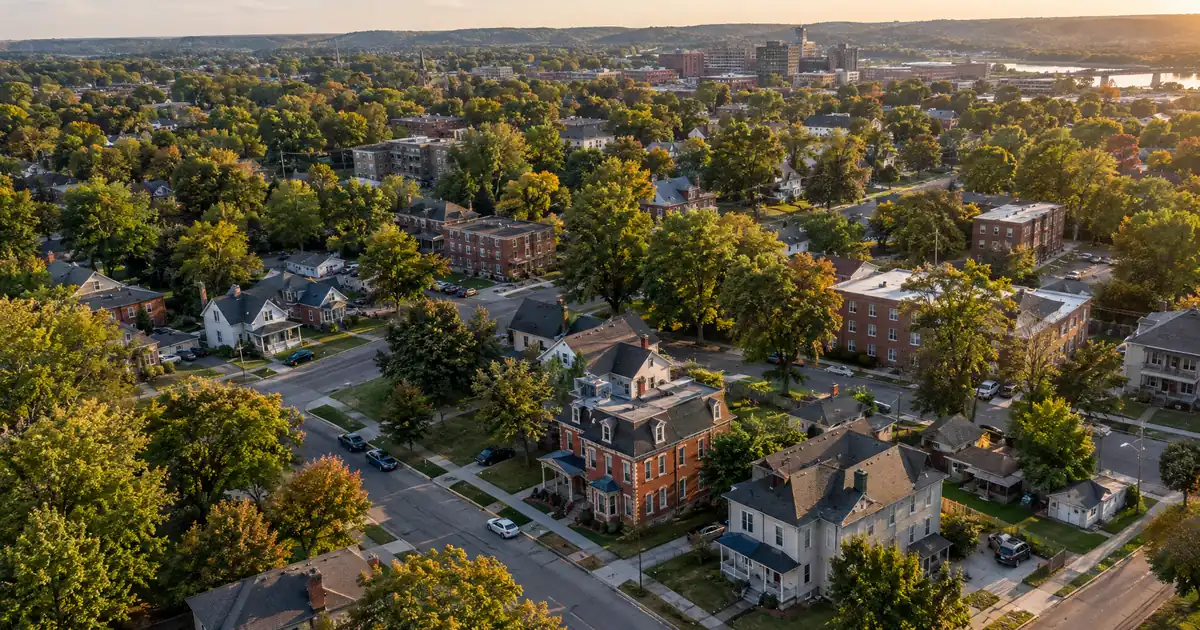
Picture two Terre Haute owners who bought at the same time. One holds a workforce single-family house on the south side. The other holds a duplex a few blocks from the Indiana State campus. Both want to pull equity out and buy again. The math favors the duplex, and not by a small margin. Debt service on a small-multifamily balance doesn’t double when the rent roll does. The single-family owner has to lean on the appraisal, and the duplex owner mostly leans on leases.
DSCR Cash-Out Calculator
Run the cash-out numbers in Terre Haute, IN
Rate source: Freddie Mac 30-yr average via FRED® — Federal Reserve Bank of St. Louis · effective Sep 24, 2026
Prefilled with starting assumptions — enter your property’s value, balance, taxes, and insurance for a more accurate picture.
Program parameters update from Lendmire’s centralized guideline source. Taxes and insurance are editable estimates.
As of Sep 24, 2026 · General Freddie Mac market benchmark, not a Lendmire loan offer. Property value, balance, taxes, and insurance are editable estimates. Maximum loan-to-value varies by lender, program, property type, and seasoning. Not a Loan Estimate, approval, or commitment to lend. Program availability and eligibility are subject to lender guidelines, credit approval, property review, and underwriting.
The Short Version:
A DSCR cash-out refinance in Terre Haute, Indiana fits owners of small multifamily or workforce rentals whose property is underwritten primarily on rental income measured against its full monthly obligation, including taxes and insurance, with proceeds capped by a 75 percent loan-to-value ceiling.
- Terre Haute has 58,427 residents, and 52.2 percent own their homes, so nearly half of households rent.
- Closed sales cluster around a $144,000 median with a middle band of $92,000 to $200,525.
- Duplexes and small converted buildings are 12.12 percent of housing units, so 2-4 unit stock is real.
- Cash-out is capped at 75 percent LTV after roughly six months of seasoning from title recording.
Why the Duplex Wins the Coverage Math
Income stacks by unit in a duplex or small multi-unit building while the loan balance tracks price. That is the argument for looking at small multifamily first.
Start with the citywide numbers. Apartments.com/CoStar data shows average rent near $1,030 for a two-bedroom and $1,356 or more for a three-bedroom. The snapshot is dated, so treat it as directional. Against the roughly $144,000 median sale price, that puts single-family rent at about 0.7 to 0.9 percent of price per month. That is a modeled ratio, not a sourced one. It is thin for a cash-out.
Run the numbers on a modeled single-family two-bedroom at the median price, refinanced at 75 percent LTV, with taxes and insurance folded into the full monthly obligation. Coverage lands around 1.15. That clears the 1.00 benchmark, but not by a wide margin. Now take a duplex of two-bedroom units, using the same averages for about $2,060 in gross monthly rent. Price it at roughly twice the single-family median and the modeled coverage sits around 1.1 to 1.15, no better than the single-family case. Once the purchase price of a duplex drops below twice the single-family median, it pulls ahead. Those are modeled assumptions, not market facts. Underwrite from actual leases.
For a rent floor on two-bedroom units, REI Prime cites a HUD Fair Market Rent of $1,094. That sits close to the aggregator average, which is a useful cross-check when the aggregators disagree with each other. And they do (Zillow, Redfin, and a market source all show different medians, some stale).
This is why the coverage number, not the appraisal headline, should drive a Terre Haute cash-out. How DSCR coverage is calculated is simple: monthly rent divided by the full monthly obligation of principal, interest, taxes, insurance, and any dues. Small multi-unit buildings give the numerator more room.
The Demand Stack Behind the Rent Roll
Terre Haute’s tenant base rests on health care, education, and government, and those sectors don’t move together. That matters for a cash-out because the refinanced property has to hold its lease income through a cycle.
Per Data USA, the most common resident sectors are Health Care and Social Assistance (4,059 people), Educational Services (3,242), and Retail Trade (3,207). The average commute is 18.5 minutes, which keeps the tenant pool tied to in-town rentals. The metro adds depth: 166,552 people, with the city positioned by the Terre Haute Economic Development Corporation as a regional employment center for west central Indiana and east central Illinois.
The employer list from Accelerate West Central Indiana is employer-reported, and some counts are older. Read it as a ranking, not a census:
- Union Health: 2,791 employees
- Vigo County School Corporation: 2,296
- Indiana State University: 1,525
- Vigo County government: 723
- Amcor: 710
- U.S. Federal Correctional Complex: 691
- Terre Haute Regional Hospital: 644
A federal facility, a school system, a not-for-profit health system, and a university make for an unusually steady base at this city size. Union Health is the largest employer in the county, and its campus sits on the east side of downtown.
Then the colleges. Indiana State University reports 6,352 undergraduates per a regional college, and its latest freshman class of 1,607 was the largest in six years. Rose-Hulman Institute of Technology adds 2,250 students. Saint Mary-of-the-Woods College and Ivy Tech round out four colleges in a city of about 58,000. Rose-Hulman’s Innovation Grove, an approximately $102 million innovation district with a $30.5 million Lilly Endowment grant behind it, points to a new-economy layer on the east side. Nothing in the research prices that node yet, so it is a watch item, not an underwriting input.
Where the Equity Sits: Submarkets
The strongest cash-out candidates are older 2-4 unit buildings near Indiana State and downtown, in Farrington’s Grove, and along the health-care corridor. The research has no reliable neighborhood-level sale prices, so this section reads the submarkets by rent ladder and tenant base.
Farrington’s Grove. The oldest surviving neighborhood in Terre Haute is a national historic district of 1,110 contributing buildings south of downtown. Housing here skews to large older homes, many with multiple units. One-bedroom rents average about $700 per Rent.com’s undated ladder, a relative marker, not a two-to-three-bedroom figure. Demand comes from Union Hospital staff and ISU-affiliated renters. The friction point is condition. Older stock can pull appraisal adjustments, and that lands on the cash-out proceeds.
ISU and the downtown corridor. The 435-acre campus sits north of downtown, and student, staff, and downtown-worker demand runs along Wabash Avenue. Duplex-to-fourplex stock here is the cleanest fit for the stacking argument above. Rent per unit is modest, but the count of units carries it.
Union Hospital area and the south side. Rent.com lists the Union Hospital area among the most affordable, at about $600 for a one-bedroom, with a tenant base of health-care and support staff. The Southland and Sarah Scott area on the south side averages $695. These are workforce rents. They work for low-basis holdings and stall on anything priced near the upper half of the sales range.
Newer apartment pockets. Sugar Grove (Indian Acres and Edgewood Grove) averages $712 and $725 for a one-bedroom. Village Quarter tops the ladder at $805, with Garden Quarter at $780 and International Village at $742. Those pockets are mostly complexes, and complexes are a different lending conversation than a 2-4 unit cash-out.
The price side is wide. Homes.com shows single-family medians of $69,500 in Twelve Points, $180,000 on Ohio Boulevard, and $559,000 in the Idle Creek Golf Community. Multi-family listings run from $39,900 to $470,000. Modeled rent-to-price at a Twelve Points house could run 1.5 to 2.0 percent if citywide rents applied, and that assumption is unverified. The low-price submarkets clear coverage most easily, but comps are thin. The Idle Creek price points won’t clear 1.0x on rent. That’s not a market for this strategy.
Skip the Appreciation Story
A Terre Haute cash-out should be underwritten on rent coverage, not on more price gains. Long-run numbers look strong, but the recent trend is modest. The sources also disagree about what “the market” even is.
REI Prime cites FHFA index gains of 55.6 percent over five years. That helps equity on older purchases. Zillow’s average home value is $158,183, up 4.3 percent over the past year. The two together say the equity may already exist, and the next leg is modest. Redfin’s year-over-year jumps are small-sample artifacts, so don’t treat them as appreciation. Owner-reported values run lower still: the Data USA median property value is $115,700, a different measure than closed sales.
That tension is the honest read. Owners who bought years ago have real equity, and the refinance converts it to capital. A borrower who buys now and expects the market to bail out thin coverage is on the wrong side of the data.
Appraisal Is Where Terre Haute Files Get Pressed
The pressure point on a Terre Haute cash-out is the appraisal. Recent closings in the market have spread across a wide range of prices, from modest older homes to well-updated properties. A range that wide means the comp the appraiser picks can move value by a lot.
Working DSCR brokers see a recurring pattern in small college-and-hospital markets like this one: the rent roll is strong and the comps are thin. Values come in light on older multi-unit buildings, and the borrower’s plan for the proceeds depends on a number that was never confirmed. The files that hold together carry a leasing history, condition documentation, and a short list of recent in-neighborhood sales ready for an appraisal reconsideration request. The files that stall assumed the appraisal would land where the borrower’s own estimate sat.
Two other friction points show up. First, liquidity signals conflict. Days-on-market figures differ sharply by source, and no rental vacancy figure was found, so stress-test with a higher vacancy assumption. Second, older buildings raise documentation questions: unit count, lease evidence, and rent-roll clarity all need to match what the appraiser sees. Terre Haute stock includes converted buildings, and a unit that isn’t clearly a separate unit gets challenged.
One reminder is enough: check current local rental rules, taxes, and insurance with qualified local professionals before closing on any scenario.
Seasoning, LTV, and Reserves
The mechanical limits on a cash-out are the same in Terre Haute as anywhere, but they bite differently at low price points. Guideline ranges reflect select wholesale-network programs and are subject to lender guidelines, credit review, and property review.
- LTV ceiling. Cash-out is typically capped at 75 percent of appraised value. The 80 percent figure belongs to purchases, not refinances.
- Seasoning. Lenders generally look for about six months of ownership, measured from title recording and documented by the settlement statement. Files that assume seasoning away get kicked back.
- Coverage. The standard benchmark is 1.00 on rent used for lender review against full PITIA. Some lenders review lower-ratio scenarios with stronger compensating factors, less leverage, or more cash in.
- Credit. Tiers commonly run 620, 660, 680, and 700, with 620 as the floor.
- Reserves. Expect about six months of PITIA, and more above $1,500,000.
- Loan size. Standard programs run up to $3,000,000. Smaller balances, common in Terre Haute, route through select lenders in the network.
On a lower-priced market, small balances are the real constraint. Proceeds depend on rent used for lender review, PITIA, reserves, and the 75 percent ceiling. They are not a guaranteed cash figure. The guide “The Refi Options” covers the mechanics, and the investor refinance breakdown compares refinance types. Manufactured homes, log homes, and barndominiums fall outside these programs.
What Happens to the Proceeds
The point of the exercise is the next deal. In a market where the median sale price sits near $144,000, proceeds from one duplex can fund the down payment on another, without touching personal income documentation. The repeatable version looks like this:
1. Refinance the seasoned duplex at up to 75 percent LTV, keeping coverage above 1.00 after taxes and insurance. 2. Set aside the reserves the lender requires on both the refinanced property and the next purchase. 3. Deploy the balance into a second 2-4 unit building priced below twice the single-family median. 4. Repeat only when coverage on the new file clears the benchmark on actual leases.
DSCR vs. conventional financing
Two common ways to finance an investment property in Terre Haute, IN. They qualify you differently — here’s how investors weigh them.
Why investors choose it
- Qualifies on the property’s rental income — no personal tax returns, W-2s, or pay stubs needed to document income.
- No personal debt-to-income ceiling to clear, so existing mortgages and obligations don’t cap your borrowing the same way.
- Can be closed in an LLC, keeping the property inside a business entity.
- Built for scaling — not held to the limit on number of financed properties that conventional financing applies.
- Underwriting centers on the deal: generally qualifies when the rent covers the payment, a 1.00x coverage ratio being a common baseline (confirmed in underwriting).
- Designed specifically for investment property, including long-term and, where the program allows, short-term rentals.
Where it’s strong
- Often the lowest ongoing financing cost for a buyer who fully qualifies on personal income — a fit for a first property or a cost-first purchase.
Trade-offs for investors
- Requires full personal income documentation and must fit within a debt-to-income limit — salary, existing debts, and other mortgages all count.
- Typically held in your personal name rather than a business entity.
- Caps how many financed properties you can carry, which can become a ceiling as a portfolio grows.
- Evaluates you as a borrower as much as the property, which usually means more paperwork.
How investors usually choose: a first or single property often optimizes for the lowest financing cost; portfolio builders often optimize for leverage, vesting in an LLC, and scaling past conventional caps. The right answer depends on your goals, the property, and current guidelines — both paths run through select lenders in Lendmire’s wholesale network, with eligibility and terms confirmed in underwriting.
Lendmire, a DSCR-focused mortgage broker, arranges these files through wholesale lending channels. Lendmire’s Indiana DSCR platform lays out the state program, and investors can request a scenario quote or call 828-256-2183.
Frequently Asked Questions
How do you qualify for a DSCR cash-out refinance in Terre Haute?
Coverage, seasoning, and credit do most of the work. The property’s rent used for lender review needs to meet the 1.00 benchmark against full PITIA, the borrower typically needs about six months of ownership from title recording, and credit generally starts at a 620 floor. Reserves of around six months PITIA are common. All of it is subject to lender guidelines and property review.
What are the requirements for an investment property loan in Terre Haute, Indiana?
Expect a lease or rent-roll package, entity documents if the property is LLC-held, insurance evidence, and an appraisal. For 2-4 unit buildings, each unit needs to be clearly documented as a separate unit. Requirements vary by borrower, property, and loan scenario, and nothing here is a commitment to lend.
Can older Farrington’s Grove multi-unit homes cause appraisal trouble?
They can. Older stock with mixed conversions draws condition adjustments, and comps in this market run across a wide price band. A packet with recent in-neighborhood sales and condition documentation gives the appraiser what an appraisal reconsideration needs. It improves the file. It doesn’t guarantee a value.
Should a Terre Haute investor count on appreciation to make a cash-out work?
No. Five-year index gains have been large, but the latest one-year figure is modest at 4.3 percent. Build the case on rent coverage after taxes and insurance, and treat further price growth as upside.
Can a LLC-owned Terre Haute rental be reviewed for DSCR financing?
Yes, an LLC is an allowed borrowing entity for DSCR financing. For current guidelines and terms, see Lendmire’s DSCR loan programs page.
About Lendmire
Lendmire, NMLS# 2371349, is a DSCR and non-QM mortgage brokerage with investor loan programs in 41 markets, including Washington, D.C. Lenders in the network commonly review eligibility around property-level rent rather than personal income documentation, subject to lender guidelines, and the brokerage helps arrange financing for LLC-owned portfolios beyond conventional financed-property limits. Recognized as a 2025 Scotsman Guide Top Mortgage Workplace and a 2026 Scotsman Guide Top Mortgage Workplace.
If you only take one thing from this piece, it’s this: in Terre Haute, the duplex near the ISU corridor earns its cash-out on rent coverage after taxes and insurance, while a single-family house at the median price depends on an appraisal that could land anywhere in a $92,000 to $200,525 band.
Get Started
Ready to find the right loan for you?
In about 30 seconds you can review financing options available for your investment property. No commitment required.
Informational only. Not a Loan Estimate, approval, or commitment to lend. Program availability and eligibility are subject to lender guidelines, credit approval, property review, and underwriting.
References
1. Census Reporter — Terre Haute
3. resideline.com — Terre Haute in Housing Market
4. NeighborhoodScout — Terre Haute Real Estate
6. REI Prime
7. Census Reporter — Terre Haute in Metro Area
8. Terre Haute Economic Development Corporation
9. Accelerate West Central Indiana
10. indianastate.edu — Indiana State Builds Enrollment Momentum Largest Freshman Class Six Years
12. Yahoo Finance — Progress Future Impact Higher Education
13. farringtonsgrovehd.org — National historic district
14. Homes.com
15. Zillow’s average home value
16. a 2025 Scotsman Guide Top Mortgage Workplace
17. a 2026 Scotsman Guide Top Mortgage Workplace
This article is part of Lendmire’s investment property cash-out refinance program — full qualification details, guidelines, and scenarios live on the program page.
Related reading: Luxury Rental DSCR Loans In New Jersey · Jersey Shore Vacation Rental Loans: DSCR Financing In Ocean City, Cape May And Long Beach Island · DSCR Cash-out Refinance In New Jersey: Pulling Equity From A Rental
Guides: Investment Property Cash-Out Refinance in Terre Haute, IN · Investment Property Cash-Out Refinance in Indiana
Brandon Miller
Founder & CEO, Mortgage Loan Originator, Lendmire LLC
- Mortgage Loan Originator · NMLS# 1129696 · Verify on NMLS Consumer Access
- North Carolina Real Estate Broker · License# 343312 · Verify on NCREC
- North Carolina Insurance Producer · License# 19053198 · Property, Casualty, Life, Health · Verify on NAIC SBS
- Lendmire LLC · Firm NMLS# 2371349 · Verify firm licensure
Required disclosures. Lendmire (NMLS# 2371349) operates as a licensed mortgage broker, not a direct lender or depository. The discussion in this article is general in nature and should not be relied upon as financial, legal, or tax advice — every investment scenario is unique and should be reviewed by a qualified professional. Any loan inquiry is subject to lender underwriting, and this article is not a commitment to lend or a guarantee of approval. Mortgage rates, loan terms, and program guidelines vary by borrower, property, and state, and may change without notice. Equal Housing Opportunity. Verify licensure at NMLS Consumer Access.