
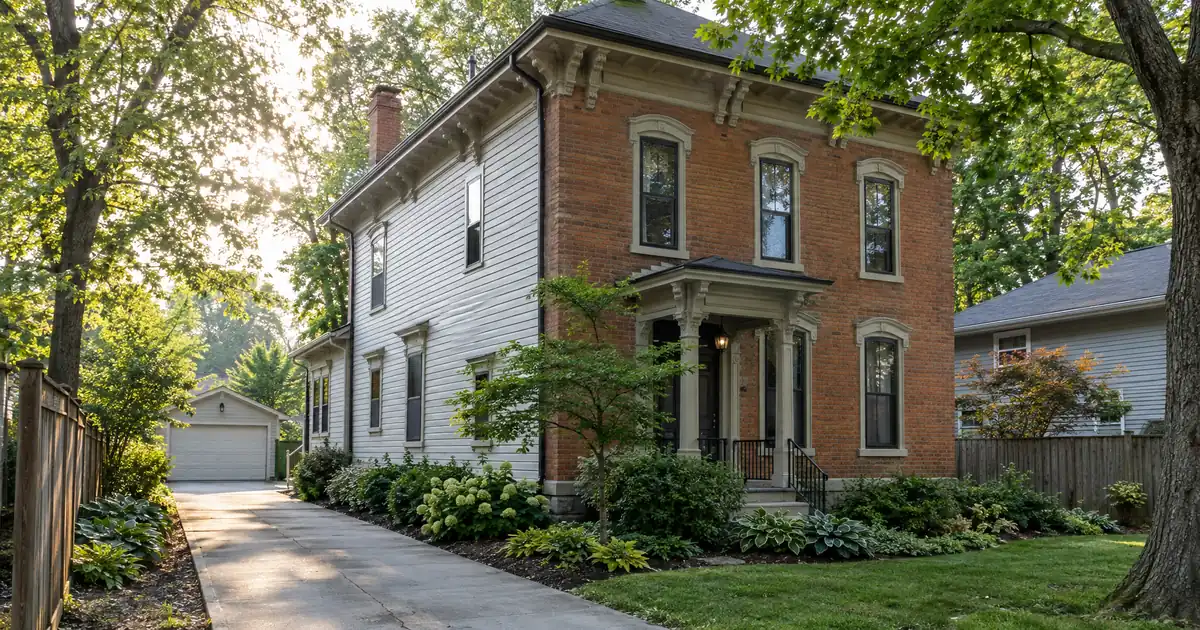
Picture an investor holding a duplex bought near the city’s $143,100 median property value, somewhere between Wabash Street and the old Haskell & Barker rail district. Both units are leased and the rehab is done. The basis is low, the building has appreciated, and the cash sits locked in drywall while a train station a few blocks away starts changing how Chicago-area renters look at this lakefront town. A DSCR cash-out refinance is the tool for turning that trapped equity into a down payment on the next property, and the structure is built around the building’s rents.
DSCR Cash-Out Calculator
Run the cash-out numbers in Michigan City, IN
Rate source: Freddie Mac 30-yr average via FRED® — Federal Reserve Bank of St. Louis · effective Sep 24, 2026
Prefilled with starting assumptions — enter your property’s value, balance, taxes, and insurance for a more accurate picture.
Program parameters update from Lendmire’s centralized guideline source. Taxes and insurance are editable estimates.
As of Sep 24, 2026 · General Freddie Mac market benchmark, not a Lendmire loan offer. Property value, balance, taxes, and insurance are editable estimates. Maximum loan-to-value varies by lender, program, property type, and seasoning. Not a Loan Estimate, approval, or commitment to lend. Program availability and eligibility are subject to lender guidelines, credit approval, property review, and underwriting.
Key Takeaways:
A cash-out refinance in Michigan City, Indiana suits investors holding low-basis duplexes and small multifamily in the older core. It is underwritten primarily on the property’s rental income measured against its full monthly obligation, with proceeds capped by the 75% LTV ceiling and the appraisal. Terms vary by lender guidelines, property type, leverage, credit profile, and full file review.
- Zillow puts the average Michigan City home value at $195,740, up 4.2% over the past year.
- Multi-unit properties stack two or more rents against one loan balance, so they clear coverage more easily than single-family.
- Cash-out LTV tops out at 75%, with about 6 months of seasoning from title recording.
- Appraisal comps are thin: Redfin showed 8 multi-family listings in one snapshot.
- New downtown supply could lift comps or compete with older rentals. Underwrite conservatively near the station.
Lendmire, a DSCR-focused mortgage broker, arranges these cash-out refinances through investor-lending channels. This article covers the equity-extraction side only: where the math holds, where it doesn’t, and what an appraiser is likely to do with a market this small.
Michigan City Market Snapshot
A quick read on the Michigan City investor landscape — figures come from the cited sources below. Confirm current property-level numbers before underwriting.
| Metric | Detail |
|---|---|
| Home prices | $143,100 median value (Data USA, Michigan City) |
| Population | 32,075 population (Wikipedia (2020 Census summary)) |
| Employment | 2,900+ employees (company-wide, NIPSCO) |
| Vacancy | 8.0% rental (Wikipedia (2020 Census summary)) |
The Basis Gap Is the Whole Story
Michigan City is a low-basis market next to a high-cost metro, and cash-out math starts there. The Census-based median value of $143,100 and the Zillow average of $195,740 frame the range. That’s a wide gap, and it reflects different methods: Data USA uses American Community Survey medians, while Zillow’s index skews toward recently traded and renovated stock. Pick one per underwriting conversation and stay consistent. This article uses the Zillow figure for current-market framing and the Census figure for the conservative floor.
Rents sit against that base. Apartments.com reports about $1,122 for a two-bedroom, with rents down 0.4% over the past year. RentCafe shows $1,080 for a two-bedroom and $1,577 for a three-bedroom, but that data covers only buildings of 50 or more units. Treat it as a ceiling for small-building rents. Run the simple ratio on those inputs and monthly gross rent lands around 0.5% to 0.8% of value. That’s a gross ratio, not a cap rate and not a coverage number.
Here’s the catch. Flat rents mean this is not a market where you refinance on a growth story. No rent growth is supported by the data. The case rests on basis, unit count, and whatever lift the rail corridor delivers.
About 42% of households rent, per RentCafe: 5,391 renter-occupied households against 7,510 owner-occupied. The last full Census count put rental vacancy at 8.0%. That’s a workable renter pool in a city of roughly 32,000, not a tight one. Resident employment runs through manufacturing (2,664 people), retail trade (1,761), and health care (1,729). Median household income is $53,089 per Indiana Demographics, which tells you rents can’t stretch far above current levels without pushing against tenant budgets.
Where the Cash-Out Math Works
The older core, meaning Wabash Street, the Haskell & Barker historic district, and the Franklin Street corridor, is where duplex, triplex, and fourplex refinances pencil best. Two rents on one balance beat one rent on one balance every time against a sub-$200K value base. That’s the thesis.
Wabash Street and Haskell & Barker. Housing here runs to older wood-frame homes, brick bungalows, foursquares, duplexes, and small apartment buildings, per a local realtor’s description of the area, which is color only. It’s the most plausible small-multifamily hunting ground in the city. For a refinance, the older stock with stable long-term leases is the cleanest file: seasoned tenants, documented rents, and an appraiser who can find at least a couple of nearby sales. Watch utility splits. One Redfin duplex listing notes tenants paying NIPSCO while the owner pays water, and that kind of arrangement changes net rent, so underwrite per unit rather than on a blended guess.
Uptown Arts District and Franklin Street. This is the appreciation-led submarket. Visit Michigan City La Porte describes the district as fun, funky, and filled with unique shops and restaurants, and it sits steps from the new station and The Franklin. A single listing shows an upper duplex unit offered at $1,700 a month. That’s one ask on one renovated unit, not a market rent. Don’t underwrite to it. Do notice that the pricing gap between renovated downtown units and the city’s median rent is where the upside hides, and where the forecast risk lives too.
Midtown, North End, and Pottawattomie Park. Redfin lists all three as popular neighborhoods. The research offers nothing on their rents or prices, so there’s nothing honest to say beyond the names. Investors holding property there should pull their own comps.
Skip the lakefront for this play. Washington Park and the Beachway draw seasonal demand, and the Sheridan Beach and Long Beach shoreline is higher-end, lower-density housing with some historic homes on the National Register. Those are not duplex-stacking markets, and a cash-out there leans on appraisal value rather than rent coverage. They can work for equity, but they’re a different conversation from the workforce-rental math this page is about.
Run the Numbers (Modeled, Not Quoted)
The following is a modeled scenario for illustration. Inputs are assumptions, not sourced market data, and coverage is calculated on full PITIA, including taxes and insurance.
Consider a duplex appraising near the $260K median multi-family list price, refinanced at the 75% LTV ceiling. Assume each unit rents between $950 and $1,080, with the top end matching the RentCafe two-bedroom benchmark. Combined rent lands at roughly $1,900 to $2,160. Coverage on that structure comes out in the 1.2x to 1.35x range including taxes and insurance, comfortably above the 1.00 benchmark that most standard DSCR programs are built around. That cushion matters because it absorbs a vacancy or a soft lease-up without dropping the file below the line. Exact terms depend on the lender’s guidelines, property type, leverage, and a full review of the borrower’s file.
Now the same exercise on a single-family home at the Zillow average of $195,740, renting for a modeled $1,100. At 75% LTV, coverage including taxes and insurance sits right around 1.0x, borderline and possibly just under. A sub-1.00 file like that is reviewed differently. Select lenders may look at sub-1.00 programs, reduced leverage, or an interest-only structure, but each requires stronger credit, more reserves, or a smaller loan, and qualification stays subject to lender guidelines, credit approval, and property review.
| Factor | Duplex (modeled) | Single-family (modeled) |
|---|---|---|
| Value basis | About $260K | About $195,740 |
| Modeled rent | $1,900 to $2,160 | About $1,100 |
| Coverage incl. Taxes and insurance | About 1.2x to 1.35x | Around 1.0x |
| Cash-out cushion | Meaningful | Thin |
Modeled inputs for illustration. Actual coverage depends on the lender’s pricing, the appraisal, and the specific property.
Now for the practitioner read. DSCR files in markets like this one typically look like small balances, older housing stock, and a coverage number that’s decided by one or two rent assumptions. The files that move smoothly arrive with signed leases, a clear utility split, and an insurance quote already in hand. The files that stall usually rely on a projected rent, a recently renovated unit with no lease history, or an appraisal gap nobody priced in. Another quirk: balances this modest can route through select lenders in the network rather than the standard programs, so an early look at lender fit saves a re-trade later.
For the mechanics behind these ratios, Lendmire’s DSCR walkthrough breaks down how rent used for lender review divides against the monthly obligation, and the guide “Where DSCR and Conventional Diverge” against conventional financing is worth a read if you’re weighing the two.
What the Station Changes (and What It Doesn’t)
The South Shore Double Track project is the most unusual fact in this market. Per Inside INdiana Business, it added 17 miles of new track between Michigan City and Gary, 14 additional trains, and cut the trip to downtown Chicago by about 30 minutes. It also closed 21 roadway rail crossings in Michigan City. An express now reaches Millennium Station in 67 minutes, and the new 11th Street Station garage has over 500 parking spaces. The same reporting cites roughly $450 million in public and private investment in Michigan City alone, including the $280 million SoLa project.
For a refinance, the rail link does two things. It adds a Chicago-linked renter pool to the workforce base, which supports rent durability. It also gives an appraiser a clean story when explaining why downtown comps are moving.
Now the two-sided part, and it’s a genuine toss-up. The Franklin at 11th Street Station is a $101 million project with 220 market-rate residences from studios to three-bedrooms. WNDU reported it’s a 12-story building with tenants moving in from late summer. SoLa adds 164 condominiums and 17 duplexed townhomes facing the lake, per Rep. Mrvan’s office. A ConstructConnect report quotes the city’s economic development director saying more than 2,000 housing units are in development, and projects about 5,000 newcomers downtown within a decade. Those are official projections, and delivery wasn’t verified.
Two outcomes are plausible. New supply lifts rents and comps across the corridor, and older duplexes near the station get repriced upward. Or the new Class A units absorb the renters willing to pay more, and renovated older rentals face competition. Nobody knows yet. The smart underwriting move is to model rents on today’s leases, not on what a luxury building down the street suggests, and treat any lift as upside rather than baseline.
What Will an Appraiser Do With Eight Listings?
Appraisal is the bottleneck in a market this thin. Redfin’s snapshot showed 8 multi-family homes for sale at a $260K median list price, and most homes for sale in Michigan City sit on the market for 129 days. A separate listing aggregator showed only two duplexes for sale in another snapshot. These are snapshots, not trends, but the pattern is consistent: few multi-unit sales comps.
That has a direct effect on cash-out proceeds. Thin comps mean an appraiser may lean on older sales or pull from adjacent markets, and that can cap the value, and therefore the equity available. Equity is never a guaranteed figure. It depends on rent used for lender review, the monthly obligation, reserves, and the 75% LTV ceiling, all subject to lender guidelines.
Expect variability, and build a buffer. Investors who bought near the median and have improved the property usually do better than those who bought at a peak listing. Also keep in mind the volatility in this market: one snapshot showed a $152K median sale price down more than 21% year over year, but only 32 sales that month. Small samples swing. Don’t read a trend into it.
The Program Terms That Matter Here
For this market, three parameters do the heavy lifting, and all are typical guideline ranges rather than commitments.
- LTV. Cash-out refinances generally cap at 75%. That’s lower than the purchase ceiling, and the two shouldn’t be confused.
- Seasoning. Most files look for about 6 months of ownership measured from title recording before cash-out. Investors who bought and rehabbed recently should check that clock before ordering anything.
- Coverage and reserves. A 1.00 DSCR is the standard benchmark, credit typically starts around a 620 floor with better positioning at higher tiers, and reserves generally run about 6 months of PITIA.
Loan sizes go up to $3,000,000 on standard programs, which is irrelevant for most Michigan City balances. The practical point is the reverse: smaller balances route through select lenders in the network. Five-plus-unit buildings typically fall into commercial-loan territory rather than 1-4 unit DSCR, so don’t plan a fifth-unit stack on this product. Manufactured homes, log homes, and barndominiums are outside these programs entirely.
Structures that hold title in an LLC are commonly supported, depending on program guidelines. For how the cash-out product is qualified in detail, see the cash-out qualification details, and the investor refinance breakdown covers how it compares to a rate-and-term refi. Investors can also view Indiana DSCR financing for the state-level program overview. Verify current local rental rules, property taxes, and insurance with qualified local professionals before you finalize numbers.
Where the Proceeds Go
The refinance is the first half. The second half is what you do with the capital.
In this market the natural redeployment is another 2-4 unit property in the same older core. The basis is low enough that proceeds from one modest refinance can fund the down payment on another. The reverse, using proceeds to chase a condo near the station, is a thinner bet because it introduces direct competition with new supply and lowers coverage per dollar invested.
DSCR vs. conventional financing
Two common ways to finance an investment property in Michigan City, IN. They qualify you differently — here’s how investors weigh them.
Why investors choose it
- Qualifies on the property’s rental income — no personal tax returns, W-2s, or pay stubs needed to document income.
- No personal debt-to-income ceiling to clear, so existing mortgages and obligations don’t cap your borrowing the same way.
- Can be closed in an LLC, keeping the property inside a business entity.
- Built for scaling — not held to the limit on number of financed properties that conventional financing applies.
- Underwriting centers on the deal: generally qualifies when the rent covers the payment, a 1.00x coverage ratio being a common baseline (confirmed in underwriting).
- Designed specifically for investment property, including long-term and, where the program allows, short-term rentals.
Where it’s strong
- Often the lowest ongoing financing cost for a buyer who fully qualifies on personal income — a fit for a first property or a cost-first purchase.
Trade-offs for investors
- Requires full personal income documentation and must fit within a debt-to-income limit — salary, existing debts, and other mortgages all count.
- Typically held in your personal name rather than a business entity.
- Caps how many financed properties you can carry, which can become a ceiling as a portfolio grows.
- Evaluates you as a borrower as much as the property, which usually means more paperwork.
How investors usually choose: a first or single property often optimizes for the lowest financing cost; portfolio builders often optimize for leverage, vesting in an LLC, and scaling past conventional caps. The right answer depends on your goals, the property, and current guidelines — both paths run through select lenders in Lendmire’s wholesale network, with eligibility and terms confirmed in underwriting.
A few practical notes on employer demand, which keeps the tenant pool stable across both properties. The Hoosiers by the Numbers LaPorte County major employers list ranks Blue Chip Casino Hotel Spa first and Franciscan Health Michigan City second, followed by Hearthside Food Solutions, with no headcounts published. The Michigan City Public Library’s local employers page also names the Indiana State Prison, Four Winds Casino, Meijer, and Walmart. Franciscan Health runs the city’s acute care hospital. Employment anchors here are casino, healthcare, manufacturing, and state jobs. No four-year university is based in Michigan City, and Ivy Tech runs a satellite tied to its Valparaiso campus. Don’t underwrite any of this as a student-rental market.
The equity math has a built-in discipline. If the next property’s coverage only clears with optimistic rent, the proceeds are better left alone. A refinance that funds a marginal deal just moves the risk.
Frequently Asked Questions
How much equity can I pull from a Michigan City duplex?
It depends on the appraised value, rent used for lender review, reserves, and a 75% LTV ceiling, so there’s no fixed number. Thin multi-family comps can pull an appraisal below what an owner expects. A seasoned duplex with documented rents and a solid appraisal generally gives the best shot at meaningful proceeds.
Do I need to own the property for six months first?
Most cash-out files look for about 6 months of ownership measured from title recording. Investors who recently bought and rehabbed should check that date first, because the clock starts at recording rather than at closing on the renovation.
Will the South Shore station and new apartments raise my appraisal?
Possibly, but it isn’t guaranteed. The Franklin’s 220 units and SoLa’s condos and townhomes could lift comps downtown, or they could compete with renovated older rentals. An appraiser works from sales that have already closed, so projected growth won’t appear in the value until sales data catches up.
Is a single-family rental in Michigan City enough for a DSCR cash-out?
It can be borderline. Values in Michigan City sit at a modest level and rents have held reasonably firm, so coverage on a single-family rental can land near 1.0x once taxes and insurance are included in a modeled scenario. Sub-1.00 files may be reviewed by select lenders with reduced leverage, stronger credit, or added reserves, subject to lender guidelines.
Are the lakefront neighborhoods a good fit for a cash-out refinance?
They’re a weaker fit for rent-coverage math. The Washington Park and Beachway area draws seasonal demand, and the Sheridan Beach and Long Beach shoreline is higher-end and lower-density. Workforce duplexes in the older core generally produce cleaner coverage on this product.
For current guidelines and terms, see Lendmire’s DSCR loan programs page.
About Lendmire
Lendmire (NMLS# 2371349) is a mortgage brokerage focused on DSCR investor financing, arranging programs through wholesale and investor-lending channels in 41 markets, including Washington, D.C. Lenders evaluate DSCR loans on property cash flow rather than personal income, subject to lender guidelines, and programs support LLC closings and investors with four or more financed properties. Lendmire is a Scotsman Guide Top Mortgage Workplace in both 2025 and 2026. Investors can call 828-256-2183 or get a DSCR quote.
The investors who season their duplexes, document every lease, and pull equity before the new downtown supply reprices the corridor will be the ones holding capital when Michigan City’s rail-driven buildout finally shows up in the comps.
Get Started
Ready to find the right loan for you?
In about 30 seconds you can review financing options available for your investment property. No commitment required.
Informational only. Not a Loan Estimate, approval, or commitment to lend. Program availability and eligibility are subject to lender guidelines, credit approval, property review, and underwriting.
References
2. average Michigan City home value at $195,740
3. Redfin showed 8 multi-family listings
4. Wikipedia (2020 Census summary)
5. NIPSCO
6. Apartments.com — Rent Market Trends Michigan City
7. RentCafe shows $1,080 for a two-bedroom and $1,577 for a three-bedroom
9. michigancitylaporte.com — See and Do Washington Park Beach
11. mrvan.house.gov — South Shores 11th Street Station Officially Open
12. WNDU
14. ConstructConnect
15. mclib.org — Job Searching Career Information Local Employers
17. 2025
18. 2026
This article is part of Lendmire’s investment property cash-out refinance program — full qualification details, guidelines, and scenarios live on the program page.
Related reading: Luxury Rental DSCR Loans In New Jersey · Jersey Shore Vacation Rental Loans: DSCR Financing In Ocean City, Cape May And Long Beach Island · DSCR Cash-out Refinance In New Jersey: Pulling Equity From A Rental
Guides: Investment Property Cash-Out Refinance in Michigan City, IN · Investment Property Cash-Out Refinance in Indiana
Brandon Miller
Founder & CEO, Mortgage Loan Originator, Lendmire LLC
- Mortgage Loan Originator · NMLS# 1129696 · Verify on NMLS Consumer Access
- North Carolina Real Estate Broker · License# 343312 · Verify on NCREC
- North Carolina Insurance Producer · License# 19053198 · Property, Casualty, Life, Health · Verify on NAIC SBS
- Lendmire LLC · Firm NMLS# 2371349 · Verify firm licensure
Disclosure information. Lendmire is a state-licensed mortgage brokerage under NMLS# 2371349. Lendmire is not a depository institution, direct lender, or financial advisor — all loans referenced are placed through wholesale lender partners and are subject to each lender's underwriting standards. This article is provided for general informational purposes and is not a commitment to lend, nor does it constitute financial, legal, or tax advice. Loan programs, terms, rates, and qualification standards change without notice and depend on borrower profile, property type, and the state in which the subject property is located. Equal Housing Opportunity provider. NMLS Consumer Access: nmlsconsumeraccess.org.