
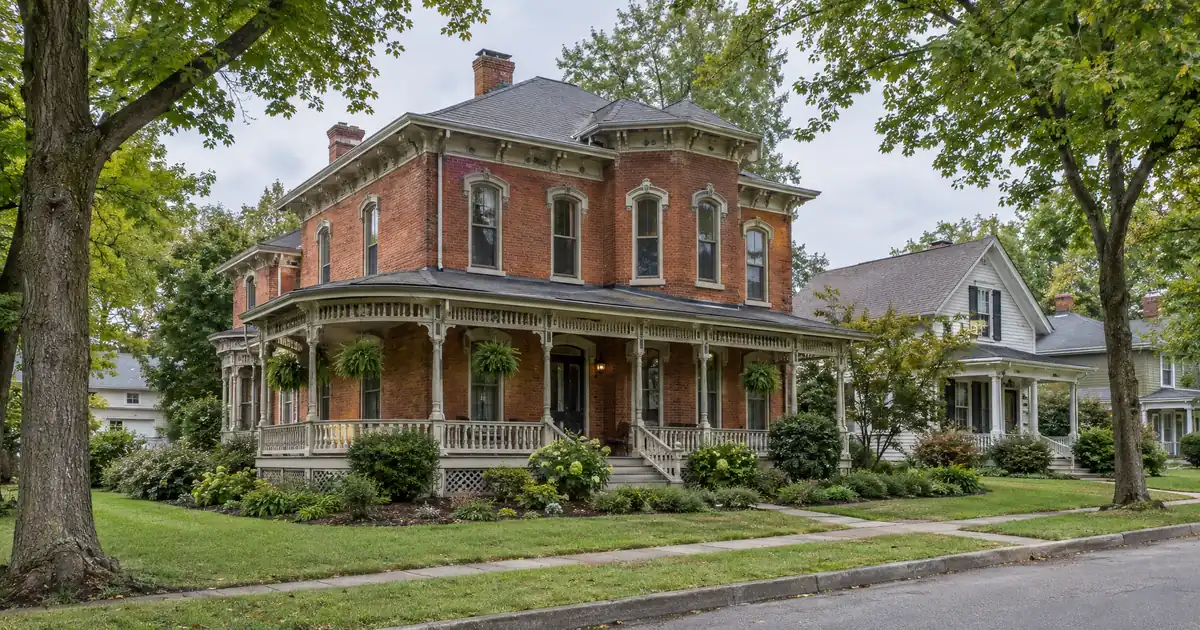
A single-family rental at Shelbyville’s typical value does not clear 1.00 on a cash-out at full leverage. Zillow puts the typical home value at $202,418, and Zumper reports a median rent of $1,020. Monthly rent works out to roughly half a percent of value. Once taxes and insurance sit in the denominator, that ratio is thin against the 75% loan-to-value ceiling on cash-out files.
The picture changes with unit count. Three doors on one payment is a different file than one door on one payment. This article walks through that math, the seasoning and appraisal friction, and the documentation gaps that stall Shelbyville files. It assumes the investor already owns the property and wants the equity out.
DSCR Cash-Out Calculator
Run the cash-out numbers in Shelbyville, IN
Rate source: Freddie Mac 30-yr average via FRED® — Federal Reserve Bank of St. Louis · effective Sep 24, 2026
Prefilled with starting assumptions — enter your property’s value, balance, taxes, and insurance for a more accurate picture.
Program parameters update from Lendmire’s centralized guideline source. Taxes and insurance are editable estimates.
As of Sep 24, 2026 · General Freddie Mac market benchmark, not a Lendmire loan offer. Property value, balance, taxes, and insurance are editable estimates. Maximum loan-to-value varies by lender, program, property type, and seasoning. Not a Loan Estimate, approval, or commitment to lend. Program availability and eligibility are subject to lender guidelines, credit approval, property review, and underwriting.
Lendmire (NMLS# 2371349) is a DSCR-focused mortgage broker. Through Lendmire’s DSCR program footprint — 41 markets, including Washington, D.C. — lenders may review qualifying rental income subject to program guidelines for Shelbyville, Indiana investors.
The Quick Read:
A DSCR cash-out refinance in Shelbyville, Indiana is underwritten primarily on the property’s rental income measured against its full monthly obligation, moving from seasoning and title documents to an appraisal with a rent schedule and a reserves check, with the 75% ceiling capping equity.
- Typical home value is $202,418 per Zillow, up 3.8% year over year.
- Median rent is $1,020 per Zumper, so single-family coverage runs thin.
- Small multifamily stacks rent against one payment, which is where coverage improves.
- Only 19 sales in the latest Redfin monthly reading means thin comps.
- Cash-out sizing depends on rent, full PITIA, reserves, and the 75% cap.
Shelbyville Market Snapshot
A quick read on the Shelbyville investor landscape — figures come from the cited sources below. Confirm current property-level numbers before underwriting.
| Metric | Detail |
|---|---|
| Home prices | 19 sales (Redfin) |
| Employment | Ryobi 977 employees (Shelby County Development) |
Older In-Town Stock Near the Public Square
The older in-town single-family and small multifamily stock around downtown and the Public Square is the best-supported cash-out product in Shelbyville. It is a qualitative call. No source produced neighborhood-level rent or price data, and Zumper says it lacks the inventory to publish it.
What the research does support is the tenant base and the product mix. Data USA shows manufacturing employing 2,501 residents, health care and social assistance 1,218, and retail 879. RentCafe reports 45% of households renting, which is 3,909 households. Point2Homes puts two-bedroom units at 43% of rentals, so a 2BR-heavy duplex or triplex is the natural fit.
The catch is inventory. Redfin showed 11 multifamily units for sale in its latest monthly reading. Its investment filter surfaced one home at a $225K median listing price, a brick duplex with two bedrooms and two baths on each side. That is thin. On a cash-out, thin inventory means few comparable sales for the appraiser and few rent-schedule comps for the lender. An owner of a small multifamily in town should expect the appraisal to lean on whatever closed nearby, and should bring documentation to support the rents.
The city’s own release names The Mill and Eight37 Lofts as affordable and workforce apartment projects. Owners of older small buildings compete with them on the lower end of the rent range.
The Coverage Math: One Door vs. Three
Coverage improves with unit count, and it is the only reason small multifamily gets the attention here. The table below models three scenarios. Rents and values are modeled assumptions built from the researched figures, not cited market data. Coverage is rent divided by full PITIA (principal, interest, taxes, and insurance) at 75% LTV on standard 30-year terms, rounded down. Terms vary by lender guidelines, property type, leverage, credit profile, and full file review.
| Scenario | Modeled rent | Coverage (incl. Taxes and insurance) |
|---|---|---|
| Typical SFR at $202,418 value | $1,020 | Below 1.00, around 0.8x |
| Same SFR at 2BR rent | $1,133 | Below 1.00, around 0.9x |
| Triplex valued near $435,000 | 3 x $1,020 = $3,060 | Around 1.1x |
The triplex row uses a LoopNet asking price of $435,000 for a three-unit building of 1,676 square feet. That works out to roughly $145,000 per unit. The same page shows another three-unit at $695,000 with a stated cap rate of 6.50%, and a five-property multifamily package at $2,214,990 at 6.80%. Those cap rates are seller-stated. Underwrite from actual rent rolls, not the listing.
Run the numbers on the second row. A single-family rental at the higher two-bedroom average from RentCafe of $1,133 still lands under 1.00 at full leverage. The 1BR average is $893.
The baseline on most standard programs is 1.00, because rent covers the payment at that level. Some lenders review lower ratios or no-ratio scenarios, but those typically come with lower leverage, different pricing, or more cash in the deal. For a sub-1.00 single-family file, the paths a lender would review include a sub-1.00 program, an interest-only structure, or a lower loan amount. Qualification remains subject to lender guidelines, credit approval, and property review. It is not something to assume going in.
The stronger play is the small multifamily over the single-family rental for an owner chasing cash-out capacity. Investors who bought a single-family rental and want out of that math could argue the opposite (less management), but the coverage gap is real. If the alternative is qualifying on personal income instead, read the guide “Where DSCR and Conventional Diverge”.
Seasoning, Appraisal, and the Appreciation Trap
Seasoning on cash-out is about six months of ownership, measured from title recording, and lenders document it from the settlement statement. Files that assume the seasoning away get sent back. Buying and refinancing on the same paper timeline doesn’t work.
The larger risk in Shelbyville is expecting appreciation to do the work. Redfin showed a $255K median sale price up 47.5% year over year, but the sample was 19 sales, and price per square foot was $118, down 7.8%. That headline gain reflects which homes happened to sell. Zillow’s typical-value trend of 3.8% is the more defensible read. Movoto shows a median list price of $269K, down 3% year over year. Redfin’s days on market rose from 24 to 34. Exact terms depend on the lender’s guidelines, property type, leverage, and a full review of the borrower’s file.
Listing prices are flat to slightly down and sales are slower. That points to a cash-flow-led hold. Cash-out proceeds will depend on the original buy price and any value-add, not on the market rising during the seasoning period. Expect the appraisal to come in conservative.
Appraisal reconsideration is a routine step, and in a market with roughly 19 sales a month it is often the step that matters. A reconsideration packet should use in-city sales, not rural or outlying comps. Redfin’s county page shows rural sales at steep discounts, including one 48% under list in Waldron, which is outside Shelbyville. Ask that the appraiser stay inside the city.
Rent Evidence: Recommend a Range, Not a Number
The rent sources disagree, and the file needs a documented position. Zumper reports a $1,020 median, up 16% year over year. RentCafe’s average is $1,113, up 10.37%. Other portals show figures roughly $250 to $340 a month lower, and one is stale. Direction is up in the sources that show a trend.
RentCafe covers only buildings with 50 or more units. It describes apartment complexes, not duplexes. Using its $1,133 two-bedroom average to support a small-building rent schedule invites a lender question.
The cleaner approach:
- Use the signed leases and the appraiser’s rent schedule as the primary evidence.
- Treat the aggregators as a range, roughly $1,020 to $1,113, and underwrite toward the low end.
- Leave vacancy out of the narrative unless the file has actual vacancy history. No sourced vacancy rate exists for Shelbyville.
The Demand Base
The tenant base is workforce, not campus. No college sits inside Shelbyville, and student-housing demand is not a driver. The demand base is employment.
The Hoosiers by the Numbers major-employer list ranks Horseshoe Indianapolis first, then Knauf Insulation, Penske Logistics, Ryobi Die Casting, and Pilkington North America. The list gives no headcounts. The Shelby County Development Corporation lists Ryobi Die Casting USA at 977 employees. Major Health Partners runs the community hospital, with health care the second-largest resident employment sector.
The Indiana Business Research Center lists the city’s population at 21,204. Shelbyville sits off I-74, about 25 minutes from I-465. The commute into the Indianapolis metro is what keeps some tenants here.
A newer piece of demand is at the county level. Fox59 reports Prime Beverage Group planning a 915,720-square-foot facility in the Velocity 74 Trade Center, with 181 jobs over its first three years. It is in Fairland, outside Shelbyville city limits, so only part of that demand lands in Shelbyville rentals. It adds to the manufacturing renter base on the I-74 corridor and helps offset new apartment supply.
DSCR vs. conventional financing
Two common ways to finance an investment property in Shelbyville, IN. They qualify you differently — here’s how investors weigh them.
Why investors choose it
- Qualifies on the property’s rental income — no personal tax returns, W-2s, or pay stubs needed to document income.
- No personal debt-to-income ceiling to clear, so existing mortgages and obligations don’t cap your borrowing the same way.
- Can be closed in an LLC, keeping the property inside a business entity.
- Built for scaling — not held to the limit on number of financed properties that conventional financing applies.
- Underwriting centers on the deal: generally qualifies when the rent covers the payment, a 1.00x coverage ratio being a common baseline (confirmed in underwriting).
- Designed specifically for investment property, including long-term and, where the program allows, short-term rentals.
Where it’s strong
- Often the lowest ongoing financing cost for a buyer who fully qualifies on personal income — a fit for a first property or a cost-first purchase.
Trade-offs for investors
- Requires full personal income documentation and must fit within a debt-to-income limit — salary, existing debts, and other mortgages all count.
- Typically held in your personal name rather than a business entity.
- Caps how many financed properties you can carry, which can become a ceiling as a portfolio grows.
- Evaluates you as a borrower as much as the property, which usually means more paperwork.
How investors usually choose: a first or single property often optimizes for the lowest financing cost; portfolio builders often optimize for leverage, vesting in an LLC, and scaling past conventional caps. The right answer depends on your goals, the property, and current guidelines — both paths run through select lenders in Lendmire’s wholesale network, with eligibility and terms confirmed in underwriting.
Supply Is the Risk
New apartments compete directly with older small multifamily. The City of Shelbyville describes Summit of Shelbyville as a $35M, 288-unit market-rate development, with Phase 1 at 72 two-bedroom units. It sits on the Progress Parkway corridor. Two-bedrooms are the same unit type that dominates the older stock. Owners on that side of town should expect competition on rent.
Single-family construction is also up. The city says permits averaged just under 40 a year, then nearly 90 a year since. Its release cites residential investment averaging $38.6M a year over the last five-year window. That is supply, and it caps rent growth on newer product more than on 1970s to 1990s buildings. Point2Homes shows those decades as the bulk of rental stock.
A proposed data-center campus at I-74 and SR-44 is the wildcard. The City of Shelbyville describes a roughly $2B project of up to 11 buildings on 429 acres. The Republic reports Prologis projecting 450 permanent jobs and 6,750 construction jobs. The tenant is unidentified, community opposition exists, and further approvals are needed. It is a possible demand catalyst, not a certainty. Do not underwrite a cash-out on it.
Where Shelbyville Cash-Out Files Stall
Most delays on these files are documentation, not credit. On files from markets like this one, several friction points recur:
1. Entity documents. If the property sits in an LLC, the operating agreement, articles, and EIN letter need to match the vesting on the title, subject to lender program eligibility. Mismatches create preventable review gaps.
2. Lease evidence. Signed leases and a rent schedule that agrees with the appraiser’s figure. Small buildings with month-to-month tenants need more support.
3. Insurance quote completeness. The quote must cover the correct structure and unit count. An old single-family quote on a converted duplex is a common miss. Fresh binders before submission prevent a coverage number that pencils and then breaks.
4. Title and seasoning. Recording date, prior settlement statement, and any payoff letter on existing debt. Settlement reconciliation matters when the payoff and the proceeds have to tie.
5. Reserves documentation. About six months of PITIA is typical, rising above a $1,500,000 balance. Statements need to show the funds are the borrower’s, not a recent transfer.
Property type matters too. Manufactured homes, log homes, and barndominiums fall outside these DSCR programs. Confirm the subject property type before ordering an appraisal.
The pattern in markets like this: the cleaner files from a documentation standpoint pair a small-building rent schedule with actual leases and an in-city comp set already assembled. The common friction point is a thin comp set that the borrower never anticipated. Review details remain subject to lender overlays, and program terms can change. Confirm current guidelines before relying on any figure here.
Putting the Proceeds to Work
Cash-out proceeds are capital, and the interesting question is what they buy. Equity available depends on rent used for lender review, full PITIA, reserves, and the 75% ceiling, and it is not a guaranteed cash figure. Loan amounts run up to $3,000,000 on standard programs. Smaller balances route through select lenders in the network.
With Shelbyville’s flat appreciation, the strategy is pulling equity from a property whose value came from the purchase basis or the rehab, then redeploying into the next door. For more on pulling equity out, or on refinancing options for a property that already carries debt, the pillar pages cover the mechanics. For the basics of the loan type, Lendmire’s DSCR walkthrough covers how coverage is calculated.
A property owner in town can review Lendmire’s Indiana DSCR loan programs or get a DSCR quote to see how a specific rent schedule and value pencil. Reach Lendmire at 828-256-2183 to talk through a file. Investors should also verify current local rental rules, taxes, and insurance with qualified local professionals.
Frequently Asked Questions
How do you qualify for a DSCR cash-out refinance in Shelbyville, Indiana?
Qualification rests mainly on the property’s rent against its full PITIA, with a 1.00 baseline on most programs. Other pieces include about six months of seasoning from title recording, credit scores generally in tiers from 620 up, and about six months of reserves. The 75% LTV ceiling then caps the proceeds. Everything is subject to lender guidelines and property review.
What are the requirements for an investment property loan in Shelbyville, Indiana?
Expect an appraisal with a rent schedule, entity documents if the property is in an LLC (subject to program eligibility), lease evidence, an insurance quote, and reserves documentation. In Shelbyville, thin comps make the appraisal package the item to prepare early. Manufactured homes, log homes, and barndominiums are not eligible.
Does a single-family rental in Shelbyville support a cash-out at 75% LTV?
Every figure here varies by lender and program — guidelines, property type, leverage, and credit profile all apply.
Often not at full leverage. At the typical $202,418 value and $1,020 median rent, modeled coverage including taxes and insurance runs below 1.00. Lenders may review lower-leverage structures, a sub-1.00 program, or interest-only options, subject to guidelines and credit approval.
Why do Shelbyville appraisals come in conservative on cash-out files?
Sales volume is low. Redfin counted 19 sales in its latest monthly reading, and small samples produce swingy medians. Rural comps can also pull values down, so a reconsideration packet with in-city sales is the standard fix.
What DSCR terms may lenders review for investors in Indiana?
Cash-out programs are typically capped at 75% LTV with a 1.00 DSCR baseline, subject to lender guidelines. Qualification leans on the property’s rent rather than personal income documents.
For current guidelines and terms, see Lendmire’s DSCR loan programs page.
Get Started
Ready to find the right loan for you?
In about 30 seconds you can review financing options available for your investment property. No commitment required.
Informational only. Not a Loan Estimate, approval, or commitment to lend. Program availability and eligibility are subject to lender guidelines, credit approval, property review, and underwriting.
About Lendmire
Lendmire (NMLS# 2371349) is a mortgage brokerage focused on DSCR investor financing, helping arrange programs through wholesale and investor-lending channels in 41 markets, including Washington, D.C. DSCR loans are evaluated by the lender on property cash flow rather than personal income, subject to lender guidelines, supporting LLC closings and accommodating investors with four or more financed properties. Scotsman Guide Top Mortgage Workplace in both 2025 and 2026.
Against the Indianapolis metro core, Shelbyville’s edge is entry price per door, not liquidity. For a cash-out today, the math favors a Shelbyville triplex or duplex over a Shelbyville single-family, and it favors Shelbyville’s per-unit basis over deeper but pricier metro markets, provided the owner brings leases and in-city comps to the appraisal.
This article is part of Lendmire’s investment property cash-out refinance program — full qualification details, guidelines, and scenarios live on the program page.
Related reading: DSCR Cash Out Refinance Shelbyville Indiana · Cash Out Refinance Investment Property Shelbyville Kentucky · Cash Out Refinance Investment Property Columbus Indiana
Guides: Investment Property Cash-Out Refinance in Indiana
Brandon Miller
Founder & CEO, Mortgage Loan Originator, Lendmire LLC
- Mortgage Loan Originator · NMLS# 1129696 · Verify on NMLS Consumer Access
- North Carolina Real Estate Broker · License# 343312 · Verify on NCREC
- North Carolina Insurance Producer · License# 19053198 · Property, Casualty, Life, Health · Verify on NAIC SBS
- Lendmire LLC · Firm NMLS# 2371349 · Verify firm licensure
Required disclosures. Lendmire (NMLS# 2371349) operates as a licensed mortgage broker, not a direct lender or depository. The discussion in this article is general in nature and should not be relied upon as financial, legal, or tax advice — every investment scenario is unique and should be reviewed by a qualified professional. Any loan inquiry is subject to lender underwriting, and this article is not a commitment to lend or a guarantee of approval. Mortgage rates, loan terms, and program guidelines vary by borrower, property, and state, and may change without notice. Equal Housing Opportunity. Verify licensure at NMLS Consumer Access.