
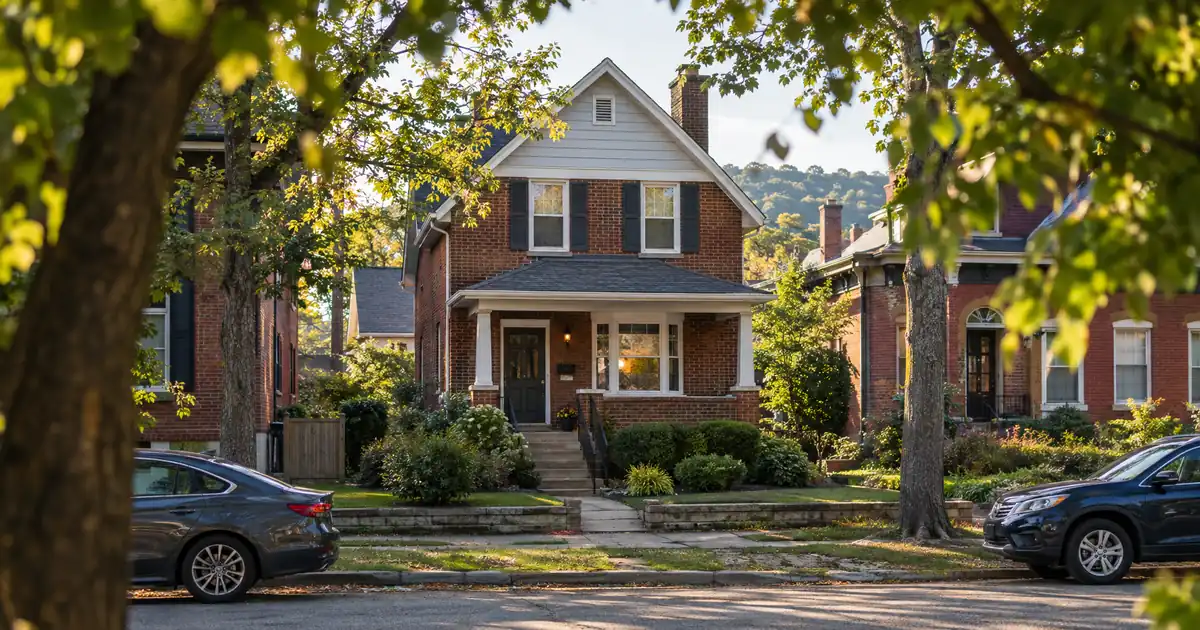
Picture an investor holding a Dutchtown duplex bought near $139,900 about a year ago, with a light rehab finished and both units leased. The question now is whether that basis can be pulled back out as capital for the next purchase, or whether the appraisal and the lease paperwork will leave the cash on the table. That is a DSCR cash-out refinance problem, and it is mostly a documentation and appraisal problem, not a qualification mystery. Through Lendmire’s DSCR program footprint, 41 markets including Washington, D.C., lenders may review qualifying rental income subject to program guidelines for St Louis, Missouri investors. Lendmire (NMLS# 2371349) is a DSCR-focused mortgage broker that arranges these loans through wholesale channels. It does not lend or approve them.
DSCR Cash-Out Calculator
Run the cash-out numbers in St Louis, MO
Rate source: Freddie Mac 30-yr average via FRED® — Federal Reserve Bank of St. Louis · effective Sep 24, 2026
Prefilled with starting assumptions — enter your property’s value, balance, taxes, and insurance for a more accurate picture.
Program parameters update from Lendmire’s centralized guideline source. Taxes and insurance are editable estimates.
As of Sep 24, 2026 · General Freddie Mac market benchmark, not a Lendmire loan offer. Property value, balance, taxes, and insurance are editable estimates. Maximum loan-to-value varies by lender, program, property type, and seasoning. Not a Loan Estimate, approval, or commitment to lend. Program availability and eligibility are subject to lender guidelines, credit approval, property review, and underwriting.
Key Takeaways:
A DSCR cash-out refinance in St. Louis, Missouri is underwritten primarily on the property’s rental income measured against its full monthly obligation, so the file turns on documented lease rents, a clean appraisal, seasoning from title recording, and reserves, with leverage held under the program’s cash-out ceiling.
- Dutchtown sells near a $139,900 median and rents near a $975 median.
- City apartment vacancy improved to 8.1 percent, so haircut rents for 7 to 10 percent vacancy.
- In-place fourplex rents often sit below renovated comps. Underwrite the lease, not the market.
- Cash-out proceeds here come mostly from forced equity, not appreciation.
St Louis Market Snapshot
A quick read on the St Louis investor landscape — figures come from the cited sources below. Confirm current property-level numbers before underwriting.
| Metric | Detail |
|---|---|
| Typical rents | $1,437 avg (Hermann London) |
| Employment | 23,434 employees (WashU Source (economic impact)) |
| Vacancy | Under 4% metro (Marcus & Millichap 2026 forecast) |
South City Is Where the Equity Gets Built
Dutchtown, Bevo Mill, and Carondelet are the strongest cash-out submarkets in the city for low-basis investors, because rent per dollar of value is high and the stock is dominated by brick 2-family and 4-family buildings. The tradeoff is that appraised value moves slowly, so the equity has to be created by the investor.
Zillow’s neighborhood pages put values at $155,335 in Bevo Mill and $131,684 in Carondelet, and Gravois Park and Mount Pleasant sit lower or similar. Those are portal ranges, not official statistics. On the rent side, Apartments.com shows Dutchtown South two-bedrooms near $903 and three-bedrooms near $1,083. A house median of $975 sits inside that band. Tenants are mostly working families and workforce renters, which tends to mean steady occupancy rather than high rents.
The property type matters as much as the neighborhood. Point2Homes reports that 49 percent of rental units in the city were built in 1939 or earlier. That is a deep inventory of small multifamily, and it helps on a cash-out file: more duplex and fourplex sales means an appraiser has real comparables rather than one-off sales to lean on. Homes.com’s multi-family search shows 416 listings averaging 37 days on market, which is portal data, but it points the same direction. Hermann London’s market commentary says 2- and 4-unit buildings in South City, Dutchtown, and Bevo Mill still trade at prices that pencil, and it flags renovation scope as the main trap.
Renovation scope is also where cash-out files get thin. If the rehab isn’t finished and the units aren’t leased, there is no rent for the lender to count in its review.
Two Scenarios, Run With Modeled Inputs
Both examples below use modeled assumptions, not market data. Coverage is rent divided by full monthly obligation including taxes and insurance, rounded down. Subject to lender guidelines, credit approval, and property review.
Scenario one: stabilized South City duplex. Say the appraised value comes in at $200,000, both units lease at $975 each (the HotPads house median used as an assumption), and the refinance is sized at 75 percent LTV. Combined rent is $1,950. Including taxes and insurance, coverage lands around 1.4x to 1.5x. That clears the standard 1.00x benchmark with room, and the room matters. It absorbs a vacancy haircut, an appraiser’s rent schedule coming in a bit under the leases, and an insurance quote that moves.
Scenario two: older fourplex, rehab half done. Run the numbers on a fourplex appraised at $250,000 with two units leased at $750 and two vacant mid-turn. A broker listing for a Gravois Park fourplex showed two units rented at $750 each, and the same page treats fourplexes in the $200s as a rare find. That is anecdotal listing copy, not statistics. At 75 percent LTV, in-place rent of $1,500 produces coverage just under 1.00x including taxes and insurance. Not ideal.
What are the options there? A lender may review a different structure: waiting until the vacant units are leased and a rent roll supports the higher number, lowering the requested leverage, or looking at a sub-1.00 program with stronger compensating factors such as reserves and credit. Whether any of those works depends on lender guidelines, credit, and the property review. The practical point is that the lease rate is what gets counted, and renovated-comp rent only helps after the units are turned. Hold the refinance until the rent roll catches up.
The Appraisal Lift Is Smaller Than You Think
Plan the refinance on stabilized rent and conservative value, because St. Louis appreciation is modest and the sources disagree about how modest. Cash-out proceeds in low-basis submarkets come mostly from rehab and rent lift.
Redfin data cited by Ark7 puts the city median sale price near $255,000, up 6.2 percent year over year. The same page cites a Zillow average value of about $188,000, down 0.4 percent. Different methodologies, different answers. Treat the truth as a range. A brokerage update citing Redfin shows the St. Louis County median up 3.6 percent with a 2 to 4 percent metro forecast. That is a county figure, not the city’s. The same update compares city price cuts at 22.8 percent against 12.4 percent in St. Charles County, and longer days on market in the city.
What does that mean for the file? An appraiser working a purchase-plus-rehab property in a city with more price cuts will want close comps before crediting the full renovation value. iBuyer’s investor dataset calls the market structurally cash-flow-oriented rather than appreciation-driven, with 68.2 percent of tracked properties priced under $250,000. It is a corporate blog with unclear methodology, so use it directionally. The takeaway is consistent across sources: size the loan on the lease income and the comps in hand, not on assumed drift.
This is a genuine toss-up for some owners. A South City investor with a big basis gap and a finished rehab will do well. An investor who bought at market and added little has less to extract. The 75 percent cap applies to appraised value either way, and available cash is not a guaranteed figure. It depends on rent used for lender review, full monthly obligation, and reserves.
Seasoning, Leverage, and Where Files Stall
On a recent purchase, cash-out generally becomes available after about six months of ownership, measured from title recording. The cash-out ceiling is 75 percent LTV, which is lower than the purchase ceiling, and the standard benchmark is 1.00x coverage on rent used for lender review against full monthly obligation. Reserves typically run about six months of that obligation, and credit tiers generally start at a 620 floor. Loan amounts go up to $3,000,000 on standard programs, with smaller balances routed through select lenders in the network. Confirm current details with Lendmire before building a plan around them.
The seasoning point is where optimistic files get kicked back. The settlement statement and recorded deed date control the clock, not the closing conversation or the date rehab started. An investor who closed a purchase in the spring and expects to refinance by midsummer should check the recording date, not the calendar feel.
Working DSCR brokers see a recurring pattern in older-housing-stock markets like this one: the coverage math is rarely what stalls the file. The leases are. Appraisers return a rent schedule that differs from signed leases, the rent roll has unit numbers that don’t match the appraisal, or an entity’s operating agreement and good-standing documents show up late. Reserves documentation and an insurance quote on century-old brick come next. A rent roll that matches the leases, entity documents in hand, and a current insurance quote before submission leave fewer preventable gaps. If the appraisal comes back light, an appraisal reconsideration packet with recent in-neighborhood sales and condition adjustments is a routine step, not an emergency one.
Entity-owned properties are common on these files, subject to lender program eligibility. Title commitments on old city parcels sometimes take extra cleanup, so clearing title early matters more than it does on newer tracts. For general program mechanics, the guide “What Is a DSCR Loan” covers the basics and the comparison lays out how this differs from conventional financing. The cash-out refinance walkthrough goes through the sequence step by step.
Benton Park, Tower Grove, and the Medical Corridor
These submarkets carry larger appraised values and thinner yield. They suit investors who want a stronger tenant profile and bigger equity numbers, and who can accept lower coverage ratios.
Zillow lists Benton Park at $278,641, Benton Park West at $183,749, and Fox Park at $278,827. Benton Park is early-20th-century brick rowhomes near the Cherokee Street arts corridor, with demand from young professionals and downtown workers. Soulard runs higher, with Redfin showing a median near $400,000. Its tenant base also drew on the former NGA campus there.
Tower Grove South, Tower Grove East, Shaw, and The Hill sit near Tower Grove Park and the Botanical Garden. Zillow’s duplex page puts values at $221,229 in Tower Grove South, $283,022 in Tower Grove East, $347,546 in Shaw, and $235,648 in The Hill. Neighborhood rents from portals are mostly apartment-weighted. RentCafe shows Shaw at $917 and Lafayette Square at $1,769, against a citywide average of $1,444, with 55 percent of households renting. Don’t use those as house comps. Underwrite block-level.
DSCR vs. conventional financing
There are two common ways to finance an investment property in St Louis, MO, and they qualify you differently — here’s how investors weigh them.
Why investors choose it
- Qualifies on the property’s rental income — no personal tax returns, W-2s, or pay stubs needed to document income.
- No personal debt-to-income ceiling to clear, so existing mortgages and obligations don’t cap your borrowing the same way.
- Can be closed in an LLC, keeping the property inside a business entity.
- Built for scaling — not held to the limit on number of financed properties that conventional financing applies.
- Underwriting centers on the deal: generally qualifies when the rent covers the payment, a 1.00x coverage ratio being a common baseline (confirmed in underwriting).
- Designed specifically for investment property, including long-term and, where the program allows, short-term rentals.
Where it’s strong
- Often the lowest ongoing financing cost for a buyer who fully qualifies on personal income — a fit for a first property or a cost-first purchase.
Trade-offs for investors
- Requires full personal income documentation and must fit within a debt-to-income limit — salary, existing debts, and other mortgages all count.
- Typically held in your personal name rather than a business entity.
- Caps how many financed properties you can carry, which can become a ceiling as a portfolio grows.
- Evaluates you as a borrower as much as the property, which usually means more paperwork.
How investors usually choose: a first or single property often optimizes for the lowest financing cost; portfolio builders often optimize for leverage, vesting in an LLC, and scaling past conventional caps. The right answer depends on your goals, the property, and current guidelines — both paths run through select lenders in Lendmire’s wholesale network, with eligibility and terms confirmed in underwriting.
Medical and university demand is the anchor here. Washington University reports 23,434 employees, and its enrollment is 15,952. The WashU Medicine campus is listed with more than 26,000 employees on an older page, so read that as approximate. Physicians, residents, nurses, and researchers form a stable renter pool around the Central West End, Cortex, and Forest Park Southeast. That demand supports longer tenancy, though it also pushes prices up, which compresses coverage. If the coverage number is thin at 75 percent, expect a lender to review lower leverage rather than a lower floor.
The NGA Move (What It Does and Doesn’t Do)
The National Geospatial-Intelligence Agency’s new West campus is the one local development with no real parallel elsewhere in Missouri, and it reshapes both ends of the city. Treat it as a demand story that is still being priced in, not a basis for underwriting rent growth.
The NGA’s own release says the campus opened in September in north St. Louis, and the NGA West page lists about 3,150 staff relocating from Soulard. A contractor release puts the cost at $1.7 billion and calls it the largest federal investment in city history. That creates a tenant pool with clearances and steady federal employment, plus a redevelopment story for St. Louis Place and Hamilton Heights, and an open question for Soulard now that the old campus is emptying.
Here is where caution applies. No reliable price or rent source exists for the north-side neighborhoods near the campus, so any investment thesis there is speculative. A lender’s appraiser will work from sales and rents that exist today, not from where the area might go. If a North City property is the refinance candidate, expect conservative value and plan for it. In Soulard, the question is whether tenant demand holds as the campus empties. Honestly, that is a risk, and the appraisal will treat it that way.
What’s the Catch on Vacancy and Jobs?
The catch is that the city’s vacancy runs higher than the metro’s and job growth is flat, so rent haircuts should be real. Supply relief helps, but it is not a growth case.
Colliers data in GlobeSt shows city apartment vacancy improving from 9.4 percent to 8.1 percent, with Central West End and Forest Park at 7.3 percent. Metro occupancy is 95.5 percent. For DSCR files, that argues for a vacancy factor in the 7 to 10 percent range rather than leaning on the metro’s tighter number. That is apartment data, so small-multifamily and house rentals behave differently, but it is the best sourced city figure available.
On the supply side, Northmarq forecasts about 1,200 units delivered, nearly 60 percent below the trailing five-year average, and its supply report shows middle- and lower-tier rents up nearly 3.0 percent. Rent growth sources range from about 1.9 to 3.1 percent. Call it low-to-mid single digits. The counterweight: Yardi Matrix reports job growth down 0.2 percent year over year, and metro occupancy of 93.4 percent trailing the national figure. Those are different measures from Colliers’, so don’t mix them in one model.
Population points the same direction. The Census Bureau puts the city at 279,695, down 7.2 percent from the 2020 base of 301,371, and median household income is $53,374. A shrinking city with flat jobs is a reason to underwrite the lease, not the pro forma.
Rent Per Dollar of Value, and Where the Proceeds Go
City stock carries more rent per dollar of value than the suburbs, which is why coverage clears more easily in the city. One local investor-buyer blog puts the city rent-to-price ratio near 0.61 percent versus 0.47 percent in St. Charles County. It compiles MARIS and Zillow data, so treat it as directional. Hermann London adds a city median near $261,000 against a metro average rent of $1,437. Rent sources vary: RentCafe shows a $1,444 citywide average, and Zumper shows $1,295. Use the range.
Once proceeds are out, the redeployment choice is between more South City small multifamily and an inner-ring play like Affton, where Zillow lists ZIP 63123 near $247,265. The inner-ring option trades lower yield for longer tenancy and lower vacancy. The stronger cash-flow play is probably more South City brick. Investors who want lower volatility could argue for the inner ring.
Whichever way it goes, the refinance is a capital step, not a result. Lendmire’s refi programs cover the structures available, and the state hub on DSCR loans in Missouri covers the broader footprint. Investors can request a quote at 828-256-2183 or through the quote form. Check current local rental rules, taxes, and insurance with qualified local professionals before sizing a deal.
Frequently Asked Questions
How do you qualify for a DSCR cash-out refinance in St Louis, Missouri?
The property’s rent used for program review has to cover its full monthly obligation, including taxes and insurance, at the standard 1.00x benchmark or better, subject to lender guidelines. The borrower typically needs a credit score at or above a 620 floor, about six months of ownership from title recording, and about six months of reserves. Leases, a rent roll, and an appraisal rent schedule are the core exhibits.
What are the requirements for an investment property cash-out refinance in St Louis, Missouri?
Cash-out is capped at 75 percent of appraised value, and the available cash depends on rent used for eligibility review, the full monthly obligation, and reserves. Loan amounts run up to $3,000,000 on standard programs. Manufactured homes, log homes, and barndominiums are outside these programs. Entity-owned properties are common, subject to program eligibility, so have operating agreements and good-standing documents ready.
How much equity can you realistically pull from a South City duplex or fourplex?
Less than the headline value suggests. The 75 percent ceiling applies to appraised value, and with modest appreciation and a higher share of price cuts in the city, the appraisal often credits renovation value only when close comps support it. Underwrite the signed leases, not renovated-comp rents, until the units are turned. Equity from forced rent lift is more reliable than equity from market drift.
Does the NGA West campus change what a St. Louis appraiser will credit?
Not directly. Appraisers work from recorded sales and current rents, and no reliable price or rent source exists yet for the north-side neighborhoods near the campus. The move adds a stable federal tenant pool and a redevelopment story, but a refinance on a North City property should still assume conservative value. Soulard is the opposite question: whether demand holds as the old campus empties.
Can a self-employed investor buying in St Louis be reviewed for DSCR financing?
Yes, subject to lender guidelines. Lendmire arranges DSCR investor loans through wholesale channels. The review centers on the property’s rental income rather than personal income documentation, which is why self-employed and entity-owned investors use it.
For current guidelines and terms, see Lendmire’s DSCR loan programs page.
Get Started
Ready to find the right loan for you?
In about 30 seconds you can review financing options available for your investment property. No commitment required.
Informational only. Not a Loan Estimate, approval, or commitment to lend. Program availability and eligibility are subject to lender guidelines, credit approval, property review, and underwriting.
About Lendmire
Lendmire, NMLS# 2371349, is a mortgage brokerage focused on DSCR investor loans, arranging financing across 41 markets, Washington, D.C. included, through wholesale and investor-lending channels. The lender reviews the property’s rental income instead of W-2 documentation, subject to lender guidelines, which suits entity-owned and multi-property investors. Lendmire has been recognized as a 2026 Scotsman Guide Top Mortgage Workplace and a 2025 Scotsman Guide Top Workplace.
The investors who get their leases signed, their rent rolls clean, and their rehabs finished in South City before they order the appraisal will pull the most capital out of that brick.
References
1. Freddie Mac 30-yr average via FRED® — Federal Reserve Bank of St. Louis
3. $975 median
4. 8.1 percent
6. WashU Source (economic impact)
7. Marcus & Millichap 2026 forecast
8. $155,335 in Bevo Mill and $131,684 in Carondelet
10. Point2Homes
11. 416 listings averaging 37 days on market
12. two units rented at $750 each
This article is part of Lendmire’s investment property cash-out refinance program — full qualification details, guidelines, and scenarios live on the program page.
Related reading: DSCR Loans in St. Louis, Missouri: Investor Financing for Soulard, The Hill, Dutchtown & Real Estate Investors · Investment Property Loans in St. Louis, MO: The 2026 DSCR Financing Guide · Cash Out Refinance Investment Property Missouri
Guides: Investment Property Cash-Out Refinance in Missouri
Brandon Miller
Founder & CEO, Mortgage Loan Originator, Lendmire LLC
- Mortgage Loan Originator · NMLS# 1129696 · Verify on NMLS Consumer Access
- North Carolina Real Estate Broker · License# 343312 · Verify on NCREC
- North Carolina Insurance Producer · License# 19053198 · Property, Casualty, Life, Health · Verify on NAIC SBS
- Lendmire LLC · Firm NMLS# 2371349 · Verify firm licensure
Legal disclosures. Lendmire (NMLS# 2371349) is a state-licensed mortgage brokerage that arranges financing through wholesale lender relationships. Lendmire is not a direct lender, depository institution, or registered financial advisor. The discussion above is general informational content about real estate financing — it is not financial, legal, or tax advice, and readers should consult licensed professionals for guidance on their individual circumstances. Loan inquiries are subject to lender underwriting; this article does not represent a commitment to lend. Loan terms, rates, and qualification standards vary by borrower, property, and state, and are subject to change at any time. Equal Housing Opportunity. NMLS Consumer Access: nmlsconsumeraccess.org.