
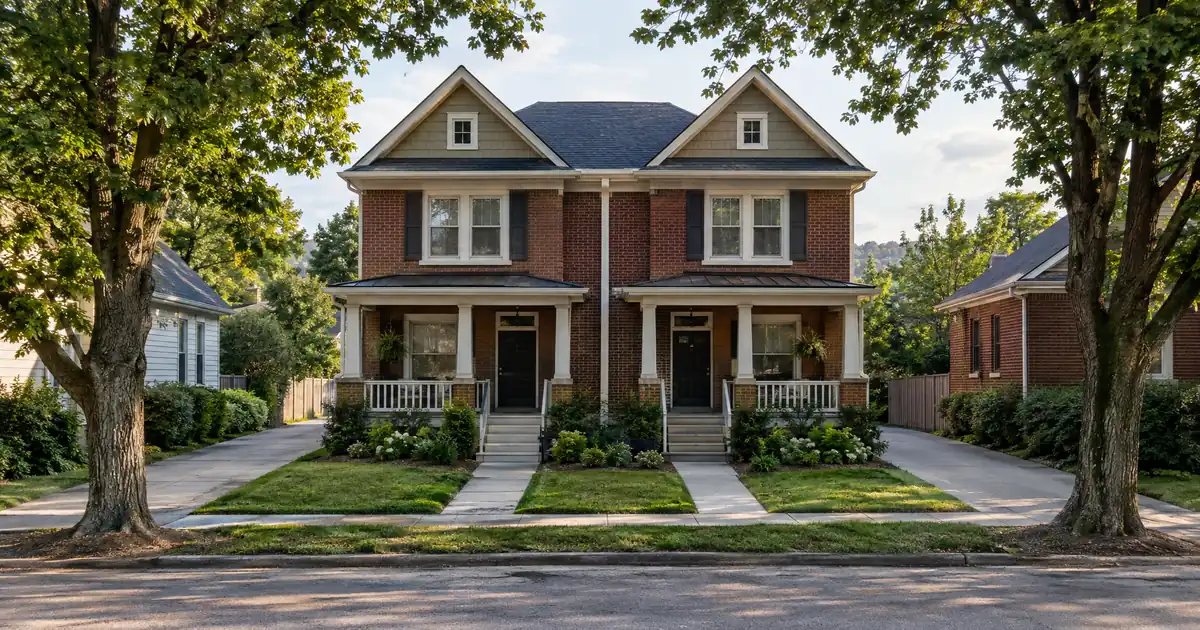
Most investors size up Covington by its median single-family rent and move on. That’s the wrong lens. The cash-out story here lives in two-unit buildings, where two leases stack on one appraisal. The single-family numbers, honestly, are thin.
For real estate investors in Covington, Kentucky, Lendmire helps structure and place DSCR financing through wholesale lenders operating in 41 markets, including D.C. (NMLS# 2371349). This piece is about pulling equity out of a Covington rental you already own: which buildings support a bigger balance, where the 75 percent LTV ceiling actually bites, and why a market with modest appreciation rewards the investor who bought right rather than the one who waited.
DSCR Cash-Out Calculator
Run the cash-out numbers in Covington, KY
Rate source: Freddie Mac 30-yr average via FRED® — Federal Reserve Bank of St. Louis · effective Sep 24, 2026
Prefilled with starting assumptions — enter your property’s value, balance, taxes, and insurance for a more accurate picture.
Program parameters update from Lendmire’s centralized guideline source. Taxes and insurance are editable estimates.
As of Sep 24, 2026 · General Freddie Mac market benchmark, not a Lendmire loan offer. Property value, balance, taxes, and insurance are editable estimates. Maximum loan-to-value varies by lender, program, property type, and seasoning. Not a Loan Estimate, approval, or commitment to lend. Program availability and eligibility are subject to lender guidelines, credit approval, property review, and underwriting.
TL;DR: A DSCR cash-out refinance in Covington, Kentucky is underwritten primarily on the property’s rental income measured against its full monthly obligation, with the amount available set by appraised value, documented rents and the lender’s LTV cap rather than the investor’s personal income.
- Latonia duplexes list at combined rents of roughly $1,745 to $2,480 per Homes.com listings.
- Single-family at the local median runs just under 1.00 coverage on modeled math.
- Cash-out leverage tops out at 75 percent LTV after about six months of ownership.
- Price growth is modest, so purchase basis and rent documentation drive proceeds.
Covington Market Snapshot
A quick read on the Covington investor landscape — figures come from the cited sources below. Confirm current property-level numbers before underwriting.
| Metric | Detail |
|---|---|
| Typical rents | $1,447 (Homes.com, Covington rentals) |
| Employment | Nearly 4,700 employees (Kentucky Cabinet for Economic) |
Latonia Duplexes Carry the Cash-Out Math
Latonia is the strongest cash-out submarket in Covington on the evidence available. The neighborhood is full of duplexes and bungalows, and the listings show real two-lease income. Stacked rent on one appraisal is what lets a small building support a balance a single-family house can’t.
Current Homes.com multi-family listings show a Latonia duplex with a 2BR and a 1BR unit generating $2,480 per month. Another duplex near the Latonia business district shows two units producing a combined $1,745. A Ritte’s East Latonia duplex with separate utilities except water lists combined income of $1,995, per Redfin’s neighborhood page. These are asking-price listings with landlord-stated rents, not closed comps. The appraiser’s rent schedule will control.
Run the numbers on a modeled $250,000 duplex at 75 percent LTV on a 30-year amortization. These are assumptions, not sourced figures. Coverage including taxes and insurance lands around 1.15 at the $1,745 rent, about 1.3 at $1,995 and about 1.6 at $2,480. Standard programs are built around a 1.00 baseline, and the low end of that Latonia range clears it with some cushion. The high end is comfortable.
Be skeptical of the top of the range, though. The $2,480 listing is one building. The $1,745 figure is a better planning number if you don’t yet have a rent roll.
Latonia rewards the landlord who actually documents rents. Leases, deposits and a clean rent ledger do more for the file than a bullish appraisal.
Austinburg: Cheaper Basis, Thinner Evidence
Austinburg is where rent relative to price looks strongest on paper, and where the evidence is thinnest. Homes.com’s Austinburg page shows multi-family homes from $190,000 to $250,000 and a median home price of $205,900 as of its last update. Redfin’s vintage-home page shows a lower median listing price near $180K, but that’s a small sample and shouldn’t anchor anything.
Pair that basis with RentCafe’s Yardi Matrix averages of $1,410 for a one-bedroom and $1,646 for a two-bedroom. One of each grosses about $3,000 a month, or roughly 1.2 to 1.6 percent of the Austinburg price range. That’s my arithmetic on citywide apartment averages, not a rent roll for an aging Austinburg duplex. Treat it as a hypothesis to test against real leases.
Here’s the catch. A low basis helps the investor who bought there but doesn’t manufacture equity on its own. If you purchased near the neighborhood median and haven’t touched the building, the cash-out window may be narrow. The Austinburg investor who bought below market or renovated is the one with room under the LTV cap.
Westside and the Five-Unit Outlier
The Westside is brick-duplex territory: one-bedroom on the first floor, a large studio with a bonus room above, in one current listing. It’s a small-multifamily target by construction, but there’s no sourced price or rent figure, so skip any neighborhood rent claims you can’t document yourself.
The more interesting listing is a five-unit building of one-bedroom apartments with separately metered utilities and nearly $40K of annual NOI, per the same Homes.com feed. Separate meters matter for underwriting because they keep the landlord’s operating costs clean. Five-unit buildings also tend to get reviewed differently than one-to-four-unit files, so the program track can change. That’s a conversation to have before the appraisal is ordered, not after.
Skip List: MainStrasse, Wallace Woods, Kenton Hills
MainStrasse Village is a genuine draw, with Oktoberfest and the dining strip, but it has no sourced price or rent data and the building stock is older and attached. Don’t build a cash-out thesis on atmosphere. Wallace Woods is 1920s bungalows and Tudor-style single-family. South Covington and Kenton Hills lean newer single-family and townhouses. All three point you toward single-family math, which brings us to the harder conversation.
Why Single-Family Cash-Outs Struggle Here
Covington’s single-family numbers don’t carry a higher balance. Homes.com reports a median home rent of $1,447 against a median home price near $250,000, about 0.58 percent monthly rent-to-value. Redfin puts the average house price lower, at $232K, reflecting a different methodology. On the $250,000 figure at 75 percent LTV, coverage including taxes and insurance comes out slightly below 1.00, around 0.95 on the modeled assumptions above.
Sub-1.00 files get harder, not impossible. A lender may review a sub-1.00 program, an interest-only structure, or lower leverage with stronger credit and more reserves. Each option changes pricing and cash out, and qualification stays subject to lender guidelines, credit approval and property review. The simpler play is usually the one the market suggests: hold single-family for appreciation and do the cash-out on the duplex.
Single-family detached is 55.24 percent of the city’s 18,293 housing units per NeighborhoodScout. The other roughly 45 percent is attached, multifamily and other. That mix is why small multifamily exists at scale here.
The Equity Mechanics: Seasoning, Appreciation and the 75 Percent Cap
Cash-out proceeds in Covington come from basis and rent documentation, not market lift. Redfin shows the average house price up just 2.5 percent year over year and rates the market “very market-rate” at 76 out of 100, per its Covington housing market page. RentCafe shows rents up about 0.62 percent over the same stretch. Nobody is getting rescued by a hot appraisal.
Most programs here look for about six months of ownership measured from title recording before cash-out, and the ceiling is 75 percent LTV. How the cash-out works depends on the appraised value, rent used for lender review against the full monthly obligation, and reserves of about six months. Credit tiers typically run from a 620 floor upward, and stronger credit generally improves pricing and leverage. Equity available is never a guaranteed figure.
Picture an investor with a Latonia duplex whose existing payoff sits well below the appraised value. The 75 percent LTV cap leaves a meaningful slice of value to work with, before reserves and closing costs and subject to the coverage ratio clearing on the appraiser’s rent schedule. Now picture the same investor who bought at full market price with a payoff above the program ceiling. There’s no cash-out available. That gap is the difference between buying right and buying at retail.
DSCR files in markets like this one typically look like a 1.10 to 1.30 coverage story on small multifamily, with the file decided by rent documentation rather than the appraisal headline. Brokers see a pattern: owners who can show signed leases and consistent deposits clear coverage with fewer surprises than owners relying on asking rents. Balances on older two-unit buildings also tend to be modest, and smaller balances route through select lenders in the network rather than standard programs, which matters for lender selection.
The guide “What Is a DSCR Loan” is the short version: monthly rent divided by the full monthly obligation, including principal, interest, taxes, insurance and any HOA dues. The investor refinance breakdown walks through the refinance types side by side. Kentucky DSCR financing covers the state-level program picture.
Old Buildings, Appraisals and Capital Repairs
Covington’s rental stock is old. Per Point2Homes, 36 percent of apartment rentals were built in 1939 or earlier, and another 15 percent date to the 1950s. The historic duplexes are the upside and the risk at once.
An appraiser and inspection will look hard at condition. Deferred maintenance can cap the value supporting your cash-out, regardless of what the rent roll says. Budget for capital repairs before you order the appraisal, not after a low number comes back. (A fresh roof and updated electrical will do more for an appraisal than a nicer listing photo.)
Who’s Renting, and Why the Demand Holds
The renter pool sits in the price band these duplexes serve. RentCafe counts 8,875 renter-occupied households in Covington, 49 percent of the total. Point2Homes finds 34.13 percent of apartments priced between $1,000 and $1,500, the largest band, and one-bedrooms are the biggest share at 40 percent. A duplex running about $1,000 per unit sits in the deepest part of that pool.
The city itself isn’t growing. Census Bureau QuickFacts puts the population at 41,110, and biggestuscities.com shows it about 5.8 percent below the 1990 peak of 43,635. Demand here is about jobs and price point, not population growth.
Data USA lists retail trade (2,853), manufacturing (2,579) and health care and social assistance (2,524) as the top resident employment sectors. Fidelity Investments is the anchor. A Kentucky Cabinet for Economic Development release put the company at nearly 4,700 professionals in the Covington area, and later NKyTribune reporting put it at 5,700 and called it the city’s largest employer. Call it roughly 5,000 or more. The same reporting flagged the remote-work trend as a risk to the city’s employer base. That’s a demand-risk note worth carrying.
St. Elizabeth Healthcare operates a Covington facility. Gateway Community & Technical College has a Covington campus. Covington is not a student-rental market, so don’t underwrite it like one.
The Brent Spence Wildcard
This one’s a genuine toss-up. The Brent Spence Bridge Corridor project began heavy construction this spring, and the existing bridge will be restriped to three lanes and carry only local traffic. Equipment World reports the total price tag has grown from $3.6 billion to $4.4 billion. The Kentucky Transportation Cabinet cites construction jobs at $30 per hour. The new bridge is expected to open several years out.
The bull case is a workforce tenant pool. The bear case is years of disruption on the city’s doorstep. There’s no evidence yet on rent or value effects, so don’t underwrite either one. Run the coverage on in-place leases and let the bridge be upside if it comes.
DSCR vs. conventional financing
There are two common ways to finance an investment property in Covington, KY, and they qualify you differently — here’s how investors weigh them.
Why investors choose it
- Qualifies on the property’s rental income — no personal tax returns, W-2s, or pay stubs needed to document income.
- No personal debt-to-income ceiling to clear, so existing mortgages and obligations don’t cap your borrowing the same way.
- Can be closed in an LLC, keeping the property inside a business entity.
- Built for scaling — not held to the limit on number of financed properties that conventional financing applies.
- Underwriting centers on the deal: generally qualifies when the rent covers the payment, a 1.00x coverage ratio being a common baseline (confirmed in underwriting).
- Designed specifically for investment property, including long-term and, where the program allows, short-term rentals.
Where it’s strong
- Often the lowest ongoing financing cost for a buyer who fully qualifies on personal income — a fit for a first property or a cost-first purchase.
Trade-offs for investors
- Requires full personal income documentation and must fit within a debt-to-income limit — salary, existing debts, and other mortgages all count.
- Typically held in your personal name rather than a business entity.
- Caps how many financed properties you can carry, which can become a ceiling as a portfolio grows.
- Evaluates you as a borrower as much as the property, which usually means more paperwork.
How investors usually choose: a first or single property often optimizes for the lowest financing cost; portfolio builders often optimize for leverage, vesting in an LLC, and scaling past conventional caps. The right answer depends on your goals, the property, and current guidelines — both paths run through select lenders in Lendmire’s wholesale network, with eligibility and terms confirmed in underwriting.
Where the Proceeds Go
The point of a cash-out is the next deal. Covington investors typically recycle proceeds into another small multifamily in Latonia or Austinburg, or into a value-add rehab that widens the next refinance window. Given modest appreciation, the logic only works if the next property is bought well. A cash-out that funds a retail-price purchase just moves the same thin margin to a second building.
On the comparison with conventional financing: DSCR files qualify on property income and usually have no financed-property cap to hit, which is what makes recycling possible. LLC-titled holdings are reviewed per lender program requirements. To talk through a specific duplex, reach Lendmire at 828-256-2183. Investors should verify current local rental rules, taxes and insurance with qualified local professionals.
What a Local Appraiser Would Tell You
Covington is a duplex town. The brick two-unit on a Latonia or Westside block, bought at a fair price and leased on paper, is what refinances cleanly. The house priced at market with a single lease, in a city that isn’t growing, is the one you hold and wait on.
Frequently Asked Questions
How do you qualify for a DSCR cash-out refinance in Covington, Kentucky?
Qualification centers on the property’s rent against its full monthly obligation, with 1.00 as the common baseline. Lenders also review credit (typically a 620 floor with stronger tiers improving terms), about six months of reserves and roughly six months of ownership from title recording. All of it is subject to lender guidelines and the property review.
What are the requirements for a cash-out refinance on a Covington duplex?
Expect a cap of 75 percent LTV, a current appraisal and a documented rent schedule. The lender weighs those against taxes, insurance and any HOA dues. Condition matters on older Covington stock, since deferred maintenance can lower the appraised value.
How long do you have to own a Covington rental before cashing out?
Most programs look for about six months of ownership, measured from title recording. With modest price growth in Covington, the six-month mark rarely produces equity on its own. Buying below market or renovating is what creates the window.
Does Covington’s slow appreciation limit how much equity I can pull?
Yes. With average prices up about 2.5 percent year over year, the appraisal rarely jumps. Cash-out depends on purchase basis, renovations and how well the rent roll is documented.
Can Lendmire help investors explore DSCR financing for properties outside Kentucky?
Yes. Lendmire arranges DSCR investor loans for properties outside Kentucky as well. Programs are generally built around qualifying on the property’s rental income rather than personal income documents, subject to lender guidelines.
About Lendmire
Lendmire — NMLS# 2371349 — is a DSCR and non-QM mortgage brokerage with investor loan programs in 41 markets, including Washington, D.C. DSCR eligibility is commonly reviewed by the lender on property-level rent rather than personal income documentation, subject to lender guidelines, and the brokerage helps arrange financing for LLC-owned portfolios beyond conventional financed-property limits. Recognized by Scotsman Guide as a 2026 Top Workplace and a top-ranked workplace in 2025.
Get Started
Ready to find the right loan for you?
In about 30 seconds you can review financing options available for your investment property. No commitment required.
Informational only. Not a Loan Estimate, approval, or commitment to lend. Program availability and eligibility are subject to lender guidelines, credit approval, property review, and underwriting.
References
1. Homes.com Covington multi-family listings
2. Homes.com Covington rentals
3. Kentucky Cabinet for Economic Development release
5. Homes.com Austinburg multi-family
6. RentCafe Covington average rent
8. Redfin Covington housing market
9. Point2Homes Covington average rent
11. Data USA
12. NKyTribune
14. Gateway Community & Technical College
15. Brent Spence Bridge Corridor fact sheet
16. Equipment World
17. Recognized by Scotsman Guide as a 2026 Top Workplace
18. Scotsman Guide — Top Workplaces 2025
This article is part of Lendmire’s investment property cash-out refinance program — full qualification details, guidelines, and scenarios live on the program page.
Related reading: Luxury Rental DSCR Loans In New Jersey · Jersey Shore Vacation Rental Loans: DSCR Financing In Ocean City, Cape May And Long Beach Island · DSCR Cash-out Refinance In New Jersey: Pulling Equity From A Rental
Guides: Investment Property Cash-Out Refinance in Kentucky
Brandon Miller
Founder & CEO, Mortgage Loan Originator, Lendmire LLC
- Mortgage Loan Originator · NMLS# 1129696 · Verify on NMLS Consumer Access
- North Carolina Real Estate Broker · License# 343312 · Verify on NCREC
- North Carolina Insurance Producer · License# 19053198 · Property, Casualty, Life, Health · Verify on NAIC SBS
- Lendmire LLC · Firm NMLS# 2371349 · Verify firm licensure
Compliance and disclosures. Lendmire (NMLS# 2371349) is a licensed mortgage broker and is not a direct lender, depository institution, financial advisor, or tax professional. Content in this article is general market analysis and educational information — not financial, legal, or tax advice for any specific situation. Lendmire does not guarantee loan approval; every transaction is subject to underwriting by the funding lender. Mortgage pricing and loan program guidelines are subject to change at any time without notice and vary by borrower characteristics, property type, and state regulations. Lendmire complies with Equal Housing Opportunity. Licensure verification: NMLS Consumer Access.