
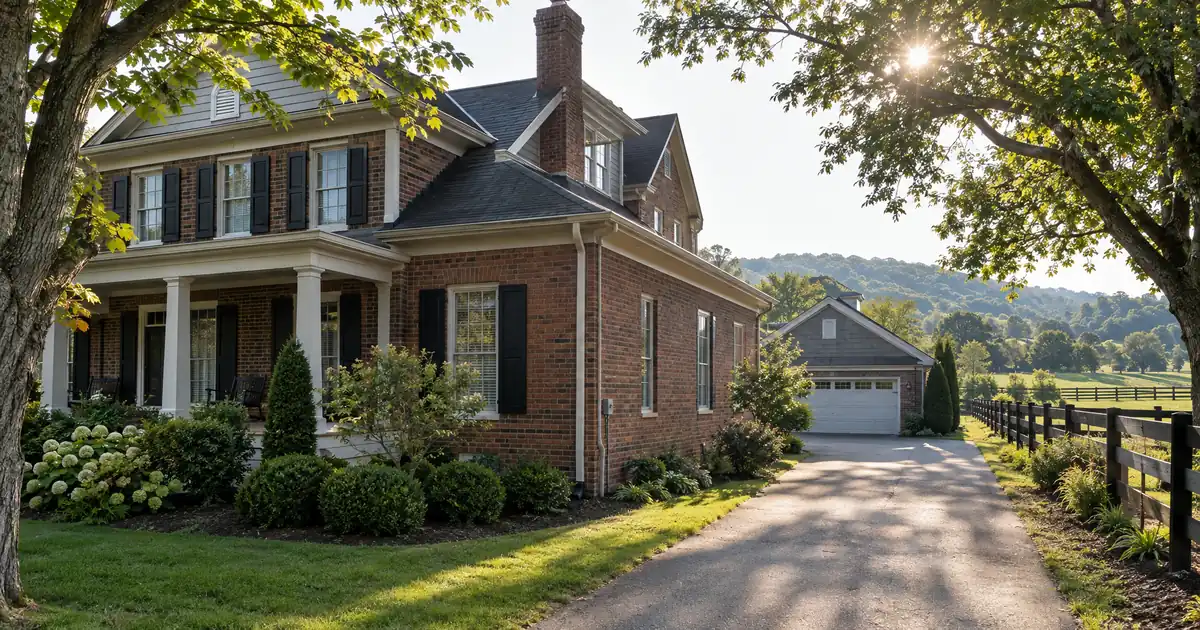
Bardstown’s median property value moved up 6.66% in a single year, from $190,800 to $203,500, according to Data USA. That is the number a cash-out file starts from. It tells an owner the equity is growing, and it also shows how small the base is. A $203,500 house renting near $1,008 a month is a different file from a duplex with two 2BR doors, and the gap between the two is what this article is about.
DSCR Cash-Out Calculator
Run the cash-out numbers in Bardstown, KY
Rate source: Freddie Mac 30-yr average via FRED® — Federal Reserve Bank of St. Louis · effective Sep 24, 2026
Prefilled with starting assumptions — enter your property’s value, balance, taxes, and insurance for a more accurate picture.
Program parameters update from Lendmire’s centralized guideline source. Taxes and insurance are editable estimates.
As of Sep 24, 2026 · General Freddie Mac market benchmark, not a Lendmire loan offer. Property value, balance, taxes, and insurance are editable estimates. Maximum loan-to-value varies by lender, program, property type, and seasoning. Not a Loan Estimate, approval, or commitment to lend. Program availability and eligibility are subject to lender guidelines, credit approval, property review, and underwriting.
At a Glance:
A DSCR cash-out refinance in Bardstown, Kentucky is underwritten primarily on the property’s rental income measured against its full monthly obligation, with the appraisal setting value and the rent schedule setting qualifying income. The owner pulls equity from a rental already held, then redeploys it.
- Small multifamily and converted buildings make up 13.57% of local housing units.
- Single-family detached homes are the majority of stock, but their rents run thin against value.
- Cash-out is capped at 75% LTV, with about 6 months of seasoning from title recording.
- Portal rent averages disagree widely, so the appraiser’s rent schedule decides the file.
- Distilleries, factories, and a hospital anchor tenant demand without a student base.
- Final terms depend on lender guidelines, property type, leverage, and the borrower’s complete credit picture.
Bardstown Market Snapshot
A quick read on the Bardstown investor landscape — figures come from the cited sources below. Confirm current property-level numbers before underwriting.
| Metric | Detail |
|---|---|
| Typical rents | $873 avg (Apartments.com Bardstown) |
| Employment | 38 jobs (Kentucky Cabinet for Economic) |
Small Buildings Off Dixie Highway Are Where the Ratio Improves
The strongest cash-out candidates in Bardstown are duplexes and small converted apartment buildings, and the corridor around Dixie Highway and Algonquin Parkway is where apartment-style workforce housing shows up in the listings. No neighborhood-level rent or price series exists for this town, so treat the corridor as a place to look, not a place with published numbers.
The housing-stock data does back the property-type call. NeighborhoodScout puts duplexes, homes converted to apartments, and other small apartment buildings at 13.57% of Bardstown’s housing units, against 69.64% for single-family detached. Small multifamily is a minority of stock but a real one. It is also the stock type that stacks rent against one payment.
RentCafe reports that none of Bardstown’s rentals sit in buildings of more than 50 units. It has 68% in complexes under 50 units and 32% as single-family rentals, with 2BR floorplans at about 64% of rentals and 1BRs at 27%. Read that as a small-scale, 2BR-heavy market. A duplex with two 2BR doors matches what tenants here already rent. The catch is comps: with no large complexes, an appraiser pricing a fourplex has a thinner set to pull from.
Rents on those 2BR doors vary by stock age. RentCafe puts market-rate 2BR apartments at $1,300 to $1,490. HUD Housing Network shows wider listing bands of $714 to $1,072 for 2BR and $1,006 to $1,510 for 3BR. Those sources mix old and new buildings, so these are bands, not comps. Still, the direction is clear. Doors at the top of the band lift a small building’s coverage. Doors at the bottom drag it down.
Here is a modeled example, not a market fact. Say you own a duplex appraised near $300,000 with two 2BR units at $1,300 each. At the 75% LTV ceiling, including taxes and insurance in the full obligation, coverage lands above 1.2x. Drop both doors to the bottom of the HUD band and the same file moves toward 1.0x. Same building, different rent schedule. That is why the rent schedule matters as much as the value. These specifics are subject to lender guidelines and a full review of property, leverage, and credit.
Why a Single $203,500 House Struggles at 75% LTV
Terms vary by lender guidelines, property type, leverage, credit profile, and full file review.
A median house renting at the median does not clear 1.00 on a cash-out. Median gross rent of $1,008 from City-Data against a median value of $203,500 works out to roughly 0.5% of value per month. That arithmetic combines two sources and is not a published ratio.
Run it as a modeled case. Assume a single-family rental valued at the median and rented at the median. At 75% LTV, with principal, interest, taxes, and insurance all counted, coverage comes out around 0.8x. That is below the 1.00 benchmark most standard DSCR programs are built around, because rent does not cover the full obligation at that level. Exact terms depend on the lender’s guidelines, property type, leverage, and a full review of the borrower’s file.
Sub-1.00 is not a dead end, but it is a different conversation. A lender may review a sub-1.00 program, an interest-only structure, or a lower LTV that shrinks the obligation. Each comes with its own reserve, pricing, and leverage terms, and eligibility depends on lender guidelines, credit profile, reserves, and property review. None of it is automatic.
Move the same house up the rent band and the picture changes. A 3BR renting near the top of the HUD band, around $1,500 in this model, pushes coverage toward 1.2x. The 3BR is the most common dwelling size here, which makes this the realistic play for single-family owners: a well-kept 3BR with a rent schedule near the high end, not a median unit at a median rent.
One more mechanic worth seeing. Pulling cash out raises the loan balance, so the monthly obligation rises, so coverage falls compared with the original loan. A property that covered at 1.3x on the old balance can cover at 1.1x after a 75% cash-out. Run the post-refinance number, not the current one. Every figure here varies by lender and program — guidelines, property type, leverage, and credit profile all apply.
How the Equity Pull Works, Step by Step
The mechanics follow a fixed order, and most friction comes from skipping a step. Here is the sequence for an owner who already holds the property.
1. Confirm seasoning. The network’s programs typically look for about 6 months of ownership, measured from title recording. The settlement statement from the purchase is the document that proves it.
2. Pull the current lease or leases. Gather lease evidence for each unit, and prepare a clear rent roll for any building with more than one door. Vacant units need a market-rent basis instead.
3. Order the appraisal with a rent schedule. The appraiser’s Form 1007 sets rent used for lender review on most files. A portal average does not.
4. Size the cash-out against the LTV ceiling. The cap is 75% of appraised value on a cash-out, never the 80% used on purchases. Whatever is left after the existing payoff and closing costs is the equity available. It is not a guaranteed figure.
5. Run coverage on the new balance. Full PITIA on the new loan, against the rent used for lender review. Typical programs use a 1.00 minimum, subject to lender guidelines.
6. Document reserves. About 6 months of PITIA is typical, stepping up to about 9 months above $1,500,000. Bank statements showing the funds, in the borrower’s or entity’s name.
7. Clear title. Any prior liens, mechanics’ claims, or entity-name mismatches get resolved before the file goes to final review.
The DSCR qualification mechanics page covers the ratio itself in more detail, and the cash-out refinance walkthrough covers the extraction process in full. Credit is reviewed in tiers, with 620 as the floor and pricing and leverage generally improving at 660, 680, and 700. Standard programs go up to $3,000,000, and smaller balances route through select lenders in the network. Bardstown balances will mostly fall in that smaller category. All of this is subject to lender guidelines, and program details should be confirmed before a file goes in.
Where Bardstown Files Come Apart
Portal rent data is the quiet killer on small-town files. Average asking rents for Bardstown differ by aggregator: $873 from Apartments.com, $1,060 from HUD Housing Network, $1,253 from RentalSource, and $1,375 from RentCafe. That is a spread of roughly 58% between the lowest and highest.
An investor who pencils coverage off the $1,375 figure and then gets an appraiser’s rent schedule closer to $1,000 has a coverage problem. Lenders underwrite to the appraisal, not to a listing site. Build the pro forma off local comps and lease evidence, and expect the appraiser’s number to govern.
DSCR files in markets like this one typically look like a small balance, a thin comp set, and a rent schedule that sits closer to the low end than the owner expects. The files that clear tend to carry a lease at or near market, clean entity documents, and reserves already sitting in an account. The files that stall usually have an owner-estimated rent that the appraiser did not support and a reserve balance that did not match the requirement on paper.
Three other failure points show up repeatedly:
- Stale-dated leases. A month-to-month tenant with no written lease leaves the rent schedule doing all the work.
- Appraisal comps on older stock. Converted buildings and older duplexes in town often lack recent like-kind sales. A documented appraisal reconsideration request, with in-neighborhood sales and condition adjustments, is a routine step, not a crisis.
- Seasoning assumptions. A recent purchase does not meet the ownership period just because the closing was a while ago. The recorded title date governs.
On vacancy, the Census figures cited on Wikipedia show a rental vacancy rate of 5.9%, with overall housing vacancy at 7.1%. The data comes from the last decennial count, so it is not current. It does support underwriting vacancy in a moderate band for correctly priced units, and RentalSource describes the market as market-rate with strong renter demand. Both are aggregator-level reads, so cite them cautiously.
Many non-QM platforms require reserves that an investor’s file may not meet, so the broker’s work is matching the file to a lender whose reserve and leverage terms fit. On small Bardstown balances, that matters more than it does on a large metro file.
Who Actually Rents Here
Tenant demand in Bardstown rests on manufacturing, distilling, and healthcare, and none of it depends on a campus. Data USA lists Manufacturing (1,322), Health Care and Social Assistance (1,019), and Retail Trade (756) as the largest sectors for Bardstown residents. The average commute is 20.5 minutes, which keeps in-town rentals market-rate against the county.
The employer list is industrial and bourbon-heavy. One Louisville names American Fuji Seal, Tower International, Heaven Hill Distilleries, Sazerac Distillers, Toyota Boshoku Kentucky, Johnan America, ORBIS Corporation, and Flowers Foods among Nelson County employers. No headcounts were found for any of them, so the list says something about diversity, not scale.
Bourbon is a real local factor. The City of Bardstown lists six distilleries in town: Heaven Hill, Barton Brands, Willett, Preservation, Bardstown Bourbon Company, and Lux Row. Heaven Hill is headquartered here, and the Kentucky Cabinet for Economic Development announced a $135 million Heaven Hill distillery in Bardstown expected to create 38 full-time jobs. Confirm current operating status before leaning on that figure, but the direction is plain: distilling employment is growing in place.
Flaget Memorial Hospital adds a steady layer. It is a 52-bed facility established in 1951, and CommonSpirit places its workforce in the 150 to 499 employee band. Nurses and support staff are a natural tenant pool for 2BR and 3BR units near the hospital, though no rent data exists for that corridor.
Nelson County itself is growing. Wikipedia cites a population of 46,738 at the last decennial count and an estimate of 49,036 since. Take it with some caution, but it points the same direction as the employer list.
DSCR vs. conventional financing
There are two common ways to finance an investment property in Bardstown, KY, and they qualify you differently — here’s how investors weigh them.
Why investors choose it
- Qualifies on the property’s rental income — no personal tax returns, W-2s, or pay stubs needed to document income.
- No personal debt-to-income ceiling to clear, so existing mortgages and obligations don’t cap your borrowing the same way.
- Can be closed in an LLC, keeping the property inside a business entity.
- Built for scaling — not held to the limit on number of financed properties that conventional financing applies.
- Underwriting centers on the deal: generally qualifies when the rent covers the payment, a 1.00x coverage ratio being a common baseline (confirmed in underwriting).
- Designed specifically for investment property, including long-term and, where the program allows, short-term rentals.
Where it’s strong
- Often the lowest ongoing financing cost for a buyer who fully qualifies on personal income — a fit for a first property or a cost-first purchase.
Trade-offs for investors
- Requires full personal income documentation and must fit within a debt-to-income limit — salary, existing debts, and other mortgages all count.
- Typically held in your personal name rather than a business entity.
- Caps how many financed properties you can carry, which can become a ceiling as a portfolio grows.
- Evaluates you as a borrower as much as the property, which usually means more paperwork.
How investors usually choose: a first or single property often optimizes for the lowest financing cost; portfolio builders often optimize for leverage, vesting in an LLC, and scaling past conventional caps. The right answer depends on your goals, the property, and current guidelines — both paths run through select lenders in Lendmire’s wholesale network, with eligibility and terms confirmed in underwriting.
Historic Downtown: Charm, Thin Comps
Downtown is the hardest area to price. Visit The USA reports over 200 buildings in the town center on the National Register of Historic Places, which means older stock, unusual layouts, and comps that may not line up with a typical appraisal grid. Visit Bardstown lists a full calendar of events, including the Kentucky Bourbon Festival in September and the Stephen Foster Story in summer, so tourism touches the area.
For a long-term rental cash-out, treat downtown as a thin-comp submarket. An older building there may carry real equity, but the appraisal is where it gets tested. Nothing in the research gives downtown rents or prices, so any pro forma there has to come from local comps, not averages. Investors should also verify current local rental rules, taxes, and insurance with qualified local professionals before committing to a property near the historic core.
Putting the Proceeds to Work
Cash-out money has two jobs: fund the next acquisition, or pay down a balance that is dragging coverage. In Bardstown the first use is more common, and it should be sized against the next property’s own coverage, not the old one’s.
Consider a scenario where an investor owns a 3BR single-family unit and a duplex, both seasoned past the ownership period. The duplex carries the higher coverage and the larger equity cushion in percentage terms, so it is the one worth refinancing. Pulling from the 3BR would drop its coverage toward or under 1.00 after the new balance. Pull from the building that can carry the new loan.
The appreciation side matters too. A 6.66% annual move in median value is a good year, not a guarantee. Equity built that way can disappear in a soft year, so sizing the extraction below the 75% ceiling is an option. Lower leverage also improves coverage. That is the trade-off, and it is a legitimate one. Pulling less may keep the file cleaner.
Frequently Asked Questions
How do you qualify for a DSCR cash-out refinance in Bardstown, Kentucky?
Qualification rests on the property’s rent covering its full obligation, with 1.00 as the typical minimum, plus a credit score of at least 620 and about 6 months of reserves. The property also needs to be seasoned about 6 months from title recording, and the loan cannot exceed 75% of appraised value. All of this is subject to lender guidelines, credit approval, and property review.
What are the requirements for an investment property loan in Bardstown, Kentucky?
On a cash-out, expect a lease or rent schedule, entity documents if the property sits in an LLC (subject to lender program eligibility), proof of reserves, and an appraisal with a rent schedule. Manufactured homes, log homes, and barndominiums fall outside these DSCR programs. Requirements shift by lender and program, so confirm them before ordering the appraisal.
How much equity can a Bardstown duplex owner pull out?
It depends on appraised value, the existing payoff, and whether rent still covers the new balance. The 75% LTV ceiling limits the maximum, but coverage often limits it first on lower-rent buildings. A duplex with both doors near the upper 2BR band usually has more room than one at the bottom of the band.
Can I use portal rent averages to qualify?
No, not as a basis. Bardstown portal averages range from $873 to $1,375, and lenders rely on the appraiser’s rent schedule and lease evidence. Use portal figures for early screening and local comps for the actual file.
What DSCR terms may lenders review for investors in Kentucky?
Lendmire arranges DSCR investor loans. A key feature on cash-out files is the 75% LTV ceiling paired with about 6 months of title seasoning. Eligibility remains subject to lender guidelines and borrower review.
For current guidelines and terms, see Lendmire’s DSCR loan programs page.
About Lendmire
Lendmire, NMLS# 2371349, is a DSCR and non-QM mortgage brokerage with investor programs across 41 markets, Washington, D.C. included. Lenders commonly review DSCR eligibility around property-level rent rather than personal income documentation, subject to lender guidelines, and the brokerage helps arrange financing for LLC-owned portfolios that exceed conventional financed-property limits. Lendmire has been recognized as a 2025 Scotsman Guide Top Workplace and a 2026 Scotsman Guide Top Workplace. See the 2026 industry recognition release and Lendmire’s industry announcements for more.
Louisville sits about 32.6 miles up the road, and it is the obvious comparison, but it brings bigger-metro pricing and deeper comps. For an owner pulling equity from a 2BR-heavy duplex today, Bardstown’s math is the better fit: lower entry values, a stable distillery and factory tenant base, and a small-building stock that matches what renters already want.
For broader investor-financing rules and property-type coverage across the state, see Kentucky DSCR loans.
Get Started
Ready to find the right loan for you?
In about 30 seconds you can review financing options available for your investment property. No commitment required.
Informational only. Not a Loan Estimate, approval, or commitment to lend. Program availability and eligibility are subject to lender guidelines, credit approval, property review, and underwriting.
References
1. Data USA
3. Kentucky Cabinet for Economic Development
5. RentCafe
7. RentalSource
8. Wikipedia
12. Wikipedia
13. Visit Bardstown
14. a 2025 Scotsman Guide Top Workplace
15. a 2026 Scotsman Guide Top Workplace
16. EIN Presswire — Lendmire Recognized as a 2026 Top Workplace by Scotsman Guide
This article is part of Lendmire’s investment property cash-out refinance program — full qualification details, guidelines, and scenarios live on the program page.
Related reading: Luxury Rental DSCR Loans In New Jersey · Jersey Shore Vacation Rental Loans: DSCR Financing In Ocean City, Cape May And Long Beach Island · DSCR Cash-out Refinance In New Jersey: Pulling Equity From A Rental
Guides: Investment Property Cash-Out Refinance in Bardstown, KY · Investment Property Cash-Out Refinance in Kentucky
Brandon Miller
Founder & CEO, Mortgage Loan Originator, Lendmire LLC
- Mortgage Loan Originator · NMLS# 1129696 · Verify on NMLS Consumer Access
- North Carolina Real Estate Broker · License# 343312 · Verify on NCREC
- North Carolina Insurance Producer · License# 19053198 · Property, Casualty, Life, Health · Verify on NAIC SBS
- Lendmire LLC · Firm NMLS# 2371349 · Verify firm licensure
Disclosures. The information presented in this article is general market commentary, not financial, legal, or tax advice. Lendmire is a mortgage brokerage (NMLS# 2371349) — not a direct lender or depository institution — and loan placement is subject to lender underwriting. Nothing in this content represents a commitment to lend. Loan terms, pricing, and program availability vary based on borrower qualifications, property characteristics, and state of subject property, and are subject to change at any time. Lendmire complies with Equal Housing Opportunity requirements. Consumer access: nmlsconsumeraccess.org.