
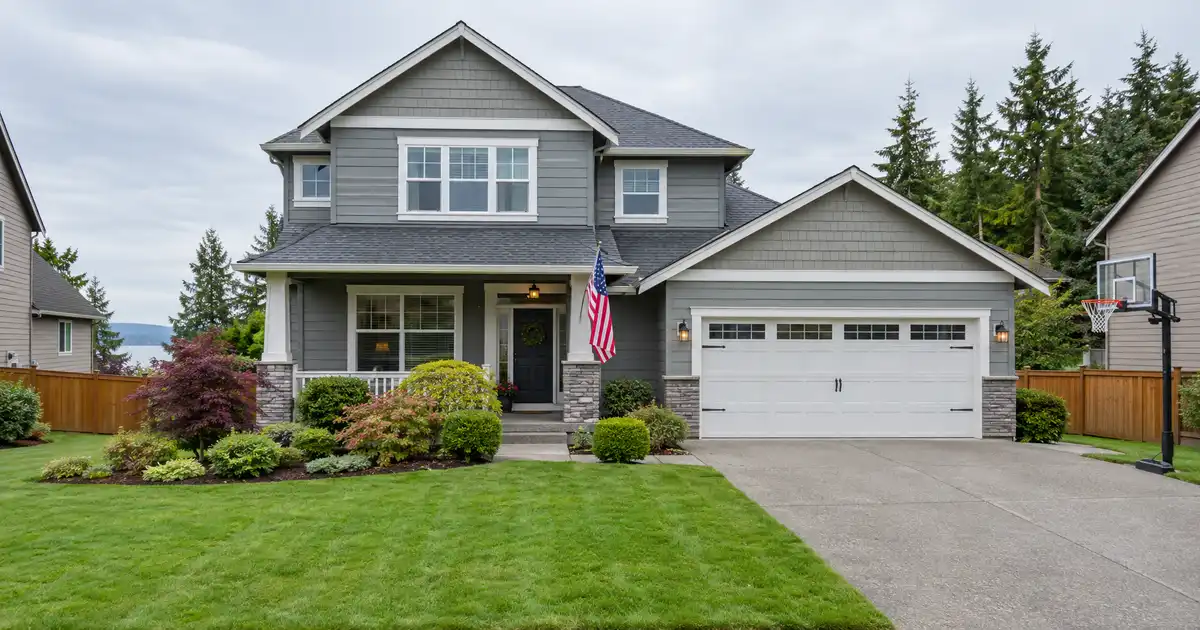
Current VA guidelines, updated from one source.
A handful of figures and the tables behind them decide most VA files, and all of them are here, drawn from one guideline source built on VA’s published rules: the down payment with full entitlement, the absence of mortgage insurance, the funding fee by first or subsequent use, the ratio guideline, and the residual-income table for the region.
100% financing with full entitlement
0% down is the program’s defining term: a buyer with full entitlement finances up to 100% of the lesser of price and value, the guaranty replaces the down payment, and the funding fee can be added on top of the loan rather than paid in cash.
No monthly premium, no upfront premium
Mortgage insurance does not exist on a VA loan: no monthly premium, no upfront premium, no cancellation rules to track. The calculator below shows a payment with nothing in that line, which is where VA differs from every other high-leverage program.
First use; 3.3% after first use; exempt for many disabled veterans
VA charges a funding fee instead of mortgage insurance: 2.15% on a first-use purchase, 3.3% on a subsequent use, less with a down payment of five percent or more, and nothing for the exempt groups. The ladder below shows every tier, including the cash-out and rate-reduction refinance fees.
Residual income decides the file
VA’s debt-to-income guideline is 41%, but it is a guideline, not a ceiling: a file above it can be approved when residual income exceeds the regional table by a fifth or more, and a file under it can still fall short on residual income. The table below shows the figures for the West region.
| Loan type | Use | Down payment | Fee |
|---|---|---|---|
| Purchase or construction | First use | less than 5% down | 2.15% |
| Purchase or construction | First use | 5% to 9.99% down | 1.5% |
| Purchase or construction | First use | 10% or more down | 1.25% |
| Purchase or construction | After first use | less than 5% down | 3.3% |
| Purchase or construction | After first use | 5% to 9.99% down | 1.5% |
| Purchase or construction | After first use | 10% or more down | 1.25% |
| Cash-out refinance | First use | Any | 2.15% |
| Cash-out refinance | After first use | Any | 3.3% |
| IRRRL | Any | Any | 0.5% |
| Manufactured home (not permanently affixed) | Any | Any | 1% |
| Loan assumption | Any | Any | 0.5% |
| Vendee loan | Any | Any | 2.25% |
| Family size | Residual income |
|---|---|
| 1 | $491 |
| 2 | $823 |
| 3 | $990 |
| 4 | $1,117 |
| 5 | $1,158 |
| Each additional member, up to seven | + $80 |
Exempt from the funding fee: veterans receiving VA compensation for a service-connected disability, those eligible for it but receiving retirement or active-duty pay instead, surviving spouses receiving Dependency and Indemnity Compensation, service members with a pre-discharge claim rating, and active-duty service members who have received the Purple Heart. VA sets no minimum credit score; the wholesale programs behind these pages start at a 580 decision score and serve loan amounts up to $4,000,000, including loans above the conforming limit with full entitlement.
Refinances: cash-out to 100% loan-to-value after seasoning of 210 days and six payments with a net tangible benefit; rate-reduction refinances of an existing VA loan at a 0.5% fee without a VA appraisal. Current VA snapshot · updated October 1, 2026 · owner-occupied principal residences, one to four units · no VA loan limit with full entitlement · loans are assumable · no prepayment penalty · Lendmire is not affiliated with the Department of Veterans Affairs.
For informational purposes only. This is not a commitment to lend or extend credit, an offer, or a quote. Program parameters shown are VA guidelines and wholesale lender overlays, are subject to change without notice, and every figure depends on the borrower, the entitlement, the property, the selected program, and full underwriting. Lendmire is a mortgage broker, not a lender, and is not affiliated with or endorsed by the Department of Veterans Affairs. Licensed in sixteen states for consumer mortgages. NMLS #2371349.
What a VA loan is — and how the file is qualified.
A VA loan is an ordinary mortgage from a private lender wrapped in a federal promise: if the loan fails, VA covers part of the lender’s loss. That promise is what lets a Lacey lender skip the down payment and the mortgage insurance, and the four cards below take the file apart piece by piece.
For the program overview, see Lendmire’s VA loan program, or the statewide guide at VA Loans in Washington; to request a Certificate of Eligibility, see VA.gov.
The guaranty replaces the down payment
Think of the guaranty as VA standing where the down payment would stand. With full entitlement the backing covers a quarter of whatever the loan is, so a Lacey buyer is not capped by a county figure; with reduced entitlement the backing is smaller, and a lender may ask for a down payment to make up the difference.
Eligibility, entitlement, and the COE
Three questions settle eligibility on a Lacey file: the service history, the character of discharge, and whether entitlement is full or partly in use. The COE answers all three. Surviving spouses, National Guard and Reserve members, and veterans with an earlier VA loan each have their own path to the certificate.
The funding fee, and who is exempt
Veterans receiving VA compensation for a service-connected disability pay no funding fee, and neither do surviving spouses receiving Dependency and Indemnity Compensation, Purple Heart recipients on active duty, or those rated before discharge. On a Lacey file the exemption is confirmed on the COE and removes the funding fee, the program’s one charge of its own.
Residual income over ratios
The ratio VA names is a guideline; the residual-income table is the standard. A Lacey file above the ratio can be approved when residual income clears the table by a fifth or more, and a file below the ratio can still be declined when residual income falls short, which is the reverse of how FHA and conventional loans read a budget.
Nothing here is a decision. The appraisal can come in under the contract price, the rate is set by the lender at lock, and the lender’s residual-income figure includes deductions this page only approximates. What holds steady is the structure the calculator reproduces: price, fee, loan, payment, residual.
Where Lacey’s veterans and service members buy — and how VA fits.
The numbers below are Lacey’s, not any one borrower’s: owner households, median home value, and household income from the U.S. Census Bureau. They tell you the scale of a typical VA purchase here; the certificate, the appraisal, and the household’s own income tell you the loan.
Read the figures as backdrop. Income is the residual-income input, value is the loan and the fee, and family size is the row in VA’s table. The Census describes the first two for the market; the file supplies all three for the borrower.
Data sources: U.S. Census Bureau — ACS 5-Year (2024) housing and population estimates, including tenure, home values, gross rents, and household income.
Distinct Lacey neighborhoods, distinct VA files.
No single VA file describes Lacey. The submarkets below differ in housing stock, price, and the appraisal questions they raise, and each one shapes how a VA purchase is put together.
Two-to-four-unit homes
Lacey duplexes and small apartment houses are VA purchases with nothing down when the veteran occupies one unit. VA counts rent from the other units under its own rules, which can require landlord experience or reserves. Roughly 13,107 Lacey households own their homes on the latest Census estimate — 56% of all households, the pool a VA purchase joins.
Newer infill and recent construction
New rows and recent infill in Lacey tend to appraise without findings, which moves the question to price. With full entitlement there is no loan limit, so a contract above the county conforming figure is still a nothing-down VA purchase, tested on residual income at that payment. Median household income in Lacey sits near $90,625 on the latest Census estimate.
Service members and the occupancy rule
Where Lacey neighborhoods serve an installation, VA purchases appear on every street, often by service members who will move again. The program is built for that: nothing down, a loan that can be assumed, and entitlement restored when the home is sold and the loan repaid. The median owner-occupied home value in Lacey runs near $457,100 on the latest Census estimate.
Condominiums and townhomes
Close-in Lacey condominiums suit the benefit well: nothing down, no insurance line, and a project review that runs through VA’s approved-project list. The dues go into the residual-income math, and the appraisal covers the project along with the unit. About 44% of Lacey’s households rent — roughly 10,323 renter households on the latest Census estimate.
Established close-in neighborhoods
An older Lacey house is a fine VA purchase; the property requirements are the hurdle, not the age. Buyers who expect a repair list write the contract with room for it, and a wood-destroying insect inspection is ordered where VA calls for one. On a home at Lacey’s median value, a VA purchase with full entitlement needs no down payment at all — the funding fee on the full $457,100 is the program’s cost, and it can be financed.
Higher-value homes
On Lacey’s higher-value homes the VA loan’s reach shows: with full entitlement there is no down payment above the conforming limit, up to the maximum loan amount shown in the guidelines above. The credit floor is the lender overlay, and the file is qualified on residual income. Lacey is home to about 58K people and sits within the Olympia-Lacey-Tumwater, WA area.
Neighborhood sets the price and the property type; VA sets the rest. The guaranty, the funding fee, the ratio guideline, and the residual-income table apply identically on every Lacey file, and full entitlement carries no loan limit anywhere in the county.
Four ways Lacey veterans put the VA benefit to work.
A good use of VA is one the program’s shape fits: no down payment, no mortgage insurance, residual-income underwriting, and a guaranty that scales with the loan. Four common Lacey uses follow.
Buy a small multi-unit home and live in one unit
A Lacey duplex, triplex, or fourplex becomes a VA purchase the moment the buyer commits to occupying one unit. The guaranty covers the loan the same way it covers a house, and the other units’ rent is documented toward the ratios and residual income the way VA permits.
Buy a condominium in an approved project
One extra step separates a Lacey condominium file from a house file: the project review against VA’s list. Once the project clears, the leverage, the fee, and the absence of mortgage insurance are exactly what they would be on a house.
Take cash out of a home with equity
Cash-out on VA is a full refinance of the first mortgage at the leverage in the snapshot, after the later of the seasoning period or the required payments, with the funding fee at the cash-out tier. A Lacey owner weighs it against a home equity line, which keeps the existing first mortgage in place.
Buy a first home with nothing down
A Lacey buyer with the income for the payment but not the cash for a down payment uses VA to purchase with nothing down, finances the funding fee, and keeps the savings for moving costs, reserves, and the first repairs on the home.
Estimate the VA payment on a Lacey price before requesting a quote.
The program’s own math on your Lacey inputs: price less any down payment, plus the financed fee, amortized at the benchmark, with escrows added and nothing for mortgage insurance. The actual rate, payment, and costs come in writing from a licensed loan officer.
Lacey VA payment estimate
Defaults describe Lacey, not your purchase: put in the real price, the real fee tier, and the real escrows.
Editable benchmark: 7.28% as of October 1, 2026 · Freddie Mac 30-year average via FRED®. A conventional market reference, not a VA loan quote.
Illustrative starting assumptions: a $455,000 price near Lacey’s median owner-occupied home value, no down payment with full entitlement, a first-use funding fee financed into the loan, a thirty-year term at the current Freddie Mac benchmark, property taxes and insurance estimated for Washington (U.S. Census Bureau). Every field is editable.
Illustrative estimate only — not a Loan Estimate, approval, quote, or commitment to lend. The rate field carries the weekly Freddie Mac thirty-year conventional benchmark, a market reference and not a VA loan quote; your rate is set by the lender at lock. The funding fee follows VA’s published table for the use and down payment entered; the residual-income figure is VA’s guideline for the region and family size, and the rough residual shown subtracts only the housing payment and the debts entered, while VA also deducts taxes, maintenance and utilities. Taxes, insurance and dues are editable estimates; closing costs are not included. Licensed in sixteen states for consumer mortgages. Lendmire is not affiliated with or acting on behalf of the Department of Veterans Affairs.
Same veteran, three very different closings.
Most buyers can close the same purchase three ways, and the structures differ more than the labels suggest: VA with nothing down and no mortgage insurance, FHA with a small investment and premiums for the life of the loan, or conventional with private insurance that falls away as equity grows.
VA, FHA, or conventional.
The program’s strengths are the down payment, the insurance, and the residual-income test; its cost is the funding fee. A Lacey veteran with full entitlement usually pays less each month on VA than on FHA at the same price, and the conventional comparison turns on the down payment and the fee tier.
FHA’s leverage is high and its credit standard is forgiving, but its insurance never comes off a full-leverage thirty-year loan. A Lacey veteran comparing the two sees the premium line in the FHA payment and nothing in that line on VA. See Lendmire’s FHA loan program.
Conventional is the comparison for a veteran with savings: with twenty percent down there is no mortgage insurance and no funding fee, and the payment can beat VA with a financed fee. Below that down payment, VA usually wins for a Lacey buyer. See Lendmire’s conventional loan program.
Which program fits best depends on the borrower’s numbers once eligibility is known. VA can come out ahead with a COE and full entitlement, conventional can for a veteran with twenty percent down and no fee exemption, and FHA is the fallback where the benefit is unavailable. The comparison is run on the actual numbers, in writing.
What to prepare for a Lacey scenario review.
What a lender reads on a Lacey VA loan, and what you can have ready before anyone asks.
This is a general preparation guide, not a universal checklist. The selected lender may request additional information based on the transaction, the property, entitlement, and the income picture. Nothing here is legal or tax advice.
Local details that can change the loan.
Check these before leaning on any number for Lacey: entitlement, the funding fee tier, the appraisal and VA’s property standards, the condominium approval, residual income, and occupancy.
Use these checks to keep the Lacey file clean and fundable.
A Lacey file that is ready to review has already answered three questions: how much entitlement, what funding fee, and whether the property is inside VA’s rules.
- Confirm the entitlement: an earlier VA loan still outstanding leaves remaining entitlement and may call for a down payment.
- Know the fee: disabled veterans receiving compensation and the other exempt groups pay no fee.
- Check the project: the lender checks VA’s approved condominium list before the appraisal is ordered.
Full or remaining entitlement
Entitlement is full on a first use, and it is restored when an earlier VA loan is paid off and the home sold; it is partial when an earlier VA loan is still outstanding or was lost to foreclosure. A Lacey buyer with full entitlement has no loan limit; with remaining entitlement, the lender may require a down payment.
The funding fee tier and the exemptions
Financed, the fee raises the loan balance and the payment; paid at closing, it raises the cash to close; paid by the seller, it counts toward the concessions cap. Which is best on a Lacey file depends on the tier and on how long the home will be kept, and the loan officer shows all three ways side by side.
Condominium project approval
VA finances a Lacey condominium only in a project on its approved list; an unlisted project can be submitted, which takes time and the association’s cooperation. The lender checks VA’s approved list before the appraisal, and the dues enter the ratios and residual income.
Assumption and release of liability
Assumability is one of the program’s quieter advantages for a Lacey owner who may sell into a higher-rate market, and one of its traps: without a release of liability the seller remains responsible, and without substitution of entitlement the seller’s benefit stays in use on a home they no longer own.
Occupancy and the reasonable-time rule
A VA loan finances a principal residence: the veteran certifies an intent to occupy within a reasonable time after closing, which VA generally reads as a couple of months. The usual Lacey exception is military life itself, where a spouse can occupy for a member on orders elsewhere.
From a Lacey Certificate of Eligibility to keys in hand.
Four steps: the certificate and pre-approval, the appraisal, the underwriting, and the closing. The Lacey version of each follows.
COE and pre-approval
The first conversation settles the shape: whether entitlement is full, whether the fee applies, what residual income supports, and whether VA is the right program next to FHA and conventional for the Lacey purchase. The lender can pull the COE directly.
Contract and appraisal
With the contract signed, the lender requests a VA-assigned appraiser, who values the Lacey home and checks it against VA’s property requirements; the Notice of Value is issued on the report. Seller concessions are checked against VA’s cap, and any condominium project approval is confirmed.
Underwriting
Underwriting on a Lacey VA file reads the whole picture: the entitlement on the certificate, the housing payment history, the seasoning of any derogatory event, and the residual income after VA’s deductions for taxes and upkeep. Conditions are issued, documented, and cleared before the approval is final.
Closing
Closing is where the fee becomes real: financed into the total loan or paid at the table, with the seller’s concessions applied and the fees a veteran may not pay removed from the sheet. The Lacey buyer takes the keys and VA backs the lender.
A brokerage that puts the benefit to work.
The case for a brokerage on a VA loan is candor with numbers: VA beside conventional on the same inputs, the fee tier stated outright, the entitlement checked first, and the terms in writing.
Three programs, one set of numbers
Before any recommendation, VA, FHA, and conventional are run on the same Lacey price, income, and down payment. The buyer sees the payment, the insurance or fee line, and the cash to close for each, and the choice follows the figures.
The fee and the entitlement explained before the offer
The fee is the program’s cost and the entitlement is its reach, and Lendmire explains both first rather than last: how much the fee is, whether it is waived or refundable, and what the certificate supports for a Lacey buyer at the price in hand.
Licensed, consumer-purpose, in writing
Lendmire is licensed in sixteen states for consumer mortgages, each loan is a consumer-purpose transaction with the full set of disclosures, and every figure a Lacey buyer relies on, from the fee to the leverage to the final terms, comes in writing from a licensed loan officer.
Trusted by veterans & families alike.


Lacey VA loan FAQs
Plain answers to the questions Lacey veterans ask most about VA loans, in the order they usually ask them.
What is a VA loan, and who is it for?
A home loan benefit earned through military service. VA does not lend the money; it backs part of a loan a private lender makes, which is what allows the lender to waive the down payment and the mortgage insurance. It fits any eligible Lacey buyer purchasing or refinancing a home they will live in.
Who is eligible for a VA loan in Lacey?
The requirements depend on when and how you served, and VA publishes them by era. A Lacey loan officer can check the service record against them in a few minutes, and the Certificate of Eligibility is the official answer.
How do I get a Certificate of Eligibility?
Three ways: online through VA.gov, through the lender using VA’s system, or by mail with VA Form 26-1880. A veteran provides the DD-214, an active-duty member a statement of service, a Guard member NGB Forms 22 and 23, a Reserve member a points statement, and a surviving spouse VA Form 26-1817 where DIC is already in pay, or the DIC application first where it is not.
What is the VA funding fee, and do I have to pay it?
VA charges it on most loans in place of mortgage insurance: a first-use purchase with nothing down pays the base tier, a subsequent use pays more, and a down payment of five or ten percent lowers either. Exempt veterans pay none of it, and a rating granted after closing can bring a refund.
Is there a VA loan limit in Lacey?
No limit with full entitlement, which is why a VA jumbo with nothing down exists. Partial entitlement brings the county conforming figure into the math; the loan officer confirms the current figure and the down payment it implies.
Can the seller pay my closing costs on a VA loan?
They can, and a Lacey VA purchase can close with the seller paying most of the costs. The cap applies to concessions rather than to ordinary closing costs, and the veteran is protected from certain fees regardless.
Can I get a VA loan after a bankruptcy or foreclosure?
Yes, with seasoning. Bankruptcy, foreclosure, deed-in-lieu, and short sale each carry their own waiting period, and a Lacey veteran with the event seasoned and the recent history clean is inside the rules. The file is read on residual income and the ratio.
What is residual income, and why does it matter?
VA’s measure of budget room. Where FHA and conventional loans read the budget as ratios, VA also reads the dollars left over, and a large Lacey family needs more of them than a single borrower at the same income.
Can I buy a duplex or fourplex with a VA loan?
Up to four units with the buyer living in one, and nothing down with full entitlement, which makes the multi-unit purchase a distinctive use of the benefit in Lacey.
Do I have to live in the home to use a VA loan?
VA backs owner-occupied homes only. Occupancy is certified at closing, with allowances for deployment and remote duty; a buyer who will never live in the home cannot use the benefit for it.
VA, FHA, or conventional for Lacey: compared on your numbers.
A Lacey VA purchase starts with three questions: eligibility, the fee, and the price. Lendmire answers them, compares the programs, and writes up the one that fits.
This guide covers Lacey — for the statewide guidelines, markets, and scenarios, see VA Loans in Washington, part of Lendmire’s VA loan program.
Nearby markets in Washington: Olympia · Tumwater · Lakewood · Tacoma · Federal Way · Auburn · Bremerton · Port Orchard
Related programs: Conventional Loans · FHA Loans · Jumbo Loans