
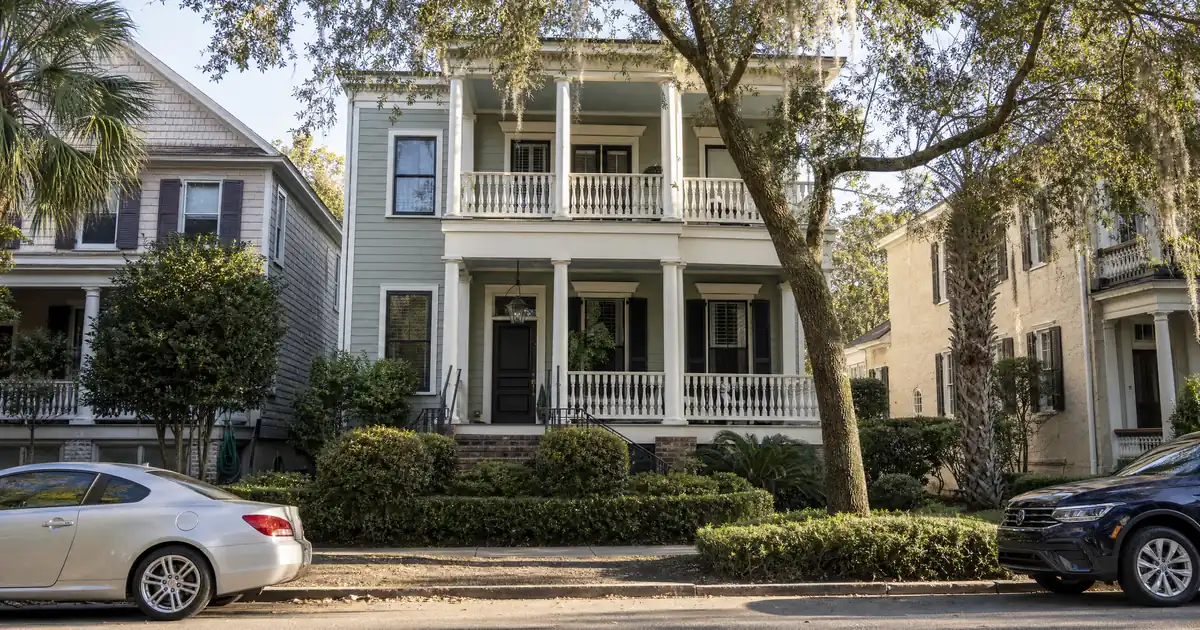
Garden City sits wedged between the Port of Savannah’s container terminals and Gulfstream Aerospace’s flight line, and it currently offers a more affordable entry point for investment property loans in Savannah, Georgia — a median sale price of $265,000 over the trailing twelve months, down 16 percent from the year before, according to Homes.com listings data. Rents in the neighborhood run between $585 and $2,000 with a median near $1,200, per Zillow’s rental manager tool, while RentCafe pegs the neighborhood average slightly higher at $1,267. That combination sounds like an easy DSCR win. The math says otherwise, and understanding why is the most useful thing an investor can learn about this market before writing an offer.
TL;DR: In Savannah, Georgia, a DSCR loan application is underwritten primarily on the subject property’s rental income measured against its full monthly obligation, including taxes and insurance, rather than the borrower’s personal income — meaning a Garden City duplex or a Pooler single-family is reviewed around its own lease economics, not a paystub.
DSCR Calculator
Run the numbers in your market
Rate source: Freddie Mac 30-yr average via FRED® — Federal Reserve Bank of St. Louis · effective Jul 30, 2026
Prefilled with starting assumptions — enter your own rent or nightly figures, taxes, insurance, and HOA for a more accurate picture.
Program parameters update from Lendmire’s centralized guideline source. Taxes and insurance are editable estimates.
As of Jul 30, 2026 · General Freddie Mac market benchmark, not a Lendmire loan offer. Rent, nightly rate, occupancy, taxes, and insurance are editable estimates. Short-term rental figures are estimates only and vary significantly by season, property type, management approach, and local short-term-rental rules — confirm local regulations before relying on them. Qualifying income for short-term rentals varies by program — some use appraisal market rent, others use documented STR history or projections — and is confirmed in underwriting. Not a Loan Estimate, approval, or commitment to lend. Program availability and eligibility are subject to lender guidelines, credit approval, property review, and underwriting.
- Garden City’s $265,000 median price and $1,200–$1,267 rents run tight on standard single-family DSCR math, closer to the mid-0.7x range at typical leverage.
- Garden City and Starland-area triplex/quadplex product clears meaningfully higher — roughly 1.2x to 1.3x on a comparable price basis.
- Pooler’s median price hit $391,000, up 12.9 percent year-over-year (Redfin).
- Citywide large-apartment vacancy sits near 6.7 percent even after roughly 2,600 new units delivered in a single year.
Savannah Market Snapshot
A quick read on the Savannah investor landscape — figures come from the cited sources below. Confirm current property-level numbers before underwriting.
| Metric | Detail |
|---|---|
| Home prices | $335,719 average home value (Zillow Home Value Index) |
| Typical rents | $1,950 avg (Zumper Savannah rent research) |
| Cap rates | 4.5-5.5% net cap (Team912) |
| University enrollment | 17,000+ students (Wikipedia — Savannah College of Art and Design) |
| Population | 347,000 metro population 2025 (Macrotrends) |
| Employment | 8,500 on-site jobs (Georgia.org) |
Garden City: Affordable Doesn’t Automatically Mean It Clears
The single-family math in Garden City is tighter than the price tag suggests. Modeling a $265,000 purchase at 75 percent loan-to-value with standard 30-year amortization, and weighing typical rent for the area against ordinary property tax and insurance loads for the market, produces a coverage ratio in roughly the 0.75x-to-0.80x range, including taxes and insurance. That’s a meaningfully sub-1.00 file on a straight single-family basis at typical leverage. Push the down payment to 50 percent and the same property nudges just over 1.00x — workable, but it means giving up leverage to get there, which changes the return math on the equity an investor has tied up.
The stronger play in this neighborhood isn’t the single-family product at all. It’s the small multifamily stock sitting right next door. A Garden City triplex with matching 2BR/1BA units generating gross annual rent above $45,000 has been transacting in the market, per Redfin’s multifamily listings for Georgia. Modeling that rent roll against a purchase price near the midpoint of the range these properties typically trade in, at 75 percent LTV, produces a coverage ratio around 1.2x to 1.3x, including taxes and insurance. A quadplex in the nearby Starland District with a mix of 2BR and 3BR units generating over $66,000 in gross annual rent shows an even wider cushion on a comparable price-per-unit basis. Unit count, not price point, is what separates a file that clears from a file that doesn’t in this corridor.
There’s a tradeoff worth flagging honestly. Garden City homes currently sell after 112 days on the market against a national average of 53, per Zillow’s rental and market tools — meaningfully slower liquidity than the citywide average. That’s a seasoning and exit-comp consideration for any future refinance, not a reason to avoid the neighborhood, but it belongs in the underwriting conversation from day one.
Working DSCR brokers see a recurring pattern in port-and-manufacturing-adjacent submarkets like this one: the rent comp on the initial file often gets pulled from a citywide or metro-blended average rather than the specific micro-market, which can overstate the coverage ratio a borrower expects going in. The stronger files pull rent comparables directly from active leases in the same zip code and stress-test the deal at more than one leverage point before it ever reaches a lender.
Ardsley Park, Midtown, and the Downtown Squeeze
Ardsley Park and Chatham Crescent — the tree-lined, historic residential blocks south of downtown — post a median rent of $1,750, roughly 25 percent below the Historic District’s $2,350 median, per RentCafe’s neighborhood data. No submarket-specific sale price is independently confirmed for this pocket, so investors should model against current listing comps rather than assume a fixed bracket, but the rent level alone signals a professional and family tenant base with better rent-to-value math than the tourist core. Midtown, the broader corridor sitting between Ardsley Park and the historic squares, is commonly cited by local investors as a value-add target — older housing stock, room for legal duplex or triplex conversions, and pricing that hasn’t caught up to the neighborhoods bracketing it on either side.
Downtown Savannah tells a different story. The Historic District’s median rent of $2,350 runs $450 above the national average, per RentCafe, driven by Savannah College of Art and Design‘s downtown footprint — the university occupies nearly 70 historic buildings woven through the same 22 squares that draw tourists — plus a dense short-term-rental economy layered on top. SCAD enrolls 18,550 students as of the most recent academic year, according to College Tuition Compare’s IPEDS-based data, with roughly a quarter of the student body drawn from outside the United States. That’s a real, durable renter pool. But downtown acquisition prices run well above the citywide median, and premium rents on a premium purchase price don’t automatically widen the coverage ratio the way they would in a below-median submarket. Straight long-term-lease DSCR math tends to run tighter here than in Garden City or Midtown, which is exactly why downtown condo and small single-family product more often gets underwritten through STR-income programs rather than a 12-month lease assumption — a distinction worth understanding via the guide “What Is a DSCR Loan” before shopping the neighborhood.
One caution worth sizing before buying near campus for student-tenant demand specifically: SCAD’s enrollment yield — the share of admitted students who actually enroll — has fallen from 29.77 percent to 26.40 percent over the past decade, per College Tuition Compare’s admissions trend data, even as total applications have grown. The university’s headline size isn’t shrinking, but its rate of pulling new students into the local rental pool has softened. Investors underwriting a Starland or Thomas Square duplex on the assumption of compounding student demand growth should stress-test against a flatter trajectory instead.
Pooler: Buying the Appreciation Curve, Not the Cap Rate
Pooler is the appreciation trade, not the cash-flow trade, and the numbers back that up directly. Median sale price hit $391,000 as of last month, up 12.9 percent year-over-year, according to Redfin’s Pooler market data. Gross cap rates in the suburb run 6.0 to 7.5 percent with net cap rates closer to 4.5 to 5.5 percent — both below the broader Savannah metro average, per local investor-facing brokerage Team912. That’s the cost of buying into a submarket with meaningfully lower vacancy risk and a deeper, faster-growing comp set.
The growth case is concrete. Pooler’s population climbed from 19,140 in 2010 to 29,544 in 2023, an annual growth rate more than five times the national average, and independent projections show another 25,000 to 28,000 residents arriving within five years, per Home Buyers of Savannah’s population analysis. That trajectory sits directly on a tri-anchor employment stack: Gulfstream Aerospace, which employs roughly 13,000 workers regionally in an ongoing production expansion, per a Bloomberg feature on the region; the Hyundai Metaplant supplier corridor spilling over from adjacent Bryan County; and Port of Savannah logistics traffic feeding the I-16/I-95 interchange Pooler sits on top of.
For an investor thinking about seasoning and a future cash-out refinance rather than day-one yield, Pooler’s depth of appreciating comps arguably supports a stronger post-seasoning appraisal case than a flatter urban Savannah submarket would — a consideration that makes the investment property refinance process worth a brief look once a file has time on the books, even though the purchase decision itself should be made on today’s cap rate, not tomorrow’s equity.
The Employment Base Behind All of This
Three forces are reshaping Savannah’s workforce-housing demand in real time, and none of them are slowing down over the next two years. The Hyundai Motor Group Metaplant America, a $7.59 billion investment in Bryan County, is on track to support 500,000 electric and hybrid vehicles annually at full production and has already created at least 8,500 on-site jobs plus a growing supplier market along the I-16 corridor. The Port of Savannah moved 5.7 million TEUs and runs 39 weekly container services — the most of any port on the South Atlantic or Gulf coasts — backed by a $4.5 billion infrastructure expansion plan. And Fort Stewart–Hunter Army Airfield employs over 25,500 people, including 21,200 full-time soldiers, anchoring BAH-backed rental demand around Richmond Hill and the base’s surrounding communities that isn’t tied to the tourism cycle at all.
Layer in healthcare. St. Joseph’s/Candler, a 714-bed system tracing back to hospitals founded in 1875 and 1804, is a five-time Magnet-designated system serving 33 counties across southeast Georgia and the South Carolina Lowcountry. Memorial Health University Medical Center, an HCA-affiliated tertiary referral hospital housing the region’s only free-standing children’s hospital and a satellite campus of Mercer University School of Medicine, adds another non-cyclical tenant base of nurses, techs, and residents. None of these employers depend on downtown foot traffic. That’s the point — a Savannah DSCR portfolio built around port, military, and healthcare tenants isn’t riding the same demand curve as a portfolio built around tourism, and the two shouldn’t be underwritten with the same risk assumptions.
Savannah’s city population sits at roughly 150,080, according to U.S. Census Bureau data, while the broader three-county metro area reached 347,000 in the most recent count, per Macrotrends. Roughly 55 percent of city households rent rather than own, per RentCafe’s tenure data — a renter-majority city is a fundamentally different underwriting environment than an owner-majority one, and it’s part of why the rent-to-price picture here rewards patience over speed.
Don’t Read Apartment Vacancy as a Warning About Your Duplex
Savannah delivered roughly 2,600 new large-complex apartment units last year — its biggest construction cycle in 25 years, expanding rental inventory by 7.1 percent in a single year, according to local investor blog CallSouthCoast. Citywide large-apartment occupancy sits at 91.9 percent with a 6.7 percent vacancy rate, modestly below the market’s ten-year average of 93.3 percent, per Team912’s market analysis. On paper, that reads like softening demand. It isn’t, for the product type most DSCR investors actually buy.
Almost all of that new supply is institutional — 200-, 300-, and 400-plus-unit apartment communities built by large developers, not the single-family homes and small multifamily buildings that make up a typical DSCR portfolio. Renter demand surged in the same window, with 634 units absorbed in one quarter alone — a 133 percent increase over the pre-pandemic average and the second-highest quarterly absorption total in a decade, per CallSouthCoast. Net absorption outpaced new deliveries the following quarter as well, 420 units absorbed against a smaller delivery count, per Team912. The takeaway: large-complex vacancy and single-family rental demand are drawing from different tenant pools in this market. A DSCR investor buying a Garden City single-family or a Midtown duplex shouldn’t discount rent assumptions just because a 300-unit Class-A complex across town is offering concessions.
What Actually Qualifies a File Here
Coverage math is the whole conversation on a Savannah purchase — the property’s rent measured against its full monthly carrying cost, not the borrower’s traditional personal-income documentation. Most purchase files run 75 to 80 percent loan-to-value, with roughly 20 to 25 percent down on standard programs and higher-leverage options up to 85 percent available on the strongest files where guidelines allow. A 1.00x coverage ratio is the common baseline lenders build around, since that’s the point where rent covers the full monthly obligation, though some programs will look at ratios below that threshold with stronger reserves, lower leverage, or additional compensating factors — never a guarantee, always subject to lender review. Credit-score tiers commonly start in the low 600s for entry programs, with higher-leverage products typically requiring stronger profiles, and reserve requirements generally run around six months of PITIA, rising toward nine months on larger loan amounts.
That framework is what makes the Garden City-versus-Starland comparison from earlier in this piece so concrete: two properties in the same zip code, same buyer profile, wildly different coverage outcomes because one is a single unit and the other is three or four units under one roof and one loan. Reviewing how rental-income review framework works alongside the program-to-program comparison against a conventional mortgage is worth doing before shopping either submarket, and investors comparing terms across the state can pull up the Georgia DSCR financing parameters before running Savannah-specific numbers. Qualification specifics — credit tier, reserve depth, leverage cap on any given file — remain subject to lender guidelines and underwriting review; program details here are general guidance, not a commitment.
Frequently Asked Questions
How do you qualify for a DSCR loan in Savannah, Georgia?
Qualification centers on the subject property’s rental income measured against its monthly obligation rather than the borrower’s personal income documentation. A lender will typically want a market rent estimate or lease, a property appraisal, reserves on hand, and a credit profile meeting program minimums — the property’s own economics carry the file, not a W-2.
What are the requirements for an investment property loan in Savannah, Georgia?
Most programs look for 20 to 25 percent down on a purchase, a credit score generally starting in the low 600s for entry tiers, and roughly six months of reserves, with higher requirements on larger loan amounts or higher-leverage requests. Exact terms vary by lender, program, and the specific property’s rent-to-value profile, subject to lender guidelines.
Is Garden City or Pooler the better submarket for a first DSCR purchase?
It depends on what the investor is optimizing for. Garden City offers the lower entry price and stronger day-one coverage on multi-unit product, while Pooler trades a lower cap rate for faster population growth, tighter vacancy, and a deeper appreciation-driven comp set for a future refinance.
Does SCAD’s enrollment support long-term rental demand near downtown?
It supports demand, but not at an accelerating pace. SCAD enrolls 18,550 students, yet its enrollment yield rate has declined from roughly 30 percent to 26 percent over the past decade — a reason to underwrite near-campus rentals on current lease comps rather than an assumption of continued growth in the student tenant pool.
DSCR vs. conventional financing
Two common ways to finance an investment property in Savannah, GA. They qualify you differently — here’s how investors weigh them.
Why investors choose it
- Qualifies on the property’s rental income — no personal tax returns, W-2s, or pay stubs needed to document income.
- No personal debt-to-income ceiling to clear, so existing mortgages and obligations don’t cap your borrowing the same way.
- Can be closed in an LLC, keeping the property inside a business entity.
- Built for scaling — not held to the limit on number of financed properties that conventional financing applies.
- Underwriting centers on the deal: generally qualifies when the rent covers the payment, a 1.00x coverage ratio being a common baseline (confirmed in underwriting).
- Designed specifically for investment property, including long-term and, where the program allows, short-term rentals.
Where it’s strong
- Often the lowest ongoing financing cost for a buyer who fully qualifies on personal income — a fit for a first property or a cost-first purchase.
Trade-offs for investors
- Requires full personal income documentation and must fit within a debt-to-income limit — salary, existing debts, and other mortgages all count.
- Typically held in your personal name rather than a business entity.
- Caps how many financed properties you can carry, which can become a ceiling as a portfolio grows.
- Evaluates you as a borrower as much as the property, which usually means more paperwork.
How investors usually choose: a first or single property often optimizes for the lowest financing cost; portfolio builders often optimize for leverage, vesting in an LLC, and scaling past conventional caps. The right answer depends on your goals, the property, and current guidelines — both paths run through select lenders in Lendmire’s wholesale network, with eligibility and terms confirmed in underwriting.
How does the Hyundai Metaplant affect rental demand outside Savannah’s city limits?
It’s pulling workforce housing demand into the Bryan County and I-16 corridor well beyond city limits, particularly around Pooler and Richmond Hill, as suppliers and plant employees relocate toward the $7.59 billion facility. Investors targeting that corridor are effectively underwriting to a manufacturing-driven demand curve rather than a tourism-driven one.
Can Lendmire help arrange DSCR financing for investment properties in Savannah?
Lendmire, NMLS# 2371349, arranges DSCR investor loans through wholesale lending channels across 41 markets, including Washington, D.C. Its programs qualify investors primarily on a property’s rental income rather than personal income documentation, a structure that fits both single-family purchases in submarkets like Garden City and small multifamily acquisitions in Midtown and Starland, subject to lender program eligibility.
Investors in Savannah, Georgia work with Lendmire to place DSCR financing through wholesale lenders, and questions about a specific property or submarket can go to 828-256-2183 or through a direct pricing quote request.
Lendmire is a mortgage brokerage focused on DSCR investor loans, arranging financing through wholesale and investor-lending channels. Qualification runs primarily on the property’s rental income as reviewed by the lender rather than W-2 documentation, subject to lender guidelines, which tends to suit entity-owned and multi-property investors.
The real choice in this market isn’t which neighborhood is “best” — it’s which trade an investor wants to make. Buy the Garden City or Midtown small multifamily play, accept slower exit liquidity and older housing stock, and get a coverage ratio that clears comfortably today. Or buy into Pooler’s growth curve, accept a lower cap rate and tighter day-one cash flow, and bet on the Hyundai-and-port-driven population trajectory to build the equity a future refinance will need. Savannah currently supports both trades — it just won’t let an investor have both in the same property.
About Lendmire
Lendmire — NMLS# 2371349 — is a mortgage brokerage specializing in DSCR investor loans, helping arrange financing across 41 markets, including Washington, D.C., through wholesale and investor-lending channels. The model centers on property-level rental income reviewed by the lender rather than W-2 documentation, subject to lender guidelines, suiting entity-owned and multi-property investors. Lendmire holds Scotsman Guide Top Mortgage Workplace recognition for 2025 and 2026.
Get Started
Ready to find the right loan for you?
In about 30 seconds you can review financing options available for your investment property. No commitment required.
Informational only. Not a Loan Estimate, approval, or commitment to lend. Program availability and eligibility are subject to lender guidelines, credit approval, property review, and underwriting.
References
1. Homes.com — Garden City Listings
2. Zillow Rental Manager — Garden City
3. Redfin — Pooler Housing Market
5. Zumper Savannah rent research
6. Team912
7. Wikipedia — Savannah College of Art and Design
8. Macrotrends — Savannah Metro Area Population
9. Georgia.org — Hyundai Motor Group Metaplant America
10. Redfin — Georgia Multi-Family Listings
11. Savannah College of Art and Design
12. College Tuition Compare — SCAD Enrollment
13. College Tuition Compare — SCAD Admissions Trends
14. Bloomberg — Hyundai Metaplant feature
16. Fort Stewart–Hunter Army Airfield
18. U.S. Census Bureau QuickFacts: Savannah city, Georgia
19. a 2025 Scotsman Guide Top Mortgage Workplace
20. a 2026 Scotsman Guide Top Workplace
This article is part of Lendmire’s DSCR loan program — full qualification details, guidelines, and scenarios live on the program page.
Related reading: DSCR Loans Savannah: Investor Financing for Savannah Rental Properties, Airbnb, and Real Estate Investors · Cash Out Refinance Investment Property in Savannah GA · Cash Out Refinance Investment Property in Aiken, South Carolina
Guides: DSCR Loans in Savannah, GA · DSCR Loans in Georgia
Brandon Miller
Founder & CEO, Mortgage Loan Originator, Lendmire LLC
- Mortgage Loan Originator · NMLS# 1129696 · Verify on NMLS Consumer Access
- North Carolina Real Estate Broker · License# 343312 · Verify on NCREC
- North Carolina Insurance Producer · License# 19053198 · Property, Casualty, Life, Health · Verify on NAIC SBS
- Lendmire LLC · Firm NMLS# 2371349 · Verify firm licensure
Disclosure information. Lendmire is a state-licensed mortgage brokerage under NMLS# 2371349. Lendmire is not a depository institution, direct lender, or financial advisor — all loans referenced are placed through wholesale lender partners and are subject to each lender's underwriting standards. This article is provided for general informational purposes and is not a commitment to lend, nor does it constitute financial, legal, or tax advice. Loan programs, terms, rates, and qualification standards change without notice and depend on borrower profile, property type, and the state in which the subject property is located. Equal Housing Opportunity provider. NMLS Consumer Access: nmlsconsumeraccess.org.