
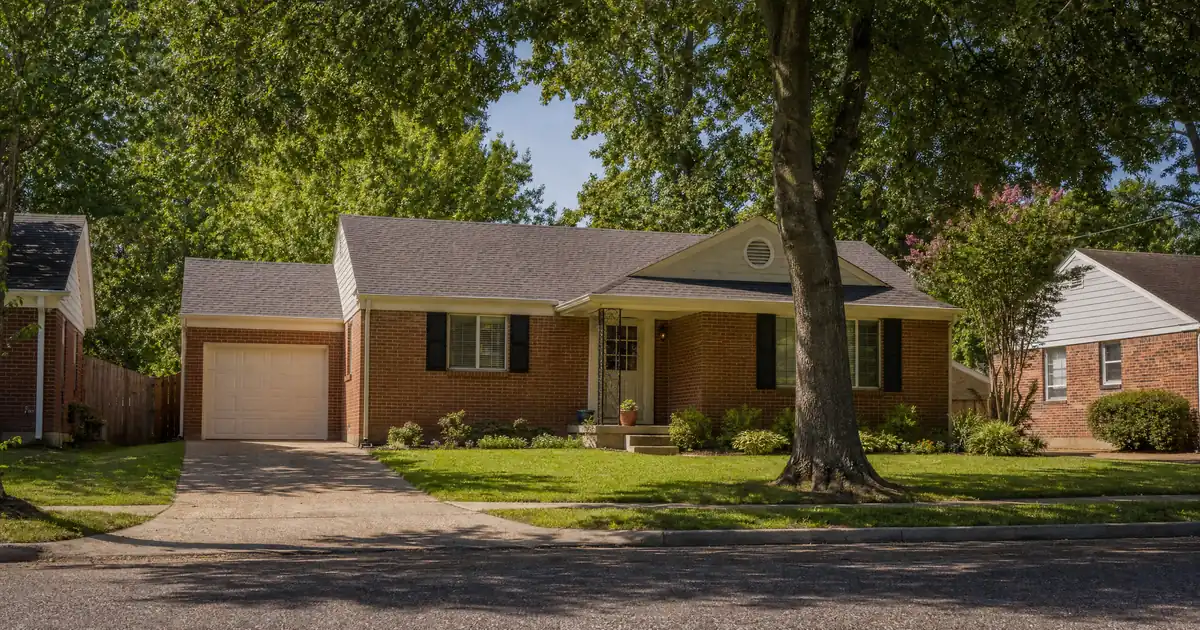
Picture an investor holding a property purchased for $130,000 in Whitehaven — the kind of deal where investment property loans in Memphis are underwritten on rental income — financed at 75% leverage, renting for $1,200 a month to a tenant who works logistics shifts a short drive from Memphis International Airport. Run the modeled numbers — principal, interest, taxes, and insurance folded together — and that property clears roughly 1.3x coverage. Compare that to a similarly leveraged purchase in Germantown at three to four times the price, where the rent-to-debt math is tighter and the thesis shifts almost entirely to equity growth. Same metro, same loan structure, two completely different investment cases. Terms vary by lender guidelines, property type, leverage, credit profile, and full file review.
The Short Version: An investment property loan in Memphis, Tennessee is underwritten primarily on the property’s rental income measured against its full monthly obligation, and the metro’s wide submarket spread — from sub-$120,000 Frayser acquisitions to $450,000 Germantown purchases (Discount Property Warehouse) — means coverage ratios swing dramatically by zip code, not just by loan structure.
DSCR Calculator
Run the numbers in your market
Rate source: Freddie Mac 30-yr average via FRED® — Federal Reserve Bank of St. Louis · effective Jul 30, 2026
Prefilled with starting assumptions — enter your own rent or nightly figures, taxes, insurance, and HOA for a more accurate picture.
Program parameters update from Lendmire’s centralized guideline source. Taxes and insurance are editable estimates.
As of Jul 30, 2026 · General Freddie Mac market benchmark, not a Lendmire loan offer. Rent, nightly rate, occupancy, taxes, and insurance are editable estimates. Short-term rental figures are estimates only and vary significantly by season, property type, management approach, and local short-term-rental rules — confirm local regulations before relying on them. Qualifying income for short-term rentals varies by program — some use appraisal market rent, others use documented STR history or projections — and is confirmed in underwriting. Not a Loan Estimate, approval, or commitment to lend. Program availability and eligibility are subject to lender guidelines, credit approval, property review, and underwriting.
- Whitehaven and Frayser single-family purchases can clear roughly 1.3x coverage at standard leverage on modeled rent assumptions.
- A $380,000 purchase priced as a triplex reaches roughly 1.02x coverage versus 0.73x as a single-family home under one lender’s underwriting model.
- Multifamily inventory carries a list price that runs below the single-family median citywide (Redfin).
- Citywide multifamily vacancy sits near 15.1%, concentrated in new Class A delivery, not workforce 2-4 unit stock (Apartments.com).
- Germantown and far-northeast Bartlett trade on appreciation; Cordova and the workforce corridors trade on cash flow.
Memphis Market Snapshot
A quick read on the Memphis investor landscape — figures come from the cited sources below. Confirm current property-level numbers before underwriting.
| Metric | Detail |
|---|---|
| Home prices | Yes — $184K median (Redfin) |
| Typical rents | $1,165 effective (MMG Real Estate Advisors) |
| Vacancy | Yes — 15.1% (Apartments.com) |
Whitehaven and Frayser: Where Rent Still Beats the Payment
The strongest raw coverage math in Memphis sits in the two neighborhoods with the lowest entry price, not the ones with the newest paint. Whitehaven single-family homes range from $80,000 to $170,000 with rents running $900 to $1,400 a month, while Frayser homes trade even lower — $50,000 to $120,000 against rents of $700 to $1,100 — a spread that produces some of the strongest cash-flow math in the metro. A separate buyer-intelligence platform pegs out-of-state investor acquisitions in Whitehaven, Raleigh, and Frayser at $60,000-$130,000 properties generating rent-to-price ratios north of 1.5% monthly (Deal Run).
Run the modeled math on a $130,000 Whitehaven purchase at 75% leverage with rent assumed at $1,200 a month. Full monthly obligation — principal, interest, taxes, and insurance combined — measured against the $1,200 rent puts coverage near 1.3x once Shelby County’s full tax load is in the payment. That’s real cushion an underwriter can work with even before touching reserves. Whitehaven’s proximity to Graceland and Memphis International Airport supports a tenant base tied to logistics and aviation shift work, and one-bedroom rents there average $587 — among the most affordable in the metro (Rent.com). Exact leverage, credit thresholds, and program terms are subject to lender guidelines and full file review.
Frayser runs leaner still. A modeled $90,000 acquisition at 75% leverage with an $800 market-rent assumption produces a coverage ratio near 1.53x — already comfortable. But Frayser carries a wrinkle worth understanding before dismissing it as a pure grind-it-out cash-flow neighborhood. The Nike Northridge distribution campus — the brand’s largest facility in North America at 2.8 million square feet — sits inside the neighborhood and anchors thousands of jobs within a short commute (Longstep Property Solutions). Nearly a third of tenants in the zip code hold housing vouchers, and current HUD payment standards there exceed open-market rent for every tracked bedroom count. That means a DSCR file in this submarket can sometimes qualify against a voucher-backed rent figure rather than a straight market-rent number — a modeled $1,000 rent instead of $800 pushes the same $90,000 purchase toward 1.9x coverage. Not every lender will treat voucher income identically, but it’s a lever worth raising with an underwriter before assuming market rent is the ceiling.
The housing stock in Frayser also skews toward older single-family homes mixed with modest duplexes, which matters more than it sounds — more on that below.
The Unit-Count Lever: Why a Duplex Beats a Single-Family Home at the Same Price
Here’s the finding that separates a Memphis file that qualifies from one that doesn’t: at mid-tier price points, unit count moves the needle more than location does. One lender’s own underwriting model ran an identical $380,000 Memphis purchase three ways. As a single-family home with $2,100 in market rent against a modeled monthly obligation of $2,885, coverage lands at 0.73x — below the no-ratio floor most programs use. Convert the same price point into a duplex, and rent rises to $2,400 against a slightly lower obligation of $2,765, producing 0.87x — a no-ratio scenario some lenders may still review depending on compensating factors. Structure it as a triplex, and rent climbs to $2,700 against $2,641 in obligation, clearing 1.02x — standard DSCR pricing territory.
That’s not a rounding difference. That’s the gap between a deal a lender walks away from and one that qualifies at standard terms.
The math works in the investor’s favor because multifamily inventory in Memphis doesn’t carry a price premium over single-family stock the way it does in coastal markets. There are currently 144 multifamily properties listed citywide at a median list price of $184,000 (Redfin), with broader inventory data showing 242 listings spanning duplexes, triplexes, fourplexes, and small apartment buildings from roughly $11,000 to $5.5 million (Homes.com). That $184,000 median sits below the citywide single-family price point — meaning an investor isn’t paying extra to stack a second or third rent roll. In Frayser specifically, the housing stock already leans toward a mix of single-family homes and modest duplexes, so the inventory to run this play exists without forcing a ground-up conversion.
For an investor sitting on a marginal single-family DSCR file in the $250,000-$400,000 range, pricing out the duplex or triplex alternative before walking away from the deal is worth the extra week of due diligence. Comparing DSCR options side by side on unit count, not just address, is often the more productive exercise than shopping rate.
Cordova, Bartlett, and Germantown: Three Exit Strategies Fifteen Minutes Apart
East Shelby County isn’t one market — it’s three, and each rewards a different investor thesis. Cordova sits in the middle, with an average sale price around $171,000 and homes moving in roughly 38 days on market, offering both moderate appreciation and workable rent coverage (Discount Property Warehouse). Single-family rents there run $1,300 to $2,000 a month against purchase prices of $180,000 to $330,000, with the Wolfchase Galleria retail corridor supplying nearby commercial employment.
Push further northeast toward Bartlett, and the thesis flips. Average sale prices near $190,000 there describe a market that’s “less of a classic Memphis cash flow play and more of an appreciation play” (Discount Property Warehouse) — meaning coverage ratios at purchase run tighter, and the payoff shows up in equity built over a longer hold, not month-one cash flow.
Germantown proper is the clearest version of that pattern. Homes there command $323,000 to $450,000, and the same source describes “heavy appreciation” as the operative dynamic (Discount Property Warehouse). An investor buying here at standard leverage should expect rent to cover the payment with far less cushion than a Whitehaven or Frayser purchase — the case for Germantown is tenant quality, school-adjacent demand stability, and a longer-term equity story, not immediate yield. Whether that trade makes sense depends entirely on what the investor is optimizing for. A retiree building a legacy portfolio might take that deal happily. A cash-flow-first investor chasing monthly income should probably look fifteen minutes southwest toward Cordova or further west toward the workforce corridor instead.
Midtown, Cooper-Young, Binghampton, and the Medical District
Midtown and its adjacent neighborhoods run on a different tenant profile entirely — students, young professionals, and hospital staff rather than logistics workers — and the yield numbers reflect it. Reported yields in Midtown, Cooper-Young, and Binghampton have exceeded 12% in some analyses (MyRivertown Realty), with Midtown one-bedrooms renting near $1,300 a month. Cross-referenced rent data shows Cooper-Young one-bedrooms averaging $1,100 and Binghampton averaging $991 (Rent.com) — a meaningfully different rent band than Whitehaven’s sub-$600 average, and a signal that this corridor draws a renter willing to pay more for walkability and proximity to Overton Square and the arts scene.
Christian Brothers University sits in the heart of Midtown, four miles east of downtown and diagonally from Cooper-Young (U.S. News & World Report), with a fall undergraduate enrollment of 1,155. A few miles away, apartments near the University of Tennessee Health Science Center in the Memphis Medical District average $1,097 a month — notably below the national apartment average of $1,806 (CollegeStudentApartments.com). That corridor layers a student and hospital-staff renter base on top of the broader medical-district employment already anchored by St. Jude Children’s Research Hospital, Methodist Le Bonheur Healthcare, and Baptist Memorial Health Care Corporation — giving small multifamily property in this pocket a dual tenant pool that can shorten the gap between leases.
Rhodes College, with roughly 1,936 students, and the University of Memphis — which enrolls more than 20,000 students, employs about 4,000 people, and pulled in $50.2 million in research funding last year (Forbes) — round out the institutional demand base feeding this side of town.
The Vacancy Number That Deserves a Second Look
Memphis posted an estimated 15.1% multifamily vacancy rate in the second quarter, ranking second nationwide among large metros (Apartments.com). On its face, that number looks like a reason to slow down. It shouldn’t be read that way without context.
That vacancy is concentrated in newly delivered Class A apartment complexes — the large, amenity-heavy buildings competing for renters who have plenty of comparable options, not the 2-4 unit workforce housing that dominates Whitehaven, Frayser, and Raleigh. A regional forecast projects new deliveries falling sharply to just 456 units in 2026, well below both the prior year and the long-term average, with effective rents expected to hold near $1,165 — up only 0.3% year over year (MMG Real Estate Advisors). That combination — a shrinking construction pipeline against flat-to-slightly-positive rents — describes a market working through oversupply at the top of the rent stack while stabilizing everywhere else. An investor buying a duplex in Frayser isn’t competing against the same 400-unit lease-up down the road; a landlord holding a Class A tower on the east side is. The distinction matters for anyone stress-testing rent assumptions before submitting a file — even in workforce neighborhoods, it’s worth modeling a softer rent scenario given the citywide backdrop, rather than assuming last year’s asking rent holds indefinitely.
Working DSCR brokers see a recurring pattern in metros with this kind of price-tier split: files on sub-$150,000 workforce properties tend to clear coverage comfortably on first pass, while files on $300,000-plus purchases in appreciation-driven suburbs come in tighter and often need either a lower-leverage structure or a stronger reserve position to get to standard pricing. Memphis fits that pattern almost exactly — the friction isn’t the market overall, it’s matching the loan structure to the right price tier.
What a DSCR File Actually Needs Here
Qualification runs off the property’s income, not the borrower’s traditional personal-income documentation, and the guide “What Is a DSCR Loan” matters more in Memphis than in most metros given how much the coverage ratio swings by zip code alone. Programs Lendmire arranges through its lending network typically look for 20% to 25% down on standard purchases, with leverage up to 80% on qualifying files and select programs allowing up to 85% for the strongest borrower profiles — credit and reserve positioning permitting. Minimum credit tiers in this network generally start around 620, with better pricing available above 660, 680, and 700, and reserve requirements typically run about six months of the full monthly obligation, rising to roughly nine months on loans above $1.5 million. A standard DSCR benchmark most programs are built around is 1.00x — the point where rent covers the payment — and some select programs will review files at or near that floor with stronger compensating factors, lower leverage, or additional reserves; none of that is guaranteed, and every file is subject to lender guidelines and underwriting review.
For an investor comparing an entity-owned Frayser triplex against a personally-held Germantown single-family purchase, the side-by-side comparison between DSCR and conventional financing often comes down to which income basis is cleaner: the property’s rent roll, or the borrower’s traditional personal-income documentation. LLC-titled purchases are common in this market and reviewable subject to program eligibility, but the entity structure itself doesn’t change the underlying coverage math — a weak-coverage deal doesn’t improve just because it closes in an LLC’s name.
Memphis-area investors working through Lendmire’s Tennessee DSCR platform can also compare purchase structures across price tiers before committing to a submarket, which matters given how differently Frayser and Germantown behave under the same loan program.
The Broader Backdrop: Affordable, Loosening, and Still Growing
Memphis remains one of the more affordable large metros in the Southeast — Redfin puts the trailing three-month median sale price at $210,000, up 8.7% year over year (Redfin), a figure roughly 48% below the national median. Zillow’s broader home value index tells a slightly different story, sitting at $150,448 and essentially flat over the past year — a gap that reflects mid-tier and luxury sale prices rising while the overall value index holds steady, and a reminder that Memphis isn’t one uniform price curve.
Inventory is loosening in the investor’s favor. Houzeo data shows 4,736 homes on the market as of a recent month, with inventory up more than 169% year over year and months of supply climbing to roughly 4.07 from 1.87 the prior year (Houzeo). For a buy-side investor, that’s a market with more room to negotiate than it had a year earlier — a meaningfully different environment than the bidding-war conditions of a tighter cycle.
The city’s population sits near 618,980, making it Tennessee’s second-largest (U.S. Census Bureau), with median household income around $51,736 (tennessee-demographics.com, Census-sourced). Behind that population sits a genuinely unusual employment anchor: Memphis International Airport is the busiest cargo airport in North America and the second-busiest in the world, with FedEx as its largest operator (Memphis International Airport). FedEx alone employs 35,000 people locally out of an 89-acre headquarters campus (an industry market report), and that overnight cargo operation feeds a logistics and warehouse workforce that shows up directly in the tenant demand supporting Whitehaven, Raleigh, and Frayser rentals.
DSCR vs. conventional financing
Two common ways to finance an investment property in Memphis, TN. They qualify you differently — here’s how investors weigh them.
Why investors choose it
- Qualifies on the property’s rental income — no personal tax returns, W-2s, or pay stubs needed to document income.
- No personal debt-to-income ceiling to clear, so existing mortgages and obligations don’t cap your borrowing the same way.
- Can be closed in an LLC, keeping the property inside a business entity.
- Built for scaling — not held to the limit on number of financed properties that conventional financing applies.
- Underwriting centers on the deal: generally qualifies when the rent covers the payment, a 1.00x coverage ratio being a common baseline (confirmed in underwriting).
- Designed specifically for investment property, including long-term and, where the program allows, short-term rentals.
Where it’s strong
- Often the lowest ongoing financing cost for a buyer who fully qualifies on personal income — a fit for a first property or a cost-first purchase.
Trade-offs for investors
- Requires full personal income documentation and must fit within a debt-to-income limit — salary, existing debts, and other mortgages all count.
- Typically held in your personal name rather than a business entity.
- Caps how many financed properties you can carry, which can become a ceiling as a portfolio grows.
- Evaluates you as a borrower as much as the property, which usually means more paperwork.
How investors usually choose: a first or single property often optimizes for the lowest financing cost; portfolio builders often optimize for leverage, vesting in an LLC, and scaling past conventional caps. The right answer depends on your goals, the property, and current guidelines — both paths run through select lenders in Lendmire’s wholesale network, with eligibility and terms confirmed in underwriting.
Frequently Asked Questions
How do you qualify for a DSCR loan in Memphis, Tennessee?
Qualification centers on the property’s rent measured against its full monthly obligation rather than the borrower’s personal income. In Memphis, that means a Frayser or Whitehaven single-family purchase often clears the standard 1.00x benchmark comfortably at typical leverage, while a higher-priced Germantown or Bartlett purchase may need lower leverage, stronger reserves, or a multi-unit structure to reach the same coverage — eligibility ultimately depends on lender guidelines, credit profile, and property review.
What are the requirements for an investment property loan in Memphis?
Programs Lendmire arranges generally call for 20-25% down on standard purchase files, credit typically starting around 620 with better positioning above 660-700, and reserves near six months of the monthly obligation. Higher-leverage options up to 85% may be available on stronger files, and every scenario is subject to lender program guidelines and underwriting.
Does a Memphis rental property need to be single-family to qualify?
No — and in this metro, that distinction can decide whether a marginal file qualifies at all. One lender’s underwriting model showed an identical $380,000 purchase move from 0.73x coverage as a single-family home to 1.02x as a triplex, purely from added rent rolls at a similar monthly obligation. Multifamily inventory citywide also carries a lower median list price than single-family stock, so unit count isn’t necessarily a price premium here.
Does Memphis’s high multifamily vacancy rate make DSCR financing riskier here?
The 15.1% vacancy figure is concentrated in large, newly delivered Class A apartment complexes, not the 2-4 unit workforce properties that dominate neighborhoods like Frayser and Whitehaven. New deliveries are projected to fall sharply, which points toward gradual rebalancing rather than a deepening oversupply problem — though it’s still worth stress-testing rent assumptions conservatively on any file, given the citywide softness at the top of the market.
How does Frayser’s Section 8 concentration affect DSCR lender review?
Nearly a third of Frayser tenants hold housing vouchers, and current HUD payment standards there exceed open-market rent for every tracked bedroom size. That can allow a DSCR file to be reviewed against a voucher-backed rent figure rather than a lower market-rent assumption, which meaningfully improves the coverage ratio on paper — though acceptance of voucher income varies by lender and program.
What loan-amount ranges may DSCR lenders review for Memphis rental properties?
Lendmire arranges DSCR investor loans with standard programs typically reviewing loan amounts up to $3 million, while smaller Memphis-scale balances common in Frayser or Whitehaven purchases route through select lenders in its network. Exact terms depend on the property, borrower file, and program guidelines.
About Lendmire
Lendmire (NMLS# 2371349) operates as a multi-state, non-QM mortgage brokerage focused on DSCR investor financing, arranging loans through its wholesale lending network across roughly 41 markets rather than funding them directly. Review through Lendmire’s network is based primarily on a property’s projected rental income rather than personal income documentation, though final terms, leverage, and pricing depend on lender guidelines, credit profile, reserves, and property-level underwriting. Investors weighing a Memphis purchase can reach the team at 828-256-2183 or request a quote to compare structures before making an offer.
An appraiser working comps in this metro would put it plainly: Memphis doesn’t have one housing market, it has three or four running side by side at wildly different price-to-rent ratios, and a common mistake an out-of-state investor makes here is applying Cordova math to a Germantown purchase, or vice versa.
The firm has been recognized by Scotsman Guide as a 2025 Top Mortgage Workplace and a 2026 Top Mortgage Workplace.
Get Started
Ready to find the right loan for you?
In about 30 seconds you can review financing options available for your investment property. No commitment required.
Informational only. Not a Loan Estimate, approval, or commitment to lend. Program availability and eligibility are subject to lender guidelines, credit approval, property review, and underwriting.
References
1. Discount Property Warehouse — Guide to Grading Memphis Zip Codes
2. Redfin — Memphis Multi-Family Homes for Sale
3. Apartments.com — High Vacancy Markets Q2 2026
4. MMG Real Estate Advisors — 2026 Memphis Forecast
5. Deal Run
6. Longstep Property Solutions — Frayser Area Property Management
7. (Homes.com)
8. (CollegeStudentApartments.com)
9. Scotsman Guide — Top Workplaces 2026
This article is part of Lendmire’s DSCR loan program — full qualification details, guidelines, and scenarios live on the program page.
Related reading: DSCR Loans Memphis: Investor Financing for Beale Street, Medical District, Midtown & Real Estate Investors · DSCR Cash Out Refinance Memphis Tennessee · Cash Out Refinance Investment Property Cordova Tennessee
Guides: DSCR Loans in Memphis, TN · DSCR Loans in Tennessee
Brandon Miller
Founder & CEO, Mortgage Loan Originator, Lendmire LLC
- Mortgage Loan Originator · NMLS# 1129696 · Verify on NMLS Consumer Access
- North Carolina Real Estate Broker · License# 343312 · Verify on NCREC
- North Carolina Insurance Producer · License# 19053198 · Property, Casualty, Life, Health · Verify on NAIC SBS
- Lendmire LLC · Firm NMLS# 2371349 · Verify firm licensure
Legal disclosures. Lendmire (NMLS# 2371349) is a state-licensed mortgage brokerage that arranges financing through wholesale lender relationships. Lendmire is not a direct lender, depository institution, or registered financial advisor. The discussion above is general informational content about real estate financing — it is not financial, legal, or tax advice, and readers should consult licensed professionals for guidance on their individual circumstances. Loan inquiries are subject to lender underwriting; this article does not represent a commitment to lend. Loan terms, rates, and qualification standards vary by borrower, property, and state, and are subject to change at any time. Equal Housing Opportunity. NMLS Consumer Access: nmlsconsumeraccess.org.