
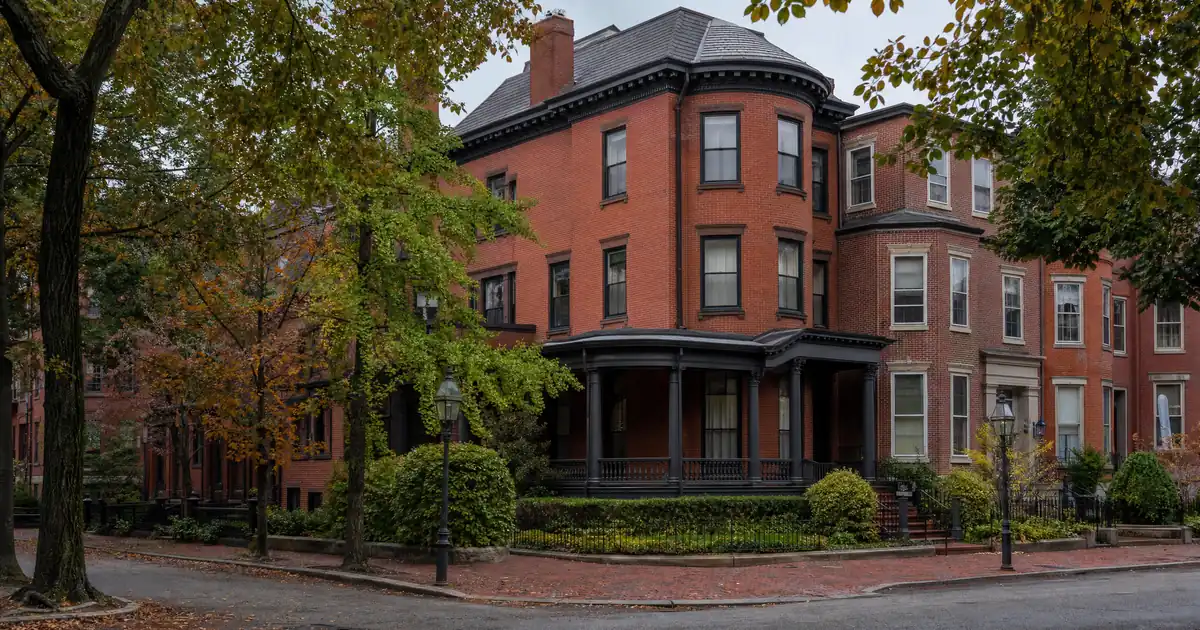
Securing investment property loans in Boston starts with a reality check: the numbers look broken before you even run them. A single-family home in the city proper carried a median price of $935,000 in August, and Greater Boston’s median crossed the $1 million mark for the first time last year, hitting $1,003,250 in June before cooling to a more modest pace of growth into 2026, according to the Greater Boston Association of REALTORS®. At those prices, a single tenant’s rent rarely covers a single-family payment.
The Short Version: In Boston, a rental property is qualified primarily by weighing its monthly rent roll against its full monthly carrying cost rather than the borrower’s personal income, and multi-unit triple-deckers in Dorchester generate rent rolls of $5,500 to $8,500 monthly on properties priced $650,000 to $1,400,000, per a Boston triple-decker market guide.
DSCR Calculator
Run the numbers in your market
Rate source: Freddie Mac 30-yr average via FRED® — Federal Reserve Bank of St. Louis · effective Jul 30, 2026
Prefilled with starting assumptions — enter your own rent or nightly figures, taxes, insurance, and HOA for a more accurate picture.
Program parameters update from Lendmire’s centralized guideline source. Taxes and insurance are editable estimates.
As of Jul 30, 2026 · General Freddie Mac market benchmark, not a Lendmire loan offer. Rent, nightly rate, occupancy, taxes, and insurance are editable estimates. Short-term rental figures are estimates only and vary significantly by season, property type, management approach, and local short-term-rental rules — confirm local regulations before relying on them. Qualifying income for short-term rentals varies by program — some use appraisal market rent, others use documented STR history or projections — and is confirmed in underwriting. Not a Loan Estimate, approval, or commitment to lend. Program availability and eligibility are subject to lender guidelines, credit approval, property review, and underwriting.
- Dorchester triple-deckers run roughly 1.05x-1.20x coverage on those rent rolls
- Roxbury and Mattapan stabilize post-rehab to 1.10x-1.25x, the strongest ratios citywide
- Stabilized multifamily cap rates run 4-4.75 percent citywide; older Class C stock trades 5.5-6.5 percent-plus
- Q1 permitting fell to 432 units, the slowest pace since 2010, which means thin new-supply competition.
- Triple-deckers cover roughly 13 percent of Boston’s residential land, concentrated in five neighborhoods
Boston Market Snapshot
A quick read on the Boston investor landscape — figures come from the cited sources below. Confirm current property-level numbers before underwriting.
| Metric | Detail |
|---|---|
| Home prices | $1,003,250 median (June 2025) (WBUR (GBAR data reporting)) |
| Cap rates | 4%-6.5%+ cap rate ranges (Metro Realty Corp 2026) |
| University enrollment | MIT: 3,437 international students (MIT Facts) |
| Population | 673,822 population (Census Reporter) |
| Employment | 82,000+ employees (Mass General Brigham employment) |
The Tenant Base That Doesn’t Take a Recession Off
Boston’s rental demand doesn’t run on one industry, and that’s the whole underwriting case for buying here instead of a cheaper market with a thinner employment base. Mass General Brigham alone employs more than 82,000 people across its hospital network, according to reporting cited by WBUR, and that’s before counting Boston Medical Center, Boston Children’s Hospital, Dana-Farber, Tufts Medical Center, and Beth Israel Lahey Health, which was formed by the 2019 merger of Lahey Hospital and Beth Israel Deaconess.
Layer on the university system. Harvard enrolled 6,675 students in Harvard College and 4,571 in the Graduate School of Arts and Sciences for the fall term, per Harvard’s Office of Institutional Research, before counting its professional schools. Across the river, MIT drew students from all 50 states and 137 countries, including 3,437 international degree-program students, per MIT’s own enrollment data. Northeastern enrolled 25,042 students in a single fall term. That’s the “brainpower triangle” — Harvard, MIT, and Tufts — sitting across the Charles River from a Longwood Medical Area that never really slows down.
The population math backs it up. Boston sits at 673,822 residents, per U.S. Census Bureau data, inside a metro of 5.03 million people — the 11th-largest in the country. Median household income runs $97,791, per capita income $60,885, and the foreign-born share sits at 28.5 percent, about 1.5 times the statewide rate — a tenant base replenished constantly by international researchers, fellows, and residents cycling through the hospital and university systems. Unemployment has stayed at or below 4 percent, per Boston’s own Planning & Development Agency. Working DSCR brokers see a recurring pattern in institution-heavy metros like this one: rent-to-value math looks tight compared to lower-cost regional markets, but vacancy risk runs unusually low, because the demand isn’t tied to one employer’s fortunes — it’s tied to five or six anchor institutions that don’t contract at the same time.
Where the Triple-Decker Math Clears Coverage
Dorchester is Boston’s most active investor submarket for one structural reason: it’s where the triple-decker was invented and where the largest concentration still stands. MBTA Red Line access and proximity to UMass Boston keep renter demand steady, and triple-deckers here price between $650,000 and $1,400,000 with combined three-unit rents of $5,500 to $8,500 a month, landing DSCR ratios of roughly 1.05x to 1.20x, per a Boston triple-decker market guide. Dorchester’s own median home price sits near $710,000 with 4.1 percent annual appreciation — investors here are buying the rent roll, not the equity story.
Roxbury and Mattapan push the same logic further down the price curve. Triple-deckers in varying condition run $450,000 to $850,000, and post-rehab combined rents of $5,000 to $7,500 stabilize to DSCR ratios of 1.10x to 1.25x — the strongest cash-flow numbers anywhere in the city, per the same market guide. This is Boston’s value-add corridor: buy under-market, stabilize the units, and the rent roll clears coverage on its own without needing appreciation to bail out the file.
The cap rate data explains why. Stabilized Class A multifamily in Boston’s core trades at 4 percent to 4.75 percent, but older Class C stock in Dorchester, Mattapan, and Roxbury trades at 5.5 percent to 6.5 percent-plus, per a CBRE-cited multifamily outlook. That spread is the cleanest signal in the whole market: it separates the neighborhoods where an investor is underwriting for coverage today from the ones where an investor is underwriting for future equity. An investor with $175,000 to put toward a purchase in this price band is, functionally, choosing between those two bets — not choosing between good and bad neighborhoods.
The Appreciation Trade: Back Bay, JP, and the Seaport
Jamaica Plain sits closer to a balance point than the core historic neighborhoods, with a median home price around $920,000, up 3.6 percent year over year, and steady demand for two-family investment properties near its parks and transit lines — home to the Harvard-affiliated Arnold Arboretum. Roslindale has emerged as JP’s more affordable alternative, with its median sale price climbing 12.6 percent year over year to $699,000, and Brighton and West Roxbury are absorbing inventory fast, with median days on market of just 19 and 20, respectively.
Back Bay, Beacon Hill, and the South End sit in a different category entirely. Beacon Hill’s median listing price reached $1.8 million with a quarter-two median sale price of $967,500, and the South End’s median sale price hit $1.3 million. These neighborhoods carry Boston’s strongest rental demand from biotech, finance, and tech tenants who want walkability and won’t push back on rent — but the acquisition cost compresses coverage ratios tighter than anywhere else in the city. This is where DSCR investors weighing the conventional-vs-DSCR tradeoffs should expect a lower cushion above the 1.00x baseline and lean on appreciation, not monthly cash flow, to carry the return.
What Slows a Boston DSCR File Down?
Two- and three-unit appraisal comps are the friction point that catches investors off guard most in this market. Triple-decker sales comps exist in depth in Dorchester, East Boston, South Boston, Allston/Brighton, and Roxbury — the five neighborhoods where these buildings cover roughly 13 percent of residential land, per BostonApartments.com’s data citing the BPDA — but a triple-decker purchased outside those corridors can leave an appraiser searching for comps that don’t exist nearby, forcing a wider comp radius and a slower appraisal reconsideration if the value comes in light.
Rent-roll documentation is the second friction point, and it’s specific to Boston’s leasing calendar. More than 65 percent of leases in Boston and Brookline start on September 1, as students, medical residents, and young professionals all chase the same inventory window at once, per Doorstead’s Greater Boston rental market report. A file that pulls rent evidence mid-cycle, months after the September turnover, can show stale lease dates or gaps in the rent roll that a lender’s underwriter has to chase down. Getting current, fully executed leases into the file before submission — not after a stipulation comes back — keeps the rent-roll documentation clean.
Condo files in the Seaport, Back Bay, and Beacon Hill carry their own overlay: HOA questionnaire completeness and condo certification. High-rise and converted-brownstone condo buildings in these neighborhoods often require a full condo questionnaire covering reserve funding, owner-occupancy ratios, and litigation history before a lender will clear the file — a step that single-family and small multifamily purchases in Dorchester or Roxbury simply skip.
A Dorchester Purchase, Modeled
Consider a scenario where an investor is looking at a Dorchester triple-decker priced at $780,000, within the sourced $650,000-to-$1,400,000 range for the neighborhood, with combined monthly rent of $6,600 across three units — inside the $5,500-to-$8,500 rent-roll band cited above. At a typical purchase leverage of 75 percent, the file is modeled — using standard 30-year amortization plus Massachusetts property tax and insurance assumptions layered into the full monthly obligation, not principal and interest alone — to land around 1.3x coverage — above the sourced 1.05x-to-1.20x range for this price band. That’s what DSCR lender review actually looks like in practice: the rent roll, not the borrower’s pay stubs, is what the lender is measuring against the payment. Reserve requirements on most DSCR files run around six months of the full monthly obligation, rising toward nine months on loan amounts above $1,500,000 — worth budgeting for on the Back Bay and Beacon Hill end of the price spectrum. Every figure here is modeled for illustration and subject to lender guidelines, credit approval, and property review — not a quote or a commitment to lend.
DSCR vs. conventional financing
Two common ways to finance an investment property in this market. They qualify you differently — here’s how investors weigh them.
Why investors choose it
- Qualifies on the property’s rental income — no personal tax returns, W-2s, or pay stubs needed to document income.
- No personal debt-to-income ceiling to clear, so existing mortgages and obligations don’t cap your borrowing the same way.
- Can be closed in an LLC, keeping the property inside a business entity.
- Built for scaling — not held to the limit on number of financed properties that conventional financing applies.
- Underwriting centers on the deal: generally qualifies when the rent covers the payment, a 1.00x coverage ratio being a common baseline (confirmed in underwriting).
- Designed specifically for investment property, including long-term and, where the program allows, short-term rentals.
Where it’s strong
- Often the lowest ongoing financing cost for a buyer who fully qualifies on personal income — a fit for a first property or a cost-first purchase.
Trade-offs for investors
- Requires full personal income documentation and must fit within a debt-to-income limit — salary, existing debts, and other mortgages all count.
- Typically held in your personal name rather than a business entity.
- Caps how many financed properties you can carry, which can become a ceiling as a portfolio grows.
- Evaluates you as a borrower as much as the property, which usually means more paperwork.
How investors usually choose: a first or single property often optimizes for the lowest financing cost; portfolio builders often optimize for leverage, vesting in an LLC, and scaling past conventional caps. The right answer depends on your goals, the property, and current guidelines — both paths run through select lenders in Lendmire’s wholesale network, with eligibility and terms confirmed in underwriting.
Frequently Asked Questions
How do you qualify for a DSCR loan on a triple-decker in Boston?
Qualification centers on whether the combined rent from all units clears the property’s full monthly obligation — taxes and insurance included — rather than the borrower’s personal income documentation. Lenders reviewing Dorchester and Roxbury triple-deckers typically want current, fully executed leases for each unit and a rent roll that matches the appraiser’s income approach, subject to lender guidelines and credit approval.
What are the requirements for an investment property loan in Boston, Massachusetts?
Most programs call for roughly 20 to 25 percent down on a purchase, a minimum DSCR around 1.00x, and reserves of about six months of the monthly obligation, rising near nine months above $1,500,000 in loan amount. Credit tiers commonly start near 620, with stronger pricing and leverage available at higher scores. Exact terms vary by lender, property, and program.
Do DSCR loans work on Boston condos in Back Bay or the Seaport?
Yes, subject to condo certification and a completed HOA questionnaire covering reserve funding and owner-occupancy ratios. High-rise and converted-brownstone buildings in these neighborhoods tend to carry tighter coverage ratios given elevated acquisition costs, so these purchases often lean more on appreciation potential than on monthly cash flow clearing comfortably above 1.00x.
Why do Dorchester and Roxbury clear coverage more easily than Beacon Hill?
Unit count, not neighborhood prestige, drives the math. A three-unit Dorchester triple-decker stacks $5,500 to $8,500 in combined monthly rent against a $650,000-to-$1,400,000 purchase price, while a Beacon Hill single-family or condo carries a $1.8 million-plus price tag against one lease. More rent-generating units per dollar of purchase price is what produces the stronger ratio.
How do DSCR lenders review rental income instead of traditional tax-return income in Massachusetts?
Lendmire, holding NMLS# 2371349, arranges DSCR programs where eligibility is commonly reviewed around the property’s rent rather than the borrower’s traditional personal-income documentation or W-2s, subject to lender guidelines. One program feature relevant here: LLC-titled purchases are supported per program eligibility, which fits how many Boston triple-decker investors already hold title.
About Lendmire
Lendmire, NMLS# 2371349, is a mortgage brokerage focused on DSCR and non-QM investor loans, with programs available across 41 markets including Washington, D.C. Property-level rent, rather than personal income documentation, is the primary review point for most DSCR files, subject to lender guidelines, and the brokerage helps structure financing for LLC-owned portfolios beyond the property caps that conventional financing typically imposes. Lendmire has been recognized as a 2026 Scotsman Guide Top Mortgage Workplace and was recognized by Scotsman Guide in 2025 as well — Lendmire’s company announcements have the details. Investors evaluating Massachusetts DSCR investor loans or comparing Lendmire’s DSCR platform overview against the refinance side of a future equity pull can reach the team at 828-256-2183 or connect with Lendmire directly.
Worcester sits an hour west with a fraction of Boston’s entry price, and on pure acquisition math it wins every time. But Worcester, Springfield, and Providence don’t have a Mass General Brigham with 82,000 employees or a Harvard-MIT-Tufts triangle drawing international tenants on a September 1 clock — and that density of institutional demand is exactly what lets a Dorchester or Roxbury triple-decker clear coverage on rent alone while a comparable building in a cheaper market can’t fill its units with the same certainty. The math favors Boston for investors buying the tenant base, not just the price tag.
Get Started
Ready to find the right loan for you?
In about 30 seconds you can review financing options available for your investment property. No commitment required.
Informational only. Not a Loan Estimate, approval, or commitment to lend. Program availability and eligibility are subject to lender guidelines, credit approval, property review, and underwriting.
References
2. CBRE-cited multifamily outlook
3. MIT Facts — Enrollment Statistics
4. U.S. Census Bureau via Census
5. WBUR
6. Harvard University Office of Institutional Research
7. Boston Planning & Development Agency — Boston at a Glance
8. BostonApartments.com — Triple-Decker Guide
9. Doorstead — Greater Boston Rental Market Report
10. a 2026 Scotsman Guide Top Mortgage Workplace
11. recognized by Scotsman Guide in 2025
This article is part of Lendmire’s DSCR loan program — full qualification details, guidelines, and scenarios live on the program page.
Related reading: DSCR Loans in Boston, Massachusetts: Investor Financing for Dorchester, Jamaica Plain, East Boston & Real Estate Investors · Cash Out Refinance Investment Property in Malden MA · Cash Out Refinance Investment Property in Lynn, Massachusetts: Tapping North Shore Equity
Guides: DSCR Loans in Boston, MA · DSCR Loans in Massachusetts
Brandon Miller
Founder & CEO, Mortgage Loan Originator, Lendmire LLC
- Mortgage Loan Originator · NMLS# 1129696 · Verify on NMLS Consumer Access
- North Carolina Real Estate Broker · License# 343312 · Verify on NCREC
- North Carolina Insurance Producer · License# 19053198 · Property, Casualty, Life, Health · Verify on NAIC SBS
- Lendmire LLC · Firm NMLS# 2371349 · Verify firm licensure
Compliance and disclosures. Lendmire (NMLS# 2371349) is a licensed mortgage broker and is not a direct lender, depository institution, financial advisor, or tax professional. Content in this article is general market analysis and educational information — not financial, legal, or tax advice for any specific situation. Lendmire does not guarantee loan approval; every transaction is subject to underwriting by the funding lender. Mortgage pricing and loan program guidelines are subject to change at any time without notice and vary by borrower characteristics, property type, and state regulations. Lendmire complies with Equal Housing Opportunity. Licensure verification: NMLS Consumer Access.